
PC Slower Than It Used to Be?
A free scan shows the junk files, broken settings and background clutter dragging Windows down - then fixes them in one click.Free scan · Windows 10 & 11Crashes, No Sound, or Screen Glitches?
Random freezes, missing sound and display glitches usually trace back to one bad driver. Find and replace yours safely.Free scan · under a minuteiTechGuides is reader-supported. When you buy through links on our site, we may earn an affiliate commission. As an Amazon Associate I earn from qualifying purchases. Learn more
A blackjack chart tells you which action has the best expected result for a particular hand under a particular set of table rules. It is a decision aid, not a guarantee of winning. To use one, identify whether your hand is hard, soft, or a pair, find the dealer’s upcard, and follow the action at their intersection—using a chart that matches the table you are playing.
How do you read a blackjack chart?
Most charts put the player’s hand down one side and the dealer’s upcard across the top. Find your hand’s row and the dealer card’s column; the cell where they meet gives the recommended action. First determine which part of the chart applies:

- Hard totals: Hands with no ace counted as 11. A hand with an ace counted as 1 is still hard.
- Soft totals: Hands with an ace counted as 11 without immediately busting. For example, ace-6 is soft 17.
- Pairs: Starting hands with two cards of the same rank. Use the pair section rather than looking up only their combined total.
Charts use abbreviations that vary, so check the chart’s legend. Common labels include H for hit, S for stand, D for double, P or SP for split, and R or SU for surrender. A double-down recommendation generally means doubling the wager and receiving one additional card; whether that action is permitted depends on the table rules.
Worked example
On Casino.com’s example chart, hard 11 against a dealer 6 calls for a double. That is an illustration of the chart’s assumed game, not a universal instruction for every blackjack variant. Casino.com’s chart and strategy guide describes its assumptions.
#1 Best Overall
Which blackjack chart should you use?
There is no single chart established as correct for every blackjack game. The right chart depends on the rules in force at your table. Before choosing one, check the posted rules or table placard for:
- Number of decks.
- Whether the dealer stands on soft 17 (S17) or hits soft 17 (H17).
- Blackjack payout, commonly expressed as 3:2 or 6:5.
- Whether surrender is available.
- Doubling restrictions, including whether doubling after a split is allowed (DAS).
- Pair-splitting and resplitting rules.
- How the dealer receives or checks for a hole card, where relevant.
These details do not necessarily change every decision, but they can change the optimal action in some situations. Casino.com says its displayed chart assumes a standard multi-deck game in which the dealer stands on soft 17. William Hill publishes separate charts for single-deck and 4–8-deck games across S17 and H17 variations. Blackjack.global lists charts for specific table-rule sets and says it selects the legal action with the highest expected value.
For other examples of why assumptions matter, blackjack.global’s 2026 catalog lists a 0.19% house edge for its double-deck S17 DAS ruleset and 0.41% for its Vegas Strip six-deck S17 ruleset; both figures use the site’s stated convention of reshuffling after every hand. It lists 1.98% for its six-deck H17 game paying 6:5. These are that site’s calculations for the listed games and convention, not estimates that apply to every casino or table. See blackjack.global’s rule-set catalog.
What do common chart actions mean in practice?
Hit or stand
Hit means take another card; stand means keep the current hand. A chart’s recommendation balances the chance of improving your hand against the dealer’s upcard and the rules assumed by the chart. William Hill’s basic-strategy guide uses hitting a soft 17 and standing on a hard 17 as memory anchors, but a complete chart is more reliable than a short list of rules of thumb.
Double
Doubling raises your wager in exchange for one additional card, subject to the table’s restrictions. Michael Shackleford, a mathematician and gaming consultant quoted by Casino.com, says: “Doubling is best with a 10 or 11, and especially against a weaker dealer card. There are also some situations where you’d double with a 9 or a soft total against a weak dealer card, but the main time you double is with 10 or 11.” Use the relevant chart for the actual recommendation; the quote is a broad orientation, not a substitute for rule-specific decisions. Casino.com’s guide attributes the statement to Shackleford.
Split
Splitting turns a pair into two hands, usually with an additional wager. William Hill highlights splitting aces and eights, and not splitting fives or tens, as basic-strategy memory anchors. The complete chart remains the better reference because splitting rules and other table conditions vary.
Rank #4

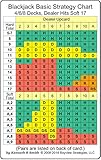
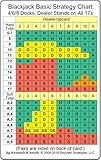
- QUICK BLACKJACK REFERENCE: Color-coded charts organize hard hands, soft hands and pairs against the dealer's upcard for fast lookup.
- CLEAR ACTION CODES: H, S, D and P markers help users locate hit, stand, double and split guidance at a glance.
- 4+ DECK SOFT 17 FORMAT: The chart is labeled for games using four or more decks where the dealer hits soft 17; confirm table rules before use.
- POCKET-SIZE PVC CARDS: The compact 3.4 x 2.1 inch format fits the included sleeve and stores easily with game accessories.
- REFERENCE AID WITH SLEEVE: Includes a black protective sleeve; use for study or play only where strategy cards are permitted.
Surrender
If the game offers surrender, this action gives up the hand in exchange for forfeiting part of the wager. Whether to surrender depends on the hand, dealer upcard, and chart assumptions; use a chart that includes the rules and surrender option at your table.
Quick wins for a faster PC:
Clear out junk files and repair common Windows errorsFree Scan →Scan for outdated or missing drivers - takes under a minuteDriver Scan →Should you take insurance or even money?
Under its basic-strategy guidance, Wizard of Odds advises against insurance and reports a 5.9% house edge for insurance in a one-deck game. Casino.com separately quotes Shackleford saying: “Never. Absolutely never, unless you’re a card counter. And that includes even money on a blackjack. Say no to that because it’s the same thing as taking insurance, which is a lousy bet and has a house advantage of 7.7%”. The 5.9% figure is Wizard of Odds’ one-deck estimate; the 7.7% figure is part of Shackleford’s statement as quoted by Casino.com. Their stated contexts differ, so neither percentage should be treated as a universal value. Wizard of Odds’ one-deck strategy page and Casino.com’s interview-based guide provide those respective guidance and attribution.
Best Value

- target gender: unisex
- material: Plastic
- including components: Cards
Can a chart help you win?
Basic strategy aims to choose the action with the best expected result over repeated play under stated rules. It cannot predict or guarantee the outcome of one hand, remove the house advantage, or establish that a player will beat the house. Its practical value is reducing decision errors—not promising a winning session.
A printed chart or blackjack basic strategy card can make the hand-versus-upcard lookup easier. Choose one only after checking that its assumptions fit the table. William Hill offers downloadable charts and suggests practice tools such as flashcards; a short memory list is useful for practice, but it does not replace the full chart for your game. William Hill’s strategy guide describes its chart variations.
Quick Recap
Product prices and availability are accurate as of the date/time indicated and are subject to change. Any price and availability information displayed on Amazon at the time of purchase will apply.
What’s actually slowing this PC down?
Pick the symptom - the matching free tool is one click away.

