
iTechGuides is reader-supported. When you buy through links on our site, we may earn an affiliate commission. As an Amazon Associate I earn from qualifying purchases. Learn more
ExergyJet is described by its author as a browser-based analyzer for turbojet and turbofan cycles. It is intended to show not only how energy moves through an engine, but also where useful work potential is lost to irreversibility. Its listed outputs include station properties, component exergy-destruction estimates, efficiency measures, visualizations, afterburner comparisons, and a PDF report. Those are publisher feature claims, not independently verified performance or validation results.
What exergy analysis adds to a jet-engine cycle
Gas-turbine engines operate on the Brayton cycle, and cycle analysis is used to predict engine performance, as NASA explains in its Brayton-cycle overview. A conventional first-law analysis tracks energy entering and leaving components. NASA’s steady-flow energy-balance explanation expresses the change in total enthalpy as heat transfer minus shaft work; this accounting describes energy conservation, but it does not by itself indicate how much of that energy could still be converted into useful work.
Exergy analysis adds that quality dimension. Exergy is the work potential of an energy stream relative to a specified reference environment. The ExergyJet educational page describes component exergy destruction using the Gouy–Stodola relation: exergy destroyed equals reference temperature multiplied by entropy generation. Entropy generation therefore gives a way to account for irreversibility, while the reference environment is part of the calculation rather than a detail that can be ignored.
How engine stations make the analysis readable
A station number identifies a boundary in the flow path, giving engineers a compact way to specify where a state is measured or modeled. In NASA’s convention, station 3 is the compressor exit and burner entrance; station 4 is the burner exit and turbine entrance; station 5 is the turbine exit. These boundaries make it possible to describe changes in properties from one component to the next without repeatedly naming the full location.
#1 Best Overall
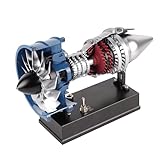
- Realistic & Authentic: The lifelike & visually stunning model provides a realistic depiction of a full-sized engine with main components including a first-stage fan, high-pressure rotor assembly, combustion chamber, high-pressure turbine assembly, low-pressure turbine assembly, and exhaust nozzle.
- High-Quality Construction: Made of high-quality metal, the meticulous model, full of detail and features, undergoes precision casting and CNC machining, along with sandblasting and anodized coloring treatment on the surface, ensuring durability and accuracy the same as the real model.
- Dynamic Display: Featuring a semi-transparent magnetic casing, this model offers a clear view of the engine's internal mechanics in motion when powered by the electric motor. The quick-release magnetic cover allows for effortless assembly and disassembly, making it ideal for demonstrations while protecting delicate components. Equipped with a sturdy mounting bracket and throttle control lever, this kit delivers an immersive hands-on experience with aviation engineering.
- DIY Assembly: Consists of 170+PCS (including screws & nuts) and comes with tools and paper-based English instructions. You will personally experience the entire assembly process, from small parts to the final completed model, constructing an awe-inspiring turbofan engine model.
- STEM Education: As an educational tool, this model unravels the internal workings of a turbofan engine, imparts knowledge about aerospace engineering, and stimulates interest, creativity, and awe for industrial technological achievements
The ExergyJet author describes the tool as analyzing an engine station by station after the user configures the cycle and flight condition. The practical value of that format is traceability: station properties and component-level estimates can be examined along the modeled flow path, rather than receiving only one engine-wide efficiency figure.
What ExergyJet is said to provide
The author’s description lists several outputs for turbojet and turbofan analysis. The publisher’s educational page also presents the product as a browser-based station-by-station analyzer. These descriptions establish what the product is claimed to offer, but not how accurately it models a particular engine or whether its results have been independently validated.
Rank #2
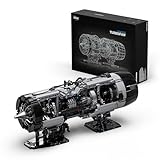
- Every gear, shaft, and joint is built for motion—an engineered engine flow you can set in motion with your own hands.
- Rotate the crank to drive linked parts in different directions and speeds, achieving a rare dual-direction, single-axis effect.
- A semi-exposed design lets you watch the mechanics at work, with metallic painted parts adding an authentic, engineered look.
- A hands-on challenge, leading to an engine you can see and operate—every gear and motion built by you.
- A build that engages both mind and hands, making this engine a memorable gift for any mechanical enthusiast.
- Station properties for the configured engine cycle and flight condition.
- Component exergy-destruction estimates, with the analysis framed around the Gouy–Stodola relation.
- Second-law efficiency alongside other efficiency measures.
- A Sankey diagram intended to visualize flows and losses.
- Comparisons involving an afterburner.
- A PDF report of the analysis.
For a reader, the key distinction is between an educational or exploratory analyzer and an engineering result suitable for design decisions. The feature list alone does not establish model fidelity, validated operating ranges, or agreement with experimental data.
The Tool Desk
Outbyte PC Repair FREERepair Windows errors before they cause bigger problemsFix Now →Outbyte Driver Updater FREEScan for outdated or missing drivers - takes under a minuteDriver Scan →How to interpret exergy results responsibly
An exergy-destruction value depends on the engine model, operating conditions, and selected reference environment. It should be read as a result for those assumptions, not as a fixed property of a component type. A useful report should make its inputs and environment clear enough that another reader can understand what the result represents.
Rank #3

- 【F35 Fighter Jet Engine Model Kit】: This F35 engine block set realistically reproduces the structure and operation of an F35 fighter jet engine. With 3-bearing swivel duct, exhaust pipe, nozzle, rotating turbine, beautifully crafted stickers. Perfectly constructed lifelike mechanical engine models, showing the beauty of real military engineering.
- 【Interactive Features】: The F35 engine's nozzle rear section can be expanded and narrowed, high-speed turbine can be rotated by motor, some parts can be disassembled to clearly see the internal multi-gear linkage mechanism. Perfectly replicates the jet engine mechanics and operation of the F35 fighter jet.
- 【Precision Craftsmanship】: This F35 engine building sets consists of 1,812 bricks for a longer building experience. Each part is smoothly and precisely crafted with metallic paintwork and comes with detailed illustrated step-by-step instructions to make this F35 jet engine model perfect to build.
- 【Space Decorations】 this F35 engine buiding block sets for adults measures 9.25*27.16*14.56 inches after assembled, which can be perfectly displayed in any space such as desks and shelves at home or office collection. It is an attention-grabbing choice for military enthusiasts and collectors.
- 【Ideal Gift】 This F35 engine building toy combines creativity, engineering and hands-on fun, making it an ideal gift for adults. Whether it's a birthday, Valentine's Day, Christmas or Thanksgiving, it's the perfect gift for military, fighter, engine and technical modeling enthusiasts.
For example, Caliskan, Ekici, and Sohret reported a maximum combustion-chamber improvement-potential rate of 5,141.27 kW in a modeled turbojet study published in Propulsion and Power Research in 2022, using environmental conditions of 15 °C and 1 bar. That value belongs to their model and assumptions; it is neither a universal combustion-chamber figure nor a result from ExergyJet.
Independent reader supportYour contribution helps us test, update, and keep practical guides available for everyone.Where it fits alongside other engine tools
NASA describes EngineSim as an interactive educational tool for exploring engine performance. That provides a useful distinction in purpose: conventional cycle-performance tools can help explore quantities such as thrust and fuel-cycle behavior, while an exergy analyzer aims to allocate work-potential losses and irreversibility across components. The available sources do not provide a direct benchmark or validation comparison between EngineSim and ExergyJet, so they should not be treated as interchangeable or ranked on accuracy from these descriptions alone.
Rank #4

- DETAILED TWIN-SPOOL ARCHITECTURE: This 1:10 scale model recreates the layered structure of an aerospace turbofan engine, including a single-stage fan, two-stage low-pressure compressor, four-stage high-pressure compressor, single-stage high-pressure turbine, and two-stage low-pressure turbine.
- PRECISION METAL CRAFTSMANSHIP: Made from precision-cast and CNC-machined metal components, the model features sandblasted and anodized surfaces for durability, refined texture, and a professional industrial finish. Its substantial construction highlights the complexity of modern turbofan engineering.
- MOTORIZED AND FULLY VISIBLE: The cutaway engine casing reveals the internal rotating assemblies as the motor simulates coordinated turbofan operation. A fixed display stand, throttle control lever, and engine sound module create a more engaging mechanical demonstration.
- 1000+ PART ASSEMBLY PROJECT: Build the engine from more than 1,000 components, including screws and nuts. Tools and an English instruction manual are included. The manufacturer estimates approximately 10 hours of assembly time. The multi-stage process is intended for experienced model builders familiar with small components and detailed mechanical assembly.
- IMPRESSIVE ENGINEERING DISPLAY: Measuring approximately 14.96 × 6.50 × 9.25 inches and weighing about 11.68 pounds when completed, the DM119 becomes a commanding mechanical centerpiece for a home, office, studio, workshop, or aviation-themed collection.
Before relying on any browser-based analyzer for technical work, check whether it documents its assumptions, supported engine configurations, operating ranges, and validation basis. If those details are not available, use its outputs as exploratory or educational results rather than as design certification.
What’s actually slowing this PC down?
Pick the symptom - the matching free tool is one click away.
Quick Recap
Best Value
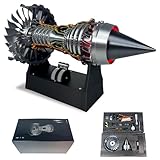
- Design: This jet engine model imitates the TR900 turbine engine
- Rotatable design: The jet engine model can be rotated to show the working principle of the turbojet engine
- Size: H 6.6 IN, L 11 IN, W 5.9 IN
- Material: 3D printed plastic
- Fun: Assembling design, more playable
Product prices and availability are accurate as of the date/time indicated and are subject to change. Any price and availability information displayed on Amazon at the time of purchase will apply.

