
Do these 3 things before closing this tab:
1Scan for outdated or missing drivers - takes under a minute2Repair Windows errors before they cause bigger problems3Fix the driver behind crashes, sound loss and screen glitchesiTechGuides is reader-supported. When you buy through links on our site, we may earn an affiliate commission. As an Amazon Associate I earn from qualifying purchases. Learn more
A desktop AI computer is a desktop PC configured to support artificial-intelligence workloads using some combination of its CPU, GPU, neural processing unit (NPU), software, and cloud services. The term is broad: it does not guarantee a particular performance level, that an app runs locally, or that AI software is included.
What makes a desktop computer an AI computer?
There is no single universal certification or hardware specification for a “desktop AI computer.” The phrase is an umbrella description for desktop systems that support AI tasks. Product listings may use “AI” broadly, so check the exact computer, configuration, and software rather than relying on the label.
For a concrete Windows category, Microsoft defines a Copilot+ PC with specific minimum requirements: an NPU capable of at least 40 trillion operations per second (TOPS), at least 16 GB of RAM, at least 256 GB of SSD storage, and Windows 11 version 24H2 or newer. These requirements apply to that category; they are not the definition or minimum specification for every desktop marketed as an AI PC.
What do the computer’s components do?
- CPU: A general-purpose processor. Some Windows AI APIs support local execution on devices with suitable CPU specifications, depending on the API and configuration.
- GPU: A graphics processor that some Windows AI APIs can use for local execution on supported hardware. Support varies by API and device.
- NPU: A specialized processor for certain AI-intensive tasks. Microsoft says many Copilot+ PC features are designed to use the NPU, but applications must be programmed to target it; having one does not automatically accelerate every AI task.
- Software and services: The application determines which hardware or cloud services do the work. A computer’s AI label does not establish that a particular app is compatible, installed, included, or able to work offline.
Microsoft’s Windows AI documentation describes APIs and supported hardware for local AI execution. Support depends on the specific API and device; some APIs can use a CPU or GPU outside Copilot+ PCs.
#1 Best Overall

- Built for Local AI Development: AMD Ryzen AI Halo is designed for local AI development and inference, featuring 128GB unified memory and support for up to 200B parameter models to build and run intensive AI workloads locally.
- 128GB Unified Memory: Features 128GB LPDDR5x unified memory at 8000 MT/s with 256 GB/s memory bandwidth, providing a shared memory pool across the CPU, GPU, and NPU to support larger AI models.
- AMD Ryzen AI Max+ 395 Processor: Features 16 cores, 32 threads, and Zen 5 architecture, paired with AMD Radeon 8060S integrated graphics featuring 40 RDNA 3.5 compute units and an AMD XDNA 2 NPU with up to 50 TOPS.
- Linux AI Developer Platform: Purpose-built for Linux-based AI development with full AMD ROCm software support and preloaded tools, models, and workflows optimized for local AI development.
- Compact, Connected Design: Includes a 2TB M.2 SSD, 10GbE LAN, Wi-Fi 7, Bluetooth 5.4, USB-C connectivity, and HDMI 2.1b.
What can a desktop AI computer do?
Depending on its hardware and compatible software, it may handle Windows AI features, creative applications, local model inference, or AI development. These are different workloads with different requirements. An NPU-equipped desktop intended for supported everyday features is not automatically equivalent to a specialized system for building and running AI.
For example, HP lists desktop systems in its AI PC category, including the OmniDesk family, with hardware varying by model and configuration. NVIDIA describes DGX Spark as “A personal AI computer, designed to build and run AI.” That is a description of a specialized product, not a general technical definition or a default choice for everyday desktop use.
Rank #2
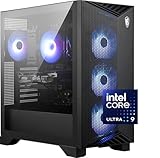
- Intel Core Ultra 9 285 Processor: Newly developed cores deliver ultra-smooth and responsive gameplay. AI accelerators prepare users for the next era of gaming on an AI PC.
- Simplistic Design: Enjoy the latest generation of Windows 11 Home for your everyday needs. *MSI recommends Windows 11 Pro for business use.
- NVIDIA GeForce RTX 5070 Ti GPU
- Cool While Gaming: In conjunction with an RGB CPU Air Cooler, the Aegis RS features four system cooling fans; three in the front and one in the rear to pull in cool air and push heat out of the PC.
- Turn on the Bright Lights: With the built-in RGB lighting, take your gaming experience to the next level by pressing the MSI LED button to cycle through lighting options. Customize lighting even further with MSI Center software.
How to tell whether a desktop fits your AI needs
Start with the application or workload you actually want to use. Then check the computer’s exact specifications and the application’s requirements. Compare systems on these factors:
| Factor | What to verify |
|---|---|
| Intended workload | Whether you need everyday Windows features, creative tools, local model inference, or AI development. |
| Application support | Whether the specific application uses the CPU, GPU, NPU, cloud services, or a combination. |
| Accelerator capability | The exact NPU or GPU capability and the workload or certification it supports. Do not treat unlike performance figures as directly comparable. |
| Memory and storage | The configuration of the specific model. Microsoft’s Copilot+ PC baseline is a category requirement, not a workload-specific recommendation. |
| Local or cloud processing | Whether the desired feature actually runs locally, and whether it requires connectivity or an account. |
| Software and cost | Whether the application requires a separate purchase, subscription, account setup, or provider enablement. |
HP’s US desktop catalog notes that some AI applications may require a purchase, subscription, provider enablement, or compatible configuration. Do not infer offline operation or privacy behavior from the “AI” label alone. The available product descriptions do not establish a comparable independent performance ranking between general AI desktops and specialized personal AI compute systems.
Quick Recap
What “AI computer” does not promise
- It does not mean every AI application will use the NPU.
- It does not guarantee that a task runs entirely on the computer rather than in the cloud.
- It does not guarantee that the required software or service is included.
- It does not guarantee a particular speed or make unlike systems directly comparable without workload-specific benchmarks.
Product prices and availability are accurate as of the date/time indicated and are subject to change. Any price and availability information displayed on Amazon at the time of purchase will apply.

