
iTechGuides is reader-supported. When you buy through links on our site, we may earn an affiliate commission. As an Amazon Associate I earn from qualifying purchases. Learn more
Your router’s device list and a network scan can disagree because they may be reporting different kinds of evidence. A DHCP list can show devices that received an address from the router, while a scan reports devices that answered particular discovery probes from a particular network location. Neither view is automatically a complete, real-time inventory, and an unfamiliar entry alone does not prove that an unauthorized device is connected.
What each view is actually showing
| What to compare | Router interface | Network scan |
|---|---|---|
| Evidence source | May show DHCP leases, active wireless stations, ARP entries, or a combined network map. Check the page’s label and fields; router interfaces vary. [TP-Link TL-WR902AC V3 user guide] | Reports responses to the discovery probes the scanner used, which can include ICMP, TCP, UDP, ARP, or IPv6 Neighbor Discovery. [Nmap host discovery documentation] |
| Time behavior | A DHCP entry can represent an address allocation and lease, not necessarily traffic at the instant you open the page. Refresh behavior and status indicators depend on the router model. [TP-Link TL-WR902AC V3 user guide] | Generally reflects responses received during the scan window. Filtering or a device’s response behavior can affect what appears. [Nmap host discovery documentation] |
| Network visibility | The router may have records from its own services or interfaces. Enterprise discovery systems may also query router ARP caches and DHCP servers, but this does not mean every consumer router’s device page does so. [Microsoft Configuration Manager discovery methods] | The scanning device’s subnet, routes, isolation settings, and probes influence which devices it can discover. [Nmap host discovery documentation; Nmap host discovery techniques] |
| Identity confidence | A client name and MAC address may be listed, but a name or label is not proof of who owns the device. [TP-Link TL-WR902AC V3 user guide] | A response shows that an address was reachable by that discovery method; it does not establish who owns the responding device. [Nmap host discovery documentation] |
For example, TP-Link’s TL-WR902AC V3 guide describes a DHCP Client List with a client name, MAC address, assigned IP address, and lease time. That is a useful record of DHCP allocations for that model, not a definition of what every router’s “connected devices” panel contains. [TP-Link TL-WR902AC V3 user guide]
Why a device can appear in one place but not the other
A router list may show a lease rather than a live connection
DHCP assigns network settings to clients and records their leases. A device can therefore remain in a DHCP list even when it is not actively sending traffic at the moment you check. Other router pages may show active wireless stations, ARP entries, or a combined map instead. Look for the exact page name, lease time, and any connection-status field before treating the list as a live headcount. [TP-Link TL-WR902AC V3 user guide]
Do these 3 things before closing this tab:
1Clear out junk files and repair common Windows errors2Fix the driver behind crashes, sound loss and screen glitches3Repair Windows errors before they cause bigger problemsA scan can miss a device that filters probes
A network scan is a method, not an oracle. Nmap’s host discovery can use different probe types, and a host may answer one kind but ignore another. Firewalls can drop probes or replies, so a device can be present yet absent from a scan’s results. The scan’s options and permissions also affect which discovery methods it can use. [Nmap host discovery documentation]
#1 Best Overall

- VERSATILE CABLE TESTING: Cable tester for data (RJ45) terminated cables and patch cords, ensuring comprehensive testing capabilities
- LARGE BACKLIT LCD: Backlit LCD display enables easy reading of pin-to-pin wiremap results, even in low-lit areas
- COMPREHENSIVE FAULT DETECTION: Test for Open, Short, Miswire, Split-Pair faults, Cross-over, and Shield, providing thorough fault detection
- INTUITIVE USER INTERFACE: User-friendly interface with three buttons and simple, easy-to-identify test responses, ensuring a smooth testing experience
- MULTIPLE TONE GENERATOR STYLES: Tone on a single wire, wire pair, or all 8 conductor wires using the multiple style tone generator (solid/warble); requires probe Cat. No. VDV500-123 (sold separately)
Local-link discovery differs from discovery across a router
On local Ethernet, Nmap normally uses ARP for IPv4 or Neighbor Discovery for IPv6. Nmap notes that ARP is often more effective than IP-based ping on the local link because a device may block ping while still needing to communicate on that network. ARP is not a general way to discover devices across routed boundaries. [Nmap host discovery documentation; Nmap host discovery techniques; Apple networking documentation on packet routing and delivery]
The scan may run from a different network segment
A scan launched from guest Wi-Fi, an isolated wireless segment, a separate VLAN, or another routed subnet may not see the same local-link traffic as a device on the main LAN. This depends on the network’s configuration; it does not mean every router isolates clients by default. Check where the scanning device is connected before comparing its results with the router’s broader records. [Nmap host discovery documentation; Nmap host discovery techniques]
Rank #2
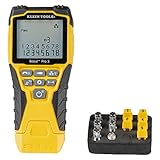
- VERSATILE CABLE TESTING: Cable tester tests voice (RJ11/12), data (RJ45), and video (coax F-connector) terminated cables, providing clear results for comprehensive testing on unenergized Ethernet cables (not designed to test PoE)
- EXTENDED CABLE LENGTH MEASUREMENT: Measure cable length up to 2000 feet (610 m), allowing for precise cable length determination
- COMPREHENSIVE FAULT DETECTION: Test for Open, Short, Miswire, or Split-Pair faults, ensuring thorough fault detection and identification
- BACKLIT LCD DISPLAY: Backlit LCD screen displays cable length, wiremap, cable ID, and test results, ensuring easy readability in various lighting conditions
- EFFICIENT CABLE TRACING: Trace cables, wire pairs, and individual conductor wires using the multiple style tone generator (requires analog probe Cat. No. VDV500-123, sold separately), simplifying cable tracing tasks
An IPv4 scan is not an IPv6 inventory
If a scan covers only IPv4, it cannot establish which devices are present using IPv6. Nmap documents local IPv6 Neighbor Discovery, while the IETF’s IPv6 operational-security guidance discusses the difficulty of inventory and the value of combining sources such as traffic records, DNS, logs, and service discovery. [Nmap host discovery documentation; IETF RFC 9099]
What’s actually slowing this PC down?
Pick the symptom - the matching free tool is one click away.
A scan can use records beyond the router page you checked
Discovery systems can combine sources. Microsoft Configuration Manager, for example, documents querying router ARP caches and DHCP servers, then sending ICMP echo requests to devices it finds. That illustrates why an address may be discoverable through one inventory method but absent from a particular router panel; it does not describe the behavior of every consumer router. [Microsoft Configuration Manager discovery methods]
Rank #3

- Multifunctional NOYAFA NF-8508 Network Cable Tester: There are nine features to meet your needs. Continuity Testing, Cable Scan, Port Flash, Length Measurement, POE Power Supply Test, QC testing, Optical Power Meter, VFL and NVC function.It is perfectly suited for various engineering cabling projects, network troubleshooting, network equipment maintenance and testing scenarios. Its precise cable scanning and fault localization capabilities help you effortlessly pinpoint the root cause of issues.
- 7 WAVELENGTHS OPTICAL POWER METER: NF-8508 network cable tester can measure 7 standard wavelengths, 850/1300/1310/1490/1550/1625/1650, power detecting range(dBm): -70 ~ +10. Its power detection range spans from -70 dBm to +10 dBm, supporting FC/SC/ST connectors. It enables precise fiber optic power measurement, helping users efficiently assess fiber signal strength and ensure healthy fiber link operation. It effortlessly detects attenuation issues within fibers, thereby safeguarding fiber network stability.
- High Efficiency Visual Fault Locator: Easy identification of fiber breakpoints, poor connections, bending or cracking. Excellent for finding the right fiber to splice or quickly finding a break. Emmiting Energy: standard wavelenth: 650nm. Fast flashing, slow flashing, high precison.The built-in self-calibration ensures stable long-term performance, and Class IIIa laser (output<5mW) ensures safe daily operation.
- PORT FLASHING:The indicator light on the connection port in the NF-8508 device flashes to help accurately locate the cable. Displays port information, including operating speed, duplex mode, and negotiation settings. Port lights flash on the same screen to show the port's operating speed, making it easy to pinpoint lines and ports.
- PoE Testing and Cable Length Test: PoE testing can check cable mapping polarity and voltage of PoE network switches, withstand 60VDC. Automatically detects and switches between 10M/100M/1000M modes, Includes cable tracking, short circuit test, interruption of circuit test and etc The RJ45 cable tester can quickly measure the length of the cable with a range of 200m. Not only network cables, but also phone lines and BNC cables.
How to compare the two lists reliably
- Identify the router page. Record its exact name and fields. Determine whether it is a DHCP client list with lease information, a live wireless-station list, an ARP table, or a combined network map. The fields and refresh behavior are model-specific. [TP-Link TL-WR902AC V3 user guide]
- Run the scan from the network you mean to check. Connect the scanning device to the same LAN or Wi-Fi segment, and note whether it is on guest Wi-Fi or a separate VLAN. Local-link ARP and Neighbor Discovery apply to local-link discovery, not across routed boundaries. [Nmap host discovery documentation; Nmap host discovery techniques]
- Compare results taken close together in time. Refresh the router page if it offers that option, then note the scan time. Compare IP and MAC addresses where available, along with lease or connection status. A name alone may not identify the device.
- Check the scan’s method and IP version. If an expected device is missing, check whether the scan used local ARP or IPv6 Neighbor Discovery, whether the target might filter probes, and whether IPv6 was included. [Nmap host discovery documentation; IETF RFC 9099]
- Identify an unfamiliar address before acting. Check network settings on your own devices and compare their addresses with the router’s records and known device activity. If an entry remains unknown, consult the router maker’s model-specific instructions before blocking it or changing Wi-Fi credentials; there is no single safe procedure that applies to every router.
How to interpret an unfamiliar entry
Treat a new address as an unresolved identification question, not a verdict about unauthorized access. A scanner’s response establishes reachability by a particular method; a router’s DHCP entry establishes an allocation record, and neither alone identifies the owner. The cited discovery documentation explains how devices are found, not how to diagnose malicious access. [Nmap host discovery documentation; TP-Link TL-WR902AC V3 user guide]
Quick Recap
Best Value

- Multi-Function Network Cable Tester: Supports RJ45 (CAT5, CAT5e, CAT6, CAT6A, CAT7) and RJ11 telephone cables. Quickly detects continuity, short circuits, open wires, miswiring, and cable shielding status, ensuring your LAN or phone lines are correctly wired and ready to use.
- Fast/Slow Mode with LED Indicators: Switch between fast and slow scan speeds to identify wiring issues more precisely. LED lights on both master and remote units show wire order, making it easy to spot errors like open pairs or misaligned pins at a glance.
- Split-Type Design for Long-Distance Testing: Master and remote units can be detached and used separately, allowing you to test both ends of a long cable run, ideal for wall-mounted ports, long runs, or structured cabling. Perfect for home, office, or professional IT setups.
- Compact, Lightweight & Durable: Ergonomically designed with sturdy ABS housing, this pocket-sized tester is ideal for on-the-go network engineers, DIYers, and electricians. It’s your go-to toolkit for cable maintenance, upgrades, or new installations.
- Safe & Easy to Use: Simple one-button operation makes testing quick and hassle-free. LED indicators clearly show wiring status, while the G light instantly identifies shielded (FTP/STP) or unshielded (UTP) cables. Supports safe testing of telephone lines with typical voltages under 48-72V, ideal for both home and professional use.
Rank #4

- Automatically runs all tests and checks for continuity, open, shorted and crossed wire pairs. Visible LED status display.
- Cable state testing (2-wire): Line DC detecting, anode and cathode determination,Ringing signal detecting open, short and cross circuit testing
- Cable Type: RJ11 Telephone cable and RJ45 LAN cable
- Connectors: Ethernet Cat 5, Ethernet Cat 5e, Ethernet Cat 6, Ethernet Cat 7, RJ11 6P and RJ45 8P
- Power Source: DC9V Battery Required (not included)
Product prices and availability are accurate as of the date/time indicated and are subject to change. Any price and availability information displayed on Amazon at the time of purchase will apply.

