
Do these 3 things before closing this tab:
1Scan for outdated or missing drivers - takes under a minute2Clear out junk files and repair common Windows errors3Fix the driver behind crashes, sound loss and screen glitchesiTechGuides is reader-supported. When you buy through links on our site, we may earn an affiliate commission. As an Amazon Associate I earn from qualifying purchases. Learn more
Adaptive network diagnostics is an engineering approach for finding network problems by collecting evidence over time, correlating signals across devices and service layers, and adjusting investigation as conditions change. It is not a single protocol or standardized architecture. Its value lies in connecting symptoms—such as loss, delay, or a service outage—to a likely fault domain and a safe recovery path.
What makes network diagnostics adaptive?
Traditional monitoring often relies on periodic polling and device alarms. That can be adequate for persistent failures, but a short-lived or cross-layer problem may occur between polls or leave no single device alert that explains its effect on a service. The IETF’s RFC 9232, Network Telemetry Framework (May 2022), describes telemetry as a broad set of techniques for generating, collecting, correlating, and consuming network data. It identifies subscription-based streaming as one way to obtain timelier evidence and supports refining collection as needs change.
In practice, an adaptive diagnostic process starts with an observed service or network symptom, gathers the evidence needed to test plausible fault domains, and narrows or broadens collection as results warrant. The goal is not to collect everything continuously. RFC 9232 warns that large volumes can consume resources, passive data may be excessive or inaccurate, and active measurement can affect user traffic. There is no universal telemetry cadence or collection recipe established by these framework sources.
What’s actually slowing this PC down?
Pick the symptom - the matching free tool is one click away.
How to investigate an intermittent network problem
- Define the affected outcome. Record what users or systems cannot do, which locations or endpoints are affected, when the symptom began, and whether it is continuous or intermittent. Separate a service-level symptom from an assumed network cause.
- Check reachability and continuity. Establish whether the relevant endpoints and service path are reachable, and whether the failure is persistent or comes and goes. These are core operations, administration, and maintenance (OAM) functions identified in RFC 8969, A Framework for Automating Service and Network Management with YANG (January 2021).
- Compare performance evidence over the same period. Examine available delay, delay variation, loss, bandwidth, and hop-count information alongside service outcomes. Keep the measurement source and time window with each value; RFC 9439 notes that performance-cost metrics can come from measurements or service-level agreements (SLAs), and unlike sources should not be treated as interchangeable.
- Localize before assigning cause. Correlate evidence across relevant devices, links, configurations, and service measures. A performance change can help narrow the fault domain, but a symptom alone does not prove a cause.
- Refine collection to test the remaining possibilities. If the initial evidence cannot distinguish between fault domains, add targeted telemetry or a controlled probe where it can answer a specific question. Scope collection by device, path, metric, and duration where possible, and account for the load and observer effect.
- Record a bounded recovery action and verify it. When evidence supports a diagnosis, document the basis for the action, its expected result, and how to roll it back or review it. RFC 8969 says service diagnosis should pinpoint a problem and provide recovery recommendations or instructions; it also describes modeled management and diagnosis operations using YANG.
What the common signals can—and cannot—tell you
Packet loss
Loss is an observed symptom, not a root-cause label. RFC 8961, Requirements for Time-Based Loss Detection (January 2021), treats packet loss as a conservative implicit congestion signal for general unicast best-effort communication, but explicitly cautions that this inference is not always correct. A loss detector also faces a timing trade-off: waiting longer can reduce false loss declarations, while waiting too long can prolong application delay or congestion.
#1 Best Overall

- Multifunctional NOYAFA NF-8508 Network Cable Tester: There are nine features to meet your needs. Continuity Testing, Cable Scan, Port Flash, Length Measurement, POE Power Supply Test, QC testing, Optical Power Meter, VFL and NVC function.It is perfectly suited for various engineering cabling projects, network troubleshooting, network equipment maintenance and testing scenarios. Its precise cable scanning and fault localization capabilities help you effortlessly pinpoint the root cause of issues.
- 7 WAVELENGTHS OPTICAL POWER METER: NF-8508 network cable tester can measure 7 standard wavelengths, 850/1300/1310/1490/1550/1625/1650, power detecting range(dBm): -70 ~ +10. Its power detection range spans from -70 dBm to +10 dBm, supporting FC/SC/ST connectors. It enables precise fiber optic power measurement, helping users efficiently assess fiber signal strength and ensure healthy fiber link operation. It effortlessly detects attenuation issues within fibers, thereby safeguarding fiber network stability.
- High Efficiency Visual Fault Locator: Easy identification of fiber breakpoints, poor connections, bending or cracking. Excellent for finding the right fiber to splice or quickly finding a break. Emmiting Energy: standard wavelenth: 650nm. Fast flashing, slow flashing, high precison.The built-in self-calibration ensures stable long-term performance, and Class IIIa laser (output<5mW) ensures safe daily operation.
- PORT FLASHING:The indicator light on the connection port in the NF-8508 device flashes to help accurately locate the cable. Displays port information, including operating speed, duplex mode, and negotiation settings. Port lights flash on the same screen to show the port's operating speed, making it easy to pinpoint lines and ports.
- PoE Testing and Cable Length Test: PoE testing can check cable mapping polarity and voltage of PoE network switches, withstand 60VDC. Automatically detects and switches between 10M/100M/1000M modes, Includes cable tracking, short circuit test, interruption of circuit test and etc The RJ45 cable tester can quickly measure the length of the cable with a range of 200m. Not only network cables, but also phone lines and BNC cables.
Delay and delay variation
Delay and jitter describe performance behavior that may help localize when or where a service degrades. They do not identify a cause without correlated context. Compare values only when their measurement method, endpoints, time period, and provenance are understood.
Reachability, continuity, and service outcomes
Reachability checks help establish whether a path or endpoint can be reached; continuity checks examine whether service remains available over time. A device can appear healthy while users experience degradation elsewhere in the service path, so network evidence should be correlated with the service being diagnosed.
Rank #2
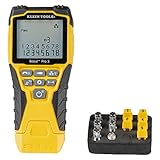
- VERSATILE CABLE TESTING: Cable tester tests voice (RJ11/12), data (RJ45), and video (coax F-connector) terminated cables, providing clear results for comprehensive testing on unenergized Ethernet cables (not designed to test PoE)
- EXTENDED CABLE LENGTH MEASUREMENT: Measure cable length up to 2000 feet (610 m), allowing for precise cable length determination
- COMPREHENSIVE FAULT DETECTION: Test for Open, Short, Miswire, or Split-Pair faults, ensuring thorough fault detection and identification
- BACKLIT LCD DISPLAY: Backlit LCD screen displays cable length, wiremap, cable ID, and test results, ensuring easy readability in various lighting conditions
- EFFICIENT CABLE TRACING: Trace cables, wire pairs, and individual conductor wires using the multiple style tone generator (requires analog probe Cat. No. VDV500-123, sold separately), simplifying cable tracing tasks
Configuration, capacity, wireless conditions, and external networks
The ITU-T’s E.475, Guidelines for intelligent network analytics and diagnostics (summary, January 2020), identifies configuration errors, insufficient capacity, wireless coverage or interference, and third-party network issues as possible sources of service-quality problems. Analytics can help locate degradation, assess plausible causes, probe network status, and anticipate possible performance decline. Such possibilities are candidates to investigate, not conclusions to draw from a single alarm or metric.
How diagnostic approaches differ
The approaches below are complementary rather than mutually exclusive. The standards describe their general roles and limitations, but do not establish universal detection times, resource costs, or accuracy benchmarks for implementations.
Rank #3

- New Upgraded Multi-function Network Cable Tester: NF-8506 TDR network tester has IP scanning, POE test, anti-interference RJ11 RJ45 CAT5 CAT6 cable test, continuity test, Ping network rate test, port flashing, sensitivity adjustment, cable Function of length test and LED flashlight.
- 200m cable length test: The NF-8506 Network cable tester is a portable cable length tester. The cable tester can accurately measure the cable length in the range of 8.2ft/ 2.5m-656ft /200m, find the cable fault distance and facilitate real-time field measurementt
- PING Tester+IP Scanner: This handheld Ping cable toner can be used to diagnose and maintain local area networks (Lans) running TCP/IP protocols. Powerful PING capabilities can verify connections, check the integrity of transmitted and received data, indicate network traffic load by measuring round-trip times and provide IP addresses
- Network Rate Test + Cable Continuity Test: Ethernet tester can quickly assess network rate issues. Conducts PING tests from multiple locations to gauge server and website response speeds. Allows users to ensure the integrity and connectivity of network cables by identifying any breaks, openings, or short circuits along the cable length.
- POE Tester: Identifies PoE devices efficiently. Detects crossover methods (unknown/end-span/mid-span/8-core power supply) and polarity. Comprehensive PoE detection, including non-standard, IEEE 802.3AF, and IEEE 802.3AT.
| Approach | What it contributes | Important limitation |
|---|---|---|
| Periodic polling and device alerts | Device status and counters collected at configured intervals; useful for persistent conditions and routine monitoring. | Low-frequency polling can miss transient problems, and a device alert may not explain a cross-layer service issue. A universal polling interval is not stated (RFC 9232). |
| Streaming telemetry | Subscription-based data delivery can provide timelier evidence for continuous monitoring and dynamic refinement. | Volume, device processing, storage, and telemetry traffic need controls. A universal streaming cadence or detection-time improvement is not stated (RFC 9232). |
| Active probes | Purposeful tests can check network status or answer a targeted reachability or performance question. | Probes may interfere with user traffic, so their scope and impact should be considered; no general probe rate is stated (RFC 9232; ITU-T E.475). |
| Passive or packet-level evidence | Observed traffic can add detail about behavior on a path or at a measurement point. | Passive collection can produce excessive or inaccurate data; it does not by itself establish a service-level cause (RFC 9232). |
| Service analytics and configuration context | Correlating performance, service outcomes, and configuration can help locate degradation and test plausible causes. | Analytics depend on relevant, comparable inputs; the cited guidance gives no universal accuracy or false-positive rate (ITU-T E.475; RFC 8969). |
How to judge a diagnostic design
When choosing or reviewing an approach, compare it against the network’s failure modes and operating constraints rather than assuming that the most detailed feed is automatically best.
- Coverage and resolution: Does the evidence include the device counters, flows, packet or in-band data, service measures, and configuration state needed to investigate the target problem?
- Detection and correlation time: How often is data collected, how quickly are events delivered, and how long does it take to correlate them into a useful diagnosis?
- Diagnostic value: Can the evidence narrow the likely fault domain and distinguish a symptom from plausible causes, or does it only report that something changed?
- Overhead and observer effect: What bandwidth, device processing, storage, and analysis resources will collection use? Could active measurement influence the traffic being investigated?
- Interoperability: Are data models and representations consistent enough to correlate evidence across vendors and operational systems?
- Automation safety: Are diagnosis and recovery actions explainable, bounded, auditable, and reviewable or reversible?
RFC 9232 emphasizes comprehensive data, correlation, and formal models that can support automation; RFC 8969 describes YANG-based management and diagnosis operations. These frameworks do not provide a universal weighting of the criteria or a benchmark that selects one design for every network.
Rank #4

- DIGITAL MODE: Easily trace and locate cables on an active network to identify their paths and destinations effectively
- ANALOG MODE: Isolate individual wire pairs, facilitating the tracing of voice, data, video, and audio cables
- CONTINUITY AND POLARITY TESTING: Results for continuity and polarity tests are displayed on LEDs that are clearly labeled and easy to read
- TRACE UNSTRIPPED WIRES: Rugged Angled Bed of Nails (ABN) clips securely attach to wires
- WIRE MAPPING CAPABILITIES: Utilize wire mapping capabilities to verify Pin-to-Pin connections and shield detection
Keep collection useful and safe
- Begin with an operational question, not a request to collect every available metric.
- Limit scope and duration when targeted evidence is sufficient, then expand collection only when the diagnosis requires it.
- Consider whether telemetry traffic needs isolation or controls so monitoring does not add avoidable load to the network under observation.
- Preserve context such as timestamps, measurement source, endpoints, and applicable SLA definition so that correlated values remain interpretable.
- Require a reviewable link between evidence and automated action; retain a way to audit the action and recover if its result is unexpected.
These controls reduce avoidable overhead, but adaptive collection does not eliminate measurement bias or guarantee a correct diagnosis.
Free tools Windows power users keep installed
One-click scans. No signup required.
Where a cable tester fits
A physical Ethernet cable tester can help check a suspected cabling fault on a particular run. It is a narrow physical-layer check, not a substitute for network-wide telemetry, path analysis, or service diagnosis. If the symptom spans multiple devices or appears only intermittently under service load, a cable check alone cannot explain the full behavior.
Quick Recap
Best Value

- VERSATILE CABLE TESTING: Cable tester for data (RJ45) terminated cables and patch cords, ensuring comprehensive testing capabilities
- LARGE BACKLIT LCD: Backlit LCD display enables easy reading of pin-to-pin wiremap results, even in low-lit areas
- COMPREHENSIVE FAULT DETECTION: Test for Open, Short, Miswire, Split-Pair faults, Cross-over, and Shield, providing thorough fault detection
- INTUITIVE USER INTERFACE: User-friendly interface with three buttons and simple, easy-to-identify test responses, ensuring a smooth testing experience
- MULTIPLE TONE GENERATOR STYLES: Tone on a single wire, wire pair, or all 8 conductor wires using the multiple style tone generator (solid/warble); requires probe Cat. No. VDV500-123 (sold separately)
Product prices and availability are accurate as of the date/time indicated and are subject to change. Any price and availability information displayed on Amazon at the time of purchase will apply.

