
Quick wins for a faster PC:
Clear out junk files and repair common Windows errorsFree Scan →Fix the driver behind crashes, sound loss and screen glitchesFind Drivers →Repair Windows errors before they cause bigger problemsFix Now →iTechGuides is reader-supported. When you buy through links on our site, we may earn an affiliate commission. As an Amazon Associate I earn from qualifying purchases. Learn more
AI is helping chip engineers explore layouts, optimize circuits, check designs and operate established electronic design automation (EDA) tools. It has not made EDA, engineering review or manufacturing constraints disappear: the evidence described here shows increasingly capable assistance, not routine autonomous design of a complete, verified, manufacturable chip.
OpenAI’s custom inference chip, Jalapeño, is a current example. OpenAI says AI contributed directly to its development and reports promising benchmark results, but those results are company-reported and apply to specified comparisons—not to every chip or workload.
What does AI do in chip design?
AI is being used for specific engineering tasks at different stages of chip development, rather than as one all-purpose system that takes an idea and independently delivers a finished chip. Examples include finding promising physical layouts, optimizing designs, supporting verification and programming, and using language or agentic models to interact with EDA tools.
Do these 3 things before closing this tab:
1Scan for outdated or missing drivers - takes under a minute2Clear out junk files and repair common Windows errors3Fix the driver behind crashes, sound loss and screen glitchesElectronic design automation is the specialized software environment engineers use to assemble semiconductor designs from intellectual-property cores and custom designs, then design, simulate and verify them. The OECD describes EDA as software that helps engineers bring those components together and design, simulate and verify a chip. Its 2025 background note also explains that EDA is developed in relation to foundry process design kits (PDKs), which encode the requirements of particular manufacturing processes.
#1 Best Overall
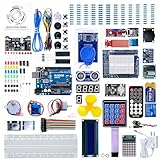
- 30+ Guided Electronics Projects: Start with LEDs and build toward LCD1602 displays, RFID access, motion detection, distance sensing, motor control and environmental monitoring for STEM learning, coding clubs, classrooms and hobby projects
- 200+ Components Across 63 Types: Includes an ELEGOO UNO R3 controller, LCD1602, RC522 RFID, RTC, HC-SR501 PIR sensor, ultrasonic sensor, DHT11, GY-521, MAX7219, keypad, joystick, relay, SG90 servo, stepper motor, breadboard and more
- Begin Without Soldering: Pre-soldered modules, a solderless breadboard, organized storage case and small-parts box reduce setup time and help beginners move from lesson to lesson while keeping LEDs, ICs, wires and sensors easy to find
- Learn, Modify and Create: Program the ELEGOO UNO R3 board with Arduino IDE using the included PDF tutorial and example code, then adjust sensor thresholds, timing, display text and motor behavior to turn guided lessons into original projects
- Flexible Power and Project Setup: Includes a 9 V, 1 A power supply, breadboard power module, 9 V battery and USB cable to support controller, breadboard and module experiments without sourcing basic setup accessories separately
That connection to a foundry matters: a design must satisfy the applicable process rules and pass engineering checks to be suitable for fabrication. AI can help explore or improve a design within that environment; it does not remove the need for simulation, verification, sign-off or compatibility with manufacturing constraints.
Where AI fits in the workflow
Chip development spans multiple kinds of work. The examples below address different stages, so they should not be treated as interchangeable demonstrations of a single capability.
Rank #2
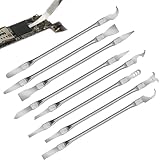
- Versatile Repair Kit:Perfect for safely removing BGA chips, CPUs, and other small components from smartphones and motherboards.
- Precision Design:Ultra-thin tools allow for easy maneuvering between chips and board without damage.
- Durable Material:Made from high-quality alloy, resistant to corrosion and bending, ensuring longevity.
- Time-Saving:Integrated blade and handle design eliminates the need for assembly, making repairs quicker.
- Comfortable Use:Ergonomic design ensures a comfortable grip, reducing hand fatigue during extended use.
| Stage or task | What AI may help with | Example and evidence |
|---|---|---|
| Floorplanning and physical layout | Explore where blocks should go and how a physical arrangement can satisfy design objectives. | Google DeepMind says its AlphaChip approach has contributed layouts across generations of Google’s TPU and other Alphabet chips. Its September 2024 retrospective describes use in layout and floorplanning. |
| Design optimization | Search for changes that improve a design against specified objectives, such as timing, area or power. | NVIDIA Research’s EDA overview describes research using methods including Bayesian optimization, reinforcement learning and generative AI across chip-design tasks. |
| RTL, verification and related engineering tasks | Assist with descriptions of digital logic, checking whether designs behave as intended, and other work in the design flow. | NVIDIA Research lists work spanning RTL, verification, logic synthesis, physical design, sign-off and design-for-manufacturing; these are research areas, not one claim that a model handles every stage autonomously. |
| Operating EDA software | Interpret instructions or results, call existing engineering tools and help iterate on a workflow. | Synopsys and OpenAI announced GPT-Synopsys on September 30, 2026, as a specialized model intended to operate Synopsys tools, interpret results and iterate. Cadence describes ChipStack as coordinating virtual engineers that use Cadence EDA tools; its capabilities and evaluations are vendor-described. |
AlphaChip illustrates why precision about the task matters. Google DeepMind presents it as a floorplanning and layout approach, not as a system that independently completes every step from specification to factory-ready chip. The page also quotes NYU Tandon professor Siddharth Garg, who says AlphaChip inspired research on reinforcement learning across parts of the design flow, including logic synthesis, floorplanning and timing optimization.
What’s actually slowing this PC down?
Pick the symptom - the matching free tool is one click away.
More recent tool-connected offerings aim to make models useful within existing EDA workflows. OpenAI president and co-founder Greg Brockman said in the September 30, 2026 Synopsys announcement: “With Synopsys, we’re bringing that work to chip design, helping engineers explore more designs and get to a working chip faster.” That is a statement of the partnership’s goal, not an independently measured productivity result.
Rank #3

- 【Sensor common board design】Based on Pico 2 RP2350 Chip, 17 sensor modules are integrated into a single board, no need for welding and complex wiring, ready to use out of the box, quick to get started
- 【Rich tutorials】Equipped with more than 20 creative tutorials, from basic to advanced
- 【Full-color touch screen】2.4-inch TFT full-color touch screen, simple interactive UI design
- 【Full-color atmosphere light】With 20 full-color atmosphere lights, can freely switch the lighting effect through the touch screen
- 【Built-in mini games】You can easily entertain and relieve fatigue after learning
Can AI design a chip by itself?
Not on the evidence described here. AI can generate suggestions, search options, optimize parts of a design and—in newer offerings—operate engineering tools. Those capabilities are meaningful, but they are different from independently turning a specification into a verified design that is ready for a particular foundry process.
In the prominent examples, AI operates alongside established software and engineering workflows. Engineers still need to define requirements, judge trade-offs, inspect results and verify the design. A tool that runs EDA software or proposes a layout should not be described as an autonomous chip designer unless evidence establishes that it completes the full end-to-end task, including the checks needed for manufacturability. The sources covered here do not establish routine end-to-end autonomy.
Rank #4

- Comprehensive Arduino Learning: The kit includes an Original Arduino Uno R3, 34 lessons, step-by-step guidance, 40+ free Video Courses, code examples, circuit diagrams, and an RAB Holder for easy setup and component organization. Designed for beginners aged 8 and up. Certified RoHS compliant, it ensures safety and quality for all learners
- Wide Range of Components: With over 200 components, including LEDs, buzzers, RFID modules, ultrasonic sensors, breadboard power supply module and multimeter, the kit enables hands-on learning and a deeper understanding of circuit design
- Practical Real-World Projects: Engage in projects like smart trash cans, automatic soap dispensers, and remote-controlled lights. Each project builds incrementally, enhancing skills and creativity while offering real-world applications of electronics and coding
- Perfect for Beginners: The handbook breaks down complex concepts into easy-to-follow steps, ensuring that even users with no prior experience can dive into electronics and programming with confidence
- Exceptional Support and Community: Access extensive resources from SunFounder, including tutorials, technical support, and an active online community. Learners can share ideas, ask for help, and explore new projects, enriching their learning journey
What OpenAI says AI contributed to Jalapeño
OpenAI describes Jalapeño as its first custom inference chip, developed with Broadcom. OpenAI says AI helped its team explore implementations, optimize arithmetic circuits, and shorten the loops for design, measurement and verification. The company reports that the project moved from initial design to tapeout in nine months.
Outdated Drivers Are Slowing You Down
One free scan finds every outdated or missing driver and matches the right update for your exact hardware.Free scan · exact hardware matchWindows Errors? Fix Them Before They Spread
Repair common Windows errors and clear accumulated junk for a smoother, more stable PC - no reinstall needed.Free scan · no reinstallTapeout is a significant design milestone, but it is not the same as proving that a chip is in broad production or deployed at scale. OpenAI says that production qualification and software preparation are continuing. As of its account accessed October 7, 2026, the company planned to deploy Jalapeño in its own compute infrastructure by the end of 2026. That is a stated plan, not confirmation that deployment has happened.
Best Value

- 【POWERFUL ESP32‑S3 CONTROLLER】Built‑in Xtensa 32‑bit LX7 dual‑core processor, 512KB SRAM, 8MB PSRAM, 16MB Flash for stable AI voice computing and multitask processing.
- 【Preloaded Dual AI Platforms】Comespre-installed with complete Deepseek and OpenAI voice dialogue projects.Experience intelligent voice interaction instantly. (Note: OpenAI functionality requires your own API key.)
- 【STABLE WIRELESS & CLEAR AUDIO】Integrated 2.4GHz Wi‑Fi + Bluetooth 5 (LE); dedicated audio decoding module for natural, responsive voice interaction.
- 【USER‑FRIENDLY VISUAL & PLUG‑AND‑PLAY】2” TFT‑SPI color screen shows real‑time chat; modular design, no extra wiring, ready to use after setup.
- 【FULL LEARNING SUPPORT】45 programmable GPIOs, rich interfaces, online web tutorials, free technical support for beginners & developers.
How to interpret Jalapeño’s reported performance
OpenAI says it tested Jalapeño with InferenceX, a public benchmark from SemiAnalysis, and compared it with commercially available systems at different operating points. The figures below are OpenAI’s reported results from those benchmark comparisons, not independent validation or a guarantee for other workloads.
| Reported result | Scope and qualification |
|---|---|
| 1.5–1.9 times more AI work per watt at peak throughput | OpenAI-reported InferenceX comparisons across three public models, in 2026. This is a benchmark-specific comparison, not a general efficiency figure for all inference workloads. |
| 1.7–3.6 times lower end-to-end latency | OpenAI-reported results across the same three public-model comparisons in 2026. The range reflects different reported comparisons rather than one universal speedup. |
| About 1.5 times higher peak performance per watt and 3.4 times lower end-to-end latency | OpenAI’s reported comparison for the Kimi K2.5 1T test specifically, using its stated comparison conditions. |
| 700 watts rated; sustained measured power at or below 550 watts | OpenAI’s figures for Jalapeño. The sustained-power claim applies to the workloads it tested, not all operating conditions. |
These are claims about inference-chip performance under stated benchmark conditions. They do not measure how much faster AI made the design process. Conversely, a claim that an AI tool helps engineers reach a design sooner does not establish that the resulting chip is faster or more energy-efficient.
How to judge AI chip-design claims
When a company says AI can design chips faster or better, first identify exactly what was done and what evidence supports the claim.
- Identify the stage. A result in floorplanning, verification or circuit optimization does not establish that the system handles the entire design flow.
- Check what the system actually does. Does it recommend changes, generate design artifacts, or execute established EDA tools? These levels of involvement are not equivalent.
- Look for the role of engineers. Determine whether humans set objectives, review proposed changes, run checks or approve results. Tool use alone does not demonstrate independent decision-making.
- Distinguish evidence types. A published research approach, a vendor’s evaluation, a product availability statement and a deployed system are different kinds of evidence.
- Inspect the measurement conditions. For productivity claims, look for the task and comparison baseline. For chip performance, look for the benchmark, workload, operating point and comparison system.
- Keep unlike outcomes separate. Design-cycle time, chip performance, power efficiency and manufacturing readiness answer different questions and need different evidence.
EDA is also a concentrated market. The OECD’s 2025 background note says three firms account for more than 60% of the global EDA market, attributing that figure to earlier OECD work rather than presenting it as a new calculation. That context helps explain why partnerships between AI companies and established EDA vendors focus on integrating models with tools already used in chip development.
Quick Recap
Product prices and availability are accurate as of the date/time indicated and are subject to change. Any price and availability information displayed on Amazon at the time of purchase will apply.

