
iTechGuides is reader-supported. When you buy through links on our site, we may earn an affiliate commission. As an Amazon Associate I earn from qualifying purchases. Learn more
A desktop GUI agent is a complete control loop, not just an AI model: it observes a screen, decides what to do, sends mouse or keyboard input through a runner, then checks the new screen state. UI-TARS illustrates the model layer, UI-TARS Desktop shows how a model can be connected to local computer operations, Claude Computer Use illustrates screen-based interaction and its privacy implications, and OSWorld 2.0 tests how well agents handle long workflows. Keeping those roles separate is essential both when building an agent and when judging its results.
What makes a desktop GUI agent work?
A useful mental model is a loop with four parts: perception, decision-making, execution, and verification. The model may interpret screenshots and choose an action, but the surrounding system determines what it can see, which actions it can take, how often it gets another observation, and whether it notices that an action failed.
- Perception: Capture the desktop and identify relevant controls, text, dialogs, and changes in the interface.
- Planning and state: Turn the request into steps, retain constraints and information gathered along the way, and revise the plan when new information appears.
- Execution: Send a bounded mouse or keyboard action through a desktop operator, then wait for the application to respond.
- Verification: Observe the result and check it against the intended change before continuing or reporting success.
These components are not interchangeable. A model that can interpret a screenshot does not, by itself, provide a screen-capture service, a safe action runner, persistence between steps, or a reliable test of the final result.
Free tools Windows power users keep installed
One-click scans. No signup required.
How UI-TARS, Claude Computer Use, and OSWorld 2.0 differ
| System | Role in a GUI-agent stack | What the cited material establishes |
|---|---|---|
| UI-TARS | Model | The paper describes a screenshot-based model that produces mouse and keyboard interactions. Its benchmark results belong to the paper’s own evaluation setup. UI-TARS paper |
| UI-TARS Desktop | Application and computer operator | Its quick start describes natural-language computer control, screenshot perception, mouse and keyboard control, and a local operator. Setup involves configuring a model provider or endpoint, so a local operator does not necessarily mean local inference. UI-TARS Desktop quick start |
| Claude Computer Use | Computer-use capability and data-handling context | Anthropic’s privacy guidance describes interpreting screen content, moving a cursor, clicking, and entering text, and says screenshots, user inputs, and outputs are processed and collected. The privacy page is not an API reference and does not establish a current tool schema or model-version setup. Anthropic Computer Use privacy guidance |
| OSWorld 2.0 | Evaluation benchmark | The paper evaluates long, realistic computer-use workflows and reports full-completion and partial-score results under specified model and interaction conditions. It is not an agent application. OSWorld 2.0 paper |
UI-TARS Desktop’s documentation describes configuring a model provider or endpoint, including a hosted endpoint for UI-TARS-1.5. That makes deployment location a separate question from action location: inference may be hosted while the operator acts on a local computer. The quick start also says browser operator mode requires a supported browser, documents a single-monitor setup, and warns that some multi-monitor configurations may fail on certain tasks. On macOS, setup requires Accessibility and Screen Recording permissions. Check the quick start for current instructions before deployment.
#1 Best Overall

- [INTEL POWERED CONTENT] - Built with a 8th Generation Hexa-Core Intel i5 and 32GB of DDR4 RAM; Modern, Windows 11 ready, with 4K support, Executive multitasking, media streaming and smooth, multi-tab web browsing; Perfect as an all-purpose multimedia computer; built for content creators; Plenty of RAM and Mass storage for photo and video editing powered by Intel HD 630
- [LATEST WIRELESS TECH] - This Dell Desktop Computer easily connects to the internet through the Built In WiFi / Bluetooth
- [SOLID STATE STORAGE] - This Dell Computer setup comes with an ultra-fast 1TB Solid State Drive (SSD); Setup as the primary boot device; Boot and load programs with lightning speed ; Additional expansion available
- [BUY & OWN WITH CONFIDENCE] - From the world's largest Microsoft Authorized Refurbisher; Quality Guarantee and Free Tech Support; Award-winning Customer Service; | Support Sustainable Business
- [MODERN HI-SPEED PORTS] - USB 3.0 (x4) | USB 2.0 (x4) | DisplayPort (x1) | HDMI Port (x1) | Audio Combo Jack (x1) | Audio Out (x1) | RJ-45 Ethernet (x1) | Internal SATA (x3)
Build the control loop around explicit state
A practical first implementation should make the model’s decisions inspectable and keep high-impact actions behind checks. The following is an engineering pattern informed by the failure modes described in the OSWorld 2.0 paper, not a claim that a particular product implements every step.
- Translate the request into a task record. Store the goal, required constraints, success conditions, actions requiring confirmation, and any unresolved questions. If the request is ambiguous in a consequential way, ask the user before operating.
- Capture an initial observation. Give the model a current screenshot and a compact state summary. Record important facts and pending requirements so that details collected in one app are not lost while working in another.
- Choose one bounded action. Generate an action from the current observation, such as a click or text entry. Keep execution restricted to the operations the task needs rather than giving the model an unrestricted computer-control channel.
- Execute, wait, and observe again. Send the action through the runner, allow the interface to respond, and capture updated state. Do not assume a click succeeded just because it was issued.
- Reconcile the result with the plan. Update task state, retain new information, and revise the next step when a dialog, delayed result, or unexpected screen changes the situation. Ask rather than guess when intent or hidden state is unclear.
- Verify the final outcome. Check the resulting document, application state, or other requested artifact against each original success condition. Report completed work and any unresolved uncertainty accurately.
The key design choice is an observation cadence: after each action, after a short group of low-risk actions, or at a meaningful transition. Longer action batches can reduce overhead, but they also delay detection when the first action changes the interface unexpectedly. For actions with consequences, prefer observing and checking before proceeding.
Rank #2

- Model: Dell OptiPlex 7050 Small Form Factor (SFF)
- Processor: Intel Core i7-7700 3.60 GHz
- Memory: 32GB DDR4 Ram
- Storage: 1TB Solid State Drive (SSD) Fast Boot + Storage
- Operating System: Windows 11 Pro (64-bit)
Why long desktop workflows still fail
OSWorld 2.0 focuses on extended, realistic workflows, including dynamic environments, cross-source reasoning, implicit-state inference, and visual-spatial precision. Its authors report 108 workflows, with a median human completion time of about 1.6 hours per task. Their abstract identifies recurring failures beyond basic GUI control: agents can lose constraints, miss information that arrives mid-task, guess instead of asking, skip verification, and struggle when they must recover hidden state.
Recommended Free Tools
Those failure modes suggest specific engineering responses rather than simply asking a model to “be more careful”:
Rank #3

- IMMERSIVE 24 INCH DISPLAY: Experience stunning clarity on a Full HD IPS screen with ultra-thin bezels, offering a 90% screen-to-body ratio that makes everything from spreadsheets to streaming come alive with vibrant colors and crisp details.
- POWERFUL INTEL PROCESSING: Tackle demanding tasks with ease thanks to the Intel processor and 16GB of high-speed memory, delivering smooth performance whether you're multitasking between applications or running productivity software.
- GENEROUS STORAGE: Store all your important files, photos, and programs with blazing-fast solid state drive technology that ensures quick boot times, rapid file access, and plenty of space for your digital life.
- ENHANCED PRIVACY AND COLLABORATION: Work confidently with the pop-up privacy camera that tucks away when not in use, plus dual microphones with noise reduction for crystal-clear video calls that keep you connected professionally.
- ECO-CONSCIOUS DESIGN: Feel good about your purchase with an EPEAT Gold registered and ENERGY STAR certified computer that combines premium performance with responsible environmental manufacturing practices.
- Constraints disappear: Keep a persistent checklist of requirements and test each one at the end.
- New information is missed: Update the state record after each meaningful screen change and revisit affected decisions.
- The agent guesses: Define when it must pause for clarification, especially where the user’s intent or an unseen application state changes the correct action.
- Verification is skipped: Treat verification as a required task step, not an optional final flourish.
Read benchmark scores with their setup attached
A percentage is meaningful only alongside the benchmark release, task set, action budget, model configuration, and scoring rule. OSWorld 2.0’s reported results are not a direct head-to-head comparison with earlier OSWorld evaluations or other benchmark versions.
| Reported result | Qualification |
|---|---|
| 20.6% full completion; 54.8% partial score | OSWorld 2.0 authors’ result for Claude Opus 4.8 with maximum thinking and batched tool calls, at the 500-step cap. This describes that benchmark setup, not all desktop tasks. OSWorld 2.0 paper |
| 318 average tool calls, compared with about 30 in OSWorld 1.0 | OSWorld 2.0 authors’ report for Claude Opus 4.7 with maximum thinking; the comparison is to OSWorld 1.0 in the paper’s stated context. OSWorld 2.0 paper |
| 24.6 at 50 steps; 22.7 at 15 steps | Values reported in the original UI-TARS paper for its OSWorld evaluation setup. They are not directly comparable with OSWorld 2.0’s results. UI-TARS paper |
| 47.5 on OSWorld; 88.2 on Online-Mind2Web; 50.6 on WindowsAgentArena; 73.3 on AndroidWorld | Author-reported UI-TARS-2 report results in that report’s evaluation setup. These figures are not OSWorld 2.0 scores or a common cross-benchmark ranking. UI-TARS-2 report |
For reproducibility, align the benchmark code, task files and assets, website deployment, and provider images to one release. The OSWorld-V2 repository identifies osworld-v2.1 as its active recommended release in guidance checked October 7, 2026. It calls for release-aligned components; mixing a moving development branch with older task assets can make a result difficult to interpret.
Rank #4
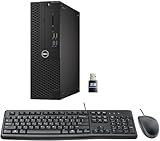
- This Certified Refurbished product is tested and certified to look and work like new. The refurbishing process includes functionality testing, basic cleaning, inspection, and repackaging. The product ships with all relevant accessories, a minimum 90-day warranty, and may arrive in a generic box. Only select sellers who maintain a high-performance bar may offer Certified Refurbished products on Amazon.com.
- Dell Optiplex 3050 SFF Desktop computer PC, Intel Quad Core i5-6500 up to 3.6GHz, 16GB DDR4, 256GB SSD
- Includes: USB Keyboard & Mouse, USB WiFi adapter, Microsoft office 30 days free trail.
- Port: Front: USB 3.0(2), USB 2.0(2); Rear: DP, HDMI, USB 3.0(2), USB 2.0(2), RJ-45.
- Support 4K (3840x2160) Dual display, makes it easy to connect two monitors at the same time, and you can expand working Windows, mirror content, or expand a single window across multiple monitors.
When reporting your own evaluation, record the exact model snapshot, prompt, action budget, batching, task release, environment image, and tool implementation. Report binary completion separately from partial progress so a reader can distinguish a task finished correctly from one that made some progress.
Plan permissions, privacy, and recovery before use
A screenshot-based agent may see whatever is displayed on the controlled computer: messages, account details, documents, and other sensitive information. Anthropic’s Computer Use privacy guidance says screenshots, user inputs, and outputs are processed and collected. Decide what may appear on screen and where inference runs before connecting an agent to a real desktop.
Best Value

- Connectivity: Includes WiFi, Bluetooth, and LAN for wireless and wired connections
- Memory: Features 16GB DDR4 RAM for smooth multitasking and performance
- Storage: Combines 500GB SSD and 1TB HDD for ample storage space
- Graphics: Integrated Intel UHD Graphics 630 for crisp visuals and video playback
- Design: Sleek desktop tower with black color and slim profile for modern look
- Use a dedicated or isolated environment for testing rather than an everyday session containing unrelated accounts and documents.
- Grant only the screen-capture and accessibility permissions required by the chosen operator, and review them when the setup changes.
- Keep irreversible or sensitive actions—such as sending, deleting, purchasing, or changing access—behind explicit user confirmation and a way to recover where possible.
- Treat on-screen text as data, not automatically as trusted instructions. A page or document can contain content that conflicts with the user’s request.
- Decide what screenshots, action traces, and task summaries are retained, who can access them, and whether sensitive values should be excluded or redacted.
For Claude Computer Use specifically, verify the current API documentation and supported model setup before implementing against it; the linked privacy guidance establishes data handling, not the current developer interface.
Quick Recap
Product prices and availability are accurate as of the date/time indicated and are subject to change. Any price and availability information displayed on Amazon at the time of purchase will apply.

