
Crashes, No Sound, or Screen Glitches?
Random freezes, missing sound and display glitches usually trace back to one bad driver. Find and replace yours safely.Free scan · under a minuteWindows Errors? Fix Them Before They Spread
Repair common Windows errors and clear accumulated junk for a smoother, more stable PC - no reinstall needed.Free scan · no reinstalliTechGuides is reader-supported. When you buy through links on our site, we may earn an affiliate commission. As an Amazon Associate I earn from qualifying purchases. Learn more
Radio-frequency interference (RFI) is unwanted radio-frequency energy that degrades reception, causes information to be misread, or prevents information from being recovered in a radio communication system. The International Telecommunication Union (ITU) defines interference by its effect on reception—not simply by the presence of another signal.
What does radio-frequency interference mean?
ITU Radio Regulations No. 1.166 define interference as “The effect of unwanted energy due to one or a combination of emissions, radiations, or inductions upon reception in a radiocommunication system, manifested by any performance degradation, misinterpretation or loss of information which could be extracted in the absence of such unwanted energy.” ITU Radio Regulations
In practical terms, unwanted energy interferes when it affects a receiver’s ability to extract the intended information. That can happen whether the unwanted energy comes from another transmission or reaches the system through radiation, induction, or a connection such as a cable. The definition is about the impact on reception, rather than a particular device or source.
Recommended Free Tools
When is interference considered harmful?
The ITU distinguishes permissible, acceptable, and harmful interference. Not every instance of interference qualifies as harmful in the regulatory sense. Under Radio Regulations No. 1.169, harmful interference is interference that endangers radionavigation or other safety services, or seriously degrades, obstructs, or repeatedly interrupts a radiocommunication service operating in accordance with the regulations. ITU Radio Regulations
#1 Best Overall

- Packaging Includes: 20 snap-on ferrite cores with 5 different sizes included, suitable for cables with inner diameters of 3mm, 5mm, 7mm, 9mm, and 13mm
- Material Construction: Made of nickel-zinc ferrite material, which enhances the electromagnetic field around the coil and effectively resists external interference
- Easy Installation: Features a cylindrical snap-on design for simple installation-just open it, clip onto the cable, and it's ready to use without disconnecting wires
- Versatile Applications: Ferrite beads are widely suitable for electromagnetic interference (EMI) suppression in various electronic devices, such as data cables, USB cables, telephone lines, and network cables to shield against external electromagnetic interference
- Signal Quality Enhancement: Helps reduce RFI and EMI noise on cables to improve signal clarity and device performance across multiple cable types
The distinction matters because the consequences range from reduced performance to disruption of safety-related services. Interference may be accidental or intentional; the definition of harmful interference turns on the danger or seriousness of its effect.
What systems can RFI affect?
RFI is not limited to AM/FM broadcasts. It can affect broadcasting, mobile and fixed communications, scientific services, and radionavigation. Navigation and telecommunications systems may rely on positioning or timing information, so disruption can matter well beyond a listener’s radio reception. The ITU describes harmful interference in relation to these services and safety applications. ITU Radio Regulations
Rank #2
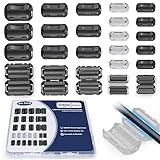
- 5-SIZE FERRITE BEADS KIT: 24pcs snap-on ferrite cores in 5 sizes (3.5mm×6, 5mm×6, 7mm×4, 9mm×4, 13mm×4). Universal fit for USB, HDMI, power cords, audio/video wires & data cables (3-13mm diameter)
- EMI/RFI FERRITE CHOKE TECHNOLOGY: Blocks electromagnetic & radio-frequency interference, enhances signal integrity for TVs, routers, speakers, home/office electronics
- SNAP-ON FERRITE RINGS, REUSABLE: Tool-free installation - open, wrap cables, snap shut! Removable and reusable without wire damage
- DURABLE FERRITE CHOKE CORE: Ni-Zn ferrite + Locking Clip. Blocks motor noise like a pro suppressor!
- ORGANIZED FERRITE STORAGE CASE: Sturdy plastic case for neat storage - ideal for electricians, IT pros, and DIY enthusiasts
Radio astronomy uses a specialized framing: ITU-R Report RA.2126-2, issued in March 2026, describes RFI as an unwanted addition to the cosmic signal that can degrade or prevent a successful observation. Astronomers may prevent it from entering the data, remove it in real time, or reduce its effects after observation. This field-specific description complements, but does not replace, the Radio Regulations definition for radiocommunication generally. ITU-R Report RA.2126-2
Interference control is also important in mission-sensitive systems. NASA’s Johnson Space Center describes electromagnetic compatibility engineering as part of making spaceflight hardware reliable and protecting critical communications from electromagnetic disturbances. NASA Johnson Space Center: EMI/EMC Engineering
Rank #3
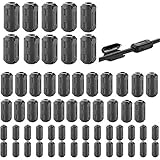
- Package included: 60 * cable clips (with 5 different size included) for cord with 3/ 5/ 7/ 9/ 13 mm inner diameter
- Ni-Zn ferrite. It can improve the electromagnetic field around the solenoid, thus avoiding outside interference.
- Easy to install and convenient to use. The cylinder can be dismountable, and the port has the elastic clip fastener.
- Helps reduce EMI on AC power lines. Black plastic enclosed ferrite core for 5 mm AC power cords. Great for cutting noise on USB, firewire, phone, power cord, coaxial, audio, video cables, etc.
- This rectangle ferrite Bead can be widely used in a variety of Data cables, USB cable, telephone line, network line to shield external electromagnetic interference.
How to investigate a suspected interference problem
Start by checking whether the problem is reproducible and what changed around the time it began. ITU-T Recommendation K.37 advises identifying the reason for the problem before selecting a corrective measure. For a practical initial check, monitor the affected radio or television while switching suspected nearby equipment off and on, where doing so is safe and feasible. Note whether the interference tracks a particular device or operating condition. ITU-T Recommendation K.37 (January 2024)
For cases that need more systematic investigation, K.37 describes monitoring with a broadband radio receiver. The useful coverage and setup depend on the system and frequencies involved; a receiver is a diagnostic tool, not proof by itself that a particular source is responsible.
Rank #4
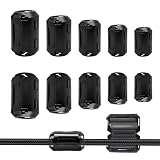
- [ Signal Integrity Protection ]: Specially formulated nickel-zinc ferrite cores in these noise suppressor cable clips effectively absorb RFI/EMI interference. Maintains signal purity in data transmission cables, audio/video lines, and power cords while preventing electromagnetic disruption. Handles multiple cable types simultaneously through superior EMI suppression that ensures complete signal integrity.
- [ Package Include ]: This complete set includes 20 ferrite core noise filters in 5 precise specifications with inner diameters of 3/5/7/9/13mm. Each specification contains 4 filters. Detailed dimensions: 3mm & 5mm ID: 1" x 0.5"(25×13mm), 7mm ID: 1.18" x 0.6"(30×16mm), 9mm ID: 1.38" x 0.8"(35×19mm), 13mm ID: 1.42" x 0.9"(36×23mm). Ensures comprehensive compatibility with various cable types.
- [ Installation Guidelines ]: The split ferrite core design simply snaps onto cables near interference sources, ideally close to shielding layer entry/exit points. For full protection, install one core at each end of the cable. Note: Effective installation requires correct identification of interference sources and troubleshooting of related issues.
- [ Quick Installation ]: Features spring-activated dual-snap mechanism with adaptive internal clamping. Simply open jaws, position around cable, and snap closed—achieves permanent EMI protection without tools or cable disassembly.
- [ Multi-Scenario Applications ]: Ideal for USB cables, keyboard/mouse wires, network lines, power cords, and audio/video interfaces. Perfect for computer workstations and network cabling to block external EMI. Effectively shields against electromagnetic interference, filters high-frequency noise pulses, and enhances audio/video signal quality.
- Record when the interference occurs and whether it is continuous, intermittent, or linked to a device switching on or operating.
- Check for new, moved, damaged, or malfunctioning equipment and for changes to nearby cables or installation conditions.
- Where appropriate, isolate suspected equipment one item at a time and observe whether the symptom changes.
- Have damaged cable screening, connectors, or installation components checked; do not assume that proximity alone identifies the cause.
Which measures can reduce RFI?
The right measure depends on how unwanted energy reaches the affected system and whether the main issue is emissions from a source, susceptibility at the receiver, or coupling through cables. ITU-T K.37 addresses EMC mitigation in telecommunications installations and systems; it is not a universal household fix. Its measures include sound installation practices, earthing and bonding, suitable cabling and power distribution, screening, filtering, and keeping disturbing equipment away from sensitive equipment. ITU-T Recommendation K.37 (January 2024)
Free tools Windows power users keep installed
One-click scans. No signup required.
- For a cable-related path: Check cable routing, screening, and connections. Rerouting or repairing a cable may help when the problem is tied to its installation. Ferrite chokes can address common-mode currents on cables, but only when that is the relevant mechanism.
- For coupling between nearby equipment: Increasing separation or applying suitable screening may help, depending on the source, receiver, frequency, and installation.
- For unwanted signals entering through a connection: Filtering may be appropriate when investigation shows that the signal path and equipment support that approach.
- For a sensitive installation: Review EMC practices such as controlled earthing and bonding, appropriate cabling, power distribution, and placement of equipment.
These measures are not interchangeable. A ferrite choke, for example, is not a general-purpose RFI cure; it is relevant to common-mode cable currents. Verify the source and likely coupling path before changing equipment or adding accessories.
Best Value

- 【Specification】Size: 5mm (Suitable for 3.5-5.0mm cables); Package Includes: 10 x Ferrite Core Ring; TIPS: There is a tolerance of 0.8mm and it is recommended for use in cables smaller than the maximum diameter range.
- 【Reduce Single Interference】The ferrite core effectively helps in reducing electromagnetic interference(EMI) and RF interference(RFI), and get clearer signal and audio quality.
- 【Detachable and Reusable】Clip on wire and removable easily. It won't cause any distortion during signal transmission.
- 【Wide Application】Mainly used for electronic connecting wire, air conditioner, PC, AC power lines, video and audio cable, telephone line, and other home appliances etc.
- 【Better Shielding】If the wire is too thin too loose or you want get better anti-interference effect, you could wrap it around more.
When to report serious interference
If interference threatens radionavigation or another safety service, or seriously degrades, obstructs, or repeatedly interrupts a regulated radiocommunication service, treat it as a serious issue rather than a routine reception nuisance. Follow the reporting route set by the relevant national authority. For cross-border cases brought to it, the ITU Radiocommunication Bureau can investigate and forward findings and recommendations to the administrations involved. ITU Radio Regulations
Quick Recap
Product prices and availability are accurate as of the date/time indicated and are subject to change. Any price and availability information displayed on Amazon at the time of purchase will apply.

