
Recommended Free Tools
iTechGuides is reader-supported. When you buy through links on our site, we may earn an affiliate commission. As an Amazon Associate I earn from qualifying purchases. Learn more
“Outside the box” means unconventional, original, or resourceful—especially when someone thinks beyond the usual limits. The phrase most often appears in “think outside the box,” an encouragement to consider ideas beyond traditional or expected ones.
What does “outside the box” mean?
Dictionary.com defines “outside the box” as acting “in an unconventional or original and resourceful way; in a way that defies usual limits.” It is an American idiom. The phrase can describe either a way of thinking or something that is itself unconventional, original, and resourceful.


Cambridge English Dictionary gives a similar learner-friendly definition of “think outside the box”: to think imaginatively by using new ideas rather than traditional or expected ones.
How do you use the phrase?
Use “think outside the box” when you mean that someone should explore possibilities beyond the familiar approach. “Outside the box” can also describe the approach or idea itself.
- As advice: “We have tried the usual fixes; let’s think outside the box.”
- To describe an approach: “Her outside-the-box solution addressed the problem from a different angle.”
What does the nine-dot puzzle have to do with it?
The idiom is widely associated with a puzzle: connect nine dots arranged in a square using four straight lines without lifting your pencil. A familiar solution draws lines beyond the apparent square formed by the dots. The puzzle illustrates how a solver may assume a boundary that the instructions never set.
That connection helps explain the metaphor: the “box” represents an assumed limit, and thinking outside it means questioning that limit. The puzzle is an illustration of the phrase, not definitive proof that it was the sole source of the expression.
Rank #2

- TOYS THAT TEACH: MindWare’s World of Dots books encourage concentration, counting and mapping. Train your brain with these advanced connect-the-dot books as you create beautiful and delightful images with up to 1,800 dots!
- WONDERFUL WORLD OF DOTS: You will love watching each detailed picture of different dog breeds unfold with this one-of-a-kind dot-to-dot series! It’s an excellent way to decompress after a long day.
- CHALLENGING PUZZLES: Particularly geared towards older kids and adults, each puzzle is designed to stimulate visually and mentally; combining math, art and fun!
- CONNECT AND COLOR: Once the last dot is connected, research your scenes to color photo-realistically or let your creativity loose and color with your own style.
- INCLUDES: (1) Extreme Dot to Dot World of Dots: Dogs Book (Ages 8 and up)
Where did “think outside the box” come from?
The exact coiner is not established. Phrase histories document related wording before the now-familiar expression, so it is safer to describe dated appearances than to credit one person with inventing it.
Quick wins for a faster PC:
Repair Windows errors before they cause bigger problemsFix Now →Scan for outdated or missing drivers - takes under a minuteDriver Scan →- David Wilton’s Wordorigins.org account describes a 1954 reference to “go outside the dots” and a 1969 Norman Vincent Peale newspaper column discussing lines that connect outside the box.
- Wilton also cites the complete wording “think outside the box” in the September 1971 issue of Data Management, alongside earlier variants such as “think outside the lines” and “think outside the dots.” The article includes the sentence, “Unfortunately, we have accepted thought process limitations that are artificial.”
- Pascal Tréguer’s Word Histories account also reports the September 1971 Data Management occurrence as the earliest recorded occurrence cited in the Oxford English Dictionary’s third edition. It notes a 1995 explanation connecting the dots and box expressions to the puzzle.
These are historical attestations, not proof of a single inventor. Wilton’s article also quotes Peale’s 1969 advice: “Step outside the box your problem has created within you and come at it from a different direction.” That quotation is from Peale’s newspaper column, not a modern scientific finding.
Rank #3
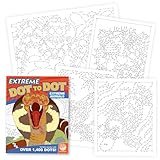
- Toys That Teach: This dot to dot book features challenging connect the dots extreme puzzles that help improve counting, mapping and concentration while teaching special awareness along with patience and planning
- Detailed Pictures: With puzzles ranging from 500 to over 1400 dots, our Extreme Animals dot to dot books for kids ages 8-12 and older reveal intricate pictures of amazing animals—including Leafy Sea Dragons or Flying Squirrels—as you connect the dots
- Complex Kids Coloring Books: Each of our connect the dots books doubles as a coloring book for kids; when you're done connecting the dots, color your pictures for beautiful, display-worthy masterpieces
- Complex Kids Coloring Books: Each of our connect the dots books doubles as a coloring book for kids; when you're done connecting the dots, color your pictures for beautiful, display-worthy masterpieces
- Includes: 1 Exteme Dot to Dot: Extreme Animals educational activity book with 32 puzzles on thick, quality paper that can be displayed upon completion (Ages 8 and up)
Is “outside the box” the same as “out of the box”?
No. “Outside the box” usually refers to unconventional thinking or an unconventional approach. “Out of the box” can mean that a product is ready to use as soon as it is taken from its packaging, as Dictionary.com notes in its separate “out of the box” entry. Context distinguishes the meanings.
Quick Recap
Product prices and availability are accurate as of the date/time indicated and are subject to change. Any price and availability information displayed on Amazon at the time of purchase will apply.

