
Recommended Free Tools
iTechGuides is reader-supported. When you buy through links on our site, we may earn an affiliate commission. As an Amazon Associate I earn from qualifying purchases. Learn more
An open AI stack is a set of AI components that can be selected, inspected, or replaced independently—not just a model with downloadable weights. For an application developer, those components can include the model, the service that runs it, a gateway or router, a harness that manages the interaction, and tools that supply capabilities or context. More broadly, an open AI ecosystem also depends on developer interfaces, data standards, and compute. There is no single canonical definition, so it helps to specify which meaning you have in mind.
What does “open” mean for AI?
“Open” can describe different things: access to model parameters, permission to use or change software, disclosure about training data, or the ability to replace one part of an application without replacing the rest. These are related, but they are not interchangeable.
The Open Source Initiative’s Open Source AI Definition 1.0 frames open source around the freedoms to use a system for any purpose, study it, modify it, and share it. For a machine-learning system, its preferred form for modification includes more than a weight file: it calls for sufficiently detailed information about training data, the complete code used to train and run the system, and parameters such as weights, under qualifying terms.
Free tools Windows power users keep installed
One-click scans. No signup required.
That makes “open weights” a narrower claim than “open source AI.” A model’s parameters may be available while its training code, data information, or license terms are not. Openness should be checked component by component; a model family may have different terms for its code, data, and weights.
#1 Best Overall

- Built for Local AI Development: AMD Ryzen AI Halo is designed for local AI development and inference, featuring 128GB unified memory and support for up to 200B parameter models to build and run intensive AI workloads locally.
- 128GB Unified Memory: Features 128GB LPDDR5x unified memory at 8000 MT/s with 256 GB/s memory bandwidth, providing a shared memory pool across the CPU, GPU, and NPU to support larger AI models.
- AMD Ryzen AI Max+ 395 Processor: Features 16 cores, 32 threads, and Zen 5 architecture, paired with AMD Radeon 8060S integrated graphics featuring 40 RDNA 3.5 compute units and an AMD XDNA 2 NPU with up to 50 TOPS.
- Linux AI Developer Platform: Purpose-built for Linux-based AI development with full AMD ROCm software support and preloaded tools, models, and workflows optimized for local AI development.
- Compact, Connected Design: Includes a 2TB M.2 SSD, 10GbE LAN, Wi-Fi 7, Bluetooth 5.4, USB-C connectivity, and HDMI 2.1b.
A quick openness checklist
- Are the model’s weights or other parameters available, and under what terms?
- Is the complete code for training and running it available?
- Is there sufficiently detailed information about training data, including its provenance and how it was collected, selected, processed, and filtered?
- Do the applicable licenses and terms allow your intended use, modification, and redistribution?
A third-party catalog, USASI, uses “Open-stack” as its own editorial tier for models with public weights, inference code, training code, a training recipe, and at least documented training-data composition. It describes this as a catalog rubric, not an external certification or the OSI definition. See its glossary and methodology for that narrower usage.
What goes into an AI application stack?
For an application developer, Together AI’s September 9, 2026 explainer uses the acronym “MIGHT” to describe five layers. It is a vendor’s framework, not a universal taxonomy, but it offers a practical way to see how an application can be assembled from separate choices.
Model
The model interprets an input and generates a response. Depending on the task, a team may choose among models with different capabilities, licensing terms, and deployment options.
PC Slower Than It Used to Be?
A free scan shows the junk files, broken settings and background clutter dragging Windows down - then fixes them in one click.Free scan · Windows 10 & 11Outdated Drivers Are Slowing You Down
One free scan finds every outdated or missing driver and matches the right update for your exact hardware.Free scan · exact hardware matchInference
Inference is the infrastructure or provider that runs the model and returns its output. It can be hosted remotely or run on infrastructure the team controls; choosing a model does not automatically dictate where it must run.
Gateways and routers
A gateway or router directs a request to a model or provider. A team may use one to make choices among capability, response speed, and cost, or to change providers without rebuilding the whole application.
Rank #2

- EVOLUTION AMD RYZEN AI MAX+ 395 MINI PC - GMKtec EVO-X2 is the next evolution in AI mini PC Ryzen Strix Halo series. Thanks to AMD Simultaneous Multithreading (SMT) the core-count is effectively doubled, to 32 threads. Ryzen AI Max+ 395 has 64 MB of L3 cache and can boost up to 5.1 GHz, depending on the workload. The Ryzen AI Max+ 395 is currently rated as the "most powerful x86 APU" on the market for AI computing.
- AI NPU with XDNA 2 ARCHITECTURE - Powered by 16 “Zen 5” CPU cores, 50+ peak AI TOPS XDNA 2 NPU and a truly massive integrated GPU driven by 40 AMD RDNA 3.5 CUs, the Ryzen AI MAX+ 395 is a transformative upgrade and delivers a significant performance boost over the competition. The Ryzen AI Max+ 395 excels in consumer AI workloads like the llama.cpp-powered application: LM Studio. Shaping up to be the must-have app for client LLM workloads, LM Studio allows users to locally run the latest language model without any technical knowledge required and unleash their creativity and productivity.
- AMD RADEON 8090S iGPU GAMING PC - The AMD Radeon RX 8060S offers all 40 CUs with up to 2.9 GHz graphics clock and uses the new RDNA 3.5 architecture. The powerful iGPU is positioned between an RTX 4060 and 4070 laptop GPU and therefore enables gaming in FHD at maximum details in most demanding games. The 8060S can also utilize the full 64GB pool, which is perfect for running LLMs such as Deepseek 32B, which runs comfortably on this machine.
- EIGHT CHANNEL LPDDR5X - LPDDR5X is a new ground breaking memory small form factor installed on-board. With blazing speeds up to to 8000MT/s, it runs 1.5x faster than the DDR5 SODIMMs; 90% better performance over DDR5 SODIMMs in video conferencing and photo editing; 30% better performance in productivity apps; 4% better performance in digital content workloads.
- QUAD SCREEN 8K DISPLAY SUPPORT - EVO-X2 AI Mini PC support 4-screen 4K/8K output via HDMI 2.1 (8K@60Hz), DisplayPort 1.4 (4K@60Hz), and dual USB 4 40Gbps Transfer speed (supporting PD3.0/DP1.4/DATA). Ideal for gaming, video editing, and multitasking, it provides expansive and crisp multi-display support.
Harness
The harness manages the interaction between the model and the application. It can coordinate context, tool access, and connections to a codebase or other workflow.
Tools
Tools—including skills and the Model Context Protocol (MCP)—give the model or harness task-specific capabilities or context. The relevant tools depend on what the application needs to do.
Do these 3 things before closing this tab:
1Fix the driver behind crashes, sound loss and screen glitches2Clear out junk files and repair common Windows errors3Scan for outdated or missing drivers - takes under a minuteTogether AI’s central point is that these choices can be independent: a team can select a model, inference provider, harness, and tools separately, and potentially replace one without rebuilding its entire workflow. The degree of interchangeability depends on whether the components’ interfaces and assumptions work together.
Why does an open stack extend beyond the model?
A broader ecosystem view includes the surrounding systems that determine how developers connect to AI, what data flows through it, and where it runs. Mozilla’s January 8, 2026 strategy describes this as a layered ecosystem: open developer interfaces, open data standards, an open model ecosystem, and open compute infrastructure.
- Interfaces: SDKs, guardrails, workflows, and orchestration shape how developers build and manage applications.
- Data: Standards and practices for provenance, consent, and portability affect whether data can be understood and moved responsibly.
- Models: Models are one layer, but their degree of openness depends on what is available and permitted.
- Compute: Infrastructure determines where training and inference happen and who controls that capacity.
This framing explains why an open model does not, by itself, make an entire product or data flow open. A product can use an openly available model while relying on closed interfaces, inaccessible data pipelines, or infrastructure the user cannot control.
Rank #3
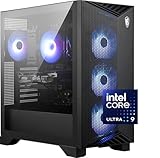
- Intel Core Ultra 9 285 Processor: Newly developed cores deliver ultra-smooth and responsive gameplay. AI accelerators prepare users for the next era of gaming on an AI PC.
- Simplistic Design: Enjoy the latest generation of Windows 11 Home for your everyday needs. *MSI recommends Windows 11 Pro for business use.
- NVIDIA GeForce RTX 5070 Ti GPU
- Cool While Gaming: In conjunction with an RGB CPU Air Cooler, the Aegis RS features four system cooling fans; three in the front and one in the rear to pull in cool air and push heat out of the PC.
- Turn on the Bright Lights: With the built-in RGB lighting, take your gaming experience to the next level by pressing the MSI LED button to cycle through lighting options. Customize lighting even further with MSI Center software.
NVIDIA’s open models and projects overview is a vendor example of publishing more than weights: it lists model families alongside weights, data, recipes, evaluation resources, and licenses, as well as tools for development, training, evaluation, inference, data preparation, and distributed serving. Those descriptions are NVIDIA’s own page statements, not an independent audit.
What’s actually slowing this PC down?
Pick the symptom - the matching free tool is one click away.
What are the practical benefits and costs?
Composability gives teams options
When components can be chosen independently, a team can experiment with models, inference providers, and workflow tools without committing to a single end-to-end product. Together AI argues this can make it easier to try new models as they appear. That flexibility is useful only when components can actually be integrated and replaced in the team’s environment.
Integration becomes your responsibility
Mozilla describes the open AI ecosystem as fragmented: models, evaluation, orchestration, guardrails, memory, and data pipelines are spread across projects with differing assumptions and interfaces. In its assessment, assembling a production-ready system can take expertise and time. “Open” therefore does not mean turnkey; teams may need to select, connect, secure, update, and evaluate components.
Compute is a constraint, not a requirement to own a GPU
Mozilla identifies access to specialized hardware as a bottleneck for training and deployment at scale, while pointing to approaches such as distributed, federated, sovereign-cloud, and idle-GPU computing. But using an open model does not require training it yourself or buying a rack of GPUs. Inference can be provided remotely, and Together AI explicitly notes that application developers need not train models or buy GPU hardware to use open models.
How should you evaluate an open stack?
There is no universal ranking of open stacks. Compare them against the task and the control you need, rather than assuming openness guarantees lower cost, greater speed, or better capability. The sources cited here do not establish a neutral, comparable benchmark proving that open stacks always outperform closed offerings on those measures.
- Rights and disclosure: Identify what is available—weights, code, training-data information—and what the terms permit.
- Interoperability: Check whether you can change the model, router, harness, and tools independently, and whether their interfaces work together.
- Control and deployment: Decide whether you need local or sovereign control, or whether a hosted inference service fits the use case.
- Operational effort: Establish who will handle serving, updates, security, evaluation, and integration.
- Workload fit: Compare capability, speed, and cost for your specific task instead of assuming that the largest model is the best choice.
What the phrase does—and does not—tell you
“Open stack” is useful when it describes a system whose layers can be examined and chosen with some independence. It is not a guarantee that every layer is open, compatible, easy to operate, or free of restrictions. Ask what is open at each layer, what rights apply, and whether the pieces meet your deployment needs.
Quick Recap
Product prices and availability are accurate as of the date/time indicated and are subject to change. Any price and availability information displayed on Amazon at the time of purchase will apply.

