
iTechGuides is reader-supported. When you buy through links on our site, we may earn an affiliate commission. As an Amazon Associate I earn from qualifying purchases. Learn more
A log timeline can make an event appear to happen before its cause without proving that either record is wrong. Logs from different systems may use clocks that disagree, distinguish event time from collection time, or include custom timestamps. A single list sorted by timestamp can therefore conflict with the actual sequence of events.
Why can logs appear to violate cause and effect?
A timestamp is a claim from a particular clock, not automatically a globally authoritative ordering key. Distributed computers can have clock skew, and that skew can affect absolute event times, causal ordering, elapsed-time calculations, and timestamp consistency. The U.S. Nuclear Regulatory Commission discusses these limits in NUREG/CR-6083.
Consider a hypothetical example: service A records sending a request at 12:00:00.400, while service B records receiving it at 12:00:00.100. If B’s clock is 500 milliseconds behind A’s, the timestamps show receipt first even though the request was sent first. Those figures illustrate how skew can reverse apparent order; they are not measurements from a real incident.
What’s actually slowing this PC down?
Pick the symptom - the matching free tool is one click away.
The title alone does not identify the failing clock, service, or timestamp field. “The timestamps conflict” is an observation; naming a host as fast or slow requires independent synchronization evidence or a defensible bound on clock error.
#1 Best Overall

- ✅【All-in-One Professional Kit with Sturdy Case】This premium network tool kit comes in a lightweight yet heavy-duty case that keeps all tools securely organized. Perfect for easy transport and storage, it’s your go-anywhere solution for home, office, server rooms, engineering projects, and network installations.
- ✅【Complete Tool Set for Pros & DIYers】Equipped with a high-performance Cat6A/Cat6/Cat5e/Cat5 pass-through crimper, wire tracker, 110/88 punch down tool, network stripper, wire cutter, 10 Cat6 pass-through connectors, and RJ45 boots. Everything you need for reliable and lasting connections.
- ✅【Versatile Ethernet Crimper with Tool-Free Adjustment】Master cable making with this multi-function crimping tool. Works with both pass-through and non-pass-through RJ45/RJ11/RJ12 connectors. Also strips, cuts, and crimps metal dovetail clips & terminals. The unique rotating knob allows quick adjustments—no screwdriver needed!
- ✅【Ergonomic 110/88 Punch Down Tool】Features a comfortable grip and interchangeable, reversible blades for 110 and 110/88 standards. Makes clean terminations in one smooth action—ideal for Cat6a, Cat6, Cat5e, and Cat5 cables.
- ✅【Smart Wire Tracker & Cable Tester】Quickly locate breaks and identify wires across connected devices like routers, switches, and PCs. Supports tracking of RJ11, RJ45, and other metal cables (with adapter). Tests network and telephone lines for opens, shorts, miswires, and reversed connections.
What is the difference between event time and ingestion time?
Event time is when the originating system says an event occurred. Observation time is when the collection system saw the log record. OpenTelemetry’s log data model calls these fields Timestamp and ObservedTimestamp, respectively; the first is measured by the origin clock and the second by the collection system. A source timestamp may be absent. See the OpenTelemetry Logs Data Model.
The difference between the two timestamps can reflect buffering or delivery delay, but it can also reflect clock disagreement. It should not be treated as a pure measurement of network delay unless the relevant clocks and collection path are understood.
Rank #2

- Ergonomic and User-Friendly: Designed with a focus on user comfort, this set of 5 cable separators features ergonomic handles which simplify the process of detangling cables. These tools fit comfortably in your hand, reducing strain and making network repairs more manageable without fuss.
- Enhanced Cable Protection: These tools are designed to prevent damage to your CAT5 and CAT6 cables during installation or maintenance. By ensuring that the cable integrity is not compromised, the tools facilitate reliable network setups and continuous, trouble-free internet connectivity.
- Compact and Convenient: The separators are not only but also compact, making it easy to store them in a toolbox or carry them around to various sites. Optimized for flexible use, they can be effortlessly transferred from job sites to home, perfectly fitting a range of environments.
- Efficiency for : Tackle large projects effortlessly with our cable untwist tools that are targeted at saving time and energy. perfect for networking and DIY enthusiasts alike, these tools enhance productivity and reduce the extraneous effort typically required in cable management tasks.
- Simplified Network Cable Management: With an emphasis on ease and efficiency, our tools allow for quick separation and orderly management of network cables. The design facilitates a straightforward untwisting motion, which accelerates setup times and ensures clutter-free, optimal organization of network lines.
What evidence can establish event order more reliably?
Keep three ideas separate: a producer’s claimed event time, the collector’s observation time, and the causal relationship inferred from local sequence or a message exchange. Sorting every record by wall-clock time collapses these different facts into one ordering.
Free tools Windows power users keep installed
One-click scans. No signup required.
- Local sequence: Records from the same process or host may show a useful local order, especially when sequence numbers or explicit send and receive records exist. This does not, by itself, establish cross-host wall-clock order.
- Message and request context: Message IDs, request IDs, and trace context can connect activity across services. OpenTelemetry describes how trace and span IDs and resource information support correlation, while noting that incomplete or separately collected context can make it fragile. See OpenTelemetry Logs.
- Known clock-error bounds: When independent evidence provides a bound on each clock’s error, timestamps can support more careful comparisons. Without such a bound, close cross-host timestamps may not establish which event occurred first.
Lamport-style logical timestamps are one approach to relating event order to physical time within an error bound, discussed in the NRC report. A logical ordering can help reason about causality, but it is not a replacement for the physical time at which an event occurred.
Rank #3
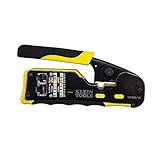
- EFFICIENT INSTALLATION: Modular crimp-connector tool with Pass-Thru RJ45 plugs for voice and data applications, streamlining installation process
- VERSATILE FUNCTIONALITY: Wire stripper, crimper, and cutter in one tool, designed for STP/UTP paired-conductor data cables
- PRECISE TRIMMING: Flush trimming to connector end face to prevent unintended contact between conductors, ensuring optimal performance
- COMPATIBLE CONNECTORS: Crimps and trims Klein Tools RJ45 Pass-Thru Connectors, providing reliable and secure connections
- WIDE COMPATIBILITY: Supports crimping of 4, 6, and 8 position modular connectors, including RJ11/RJ12 standard and RJ45 Klein Tools Pass-Thru
Can custom timestamps or leap seconds create confusing timelines?
Custom event timestamps
Instrumentation can assign a custom timestamp to a tracing event. OpenTelemetry’s tracing API permits this, and recorded event order will typically—but not necessarily—match timestamp order. A timestamp may also fall outside the containing span’s start and end times; consumers are expected to account for that possibility. Check whether an override was supplied before concluding that a host clock was wrong. See the OpenTelemetry Trace API.
Leap seconds and time-scale conversion
Time labels near a leap second need special care. NIST explains that some implementations repeat a civil-time label around the leap second, which can make ordering ambiguous if the records do not retain enough time-scale or offset context. See the NIST Internet Time Service.
Rank #4

- 【3 In 1 Wire Management】Our Pen-shaped network cable tool combines stripping, straightening, and organizing functions in one compact device, Perfectly for Cat5e, Cat6, and Cat7 cables, making it a must-have for IT technicians, telecom engineers.
- 【Efficient and Labor】Equipped with SK5 steel blade, the wire stripper delivers clean, accurate cuts without damaging internal wires. The elastic outer-skin stripping function, ensuring the network cable tool professional results for network setups and repairs, Saving time with a tool that replaces multiple gadgets in your toolkit.
- 【Ergonomic and Gentle】Designed for comfort and efficiency, the rotating handle reduces hand fatigue during prolonged use. The handle is made of ABS engineering plastic, and the blade holder is made of nylon plastic. It protects cable integrity while providing a firm grip. Ideal for intricate data center or home office cabling tasks.
- 【Compact and Portable】12mm long(4.9" L)and 18g lightweight, this Wire Straightener Network Cable Organizer fits effortlessly into pockets or toolkits. Its compact size ensures you quick cable fixing everywhere and anytime.
- 【Streamlined Cable Management】Tired of tangled wires? This Wire Stripping & Management Tool can quickly untwists and straightens twisted pairs, simplifying network maintenance. A smart solution for electricians and IT pros who demand neat, efficient cable setups in servers, routers, or telecom systems.
NTP and POSIX time representations also have leap-second-related differences when converted to UTC, including historical-offset caveats. If the records cluster around a leap second or passed through different time conversions, inspect those settings before treating a repeated or shifted label as ordinary clock skew. See the Network Time Foundation’s leap-second reference.
Quick Recap
Best Value

- Take command of your network with the Cable Matters Network Toolkit with Carrying Case; 7-in-1 Ethernet cable tool kit includes tools to build, test, and deploy an Ethernet network with custom Ethernet cables; Ethernet network tester and builder kit is ideal for IT professionals and DIYers alike
- Build the perfect Ethernet cables with the RJ45 Ethernet crimper kit; Ethernet crimping tool features a built-in cutter, stripper, and crimper in one; Cat6 crimping tool supports 8P8C/RJ-45, 6P6C/RJ-12, 6P4C/RJ11 network cables; The network cable crimping tool includes a 8-pack of Cat6 RJ45 modular plugs and boots; Get started immediately with an ethernet connector kit
- The toolkit also includes a punch down tool and punch down stand for simple crimping work; 110 block tool uses spring-action for fast, low-effort cable seating and termination with reversible cut/punch blade; Punch down tool kit stand provides a stable, level surface to work with in the field; Solid keystone jack palm tool supports RJ11 and RJ45 connectors while using a punch tool
- Test your network cables with the network cable tester; Network & cable testers ensure the correct pin connections in RJ11, RJ45, and ISDN cables; Ethernet tester verifies integrity of cable shielding for noise reduction; RJ45 tester features LED lights and an easy-to-use interface for verifying cable status quickly
- The network cable toolkit includes a durable carrying case for storage and transport; Network tools fit securely in the bag for easy access in the field; Access all networking tools quickly, including the punchdown tool, Ethernet crimping tool, Cat5 crimper kit, and Cat6 ends
How should you reconstruct a distributed log timeline?
- Preserve the originals. Save raw records and metadata before normalizing timestamps or sorting. Retain the host or service identity, timestamp field, time zone or offset, precision, observation time if available, trace or request identifiers, and collection route.
- Separate the clocks. Record which clock generated each source timestamp and which generated the collector’s observation timestamp. Note when a source timestamp is missing. Do not interpret the gap as network delay alone unless clock offsets are accounted for.
- Build local sequences first. Group records by source and use local ordering clues such as sequence numbers or explicit send and receive events. Then connect systems using message IDs, trace context, request IDs, and other shared identifiers.
- Inspect timestamp overrides. For tracing events, determine whether instrumentation supplied a custom time and whether it falls outside the containing span’s boundaries.
- Check synchronization and time handling. Review available time-sync state and adjustment records, UTC offsets, host reboots, virtualization pauses, and leap-second or time-scale configuration. These checks can identify plausible mechanisms, but a general possibility is not proof of what happened on a particular host.
- State only what the evidence supports. If clocks cannot be independently bounded, report that timestamps conflict or that the order is uncertain. Claim that a particular host was a specific amount fast or slow only when synchronization evidence supports that conclusion.
Product prices and availability are accurate as of the date/time indicated and are subject to change. Any price and availability information displayed on Amazon at the time of purchase will apply.

