
What’s actually slowing this PC down?
Pick the symptom - the matching free tool is one click away.
iTechGuides is reader-supported. When you buy through links on our site, we may earn an affiliate commission. As an Amazon Associate I earn from qualifying purchases. Learn more
A link checker should return unknown when it could not complete a meaningful inspection. It should report link not found only after identifying and fully inspecting the expected article body without finding the target. A timeout, access denial, login page, or failed body selector is not proof that a link is absent.
This distinction is a practical design recommendation, not a published standard or a measured validation study. Hoyeon’s DEV Community article describes an internal workflow and says it was generated by an AI agent without independent human editorial review. Read the source article on DEV Community.
What should the result mean?
A simple true-or-false result hides whether the checker actually saw enough of the page to answer its question. Separate the evidence gathered from the interpretation assigned to it:
| Result | When to use it | What it establishes |
|---|---|---|
| Verified at this time | The checker identified the expected article body and found the configured target link within it. | The target appeared in the inspected body during this check. It does not establish that a search engine indexed the link or that it has any particular value. |
| Link not found | The expected body was identified and fully inspected, but the target was absent. | A negative finding for that completed inspection—not a claim about what happened before or after it. |
| Unknown | The inspection was blocked or incomplete, such as by a timeout, access denial, login page, or failure to identify the body. | The checker could not determine whether the target was present. |
| Missing response observed | The server returned an HTTP 404 or 410 response. | The checker observed that response. Recheck before escalating; a repeated missing response may support a separate “removal suspected” state, but does not prove why the publisher removed the page or link. |
These are workflow categories, not universal HTTP status definitions. Keep the observed status separate from the checker’s interpretation. A successful HTTP response can still contain a login page rather than the article.
#1 Best Overall

- VERSATILE CABLE TESTING: Cable tester for data (RJ45) terminated cables and patch cords, ensuring comprehensive testing capabilities
- LARGE BACKLIT LCD: Backlit LCD display enables easy reading of pin-to-pin wiremap results, even in low-lit areas
- COMPREHENSIVE FAULT DETECTION: Test for Open, Short, Miswire, Split-Pair faults, Cross-over, and Shield, providing thorough fault detection
- INTUITIVE USER INTERFACE: User-friendly interface with three buttons and simple, easy-to-identify test responses, ensuring a smooth testing experience
- MULTIPLE TONE GENERATOR STYLES: Tone on a single wire, wire pair, or all 8 conductor wires using the multiple style tone generator (solid/warble); requires probe Cat. No. VDV500-123 (sold separately)
What evidence should a check retain?
A badge alone makes it difficult to distinguish a real negative finding from a failed attempt. Store enough detail to reconstruct what the checker observed and why it chose a result.
- The requested URL and the final URL after redirects.
- The check time, transport outcome, and HTTP status when available.
- Whether the expected article body was identified and whether any configured marker matched.
- Whether the expected destination was found, along with the reason for an unknown result.
Display the latest attempt alongside the last verified observation. That lets an operator see both what is currently uncertain and when the link was last confirmed.
Rank #2
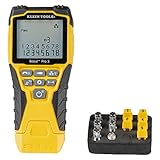
- VERSATILE CABLE TESTING: Cable tester tests voice (RJ11/12), data (RJ45), and video (coax F-connector) terminated cables, providing clear results for comprehensive testing on unenergized Ethernet cables (not designed to test PoE)
- EXTENDED CABLE LENGTH MEASUREMENT: Measure cable length up to 2000 feet (610 m), allowing for precise cable length determination
- COMPREHENSIVE FAULT DETECTION: Test for Open, Short, Miswire, or Split-Pair faults, ensuring thorough fault detection and identification
- BACKLIT LCD DISPLAY: Backlit LCD screen displays cable length, wiremap, cable ID, and test results, ensuring easy readability in various lighting conditions
- EFFICIENT CABLE TRACING: Trace cables, wire pairs, and individual conductor wires using the multiple style tone generator (requires analog probe Cat. No. VDV500-123, sold separately), simplifying cable tracing tasks
How should the checker match a link?
Inspect the article body, not the whole page
A page-wide search can find the same domain in navigation, comments, related links, or advertising. First identify the article body, then look for the expected destination there. If the body cannot be identified, the check is unknown rather than negative.
Recommended Free Tools
Compare resolved destinations
Parse link destinations and resolve relative URLs against the final page URL. Do not rely on substring matching: a URL that merely contains the expected text may point somewhere else, and a relative destination can resolve differently than it appears at a glance.
Rank #3

- Multifunctional NOYAFA NF-8508 Network Cable Tester: There are nine features to meet your needs. Continuity Testing, Cable Scan, Port Flash, Length Measurement, POE Power Supply Test, QC testing, Optical Power Meter, VFL and NVC function.It is perfectly suited for various engineering cabling projects, network troubleshooting, network equipment maintenance and testing scenarios. Its precise cable scanning and fault localization capabilities help you effortlessly pinpoint the root cause of issues.
- 7 WAVELENGTHS OPTICAL POWER METER: NF-8508 network cable tester can measure 7 standard wavelengths, 850/1300/1310/1490/1550/1625/1650, power detecting range(dBm): -70 ~ +10. Its power detection range spans from -70 dBm to +10 dBm, supporting FC/SC/ST connectors. It enables precise fiber optic power measurement, helping users efficiently assess fiber signal strength and ensure healthy fiber link operation. It effortlessly detects attenuation issues within fibers, thereby safeguarding fiber network stability.
- High Efficiency Visual Fault Locator: Easy identification of fiber breakpoints, poor connections, bending or cracking. Excellent for finding the right fiber to splice or quickly finding a break. Emmiting Energy: standard wavelenth: 650nm. Fast flashing, slow flashing, high precison.The built-in self-calibration ensures stable long-term performance, and Class IIIa laser (output<5mW) ensures safe daily operation.
- PORT FLASHING:The indicator light on the connection port in the NF-8508 device flashes to help accurately locate the cable. Displays port information, including operating speed, duplex mode, and negotiation settings. Port lights flash on the same screen to show the port's operating speed, making it easy to pinpoint lines and ports.
- PoE Testing and Cable Length Test: PoE testing can check cable mapping polarity and voltage of PoE network switches, withstand 60VDC. Automatically detects and switches between 10M/100M/1000M modes, Includes cable tracking, short circuit test, interruption of circuit test and etc The RJ45 cable tester can quickly measure the length of the cable with a range of 200m. Not only network cables, but also phone lines and BNC cables.
Choose URL equivalence rules deliberately
Decide for each target whether trailing slashes, query parameters, and fragments affect a match. Do not strip every query parameter by default; some parameters may be meaningful to the destination. If a publisher uses a redirect wrapper, record it for separate review instead of automatically treating the wrapper as a direct match.
What should happen when the result is uncertain?
Route unknown and link-not-found outcomes to review rather than letting them trigger automatic reposting. In particular, a failed fetch or an unrecognized page should not silently become evidence that a link was removed. Keep the last verified observation visible so reviewers can distinguish a new failure from a confirmed change.
Rank #4

- Automatically runs all tests and checks for continuity, open, shorted and crossed wire pairs. Visible LED status display.
- Cable state testing (2-wire): Line DC detecting, anode and cathode determination,Ringing signal detecting open, short and cross circuit testing
- Cable Type: RJ11 Telephone cable and RJ45 LAN cable
- Connectors: Ethernet Cat 5, Ethernet Cat 5e, Ethernet Cat 6, Ethernet Cat 7, RJ11 6P and RJ45 8P
- Power Source: DC9V Battery Required (not included)
For 404 or 410 responses, preserve the observed status and recheck before escalation. A repeated missing response can justify a “removal suspected” label, but it does not explain the publisher’s reason or prove that the response will persist.
Which cases should be tested before using a checker?
Use fixtures to challenge the checker beyond the happy path. These examples test classification logic; they do not demonstrate support for any live publisher’s current markup.
Best Value

- Multi-Function Network Cable Tester: Supports RJ45 (CAT5, CAT5e, CAT6, CAT6A, CAT7) and RJ11 telephone cables. Quickly detects continuity, short circuits, open wires, miswiring, and cable shielding status, ensuring your LAN or phone lines are correctly wired and ready to use.
- Fast/Slow Mode with LED Indicators: Switch between fast and slow scan speeds to identify wiring issues more precisely. LED lights on both master and remote units show wire order, making it easy to spot errors like open pairs or misaligned pins at a glance.
- Split-Type Design for Long-Distance Testing: Master and remote units can be detached and used separately, allowing you to test both ends of a long cable run, ideal for wall-mounted ports, long runs, or structured cabling. Perfect for home, office, or professional IT setups.
- Compact, Lightweight & Durable: Ergonomically designed with sturdy ABS housing, this pocket-sized tester is ideal for on-the-go network engineers, DIYers, and electricians. It’s your go-to toolkit for cable maintenance, upgrades, or new installations.
- Safe & Easy to Use: Simple one-button operation makes testing quick and hassle-free. LED indicators clearly show wiring status, while the G light instantly identifies shielded (FTP/STP) or unshielded (UTP) cables. Supports safe testing of telephone lines with typical voltages under 48-72V, ideal for both home and professional use.
- A login page returned with a successful HTTP response: classify as unknown if the article body was not inspected.
- The target appears in comments but not in the article: do not count it as a body match.
- A misleading relative URL: resolve it against the final page URL before comparing destinations.
- A JavaScript-rendered article body: if the checker cannot identify and inspect it, return unknown rather than link not found.
- A fully inspected article body without the target: classify as link not found.
- A missing response followed by a successful check: retain both observations instead of treating the first response as conclusive.
Keep fixture-test results separate from checks of live pages. The examples are illustrative test cases, not measured incident counts or evidence of a classifier’s real-world accuracy.
Quick Recap
Product prices and availability are accurate as of the date/time indicated and are subject to change. Any price and availability information displayed on Amazon at the time of purchase will apply.

