
What’s actually slowing this PC down?
Pick the symptom - the matching free tool is one click away.
iTechGuides is reader-supported. When you buy through links on our site, we may earn an affiliate commission. As an Amazon Associate I earn from qualifying purchases. Learn more
A version number is only a useful compatibility signal when a project defines its public contract and classifies changes against it. In Sergey Shinder’s account of an internal HTTP client, release automation treated a removed configuration key as a patch-level fix; services that accepted the update then failed at startup. SemVer specifies what major, minor, and patch increments mean, but it cannot make a project follow those rules or decide which consumer-visible behaviors belong in its API.
What changed in the version that broke services?
Shinder describes six services failing to start within about forty minutes of one another on a Wednesday morning. The services had not been deployed. Scheduled dependency updates had rebuilt them overnight and selected version 3.4.1 of an internal HTTP client library. That release had removed a configuration key after an earlier compatibility shim was dropped.


According to Shinder, the change was explained in the commit body, but release automation classified the change from the conventional commit prefix fix and produced a patch version. Consumers using caret version ranges accepted the new release automatically. The failure surfaced when containers read their configuration at startup; the tests and pipelines had remained green until then.
The Tool Desk
Outbyte PC Repair FREEClear out junk files and repair common Windows errorsFree Scan →Outbyte Driver Updater FREEScan for outdated or missing drivers - takes under a minuteDriver Scan →This is Shinder’s account of a particular incident, not an independently audited reliability study. It illustrates how a release label, automated dependency selection, and a gap in downstream checks can combine; it does not establish that a specific testing approach catches every compatibility break. Read Shinder’s account on DEV Community.
#1 Best Overall
What should major, minor, and patch versions promise?
Semantic Versioning 2.0.0 defines version increments in relation to a declared public API. Its specification says that software using SemVer must declare that API; a project needs to make clear what consumers can rely on. The standard’s rules are:
- Major: increment for backward-incompatible changes to the public API.
- Minor: increment for backward-compatible new public functionality.
- Patch: increment for backward-compatible bug fixes.
These rules do not automatically determine whether a configuration key is public. The project must define its contract. If consumers configure the library with a key, and the library’s behavior depends on it, a team should decide explicitly whether that key is part of the supported interface. In Shinder’s case, the team treated consumer-facing configuration as part of the contract and moved keys into a schema so they could be checked. See the Semantic Versioning 2.0.0 specification.
Rank #2
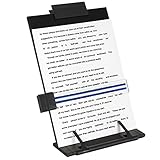
- Great for Body Health: The document holder is adjustable with 7 position at the backstand to adjust height and angle to make you easily reading without straining your back, shoulders or neck, then you can enjoy reading books while promoting a proper posture and even improve the spinal health.
- HIGH PRACTICAL: Design with Highlighting Line Guide makes you're easier to see where you left off and keep your track while typing, reading or transcribing. Comes with page holder clip to ensure documents do not slide. Help you work more efficiently.
- Really Sturdy & Stable: The bottom is designed with a page support clip to keep the book open on the page you need to read. The metal backplate, easily supports your documents. Very sturdy and can withstand multiple sizes of papers, recipes, books, magazines, textbooks and catalogs.
- Premium Material: The Book Stand is made of high-quality metal and ABS, with a polished and baked-on finish, it's durable, smooth, not easily broken, easy to clean and looks stylish, and has rounded corners to protect hands from injury or scratches.
- Foldable & Compact: 13.9" x 8.3" (35.5cm x 21cm). Fold quickly and store easily. Portable and lightweight, easy to carry to library, home, office and outdoor. Great gift for colleague, children, friend and family.
Why can a patch release break a service?
A patch number is a compatibility promise only if the project’s release process correctly recognizes breaking changes. Shinder’s incident had two weak signals: a commit prefix suggested a fix, and the release automation relied on that label rather than checking the actual published artifact against the prior one. A descriptive commit body did not prevent the release from being assigned a patch version.
Free tools Windows power users keep installed
One-click scans. No signup required.
There was also a downstream gap. Library tests and build pipelines passed, but the failure depended on consumer configuration being read at startup. Checks that compile or test the library alone may not exercise that integration path. The issue became visible only when the updated library ran inside affected services.
How did the team add compatibility checks?
Compare the candidate artifact with the published one
Shinder says the library pipeline compares a candidate release artifact with the currently published artifact. Its examples of breaking changes include removed public symbols, changed signatures, and removal of configuration keys declared in a schema. When the inferred version does not agree with the diff, the pipeline blocks the release for human review. This makes the artifact’s changes, rather than a commit label alone, part of the release decision.
Build and start representative consumers before publication
The account describes publishing candidates to a staging registry, building three representative consumer services against them, and running startup smoke tests before publishing to the production registry. Shinder reports that this process caught two potential configuration incidents in the following month. Those counts are anecdotal results reported by the author, not a general success rate or independent measurement.
Make dependency updates a conscious choice
The team’s approach, as described by Shinder, uses exact dependency versions and an update bot that opens a pull request for each bump. A person chooses when to merge an update rather than allowing a broad version range to select it automatically. This adds review and upgrade-management work, but it makes the timing of an upgrade deliberate.
Which safeguard addresses which failure point?
| Control | Failure point addressed | Trade-off |
|---|---|---|
| Compare release artifacts and review mismatches | Incorrect release classification based on a commit label | Requires compatibility rules and human review when the inferred version and diff disagree. |
| Test candidate releases with representative consumers | Integration failures that library-only checks may miss | Requires staging publication and consumer builds and startup checks. |
| Pin exact versions and review update pull requests | Automatic movement through broad version ranges | Gives people control over upgrade timing but adds dependency-update work. |
| Define the public API, including relevant configuration | Ambiguity about whether a consumer-visible change is breaking | Requires the project to document and maintain its contract. |
These measures are complementary: one improves release classification, another checks downstream behavior, and another controls when consumers accept an upgrade. None is presented as a guarantee against every compatibility problem. SemVer itself is a set of rules for projects that adopt it, not proof that a particular release followed them.
Quick Recap
How should you judge a dependency update?
- Check the project’s declared public API and whether it includes the configuration, commands, or other behaviors your application uses.
- Look beyond the version label when a release could affect consumer-facing behavior; a commit prefix is metadata, not a complete compatibility test.
- Assess whether checks exercise your integration path, including configuration loading and startup, rather than only building or testing the library in isolation.
- Understand whether your version range can accept updates without a person choosing the timing, and whether your team prefers that convenience or reviewed, deliberate upgrades.
Product prices and availability are accurate as of the date/time indicated and are subject to change. Any price and availability information displayed on Amazon at the time of purchase will apply.

