
iTechGuides is reader-supported. When you buy through links on our site, we may earn an affiliate commission. As an Amazon Associate I earn from qualifying purchases. Learn more
Hybrid cloud networking connects selected workloads and management systems across a datacenter, edge locations, and one or more clouds. A sound design starts by mapping traffic and address space, then chooses a path for each workload and makes routing, security, DNS, resilience, and operational ownership explicit. Microsoft uses “hybrid” for architectures combining cloud services with infrastructure and workloads in datacenters, edge locations, and other clouds (Microsoft Learn: Get started with Azure hybrid and adaptive cloud architecture).
What is hybrid cloud networking?
It is the network architecture and operating model that lets workloads and management planes in separate environments communicate when they need to. Those environments might include an on-premises datacenter, Azure, another cloud provider, or edge locations. The objective is not to connect everything indiscriminately: define which systems need to exchange traffic, which paths they should use, and which team owns each boundary.
That makes hybrid networking more than a choice between a VPN and a private circuit. Address allocation, route propagation, DNS, traffic inspection, redundancy, and monitoring all affect whether a connection is usable and supportable. The examples below draw primarily on Microsoft Azure guidance; other cloud providers have their own services and configuration details.
Do these 3 things before closing this tab:
1Clear out junk files and repair common Windows errors2Scan for outdated or missing drivers - takes under a minute3Repair Windows errors before they cause bigger problemsHow should you plan a hybrid network before connecting it?
Start with discovery, not with a gateway purchase or circuit order. Microsoft’s cross-cloud guidance begins by mapping the existing topology and traffic because connectivity choices depend on what must communicate and how it behaves (Microsoft Learn: Connectivity to other cloud providers; Microsoft Learn: Azure networking plan and design overview).
#1 Best Overall

- OneMesh Compatible Router - Form a seamless WiFi when work with TP-Link OneMesh WiFi Extenders
- Next-Gen Wi-Fi 6 Technology – The Archer AX10 leverages advanced Wi-Fi 6 features like OFDMA and 1024-QAM to deliver improved efficiency across your entire network. Perfect for high-bandwidth activities like streaming, gaming, and smart home connectivity.
- Next-gen Dual Band router - 300 Mbps on 2. 4 GHz (802. 11n) plus 1201 Mbps on 5 GHz (802. 11ax)
- Connect more devices than ever before - Wi-Fi 6 technology simultaneously communicates more data to more devices using OFDMA and MU-MIMO while reducing lag dramatically
- Powerful Dual-Core 900MHz Processor – Handles multiple data streams simultaneously for reliable performance across your devices. Ensures smooth streaming, online gaming, and video conferencing without buffering or lag.
- Inventory workloads and ownership. Record what runs in each datacenter, cloud, or edge location; which management planes need access; and which team operates each network, gateway, firewall, and DNS service.
- Map traffic flows. For each required flow, identify source, destination, direction, purpose, expected bandwidth, and sensitivity to latency or interruption. Include ingress, egress, and east-west traffic within each environment.
- Record network ranges and names. Document existing private CIDRs, routes, and DNS namespaces before assigning ranges to new networks. Include private service names and planned migration cutovers.
- Set requirements per workload. Decide how predictable the path must be, what throughput is needed, how quickly connectivity is required, and what failover behavior is acceptable.
- Assign operational responsibility. Identify who configures and monitors routes, tunnels, firewalls, DNS forwarding, and customer-side devices, including who responds when a cross-cloud flow fails.
How do you avoid overlapping IP addresses across clouds?
Plan private address space centrally before connecting networks. In Microsoft’s documented Azure VNet-to-other-cloud VPC scenario, private address ranges must not overlap anywhere in the connected topology; overlap can prevent the networks from connecting as intended. Microsoft recommends centralized IP address management for multi-cloud planning (Microsoft Learn: Connectivity to other cloud providers).
Include datacenter ranges, cloud virtual networks, remote sites, and any networks that may later be added to the same routed environment. Keep an allocation record and establish who approves new ranges. Where customer-managed BGP or an exchange provider is involved, document which routes are advertised, accepted, and owned by each side; otherwise route changes can create reachability problems that are difficult to diagnose across organizational boundaries.
Rank #2

- DUAL-BAND WIFI 6 ROUTER: Wi-Fi 6(802.11ax) technology achieves faster speeds, greater capacity and reduced network congestion compared to the previous gen. All WiFi routers require a separate modem. Dual-Band WiFi routers do not support the 6 GHz band.
- AX1800: Enjoy smoother and more stable streaming, gaming, downloading with 1.8 Gbps total bandwidth (up to 1200 Mbps on 5 GHz and up to 574 Mbps on 2.4 GHz). Performance varies by conditions, distance to devices, and obstacles such as walls.
- CONNECT MORE DEVICES: Wi-Fi 6 technology communicates more data to more devices simultaneously using revolutionary OFDMA technology
- EXTENSIVE COVERAGE: Achieve the strong, reliable WiFi coverage with Archer AX1800 as it focuses signal strength to your devices far away using Beamforming technology, 4 high-gain antennas and an advanced front-end module (FEM) chipset
- OUR CYBERSECURITY COMMITMENT: TP-Link is a signatory of the U.S. Cybersecurity and Infrastructure Security Agency’s (CISA) Secure-by-Design pledge. This device is designed, built, and maintained, with advanced security as a core requirement.
Should you use a VPN or a private connection?
Choose based on the traffic’s requirements and the team’s ability to operate the design. Microsoft describes three patterns for connectivity to other cloud providers. A private circuit can offer more predictable performance than an internet-based VPN, while a site-to-site IPsec VPN is an encrypted option when private connectivity is unavailable, uneconomic, or unnecessary. An exchange provider can carry more routing complexity and day-to-day operational overhead, but introduces a provider relationship and location dependencies (Microsoft Learn: Connectivity to other cloud providers).
| Pattern | Useful when | Main tradeoff |
|---|---|---|
| Private circuit with customer-managed routing | The team needs detailed BGP control and performance engineering and has network expertise. | The team takes on more routing and troubleshooting responsibility. Microsoft describes this pattern as providing control over BGP decisions and traffic engineering. |
| Private circuit through a cloud exchange | The team wants private connectivity and prefers the exchange provider to carry more routing complexity and operational overhead. | Provider locations and availability must fit the design, and the arrangement adds a provider relationship. |
| Site-to-site IPsec VPN | A private circuit is unavailable, uneconomic, or not technically required, or an encrypted connection is needed quickly. | Internet-path performance can mean lower throughput and more variable latency than private connectivity. |
For Azure specifically, Microsoft’s 2025 cross-cloud guidance says ExpressRoute provider circuits commonly offer 50 Mbps–10 Gbps and lists ExpressRoute Direct port speeds of 10 Gbps and 100 Gbps. These are stated Azure offering capabilities, not general limits for hybrid networks; verify provider, region, and SKU details in current documentation before procurement (Microsoft Learn: Connectivity to other cloud providers).
Rank #3

- Next-Gen Gigabit Wi-Fi 6 Speeds: 2402 Mbps on 5 GHz and 574 Mbps on 2.4 GHz bands ensure smoother streaming and faster downloads; support VPN server and VPN client¹
- A More Responsive Experience: Enjoy smooth gaming, video streaming, and live feeds simultaneously. OFDMA makes your Wi-Fi stronger by allowing multiple clients to share one band at the same time, cutting latency and jitter.²
- Expanded Wi-Fi Coverage: 4 high-gain external antennas and Beamforming technology combine to extend strong, reliable, Wi-Fi throughout your home.
- Improved Battery Life: Target Wake Time helps your devices to communicate efficiently while consuming less power.
- Improved Cooling Design: No heat ups, no throttles. A larger heat sink and redefined case design cools the WiFi 6 system and enables your network to stay at top speeds in more versatile environments.
Do not select one connection type for every flow by default. Compare each workload’s measured bandwidth and latency needs with performance variability, availability, provisioning time, cost, routing control, and the operating effort your team can sustain. Microsoft notes that a VPN is often the quickest option when private circuits are not already available; the guidance does not establish a universal price or performance guarantee.
How do you secure a hybrid cloud network?
Build controls around the traffic that discovery identified. Segment workloads, restrict ingress, egress, and east-west flows at appropriate network boundaries, and inspect traffic with firewalls or other suitable controls. Keep workloads private where practical and use private endpoints for supported platform services when they fit the design.
Rank #4

- NIGHTHAWK WIFI 6 ROUTER FOR YOUR WHOLE HOME: Delivers fast, reliable WiFi across every room of your apartment or small home for streaming, gaming, video calls, and smart home devices, all running at the same time without slowing each other down.
- WORKS WITH YOUR EXISTING INTERNET SERVICE: Pairs with your existing modem or gateway via ethernet. Compatible with most cable, fiber, DSL, and satellite providers. Some gateways and modem router combos may require bridge mode. No coax needed.
- SET UP AND MANAGE YOUR NETWORK WITH THE NIGHTHAWK APP: Download the free Nighthawk app on iOS or Android for guided setup. Manage WiFi, run speed tests, pause devices, and set up guest networks from anywhere. Active internet required.
- READY FOR THE DEVICES YOU ALREADY OWN: Your phones, laptops, and TVs work right out of the box. WiFi 6 delivers speeds up to 1.8 Gbps across 2.4 GHz and 5 GHz bands. Backward compatible with WiFi 5 and earlier.
- COVERAGE IN EVERY ROOM: Covers up to 1,500 sq. ft. for up to 20 connected devices. Walls, floors, and interference can reduce range. Larger or multi-story homes may benefit from a NETGEAR Orbi mesh WiFi system.
For Azure, Network Security Groups provide layer 3 and layer 4 controls applied at a subnet or network interface. Their rules need deliberate scoping; this is an Azure-specific implementation example, not a description of how every cloud implements network controls (Microsoft Learn: Architecture strategies for networking and connectivity).
- Allow only the source, destination, protocol, and direction required for a documented flow.
- Apply segmentation at suitable boundaries on both sides of the connection rather than treating the tunnel or circuit itself as a security policy.
- Include management traffic and private service access in the security design, not just application traffic.
- Define who reviews rule changes and how traffic is inspected at each boundary.
How should DNS work across hybrid environments?
Specify how each environment resolves names hosted in the others. Decide which environment is authoritative for each namespace, what forwarding is required, and how private service names resolve during migration and steady state. Test both directions where applications in each environment need to locate services in the other.
Best Value
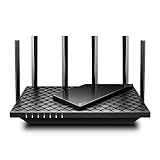
- 𝐆𝐢𝐠𝐚𝐛𝐢𝐭 𝐖𝐢𝐅𝐢 𝐟𝐨𝐫 𝟖𝐊 𝐒𝐭𝐫𝐞𝐚𝐦𝐢𝐧𝐠 – Up to 5400 Mbps WiFi for faster browsing, streaming, gaming and downloading, all at the same time. Performance varies by conditions, distance to devices, & obstacles such as walls.
- 𝐅𝐮𝐥𝐥 𝐅𝐞𝐚𝐭𝐮𝐫𝐞𝐝 𝐖𝐢𝐅𝐢 𝟔 𝐑𝐨𝐮𝐭𝐞𝐫 – Equipped with 4T4R and HE160 technologies on the 5 GHz band to enable max 4.8 Gbps ultra-fast connections.Power:12 V 2.5 A
- 𝐂𝐨𝐧𝐧𝐞𝐜𝐭 𝐌𝐨𝐫𝐞 𝐃𝐞𝐯𝐢𝐜𝐞𝐬 – Supports MU-MIMO and OFDMA to reduce congestion and 4X the average throughput
- 𝐄𝐱𝐭𝐞𝐧𝐬𝐢𝐯𝐞 𝐂𝐨𝐯𝐞𝐫𝐚𝐠𝐞 - Covers up to 2,000 sq. ft. High-Power FEM, 6× Antennas, Beamforming, and 4T4R structures combine to adapt WiFi coverage to perfectly fit your home and concentrate signal strength towards your devices.
- 𝐌𝐨𝐫𝐞 𝐕𝐞𝐧𝐭𝐬, 𝐋𝐞𝐬𝐬 𝐇𝐞𝐚𝐭 – Improved vented areas help unleash the full power of the router
Cross-cloud DNS can require additional forwarding configuration and operational cost, according to Microsoft’s connectivity guidance. Treat forwarding rules and ownership as part of the network plan: a working route does not by itself ensure that clients can resolve the destination’s name (Microsoft Learn: Connectivity to other cloud providers; Microsoft Learn: Azure networking plan and design overview).
How do you make hybrid connectivity resilient?
Plan for the complete path, not just the cloud-side gateway. Microsoft’s Azure Architecture Center states: “Reliability for hybrid connectivity depends on the resiliency of both the Azure-side gateway or circuit and the on-premises and network paths that connect to it.” Redundancy on one side cannot compensate for a single point of failure on the other (Microsoft Learn: Connect an on-premises network to Azure).
- Use zone-redundant gateway SKUs where supported.
- Consider active-active Azure VPN gateways for higher resilience and aggregate throughput.
- Use two on-premises VPN devices when the design needs to remove a local device as a single point of failure.
- Consider a site-to-site VPN as a failover path for ExpressRoute, with routing preference configured to avoid asymmetric routing.
These are Azure-specific design recommendations. Customer-managed edge routers, VPN devices, and non-Microsoft network virtual appliances remain the customer’s responsibility for patching and failover; Microsoft service SLAs do not cover those customer-managed components.
What should you monitor and who should own it?
Monitor tunnel uptime, latency, and throughput, and establish which team investigates each metric and each side of a boundary. A failure may involve cloud routing, an on-premises device, a provider path, DNS forwarding, or a security rule; troubleshooting is harder when different teams or providers own those pieces. Microsoft’s planning guidance emphasizes mapping topology and traffic, while its cross-cloud guidance highlights the operational complexity of connectivity between environments (Microsoft Learn: Azure networking plan and design overview; Microsoft Learn: Connectivity to other cloud providers).
For a customer-managed VPN edge, assess support for the required VPN/IPsec configuration, throughput under encryption, BGP needs, dual-device failover, support lifecycle, and compatibility with the cloud gateway. Validate those requirements against the actual design; not every hybrid deployment requires physical VPN hardware.
Quick Recap
Hybrid cloud networking design checklist
- Workloads, required flows, and management-plane access are inventoried.
- Private address ranges do not overlap across the connected topology.
- Each flow has an appropriate path based on its performance and availability needs.
- Route ownership and propagation are documented.
- Segmentation, traffic inspection, and scoped access rules are defined at relevant boundaries.
- DNS authority and forwarding are planned for migration and steady state.
- Redundancy accounts for cloud gateways, circuits, on-premises devices, and network paths.
- Teams know who monitors uptime, latency, and throughput and who owns each failure domain.
Product prices and availability are accurate as of the date/time indicated and are subject to change. Any price and availability information displayed on Amazon at the time of purchase will apply.

