
iTechGuides is reader-supported. When you buy through links on our site, we may earn an affiliate commission. As an Amazon Associate I earn from qualifying purchases. Learn more
To run a large language model on hardware you control, first choose a task and a model that fits your available memory, then select a local app or inference server that supports your operating system and hardware. For a first experiment, a desktop chat app is usually simpler than configuring an API server. You do not need an NVIDIA GPU to run models locally, but the hardware, model format, quantization, context length and runtime determine what will work—and how quickly.
What should you decide before choosing software?
Start with the work you want the model to do: interactive chat, drafting, summarization, question answering over your material, or an API for an application. A model that is adequate for short chat may be a poor fit for a long-context task or a server handling several requests.
Then check the hardware you already have. Note its operating system, GPU type and available graphics memory (VRAM), or, on a system with shared memory, how much memory is available to the model. Also consider whether you need a graphical app, a command-line workflow or an API. NVIDIA’s local-AI guidance identifies operating system, model format, GPU architecture and memory, API requirements, and throughput target as factors in choosing a backend.
Free tools Windows power users keep installed
One-click scans. No signup required.
- Model size and capability: Parameter count is a rough indicator, not a fit guarantee or a speed prediction.
- Memory: The model’s weights need room, but runtime overhead and the context also use memory.
- Context length: The context is the material the model can consider, including the prompt, conversation history, tool output and retrieved content. A longer context generally requires more memory.
- Quantization: A quantized model stores weights in a more compact representation, reducing memory needs. More aggressive quantization can reduce output quality.
- Throughput: Tokens per second can help describe generation speed, but prompt processing and the feel of an interactive task matter too.
Before purchasing hardware, verify that the particular model format and runtime support it. Software and model compatibility change; the recommendations below reflect NVIDIA’s guide accessed October 7, 2026, not a promise that every listed combination works in every app.
#1 Best Overall

- Unlock next-generation AI computing with AMD Ryzen AI Max+ 395 processor featuring 16 cores, 32 threads, up to 5.1GHz boost clock, and integrated Ryzen AI engine delivering up to 126 TOPS AI performance. EVO-X3 is designed for local AI models, content creation, development, and professional workloads.
- OCuLink External GPU Expansion – Upgrade Beyond a Mini PC: Take your graphics performance further with a dedicated OCuLink (PCIe 4.0 x4) interface. Connect an external GPU dock to add desktop-class graphics power for AAA gaming, AI acceleration, 3D rendering, video production, and advanced creative applications. EVO-X3 gives you the flexibility of a compact PC with workstation-level expansion capability.
- AI NPU with XDNA 2 ARCHITECTURE - Powered by 16 “Zen 5” CPU cores, 50+ peak AI TOPS XDNA 2 NPU and a truly massive integrated GPU driven by 40 AMD RDNA 3.5 CUs, the Ryzen AI MAX+ 395 is a transformative upgrade and delivers a significant performance boost over the competition. The Ryzen AI Max+ 395 excels in consumer AI workloads like the llama.cpp-powered application: LM Studio. Shaping up to be the must-have app for client LLM workloads, LM Studio allows users to locally run the latest language model without any technical knowledge required and unleash their creativity and productivity.
- AMD RADEON 8090S iGPU GAMING PC - The AMD Radeon RX 8060S offers all 40 CUs with up to 2.9 GHz graphics clock and uses the new RDNA 3.5 architecture. The powerful iGPU is positioned between an RTX 4060 and 4070 laptop GPU and therefore enables gaming in FHD at maximum details in most demanding games. The 8060S can also utilize the full 128GB pool, which is perfect for running LLMs such as Deepseek 70B Q8, which runs comfortably on this machine.
- EIGHT CHANNEL LPDDR5X - LPDDR5X is a new ground breaking memory small form factor installed on-board. With blazing speeds up to to 8000MT/s, it runs 1.5x faster than the DDR5 SODIMMs; 90% better performance over DDR5 SODIMMs in video conferencing and photo editing; 30% better performance in productivity apps; 12% better performance in digital content workloads.
What model can your hardware handle?
NVIDIA RTX starting points
NVIDIA’s RTX guide offers the following starting-model suggestions by GPU memory. Treat them as vendor recommendations for its ecosystem, not hard minimums or guarantees: quantization, context length, runtime overhead and the specific model build affect fit.
| RTX GPU memory | NVIDIA guide’s suggested starting model | How to interpret it |
|---|---|---|
| 6–8 GB | Qwen 3.5 4B | A starting point for a smaller model; confirm the selected quantization and context in your chosen runtime. |
| 12–16 GB | Qwen 3.5 9B or Gemma 4 12B | Two vendor-suggested options, not a claim that either will fit every configuration. |
| 24 GB or more | Qwen 3.6 27B | A starting suggestion for this memory tier; workload and runtime still matter. |
| DGX Spark | Qwen 3.6 35B | NVIDIA lists this separately for DGX Spark; it is not a general recommendation for 24 GB consumer GPUs. |
NVIDIA describes NVFP4 or Q4_K_M as a good balance of throughput, accuracy and memory for its RTX guidance. That is NVIDIA’s recommendation, not an independent benchmark or a guarantee for every model. If a model nearly fits, a shorter context or a smaller model may be a more useful tradeoff than pushing quantization aggressively.
NIM memory figures are specific to NIM
NVIDIA NIM 1.7.0 gives rough example memory estimates. These are NIM-specific guidelines; they are not universal minimums for consumer systems or quantized deployments in other runtimes. NVIDIA says actual estimates can vary and do not apply to trtllm_buildable profiles.
Rank #2

- 【High-Performance APU】The MS-S1 MAX features an AMD Ryzen AI Max+ 395 APU, integrating a Zen 5 architecture CPU (up to 5.1GHz, 16C/32T, 64M L3 Cache), an RDNA 3.5 GPU, and an NPU (50 TOPS). The total system output is 126 TOPS. It provides powerful parallel computing capabilities for demanding AI workflows. It is ideal for running local LLMs, multimodal models, and computationally intensive tasks
- 【128GB UMA Memory】Equipped with up to 128GB of LPDDR5x-8000MT/s unified memory, it enables the CPU and GPU to access a shared, high-bandwidth memory pool with extremely low latency. Ideal for large-scale AI inference, 3D workloads, and complex timelines in video editing. It eliminates traditional VRAM bottlenecks, ensuring smoother data transfer during high-intensity computations. The UMA design maximizes performance stability under high loads
- 【Flexible Expansion】The MS-S1 MAX features USB4 V2 (up to 80Gbps), dual 10GbE LAN, HDMI 2.1 (up to 8K60), a full-length PCIe x16 expansion slot, and dual M.2 slots supporting up to 16TB RAID 0/1. Wi-Fi 7 provides stronger signal coverage and a more stable wireless experience. The slide-out design facilitates upgrades and maintenance. It easily adapts to personal, studio, or rack-mount enterprise environments
- 【High-Efficiency Cooling System】Utilizing an aerospace-grade aluminum alloy chassis, copper base plate, six heat pipes, dual turbine fans, and advanced PCM thermal conductive material, it maintains stable cooling performance even under continuous load. This system supports 130W continuous power and 160W peak power operation, with a built-in 320W power supply. It boasts multiple global certifications including CCC, FCC, UL, CE, and UKCA, ensuring stable and reliable operation in various environments
- 【Cluster Design】Two MS-S1 MAX units can be configured as a dual-unit cluster to run a large 235B Q4 model locally, achieving an output speed of 10.87 tok/s. Supporting 2U rack deployment, multiple MS-S1 MAX units can be cascaded into a distributed cluster to create a high-efficiency AI computing center. A cluster of four MS-S1 MAX units successfully ran a DeepSeek-R1 671B Q4 large model. A reserved cluster power-on interface allows for unified start-up and shutdown
| Model in NIM 1.7.0 guidance | Rough memory estimate |
|---|---|
| Llama 8B | About 15 GB |
| Llama 70B | About 131 GB |
| Mistral 7B Instruct v0.3 | About 14 GB |
| Mixtral 8x7B Instruct v0.1 | About 88 GB |
Do not compare these estimates directly with a different runtime’s quantized model and treat the difference as a contradiction: the packaging, precision and deployment profile may differ.
Which local inference route fits your use?
| Route | Best suited to | Tradeoff to consider |
|---|---|---|
| Desktop chat app | Trying local chat, drafting, rewriting, summarization or Q&A with minimal setup. | Convenience comes with less control than configuring a serving engine; check its model formats and hardware support. |
| llama.cpp command line or API | Running a model directly, experimenting with hardware backends, or launching an OpenAI-compatible API server. | Offers broad hardware and quantization options, but requires more hands-on setup than a typical chat app. |
| vLLM serving | More configurable model serving, particularly for users comfortable with Linux and server setup. | NVIDIA’s RTX guide points advanced users to vLLM and says it requires Linux. Its CPU documentation also provides a Docker CPU-serving route. |
| NVIDIA NIM | A separately packaged NVIDIA deployment path with defined prerequisites. | It is not interchangeable with a lightweight desktop runner; NIM 1.7.0 has product-specific system and licensing requirements. |
For the simplest first chat
NVIDIA lists LM Studio, Ollama and llama.cpp as straightforward ways to get a chat workflow going: install an app, choose a model that fits, then try a real task. NVIDIA’s advice is, “The easiest way to get started is to choose a model that fits your GPU, then choose the app that matches what you want to do.” That is useful vendor guidance, but it is framed for its RTX audience.
Keep the first test small and representative. Try the prompt length and task you actually expect to use, then see whether the model fits and responds at an acceptable pace. A short prompt that works does not prove a long document or extended conversation will fit.
Rank #3

- 【OpenClaw & Local LLM Preinstalled】Model number: SER, Brand: Beelink, Manufacturer: Shenzhen AZW Technology Co., Ltd., Beelink AI Mini PC skips the complicated setup and ready to use right out of the box. Compared with cloud APl costs, running OpenClaw locally on the SER10 Max with the Radeon 890M iGPU enables truly zero-cost usage while ensuring full data privacy and security, ideal for scenarios that require frequent Al usage
- 【Next-Gen Ryzen AI 9 HX 470 Performance】Experience the pinnacle of Zen 5 architecture. With 12 cores, 24 threads, and the groundbreaking AMD XDNA 2 NPU delivering 86 AI TOPS, the SER10 MAX is built for the future of AI computing, seamless multitasking, and pro-level content creation
- 【Elite Radeon 890M Graphics & Triple 4K Display】Equipped with the powerful integrated Radeon 890M GPU, this Mini PC handles AAA gaming and 4K video editing with ease. Expand your workspace across three screens via HDMI 2.1, DisplayPort 2.1, and a full-featured USB4 (40Gbps) port for ultimate productivity
- 【Ultra-Fast 10Gbps Ethernet & Connectivity】Break the networking bottleneck with a 10Gbps LAN port, offering 4x the speed of standard 2.5G setups. Perfect for NAS users, large file transfers, and lag-free online gaming. Includes USB4 for high-speed data and power delivery
- 【Massive Expandability: Up to 96GB RAM & 8TB SSD】Beelink SER10 Max comes with 32GB DDR5 5600MHz RAM. Storage is equally flexible with dual M.2 2280 PCIe 4.0 SSD slots, supporting a massive 8TB internal capacity (4TB per slot) to house all your games, projects, and media
For a command line or local API
llama.cpp’s quick start documents downloading and running a model, as well as starting an OpenAI-compatible API server. It supports a broad set of hardware backends and quantization options. Choose this route if you want direct control or need another program to send requests to a local model; allow time to configure the model file and backend rather than expecting a one-click chat experience.
For configurable serving
vLLM and llama.cpp are options NVIDIA identifies for advanced RTX and DGX users. The Linux requirement in NVIDIA’s RTX guide applies to its vLLM recommendation; check the current installation documentation for the exact route and platform you intend to use. vLLM’s CPU documentation includes Docker instructions, while its Apple Silicon CPU support is described as experimental. Its Metal GPU path is provided through a community-maintained plugin, so do not assume that it has the same support status as a documented core backend.
For NVIDIA NIM
NIM is a separate deployment product, not just another name for running a downloaded model in a desktop app. The NVIDIA NIM 1.7.0 getting-started documentation specifies Linux, a compatible NVIDIA driver, Docker, CUDA and an NVIDIA AI Enterprise license for self-hosting. Check the terms and prerequisites for the exact version you plan to deploy; these NIM requirements do not apply to all local-model software.
Rank #4
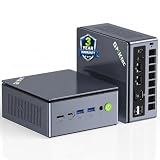
- PREMIUM GAMING PC MINI COMPUTER - The Nucbox M7 Ultra Mini PC is a small form factor Desktop Micro Mini Computer with an AMD Ryzen 7 PRO 6850U (8C/16T 2.70Ghz Base speed with Turbo speed up to 4.7Ghz) processor. The GPU is integrated with a powerful AMD Radeon 680M 12 Cores Graphics Card; performance is almost close to that of a full NVIDIA GTX 1050 Ti. Coupled with the support of FSR 3.0+ technology, the computer can handle heavy computing tasks and AAA gaming
- MINI PC COMPUTER SUPPORTS QUAD SCREEN 8K DISPLAY - Nucbox M7 Ultra gaming pc is equipped with Dual USB4 USB-C Video output. The latest HDMI 2.1 port can connect to large screen TV and Display Monitors and output up to 8K@60Hz resolution. The Type-C DisplayPort Video output can connect to the latest monitor displays utilizing 4K@144Hz. Features simultaneous four screen display
- OCULINK PORT - The M7 Ultra Oculink port enables higher bandwidth capabilities, better frame rates and lower lag. The standard also operates at PCIe x4 speeds, compared to Thunderbolt's x3. Gamers and content creators can benefit from OCuLink's higher bandwidth, resulting in better performance and lower lag for eGPU setups
- UPGRADED DUAL COOLING FANS - Our new Hyper Ice Chamber 2.0 design uses larger top and bottom cooling fans with 360 degrees in and out air flow. The copper base keeps the fan cool and we have lowered the fan noise down to 35dB in Quiet mode
- THREE PERFORMANCE MODES UPDATED UEFI - The M7 Ultra mini computer features an all new BIOS update with three performance modes (Quiet 35W, Balance 50W, or Performance 65W-70W). VRAM Allocation is also possible with Auto Power On, Wake-on-LAN options available
Can you run models without an NVIDIA GPU?
Yes. llama.cpp documents backends for Apple Silicon using ARM NEON, Accelerate and Metal; NVIDIA GPUs using CUDA; AMD GPUs using HIP; and other systems using backends including Vulkan and SYCL. It also supports CPU/GPU hybrid inference, where some computation can be offloaded even if the whole model does not fit in VRAM. Hybrid execution may let you try a larger model, but it does not mean performance will match a model that stays entirely in GPU memory.
Apple Silicon
llama.cpp lists Apple Silicon as a first-class target. Separately, an Ollama post published March 30, 2026 described an Apple Silicon implementation preview using MLX and recommended more than 32 GB of unified memory for its showcased Qwen3.5-35B-A3B setup. The post’s test was conducted March 29, 2026 with that model and specified quantization configurations; its performance results should not be generalized to other models, quantizations or Macs. The preview is not evidence that every Ollama model or workflow uses that implementation.
CPU-only systems
CPU inference is another option, including through vLLM’s documented Docker CPU-serving route. Whether it is practical depends on the model and workload; the available sources do not establish a universal speed or memory threshold. If you need responsive interactive use, test your actual prompt and model rather than assuming a CPU route will feel like GPU inference.
Best Value

- SIZE DOWN. POWER UP — The far mightier, way tinier Mac mini desktop computer is five by five inches of pure power. Built for Apple Intelligence.* Redesigned around Apple silicon to unleash the full speed and capabilities of the spectacular M4 chip. With ports at your convenience, on the front and back.
- LOOKS SMALL. LIVES LARGE — At just five by five inches, Mac mini is designed to fit perfectly next to a monitor and is easy to place just about anywhere.
- CONVENIENT CONNECTIONS — Get connected with Thunderbolt, HDMI, and Gigabit Ethernet ports on the back and, for the first time, front-facing USB-C ports and a headphone jack.
- SUPERCHARGED BY M4 — The powerful M4 chip delivers spectacular performance so everything feels snappy and fluid.
- BUILT FOR APPLE INTELLIGENCE — Apple Intelligence is the personal intelligence system that helps you write, express yourself, and get things done effortlessly. With groundbreaking privacy protections, it gives you peace of mind that no one else can access your data — not even Apple.*
How do you get started without overbuilding?
- Pick one task. Decide whether you want chat, document summarization, question answering or an API. This determines what to test and whether a desktop app or server is appropriate.
- Inventory the machine. Record the operating system, GPU/backend, available VRAM or unified memory, and whether CPU-only or hybrid execution is acceptable.
- Select a model and format that the runtime supports. Use the memory tier guidance as a starting point, then check current compatibility for the exact model build, quantization and context you intend to use.
- Choose the simplest suitable runtime. Start with a desktop app for manual experimentation; use llama.cpp for command-line control or a local API; consider vLLM or NIM when their serving and deployment characteristics match your requirements.
- Test a representative workload. Include the context length, files or retrieved material, and response style you expect. Watch for memory limits and measure response speed on the machine itself.
- Adjust one constraint at a time. If the workload does not fit, try a smaller model, a shorter context or a less demanding configuration. If it fits but is too slow, compare a different backend or hardware path rather than relying on parameter count alone.
- Check operational details before exposing an API. Confirm what address and network the server listens on, who can reach it, and whether connected tools or integrations send data elsewhere.
What does “self-hosted” mean for privacy and security?
When inference and the workflow are genuinely local, prompts, files and local context can stay on the device; NVIDIA describes that possibility for local workflows. But “local” does not establish the data path of every feature. A web lookup, connected agent, telemetry setting, cloud integration or exposed API can change what leaves the machine or who can send requests to it.
- Review the app’s settings and documentation for web access, connected tools, telemetry and cloud features.
- Keep a local API bound to a trusted interface and restrict network access unless remote access is deliberately configured.
- Check the model’s license separately from the runtime’s terms, especially before using a model commercially or redistributing it.
- For packaged deployment products such as NIM, verify the version-specific license and infrastructure requirements.
How should you compare options on your own machine?
There is no universal winner among a desktop runner, a server engine, a GPU backend and a CPU route. The source material here does not provide a matched cross-platform test of current throughput, prices or energy use. Make a small comparison using the same model, quantization, context length and task on the hardware you might actually use.
- Memory fit: Include weights, context and runtime overhead, not just parameter count.
- Compatibility: Check operating system, model format, GPU architecture and backend, plus CPU or hybrid fallback behavior.
- Use pattern: A single-user interactive chat and a concurrent API service have different operational needs.
- Control: A desktop app reduces setup friction; direct server configuration offers more control but adds deployment work.
- Licensing and maintenance: Check both model and runtime terms, then account for drivers, containers and product-specific prerequisites.
- Measured performance: Compare prompt processing and generation speed on your actual workload. Vendor tests, including Ollama’s March 2026 test, apply to their stated model and configuration rather than all systems.
If you are considering new hardware, choose it only after defining the model and workload. An RTX card with sufficient VRAM is one possible route, but the appropriate memory capacity depends on that choice; no particular card or price is established here. Apple Silicon is another category for readers who prefer macOS and unified memory, but there is no supported SKU or price comparison to recommend one model over another.
Do these 3 things before closing this tab:
1Clear out junk files and repair common Windows errors2Scan for outdated or missing drivers - takes under a minute3Repair Windows errors before they cause bigger problemsQuick Recap
Product prices and availability are accurate as of the date/time indicated and are subject to change. Any price and availability information displayed on Amazon at the time of purchase will apply.

