
Recommended Free Tools
iTechGuides is reader-supported. When you buy through links on our site, we may earn an affiliate commission. As an Amazon Associate I earn from qualifying purchases. Learn more
A Z-Wave bridge is the controller that connects a smart-home app or automation platform to devices on a Z-Wave network. It may be a stand-alone hub, gateway, alarm panel, or computer-connected controller; the label “bridge” alone does not identify one standardized product or guarantee compatibility with a particular app or device.
What a Z-Wave bridge does
The Z-Wave Alliance uses “hub,” “gateway,” and “controller” for hardware that provides Z-Wave functionality and controls commands. In everyday use, “Z-Wave bridge” usually describes that controller role: it receives instructions from a control app or platform and communicates them to Z-Wave devices.
| # | Preview | Product | Price | |
|---|---|---|---|---|
| 1 |
|
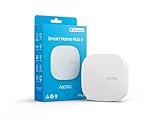
Aeotec Smart Home Hub2 - V4, Works as a SmartThings Hub, Zigbee, Matter Gateway, Compatible with... | $129.99 | Buy on Amazon |
| 2 |

|
Hubitat Elevation C-8 Pro Smart Home Hub - Z-Wave Zigbee Matter | $194.95 | Buy on Amazon |
The controller may be a separate smart-home hub or part of another product, such as an alarm panel. A computer controller interface is another form, but it depends on compatible software and is not automatically a complete, ready-to-use hub. The Alliance catalog distinguishes gateway controllers from computer controller interfaces (Z-Wave Alliance Product Catalog).
How commands travel through a Z-Wave network
- You issue a command: In the Alliance’s example, you use a phone, tablet, or computer to tell the system to lock a door.
- The controller routes it: The hub passes the command into the Z-Wave network, which can relay it through network devices to the target lock.
- The device responds: The lock carries its status back through the network to the hub, and the app can show confirmation.
Z-Wave is a wireless radio-frequency technology designed for control, monitoring, and status reading in residential and light commercial settings. It supports mesh networks and operates below 1 GHz; its PHY and MAC layers are defined by ITU-T Recommendation G.9959, according to the Z-Wave Alliance technology overview. The bridge is not a Wi-Fi router, and Z-Wave devices do not necessarily connect directly to the internet; the controller is the point that coordinates their Z-Wave communications.
#1 Best Overall
- Powered by SmartThings: Connect, monitor, and automate your home through the SmartThings app. Build a reliable, unified smart home using Samsung's proven ecosystem
- Matter + Zigbee Smart Home Hub: Supports the newest Matter standard plus Zigbee for lighting, sensors, plugs, switches, thermostats, and more - thousands of compatible devices. PLEASE NOTE: Z-Wave not supported
- Easy Setup with Wi-Fi or Ethernet: Get started in minutes using Wi-Fi or a wired Ethernet connection for apartments, houses, and expanding smart home systems - Z-Wave not supported
- Automations That Work for You: Create custom routines for security, lighting, comfort, and energy savings. Many local automations continue working even if your internet goes offline
- Wide Device Compatibility: Connect compatible smart devices from Aeotec and many other brands to build a unified system for lighting, voice control, energy management, and climate settings
How Z-Wave differs from Wi-Fi
Z-Wave uses a low-power, sub-1 GHz radio band rather than Wi-Fi’s 2.4 GHz band, according to the Alliance. The exact frequency depends on region: the Alliance FAQ lists 908.42 MHz for the United States and Canada (Product Catalog FAQ). This is one reason a controller intended for one country should not be assumed to work in another.
Does a Z-Wave bridge work with every smart-home app and device?
No. Z-Wave certification supports interoperability among Z-Wave products and backward compatibility, but that does not establish that every controller integrates with every third-party app or platform. Check both the controller’s supported ecosystem and the specific device functions you need.
Rank #2
- LOCAL PROCESSING FOR INSTANT RESPONSE: The Hubitat Elevation C-8 Pro runs automations directly on the hub, not on remote servers, so lights, locks, thermostats, and routines keep working even when your internet goes down; this local-first architecture delivers near-instant response to every trigger without relying on remote servers to process commands; compatible with 1,000+ devices across 100+ brands, and device data stays at home for enhanced privacy
- WORKS WITH ALEXA, GOOGLE HOME, AND APPLE HOMEKIT: Connect your preferred voice assistant and start controlling your smart home from day 1; the C-8 Pro is compatible with Amazon Alexa, Google Home, and Apple HomeKit, so your existing ecosystem works alongside the hub without compromise; Ring camera integration adds a concrete layer of security awareness; approachable setup is supported by step-by-step documentation and an active online community ready to guide you through every stage
- MULTI-PROTOCOL SUPPORT WITH EXTENDED RANGE: A single hub covers Matter 1.5, Z-Wave 800 Series with Long Range, Zigbee 3.0, and Bluetooth, so existing devices stay compatible without extra bridges or adapters; 800 Series Z-Wave and Zigbee 3.0 deliver improved reliability and mesh stability, backed by Z-Wave Alliance membership; 2 dedicated external antennas, one for Z-Wave and one for Zigbee, extend wireless reach in larger homes and device-dense environments where signal consistency is critical
- AI-ASSISTED AUTOMATION AND ADVANCED RULE ENGINE: The AI-assisted routine builder suggests and builds automations based on your connected devices, no programming required; Rule Machine enables multi-condition logic across lighting scenes, geofenced arrivals, layered security responses, and whole-home scheduling; when your family arrives after dark, the hub can unlock the door, activate pathway lights, and adjust the thermostat, turning complex sequences into reliable hands-free routines
- NO SUBSCRIPTION REQUIRED AND CONTINUOUS UPDATES: Full platform functionality needs no recurring subscription; every automation, integration, and advanced feature is available from setup; continuous platform updates since 2018 have expanded compatibility without requiring new hardware; an active community of tech-savvy homeowners and DIY smart home builders shares custom apps, drivers, and automation blueprints for ongoing value; compact at 3.23 x 2.95 x 0.67 in and just 0.16 lb, it fits anywhere
The Alliance catalog can be searched by region, brand, product ID, or model. Its FAQ also advises checking manufacturer information to confirm that a device provides the needed features. Certification is a useful compatibility signal within Z-Wave, not a blanket promise about every platform integration (Z-Wave Alliance interoperability).
What to check before choosing a Z-Wave controller
- Region and radio plan: Choose a model intended for your country and verify its listed frequency plan. Catalog entries can be region-specific; for example, the entry for Smart Home Hub model IM6001-V3P03 lists the Republic of Korea and a Korea frequency plan. That listing is not a US recommendation (catalog entry and FAQ).
- Controller form: Decide whether you need a stand-alone gateway or a computer interface that relies on compatible automation software. The catalog lists these as distinct controller categories (Product Catalog).
- App or platform integration: Confirm that the exact controller works with the smart-home platform you plan to use; Z-Wave support by itself does not prove third-party integration.
- Device and feature support: Check the manufacturer’s information for the precise model and functions you need, such as the relevant lock, sensor, switch, or thermostat features.
- Service terms: If the controller relies on an online service or subscription, check the manufacturer’s current terms rather than assuming those details from its Z-Wave certification.
Is “Z-Wave Bridge” a specific product?
Not necessarily. It is often a functional description for a Z-Wave controller, but the Alliance catalog also includes a specifically named “Nexia Bridge,” described there as a Z-Wave Plus central static controller (Z-Wave Alliance Product Catalog). The product name should not be confused with a universal device category: check the exact model, region, and integrations before choosing hardware.
Quick Recap
Product prices and availability are accurate as of the date/time indicated and are subject to change. Any price and availability information displayed on Amazon at the time of purchase will apply.

