
iTechGuides is reader-supported. When you buy through links on our site, we may earn an affiliate commission. As an Amazon Associate I earn from qualifying purchases. Learn more
Processing-in-memory (PIM) is a computing architecture that places some computation inside or close to the memory holding data. The goal is to reduce how much data must travel to a separate CPU or accelerator—not to make every program faster automatically.
What processing-in-memory means
In a conventional computer, a processor fetches data from memory, works on it, and may send results back. When a task involves large datasets, repeatedly moving information between memory and processors can consume time, energy, and bandwidth. PIM changes where some work happens: rather than moving all relevant data to a separate processor, it brings selected computation to the data.
IBM’s 2019 article, “Processing-in-memory: A workload-driven perspective”, describes PIM as “a computing paradigm that avoids most data movement costs by bringing computation to the data.” The phrase “most data movement costs” describes the aim of the approach, not a guarantee that a particular system eliminates movement or improves performance.
How PIM can be implemented
PIM is a broad architectural category, not a single chip layout. A 2020 survey, A Modern Primer on Processing in Memory, distinguishes two broad design families:
#1 Best Overall

- A-Tech 16GB RAM Module, DDR4 SO-DIMM 260-Pin, 3200MHz PC4-25600 (PC4-3200AA)
- Non-ECC Unbuffered, JEDEC DDR4 Standard 1.2V Operating Voltage
- Compatible with select Laptop, Notebook, Mini PC, and All-in-One (AIO) systems. Please verify your system's memory type, form factor, and maximum supported capacity before purchasing
- Not compatible with desktop DIMM, non DDR4 memory, or ECC memory types such as RDIMM, LRDIMM, and ECC UDIMM
- Increases available memory capacity to enhance system responsiveness, application performance, and multitasking capabilities.
Processing-using-memory (PUM)
PUM uses the behavior or operations of memory devices to carry out selected computations in situ—within the memory rather than sending all the data to a separate processor. It is suited to operations that the particular memory design can perform; it does not turn memory into a general-purpose CPU.
Processing-near-memory (PNM)
PNM places compute logic close to memory circuitry. For example, processing logic may sit in a logic layer associated with 3D-stacked memory or near a memory controller. The computation is close to the data, but it need not occur inside individual memory cells.
Rank #2

- A-Tech Memory RAM upgrade compatible for select Desktop PC/Computers
- Single 2 GB Module; DDR3 DIMM 240-Pin; Speeds up to 1600 MHz, PC3-12800/PC3-12800U
- NON-ECC Unbuffered ( UDIMM ); 1Rx8 or 1Rx16 (Single Rank); JEDEC standard DDR3 1.5V or DDR3L 1.35V
- Expands your system's available Memory RAM resource, improving performance, speed and allowing you to take on more while maintaining a smooth experience
- Quick and easy to install, no expertise required (Please refer to your system's manual for seating and channel guidelines)
These families are design approaches, not settings users can switch on in ordinary RAM. Hardware, software, and system support must work together to assign suitable operations to the PIM resources.
Why reduce data movement?
For data-heavy tasks, moving information between memory and a processor can itself be a significant cost. PIM aims to reduce that traffic by processing some data where it resides. Research has examined possible uses in data analytics, machine learning, and genome analysis; these are areas of investigation, not a promise that every PIM implementation supports or accelerates each workload.
Rank #3

- Actual memory speed may vary depending on the system, CPU, motherboard, BIOS settings, and supported memory configuration. DDR4 3200MHz modules may operate at lower speeds such as 2933MHz or 2666MHz when supported by the host system. Please check your device specifications and compatibility before purchase.
- Adherence to JEDEC and compliance to RoHS with respect to environmental protection regulation, production and manufacturing
- All new generation product of DRAM module. Strict test and verification procedures are performed for products
- Lifetime warranty and Free technical support
- ※ Refer to the latest version on the official website. In case of discrepancies, the official website prevails.
The outcome depends on the operation, the implementation, and whether software can use the available near-memory resources effectively. A task that cannot be mapped to those resources—or whose benefits are outweighed by system and programming costs—may not gain from PIM. The cited literature discusses the motivation and adoption challenges, but does not establish one universal performance improvement or percentage.
How PIM differs from in-memory database processing
“In memory” is also used for databases that keep active data or indexes in RAM so processing can avoid some disk access. That describes where data is held; it does not, by itself, mean computation circuitry has been added to memory.
Rank #4
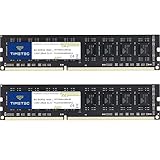
- [Color] PCB color may vary (black or green) depending on production batch. Quality and performance remain consistent across all Timetec products.
- DDR3L / DDR3 1600MHz PC3L-12800 / PC3-12800 240-Pin Unbuffered Non-ECC 1.35V / 1.5V CL11 Dual Rank 2Rx8 based 512x8
- Module Size: 16GB KIT(2x8GB Modules) Package: 2x8GB ; JEDEC standard 1.35V, this is a dual voltage piece and can operate at 1.35V or 1.5V
- For DDR3 Desktop Compatible with Intel and AMD CPU, Not for Laptop
- Guaranteed Lifetime warranty from Purchase Date and Free technical support based on United States
Microsoft’s Azure SQL in-memory technologies documentation illustrates the distinction: in-memory columnstore keeps data needed for processing in memory, while data that does not fit remains on disk. In short, database in-memory processing keeps useful data in RAM; architectural PIM moves some compute capability into or close to memory.
Do these 3 things before closing this tab:
1Clear out junk files and repair common Windows errors2Scan for outdated or missing drivers - takes under a minute3Repair Windows errors before they cause bigger problemsWhat PIM does—and does not—imply
- It is about locality: the central idea is to reduce data movement by placing selected computation near the data.
- It is broader than “a processor and RAM on one chip”: PIM includes arrangements inside memory devices and logic placed near memory, among other approaches.
- It is workload-dependent: benefits depend on the task and implementation; PIM is not a universal speedup.
- It needs system support: programming models, compilers, runtimes, and integration affect whether software can use the hardware.
- It is related to, but not identical with, processing in storage: research on processing in storage-class memory explores tasks such as compression, encryption, and format conversion near or within storage. That is an adjacent near-data-processing direction, not a synonym for every PIM design. See the USENIX HotStorage 2020 paper on Processing in Storage Class Memory.
Where PIM fits in computing
PIM is an evolving architecture for workloads where data movement is an important cost and some computation can be performed inside or near memory. Understanding whether a particular system benefits requires looking at its actual hardware and software support, and at the workload being run. It should not be treated as a capability present in every computer simply because that computer has RAM or uses an in-memory database.
Quick Recap
Best Value

- Micro SD Card Module: The module includes 74HC125 and AMS1117 chips, enabling voltage level conversion between 3.3V and 5V systems, ensuring stable communication between the Micro SD card and host devices with different voltage levels.
- Interface level: 3.3V or 5V
- Supported Interface: SPI
- Supported Card Type: Micro SD Card (TF Card)
- Socket: Pop-up
Product prices and availability are accurate as of the date/time indicated and are subject to change. Any price and availability information displayed on Amazon at the time of purchase will apply.

