
Recommended Free Tools
iTechGuides is reader-supported. When you buy through links on our site, we may earn an affiliate commission. As an Amazon Associate I earn from qualifying purchases. Learn more
AI can produce an answer that sounds like a forecast, but fluency is not proof that it knows what will happen. In an essay excerpted from Prophecy: Prediction, Power, and the Fight for the Future, from Ancient Oracles to AI, philosopher Carissa Véliz argues that predictions are not just estimates: when people or institutions act on them, forecasts can shape the future they claim to describe. Her warning is to look beyond whether a prediction sounds convincing and ask who made it, what supports it, and who bears the consequences.
Why Véliz compares AI forecasts with fortune-telling
Véliz opens with a classroom anecdote about an executive who uses chatbots as “fortune tellers.” One participant reportedly said a chatbot predicted a 2% rise in the stock market. The anecdote illustrates how people may treat an AI answer as a forecast; it does not establish that chatbots can reliably predict markets. The market, date, and verification details are not given in the reproduced text.


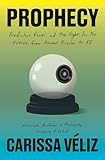

The comparison is about how prediction is received, not a claim that chatbots and traditional fortune-telling work in the same way. A chatbot may generate a plausible-sounding answer from patterns in its training data, but the answer remains an estimate about an uncertain future—not evidence that the event will happen.
Quick wins for a faster PC:
Fix the driver behind crashes, sound loss and screen glitchesFind Drivers →Repair Windows errors before they cause bigger problemsFix Now →How prediction can affect what happens next
Véliz’s central distinction is that a statement about the future can influence decisions in ways a statement about the past or present cannot. If people believe a forecast, they may change their behavior; those actions can help bring about, prevent, or otherwise alter the predicted outcome. That is the essay’s conceptual argument, not a claim that every forecast is baseless or self-fulfilling.
#1 Best Overall
This matters when a forecast is used to guide consequential choices. A prediction about a person, market, or political event may be treated as neutral information even when it influences what decision-makers do. The useful question is not only “Is this prediction accurate?” but also “What might people do because they believe it?”
What machine learning has to do with prediction
Véliz broadly describes machine-learning tasks—including translation, image classification, and language generation—as making predictions based on patterns learned from prior examples. This is a helpful way to understand why such systems can produce outputs about what comes next, but it is not a complete technical definition of machine learning.
Rank #2
Her wider argument is that predictive capability is connected to power. Data and computing resources can enable systems to identify patterns and generate forecasts; organizations that deploy such systems may gain influence over decisions. The essay makes this argument at a high level. It should not be taken, on its own, as independent evidence for specific claims about data collection, surveillance, resource use, or exploitation.
Why prediction markets trouble the author
Véliz points to Polymarket as an example of prediction becoming an industry. She criticizes betting on political instability, disasters, and human suffering, arguing that it turns consequential events into spectacle. This is her ethical criticism. The reproduced article does not independently verify a particular market, its current availability, or a dated example.
The essay also mentions an illustrative 58% expectation that the Oklahoma City Thunder would win an NBA championship. Without a date or verified market record, that figure should not be read as a current probability or a confirmed prediction-market statistic. Its role in the argument is to show how a future outcome can be expressed as a number, not to demonstrate that the number is reliable.
Laplace’s demon and the dream of certainty
Véliz invokes Laplace’s demon as an image of the aspiration to eliminate uncertainty: an imagined intelligence with complete information and enough computational power to comprehend the universe’s past and future. It is a historical thought experiment used rhetorically, not a realistic forecast of what science or AI can achieve.
The image helps frame the essay’s concern: the more powerful a prediction appears, the easier it may be to mistake an estimate for certainty. But no forecast should be treated as a view from nowhere. It depends on data, assumptions, and the choices of the people who build and use the system.
Do these 3 things before closing this tab:
1Clear out junk files and repair common Windows errors2Fix the driver behind crashes, sound loss and screen glitches3Repair Windows errors before they cause bigger problemsA practical way to evaluate a confident forecast
Véliz’s discussion suggests four questions to ask before relying on a prediction. This is a practical reading guide, not a formal framework named by the author:
- Who made it? Identify the person, organization, or system behind the forecast, and who has the authority to act on it.
- What evidence supports it? Look for the data, assumptions, uncertainty, and time frame. A confident tone is not a substitute for those details.
- Whose interests does it serve? Consider who benefits if people accept the forecast and whether the forecaster has a stake in the outcome.
- What happens if people act on it—or if it is wrong? Identify who may be affected, whether the forecast could change their options, and whether there is a way to challenge or correct a decision based on it.
These questions do not make every forecast useless. They help distinguish a prediction offered as fallible information from one treated as unquestionable authority.
Independent reader supportYour contribution helps us test, update, and keep practical guides available for everyone.What the essay’s warning does—and does not—establish
Véliz’s argument is a critique of the power and consequences of prediction, not a demonstration that AI can accurately foresee events or that all forecasting is dangerous. The classroom story and sports example are illustrations, not independently verified statistics. The claims about machine learning are broad explanatory framing, while the ethical claims about prediction markets are the author’s judgments.
The piece is presented as an excerpt from Véliz’s book Prophecy: Prediction, Power, and the Fight for the Future, from Ancient Oracles to AI. The reproduced article text identifies it as a CNET Alt View guest column dated April 23, 2026, but that repost is not the original publisher page or independent corroboration. A brief further reading is Véliz’s book; edition, ISBN, and current availability are not established here.
Quick Recap
Product prices and availability are accurate as of the date/time indicated and are subject to change. Any price and availability information displayed on Amazon at the time of purchase will apply.

