
Quick wins for a faster PC:
Scan for outdated or missing drivers - takes under a minuteDriver Scan →Repair Windows errors before they cause bigger problemsFix Now →iTechGuides is reader-supported. When you buy through links on our site, we may earn an affiliate commission. As an Amazon Associate I earn from qualifying purchases. Learn more
Fine-tuning a speech recognizer was the quick part of Servin Osmanov’s Crimean Tatar project. The harder work was making its evaluation trustworthy: duplicated audiobook content had slipped past filename checks, and a few looping clips dominated the error count. His case study shows why ASR quality depends on careful data splits, content-based deduplication, disciplined test-set use, and decoding choices—not just model training.
Why trustworthy evaluation came before training
Speech-recognition scores are only meaningful if evaluation audio is genuinely separate from training audio. In Osmanov’s Crimean Tatar corpus, adjacent clips could share a reader, recording session, microphone, or even a sentence split across clip boundaries. A random clip-level split could therefore test whether the model recognized familiar voices or recording conditions, rather than how well it handled unseen material.
He instead held out two complete books and two readers. The resulting test set contained 893 clips, totaling 1 hour and 52 minutes. This split made the evaluation more demanding and better aligned with the question of how the recognizer would perform on unfamiliar books and speakers.
Outdated Drivers Are Slowing You Down
One free scan finds every outdated or missing driver and matches the right update for your exact hardware.Free scan · exact hardware matchWindows Errors? Fix Them Before They Spread
Repair common Windows errors and clear accumulated junk for a smoother, more stable PC - no reinstall needed.Free scan · no reinstallWhy filenames did not catch the duplicates
A filename comparison found no overlap between training and held-out files. But the same audiobook content had been segmented by different tools and saved under different names. Matching runs of six consecutive words exposed four duplicated audiobooks. One selected book had a training twin for 651 of its 672 clips—96.9%—before cleanup.
#1 Best Overall

- Omnidirectional Microphone - It is not a Speaker or Speakerphone, it is a condenser microphone. The microphone has an omnidirectional pickup pattern with a pickup distance of 11.5 ft, making it easy to capture the most subtle sounds from 360° directions and transmit the sound more loud and clear. Participants can hear each other without raising their voices.
- Made for Conferences - This microphone is perfect for small or medium meetings over an internet network by using Skype/GoToMeeting/WebEx/Hangouts/Fuze/VoIP/Zoom and other softwares. You can also use it for court reports, seminars, remote training, business negotiations, video chats, etc.
- Plug & Play, No Drivers Required - The microphone is compatible with all operating systems - both Windows and macOS. You just need to plug the microphone to start recording. If there is no response after inserting the mic, please go to the microphone setting of your computer and select the mic as the INPUT device.
- Convenient Mute Button - Quickly mute/unmute your microphone. The built-in blue indicator light for checking whether the USB microphone is working.
- Well Designed Cable - The microphone is constructed of sturdy and metal material and the base is fitted with an anti-slip mat which keeps it stable on desktop during use. It is small, convenient and does not require much space when in use. Connected with a 1.8m nylon shielded wire, it effectively eliminates signal interferences to achieve the best recording results.
After identifying and removing the duplicates, Osmanov rechecked the split by content: no held-out clips remained in training, and there were no matching six-word sequences. The practical lesson is to treat filenames as labels, not proof of unique content. Depending on a corpus, identity checks may need to include transcripts, audio fingerprints, or both.
Split according to the corpus’s structure
For a speech corpus, the right unit to hold out is often larger than an individual clip. Keep related material together when clips share a speaker, session, source document, or device. Otherwise, similar fragments can leak across partitions and make the test score look better than performance on truly new material.
What fine-tuning changed—and what it did not
With the split cleaned, Osmanov fine-tuned an adapter rather than updating the full Whisper model. His report describes 15.5 hours of training speech, 31 million trainable adapter parameters alongside roughly 1.5 billion frozen model parameters, and three epochs over 705 steps. Training took 90 minutes on a home GPU, used up to 10.4 GB of VRAM, and produced a 126 MB adapter.
Those figures describe this setup, not a general estimate for other languages, models, datasets, or hardware. The report also notes that checkpoint 100 performed worse than the starting model, while most gains had appeared by around step 200; neither the timing nor the convergence point should be assumed to transfer to another project.
Rank #2

- Microphone grille with optimized structure
- Integrated pop filter
- International products have separate terms, are sold from abroad and may differ from local products, including fit, age ratings, and language of product, labeling or instructions.
Reported scores across the project
| Stage | WER | CER | What changed |
|---|---|---|---|
| Starting model | 34.6% | 11.9% | Baseline on the held-out test set |
| After fine-tuning | 20.1% | 9.4% | Adapter training; model weights changed |
| After decode-time tuning | 17.0% | 7.0% | Decoding configuration changed; no additional weight update |
These are Osmanov’s reported results for this case study, not independently replicated benchmarks. Word error rate (WER) counts word substitutions, deletions, and insertions relative to a reference; character error rate (CER) applies a similar comparison at the character level. The baseline WER also slightly overstates recognition mistakes: the model rendered a year as digits while the reference spelled it out, and the scorer counted four substitutions. That is a normalization mismatch as well as a recognition issue.
How decoding improved results without another training run
Fine-tuning was not the only way to improve the reported score. Osmanov tested 24 decoding configurations on a 255-clip selection set, then applied the chosen configuration to the held-out test set. Beam search, which keeps multiple candidate token sequences in consideration instead of committing greedily at each step, was part of the final configuration. With model weights unchanged, the reported test results improved from 20.1% WER and 9.4% CER after fine-tuning to 17.0% and 7.0%.
The trade-off was speed: beam search took 3.1 times as long to decode as the preceding configuration. Whether that is worthwhile depends on the application. A slower pass may be acceptable for offline archival transcription; a latency-sensitive live system may need a different balance.
A small number of clips drove a large share of the errors
Aggregate scores concealed a concentrated failure mode. Of 409 recovered word errors, 160 came from three of the 893 held-out clips—0.34% of the clips. Those recordings looped, producing repeated output. Beam search eliminated looping in the held-out set, so the overall score gain reflected both fewer errors and a fix for a specific, severe behavior; it was not a uniform improvement across every clip.
Rank #3

- Free-floating, decoupled microphone for precise recordings
- Built-in pop filter for perfect sound quality
- Built-in motion sensor for device control by gestures
- Freely configurable function keys for personalised workflow
- Microphone grille with optimised structure for crystal clear sound
This distinction matters when transcripts will be reused. A looping transcript can introduce large blocks of false text into an archive or later training material, even if most clips are transcribed reasonably well.
Why repetition bans can make transcripts worse
It can be tempting to block repeated n-grams—sequences of words or tokens—on the assumption that repetition signals a decoding failure. But repetition can be ordinary speech. In Osmanov’s Crimean Tatar examples, repeated names, forms of address, or pleading phrases were legitimate. On the selection set, the repeated n-gram ban broke 17 of 255 cases and fixed one; 12 of the broken cases had been essentially perfect before the constraint was applied.
Decoding constraints should therefore be checked against natural patterns in the target language. A rule that suppresses repetition may remove a loop in one clip while corrupting a genuine phrase in another.
How to use development and test sets without confusing them
Osmanov’s 255-clip selection set—about half an hour of speech—was used to rank checkpoints and decoding settings. The two held-out books were reserved for final testing. The development set reported 17% WER, compared with 34.6% on the held-out test set, illustrating that a score on a small selection set need not represent performance on harder or more varied material.
Rank #4
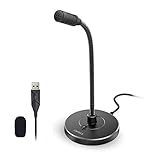
- 【Crystal Clear Audio Quality】Our Omnidirectional pattern condenser microphone accurately captures your voice, making it perfect for dictation, online classrooms, and more.
- 【Active Noise-Cancelling】Come in CMTECK CCS2.0 SMART CHIP with Omnidirectional Polar Pattern, which can effectively block the background noise. The pop filter prevents plosives from overloading the microphone, ensuring only your voice is heard.7
- 【Convenient Mute Button with LED Indicator】You can quickly mute/un-mute the microphone with the Mute Button and the built-in LED light lets you know the working status(Greenlight: Connected; Red light: Mute mode).
- 【Easy to use】 No drivers needed, just plug and record without external power supply, directly connect the microphone to a USB compatible device, well compatible with Windows(7, 8 and 10), Mac OS and PS4 (NOT compatible with Raspberry Pi/Linux/Android)
- 【Mini size with Adjustable Gooseneck】Adopted flexible and adjustable gooseneck metal pipe, easily adjust position 360 degrees to suit user comfort. The compact and stable base maximizes your desktop space.
Use development data to choose among alternatives; reserve a representative test set to estimate performance under its stated conditions. Repeatedly changing a system in response to test results turns the test set into another selection set and makes its score less useful as an independent estimate. In this project, the test set was used after selection decisions rather than for repeated configuration ranking.
Osmanov did not report a score for Whisper’s temperature fallback. The selection set contained no looping clips that could show whether that intervention helped, so its effect was not validated in this experiment.
Independent reader supportYour contribution helps us test, update, and keep practical guides available for everyone.What the robustness tests do—and do not—show
Osmanov also tested 17 corruptions on the same 893 clips. In his exercise, equal-loudness competing speech increased WER from 17% to 69%; a hallway-sized reverberant room multiplied errors by 2.5. Steady noise was less damaging than babble, and music was less damaging still. These are results from the author’s particular corruption exercise, not universal rankings for all speech recognizers or recording conditions.
Recommended Free Tools
Osmanov’s interpretation was that separating competing speech and improving microphone placement could matter more than some other recording changes. The tests support treating overlapping voices and reverberation as important risks in this case, but they do not establish a general prescription for every deployment.
Best Value
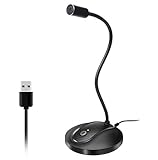
- 360 Degree Position Adjustable Gooseneck Design --Plug and play USB microphone Pick up the sound from 360-degree with high sensitivity, in the best possible location for sound to your PC gaming, dragon voice dictation, and talk to Cortana
- Mute Button & LED Indicator --One-click to mute/unmute your microphone for pc, Build-in LED indicator tells you the working status at any time
- Intelligent Noise-Canceling Tech --Premium omnidirectional condenser microphone with noise-canceling technology can pick up your clear voice and reduce background noise and echo
- USB Plug&Play(1.8/6ft USB Cable) -- No driver required. Just need to plug & play for the microphone to start recording, well compatible with Windows(7, 8, 10 and 11) and macOS. (NOT compatible with Xbox/Raspberry Pi/Android)
- Solid Construction--Adopting premium metal pipe and heavy-duty ABS stand to make sure that you will be satisfied with our computer mic quality
He also reports that a telephone-band filter did not worsen the score, while tempo changes of plus or minus 15% cost at most 6%. Those results are specific to the tested material and transformations; they should not be read as proof that filtering or speed changes are harmless in other settings.
A practical workflow for low-resource ASR evaluation
- Map the data’s relationships. Identify speakers, sessions, source books or documents, and any segmentation process that may have created related clips.
- Choose held-out groups before training. Keep entire meaningful units—such as books, speakers, or sessions—out of training when the intended use involves new material of that kind.
- Audit for content overlap. Check more than filenames. Compare transcript sequences and, where appropriate, audio content to find the same recording or text stored under different names or segmentations.
- Keep a selection set separate. Use development data to rank checkpoints and decoding settings; do not treat its score as the final estimate.
- Inspect errors, not just averages. Look for looping, repeated output, speaker-specific problems, and normalization disagreements that aggregate WER or CER can obscure.
- Test decoding changes against real language. Measure accuracy and latency, and verify that anti-repetition or other constraints do not damage legitimate speech patterns.
- Report conditions and limits. State which data was held out, how choices were selected, what transformations were tested, and which interventions were not validated.
What this case study establishes
Osmanov’s report is a project account, not a controlled comparison across languages or systems. It does not provide a complete reproducibility package, a precise starting-model checkpoint identifier, or all 24 decoding configurations. Its results are useful as evidence of what happened in this Crimean Tatar project, but they cannot guarantee the same gains, costs, or failure modes elsewhere.
Its central engineering lesson is nevertheless concrete: a fine-tuning run can be short while the work that makes its score credible is not. Deduplicate by content, split data by meaningful relationships, protect the test set from repeated tuning, and investigate what errors make up the aggregate score.
Source: Servin Osmanov’s DEV Community article. The article’s publication line says “Sep 23” without a year; indexing associates it with 2026.
Quick Recap
Product prices and availability are accurate as of the date/time indicated and are subject to change. Any price and availability information displayed on Amazon at the time of purchase will apply.

