
PC Slower Than It Used to Be?
A free scan shows the junk files, broken settings and background clutter dragging Windows down - then fixes them in one click.Free scan · Windows 10 & 11Outdated Drivers Are Slowing You Down
One free scan finds every outdated or missing driver and matches the right update for your exact hardware.Free scan · exact hardware matchiTechGuides is reader-supported. When you buy through links on our site, we may earn an affiliate commission. As an Amazon Associate I earn from qualifying purchases. Learn more
ContextGuide, described by Akanksha Sharma, puts a retrieval step between a user’s question and an AI-generated answer: Question → Context → Answer. The agent first looks up relevant material in a structured knowledge base, then uses that context to respond. The idea addresses a familiar problem: an AI can sound confident about a technical question even when its answer lacks the details found in the documentation.
How ContextGuide is meant to work
Sharma’s DEV Community post describes a flow in which the agent interprets a question, retrieves relevant documentation, guides, or references from a knowledge base, reasons over that material, and returns an answer with sources. Instead of relying only on what the model already knows, the design gives it somewhere useful to look before it responds.
The post divides the work among three components: Sanity organizes the knowledge, Sanity Context makes the content queryable, and MCP connects the agent to the retrieved context. MCP, or Model Context Protocol, is the connection mechanism in this design—not the agent itself.
For example, a user might ask, “Which authentication method should I use here?” The intended process is to find relevant material first and base the response on it, rather than generate a general answer without consulting the project’s own guidance.
#1 Best Overall

- AI-Powered Raspberry Pi Robot Dog — PiDog: Powered by Raspberry Pi (5/4B/3B+/3B/Zero 2W), OpenClaw, and multi-LLMs like ChatGPT, Gemini, Grok, DeepSeek, Qwen & Ollama. With 12 servos, camera, gyroscope, hearing & touch sensors, PiDog can see, listen, talk, move, and interact intelligently. Supports OpenCV, MediaPipe, TTS & STT, app control, FPV & Python. A great STEM robotics gift for students, makers & tech enthusiasts—perfect for birthdays and holidays. (Raspberry Pi not included)
- Realistic Dog-like Movements: PiDog's 12 powerful servos enable 32 dog-like actions, including walking, sitting, standing, shaking its head, wagging its tail, and performing playful tricks, closely mimicking a real dog and providing an engaging experience. This is an AI development robot product designed for engineers, suitable for ages 15 and above
- Rich Sensor Suite for Interactive Experiences: PiDog features ultrasonic, touch, gyroscope, sound, camera, speaker and microphone. These provide it with advanced hearing, vision, and touch, enabling it to see, detect obstacles, respond to touch, and recognize sounds, making interactions highly engaging
- AI-Powered Interactions with OpenClaw & Multi-LLMs. PiDog combines voice, vision, and gesture recognition for immersive AI experiences. Powered by OpenClaw and multi-LLMs like ChatGPT, Gemini, Grok, DeepSeek, Qwen, Doubao, and Ollama (local LLMs), it can understand questions, respond naturally through TTS & STT, recognize math problems, interpret hand gestures, and hold smart conversations. OpenClaw also enables customizable AI behaviors and personalized robotics development, helping users create their own intelligent robotic companion
- Comprehensive Learning Resources and Support: PiDog offers detailed online documentation, video tutorials, prompt technical support, and an active forum community, ensuring beginners can easily complete all projects and enjoy a great experience
What Sanity Context does—and does not do
Sanity documents Context as a hosted, read-only MCP server that gives agents structured access to content from a live dataset or a Knowledge Base. A builder still needs to provide an MCP-capable AI harness to run the agent and manage its answer flow. Context supplies access to information; it does not run the agent loop or write changes back to the dataset. Sanity Context documentation.
Sanity documents two ways to retrieve content:
- GROQ mode: queries a dataset when a request arrives. This fits content that is structured and suited to live queries.
- Knowledge Base mode: retrieves from an index prepared ahead of time. Knowledge Bases can draw on datasets, websites, and files; Sanity currently describes this feature as an opt-in beta. This mode may suit knowledge spread across different sources or formats. Sanity Context documentation and Sanity Knowledge Base documentation.
The choice is about how the source material is organized and retrieved, not a guarantee that one mode will produce more accurate answers. GROQ queries live structured data; a Knowledge Base serves a prebuilt index.
Rank #2
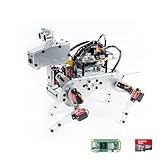
- Raspberry Pi AI Robot: powered by Raspberry Pi (5/4B/3B+/3B/Zero 2W), features 12 servos and sensors for vision, hearing, and touch. Integrated with ChatGPT-4o, it responds to complex queries. With app control and FPV, users can manage and see its view in real-time. It supports Python programming
- Realistic Movements: 12 powerful servos enable 32 actions, including walking, sitting, standing, shaking its head, wagging its tail, and performing playful tricks, closely mimicking a real and providing an engaging experience
- Rich Sensor Suite for Interactive Experiences: features ultrasonic, touch, gyroscope, sound, camera, speaker and microphone. These provide it with advanced hearing, vision, and touch, enabling it to see, detect obstacles, respond to touch, and recognize sounds, making interactions highly engaging
- Engaging Interactions with ChatGPT-4o: with ChatGPT-4o enables voice interactions and visual recognition, making it smarter and more responsive. Users can have natural conversations, solve math problems via the camera, and interpret gestures, creating diverse and fun interactions
- Comprehensive Learning Resources and Support: offers detailed online documentation, video tutorials, prompt technical support, and an active forum community, ensuring beginners can easily complete all projects and enjoy a great experience
Handling sources that disagree
Sharma imagines a case where two sources recommend different authentication methods. Her proposed behavior is for the agent to acknowledge the disagreement and show what each source says, rather than confidently choosing one. As she puts it, “Sometimes the honest answer isn’t: ‘Here’s the answer.’ Sometimes it’s: ‘Here’s what the sources say and here’s where they disagree.’”
That is a design goal described in the post, not a reported test or a detailed conflict-resolution algorithm. A retrieval step can expose relevant sources, but the article does not establish how ContextGuide ranks conflicting material or decides which source takes precedence.
Rank #3

- AI-Powered Raspberry Pi Smart Car — PiCar-X: PiCar-X brings AI learning to life — powered by Openclaw and multi-LLMs including ChatGPT, Gemini, Grok, DeepSeek, Qwen, Doubao, Ollama (Local LLMs), and compatible with many more AI platforms. Featuring OpenCV, MediaPipe, TTS & STT, PiCar-X enables true AI vision and voice interaction — it can see, listen, talk, drive and think like an intelligent companion. Ideal for students (10+), educators, and engineers, PiCar-X is the perfect gateway to explore AI, robotics, and machine learning on Raspberry Pi 5/4/3B+/3B/Zero 2W (Raspberry Pi not included)
- Engaging Interactions with Multi-LLMs: PiCar-X, powered by Openclaw and multi-LLMs — including ChatGPT, Gemini, Grok, DeepSeek, Qwen, Doubao, and Ollama (Local LLMs) — and compatible with many other AI platforms, supports voice interaction and visual recognition to make the robot smarter and more responsive. Users can enjoy natural AI conversations, solve math problems through the camera, and interpret gestures, unlocking a world of diverse and fun AI-driven interactions
- Feature-rich and Adaptable: PiCar-X offers engaging applications like line following and obstacle avoidance, supports TTS (Text-to-Speech) and STT (Speech-to-Text) for interactive voice control, and includes a camera for video and vision recognition. It also comes with various sensors, while its customizable design enables a wide range of creative AI and robotics projects
- Versatile Programming Options: Catering to users of all skill levels, PiCar-X supports both Python and Scratch programming languages, allowing for flexible learning and skill development
- Simplified Assembly & Support: PiCar-X is perfect for beginners, yet learning with experienced users is recommended for best results. It comes with easy assembly instructions and forum support for smooth project completion
What the post establishes about results
The post explains the concept and its component roles, but reports no accuracy rate, benchmark, usage figure, or other measured outcome. Sanity’s documentation verifies the capabilities and limitations of the underlying Context service; it does not verify that ContextGuide was implemented, tested, or shown to improve answer accuracy.
The practical takeaway is narrower and still useful: retrieving relevant knowledge before answering gives an agent material to ground a response in. Whether that makes a particular answer correct depends on the sources retrieved and how the agent uses them.
Quick Recap
Rank #4

- BUILD, CODE & DRIVE YOUR OWN ROBOT CAR: Turn coding, electronics and engineering into a working programmable robot car you can assemble, program and drive; ideal for weekend family projects, STEM classrooms, coding clubs, robotics lessons and maker challenges
- EXPLORE FPV, LINE TRACKING & OBSTACLE AVOIDANCE: Control the robot with the ELEGOO app or IR remote, view live FPV video through the onboard camera, follow black lines, avoid obstacles with the ultrasonic sensor and explore multiple interactive driving modes
- BEGINNER-FRIENDLY BUILD WITH GUIDED WIRING: Keyed XH2.54 connectors help reduce wiring mistakes, while the illustrated tutorial and example programs guide beginners step by step from chassis assembly and module connection to programming and the first successful run
- GO BEYOND ASSEMBLY WITH CREATIVE CODING: Program with Arduino IDE to explore movement, sensors and control logic, then modify example code to create custom routes, reactions and robotics experiments that develop coding, problem-solving and engineering skills
- COMPLETE RECHARGEABLE STEM ROBOTICS KIT: Includes an ELEGOO UNO R3 controller board, ESP32-WROVER-based camera and Wi-Fi module, line-tracking and ultrasonic sensors, motors, IR remote and a 2000 mAh rechargeable lithium-ion battery; recommended for ages 8+ with adult guidance for first-time builders
Product prices and availability are accurate as of the date/time indicated and are subject to change. Any price and availability information displayed on Amazon at the time of purchase will apply.

