
iTechGuides is reader-supported. When you buy through links on our site, we may earn an affiliate commission. As an Amazon Associate I earn from qualifying purchases. Learn more
More system RAM can make larger local AI models, longer contexts, or additional concurrent workloads feasible—but it does not add GPU memory or guarantee faster responses. The difference depends on where the model is placed, how large and quantized it is, and how much memory its context and cache need. The available information does not establish a particular machine or before-and-after test, so this guide explains what a RAM upgrade can change without claiming a personal performance result.
What more RAM changes when you run an AI model locally
A model needs memory for its weights and other parameters when it is loaded. LM Studio describes this allocation as taking place in the computer’s RAM. More system memory can therefore give a local runtime more room to load a model or handle memory-intensive settings—particularly when the workload uses system memory or shares work between the CPU and GPU.
That is a capacity change, not a universal speed upgrade. If a model already fits comfortably in the memory available to its runtime, additional RAM alone does not establish that token generation will be faster. Speed also depends on the model, quantization, runtime, processor, GPU, and placement.
How much RAM do you need for local AI?
There is no single minimum that applies to every model runner and workload. As of documentation accessed in 2026, LM Studio gives these platform-specific recommendations:
#1 Best Overall

- [Color] PCB color may vary (black or green) depending on production batch. Quality and performance remain consistent across all Timetec products.
- DDR3L / DDR3 1600MHz PC3L-12800 / PC3-12800 240-Pin Unbuffered Non-ECC 1.35V / 1.5V CL11 Dual Rank 2Rx8 based 512x8
- Module Size: 16GB KIT(2x8GB Modules) Package: 2x8GB ; JEDEC standard 1.35V, this is a dual voltage piece and can operate at 1.35V or 1.5V
- For DDR3 Desktop Compatible with Intel and AMD CPU, Not for Laptop
- Guaranteed Lifetime warranty from Purchase Date and Free technical support based on United States
| Platform | LM Studio guidance | Important qualification |
|---|---|---|
| Apple Silicon Mac | 16 GB or more of RAM | LM Studio says Macs with 8 GB may still run smaller models with modest context sizes. Its documented supported Apple Silicon generations are M1, M2, M3, and M4, with macOS 14 or newer. |
| Windows | At least 16 GB of RAM and at least 4 GB of dedicated VRAM | LM Studio supports x64 and ARM systems; its x64 requirement includes AVX2. These are LM Studio recommendations, not universal thresholds for all runtimes or models. |
These figures are starting points from LM Studio’s system requirements, not a promise that a particular model, context length, or concurrent workload will fit. Check the requirements for the runtime and model you intend to use.
System RAM and GPU VRAM are different resources
System RAM is general-purpose memory used by the computer. Dedicated VRAM is memory on a discrete GPU. Increasing system RAM does not increase the GPU’s dedicated VRAM, so a model that cannot fit entirely in VRAM may still be unable to run as a full-GPU workload after a system-memory upgrade.
Rank #2

- ✅【DDR3 8GB Kit 1333MHz UDIMM RAM 】PC3-10600, DDR3 1333MHz, Unbuffered, Dual Rank, Non ECC, 1.5V CL9, apply for AMD, Intel, Mac system
- ✅【Advanced Chips】All DDR3 8GB RAM are high quality ram memory module. Professional company, high-quality materials, upgrade designed for DDR3 UDIMM compatible desktop
- ✅【Stable and Durable】8GB DDR3-1333MHz DIMM RAM, 100% tested for stability, durability and compatibility. All PC3-10600 modules undergo quality assurance testing to ensure dependable and reliable performance
- ✅【Increases System Performance】PC3 8GB ram will speed up loading times, improve system responsiveness, and increase your system's ability to handle greater workloads. Warm tips: Please make sure your desktop model meets 2x4GB 1333 10600 kit, you can also contact us to make sure
- ✅【Lifetime Service】Lifetime warranty, free technical support. You can also contact us to ensure compatibility. Any questions, feel free to contact us, we are always be with you
Placement helps explain what is happening. Ollama’s ollama ps command reports whether a loaded model is placed entirely on the GPU, entirely in system memory (shown as CPU), or split between CPU and GPU. A system-RAM upgrade can provide more room for system-memory or mixed placement, but the result is not the same as adding VRAM. The command and placement examples are documented in Ollama’s FAQ.
Hybrid placement can be useful, but the sources do not establish a universal speed penalty or performance percentage for CPU or mixed inference. Check the actual placement and measure the workload you care about rather than assuming that a model’s ability to load means it will respond at an acceptable speed.
Rank #3
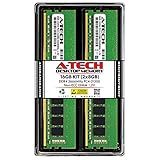
- Compatible with select DDR4 Desktop computers + Easy to install at home, no expertise required
- Maximize your system's performance, boost loading speeds and multitask with ease
- Backed by A-Tech's Lifetime Warranty + Friendly tech support team available to help before and after your purchase
- 16GB RAM Kit ( 2 x 8GB Modules ) | DDR4 DIMM 288-Pin | Speeds up to 2666MHz (2667MHz), PC4-21300 / PC4-2666V
- NON-ECC Unbuffered | 1Rx8 or 2Rx8 - Single or Dual Rank | JEDEC DDR4 standard 1.2V
What else determines memory use?
Model size and quantization
Model weights are only one part of a workload’s memory needs. The llama.cpp project supports integer quantization levels from 1.5-bit through 8-bit to reduce memory use, as well as CPU-plus-GPU hybrid inference for partially accelerating models that exceed total VRAM capacity. Quantization changes the memory/performance trade-off; the resulting speed and output quality depend on the model, selected quantization, runtime, and hardware. It does not turn system RAM into GPU memory. See the llama.cpp project documentation.
Context length and the key/value cache
The context window—the amount of text the model can use in a conversation or prompt—also affects memory use. Ollama documents a default context window of 4096 tokens, a software default rather than a hardware requirement. Its FAQ says Flash Attention can significantly reduce memory use as context grows when supported, and that K/V cache quantization can further reduce cache memory with possible precision trade-offs.
Rank #4

- 【DDR3 2x 4GB 1600MHz 12800 Udimm Desktop RAM Card】DDR3-1600, PC3-12800, Unbuffered, Dual Rank, Non ECC, 2Rx8, 240-Pin, 1.5V, CL11 memoria ram
- 【Advanced Chips】All DDR3 4GB 12800 ram card are high quality ram memory module, apply for desktop computer AMD, Intel, Mac system
- 【Stable and Durable】8GB DDR3-1600MHz Udimm, 100% tested for stability, durability and compatibility. We test all rams before shipment to ensure all PC3-12800U ram card works stably and normally
- 【Increases System Performance】PC3 8GB ram will empower your computer to achieve faster loading times, system responsiveness, increase your system's ability to handle greater workloads. Note: Please make sure your desktop computer meets PC3 12800 1600 kit
- 【Lifetime Service】Compatible with Macbook, iMac, HP, Dell, Lenovo, ASUS, Acer, etc. Lifetime warranty, free technical support. Any questions, feel free to contact us, we will reply within 24hrs
Ollama’s approximate comparisons concern K/V cache memory, not model-weight size: it says q8_0 uses about half the memory of an f16 cache, while q4_0 uses about one quarter. The FAQ notes that the precision impact of lower-precision cache settings may be more noticeable at higher context sizes. These options depend on runtime support and configuration; consult Ollama’s FAQ for details.
The Tool Desk
Outbyte Driver Updater FREEScan for outdated or missing drivers - takes under a minuteDriver Scan →Outbyte PC Repair FREEClear out junk files and repair common Windows errorsFree Scan →Multiple models or requests
Ollama says multiple models can be loaded concurrently when sufficient memory is available. If memory is insufficient, requests may be queued and previously loaded models unloaded to make room. For GPU inference, its FAQ says concurrent model loads require each new model to fit completely in VRAM. Extra system RAM may help with some system-memory workloads, but it does not remove that GPU-fit constraint.
Independent reader supportYour contribution helps us test, update, and keep practical guides available for everyone.How to decide whether to upgrade RAM or change settings
Start with the bottleneck you are trying to solve. These checks distinguish a capacity problem from a GPU-fit, model-size, or context-setting problem:
- Identify the computer’s memory limits. Find its supported maximum capacity, memory generation and form factor, and whether its RAM is upgradeable. General software guidance cannot identify a compatible module for an unspecified computer.
- Check model placement. If you use Ollama, run
ollama pswhile a model is loaded and note whether it is on GPU, CPU/system memory, or split across both. - Check whether the model and quantization fit the goal. A smaller model or a supported lower-memory quantization may address a fit problem; hybrid CPU/GPU inference is another option where the runtime supports it.
- Review context and cache settings. If long conversations or prompts are the issue, check the configured context length and whether the runtime supports Flash Attention or K/V cache quantization. These settings can affect memory independently of model weights.
- Separate fit from throughput. If the model loads but responses are too slow, more RAM is not proven to solve the problem. Record the model, quantization, context, placement, and hardware, then measure the workload after changing one relevant factor at a time.
- Verify the exact upgrade before buying. Match the device’s supported capacity, memory generation, module type, and upgradeability. The general recommendations above cannot determine a compatible kit.
What a RAM upgrade does—and does not—prove
A memory upgrade can change which workloads fit in the system’s available memory, especially when a runtime uses system RAM or needs room for larger contexts or multiple models. It does not by itself establish faster generation, guarantee a specific model will fit, or increase dedicated VRAM. To describe a real before-and-after result, the machine, RAM capacity, runtime, model, quantization, context, GPU, and measured workload would all need to be known.
Quick Recap
Product prices and availability are accurate as of the date/time indicated and are subject to change. Any price and availability information displayed on Amazon at the time of purchase will apply.

