
iTechGuides is reader-supported. When you buy through links on our site, we may earn an affiliate commission. As an Amazon Associate I earn from qualifying purchases. Learn more
For removing an old film finish from a suitable, broad, flat wood surface, a belt sander is the fastest-supported choice: WOOD Magazine recommends an 80- or 100-grit belt at about half the sander’s maximum speed. That advice is specific to old film finish—not every penetrating stain, paint, wood species, or workpiece. Belt sanders remove material aggressively, so the right tool depends on the surface and the finish you need afterward.
Which sander should you use for an old wood finish?
| Option | Best-supported role | Trade-off or caution |
|---|---|---|
| Belt sander | Rapid removal of old film finish from suitable broad, flat wood. WOOD Magazine recommends an 80- or 100-grit belt at about half maximum speed. | Aggressive material removal can damage a surface if the tool is unsuitable or poorly controlled. This is not a universal method for every stain or finish. |
| Random-orbit sander | A woodworking and refinishing option; some models offer variable speed and compatible dust extraction. | The available sources do not establish that it removes old finishes as quickly as a belt sander. Its sanding pattern can leave swirls visible beneath stain or dye. |
| Chemical stripper | WOOD Magazine recommends stripping rather than sanding old painted finishes of uncertain origin. | Choose a product suited to the finish and substrate, and follow its directions and applicable local guidance. |
The comparison is about tool roles, not a head-to-head speed test: the available sources do not provide a controlled comparison of these options. Consider the workpiece’s size and flatness, the finish or paint type, how much control the surface requires, the scratch pattern, dust collection, and abrasive availability.
When a belt sander is the right choice
WOOD Magazine’s specific recommendation is to run a belt sander at about half its maximum speed with an 80- or 100-grit belt to remove an old film finish. Its broader sander guide describes belt sanders as aggressive tools for rapid material removal and places 60–120 grit in the rough-sanding range. The guide recommends switching to a finishing tool after rough sanding.
This makes a belt sander a reasonable choice for a suitable, relatively flat, broad wood surface when fast removal matters. It is less appropriate where the workpiece is delicate, irregular, narrow, or difficult to control: aggressive sanding can remove wood along with the finish. Keep the tool moving and assess progress frequently rather than assuming the grit or speed setting alone will protect the surface.
#1 Best Overall
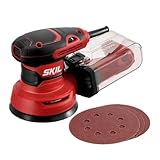
- POWERFUL - With a 2.8 amp motor and 13,000 orbits per minute, it's able to deliver a smooth performance over a variety of sanding applications.
- EASY TO CLEAN DUST CONTAINER - The X-flow dust collector uses cyclone force to collect dust in it's easy-to-empty transparent container.
- SPEED CONTROL - Variable speed control provides the right amount of power and control across different materials.
- LOW VIBRATION - Through its ergonomic design and a soft rubber grip your hand stays comfortable while counterweight balance reduces hand fatigue from vibration. All so that you can work longer.
- SAND IN TIGHT PLACES - With a compact size and ergonomic design This sander can get into tight spaces easily and maximizes user control.
What about tough stains?
“Stain” can mean a penetrating colorant or a film-forming finish, and the distinction matters. The cited belt-sander advice concerns an old film finish; it does not establish that a belt sander quickly removes every penetrating stain. Sanding may remove wood without eliminating color that has soaked into it, and results can vary with the wood and stain. Do not treat the belt-sander recommendation as a guarantee for stained wood.
Grit also affects the color of a later finish. WOOD Magazine notes that sanding finer can leave fewer openings in the grain to hold pigment, making a pigmented stain appear lighter. If the final color matters, test the planned sanding and finishing sequence on an offcut or a hidden area before working on the visible surface.
Rank #2

- 3-Amp motor spins the pad at 8,000 - 12,000 OPM
- Separate counterweight design reduces vibration for improved comfort
- Improved dust-sealed switch protects against dust ingestion for longer switch life
- Dust port is designed to fit directly to the DWV010 or DWV012 dust collectors
- Shorter height allows the user to get closer to the workpiece
Using a random-orbit sander for refinishing
A random-orbit sander is a credible woodworking and refinishing alternative when its control, abrasive options, or dust-extraction setup suit the job. However, the available sources do not show that it removes old film finish at the same rate as a belt sander, so choose it for suitability rather than an assumed speed advantage.
Check the wood carefully before applying stain or dye. WOOD Magazine warns that random-orbit sanding can leave swirls that become visible after coloring. Inspect the surface under suitable light; if needed, hand-sand with the grain at the final grit. A machine alone does not guarantee a swirl-free stained finish.
Rank #3

- SMOOTH FINISH: pad dampening system designed to eliminate swirl marks on both flat and contoured surfaces
- EASY DISC ATTACHMENT: through Bosch's signature Hook and Loop disc attachment system, sanding pads stick to the hand sander, acting like a Velcro-adhesion material
- VARIABLE SPEED CONTROL: powerful 2.5 AMP motor allows speed to work-piece and task matching with ease; no-load OPM: 7,500-12,000
- DUST COLLECTION: features a micro filter system for fine dust and trapping particles as small as a 1/2-micron in diameter. Durable and compact, the dust canister shows dust level and easily detaches for mess-free tasks
- KIT CONTENTS: Includes sanding pad, sanding disc, dampening ring, dust canister, vacuum adapter and carrying bag
Choose the finishing grit after the old finish is gone
For the old-film-finish removal task, the specific belt recommendation is 80 or 100 grit. After removal, use a finer progression suited to the finish you plan to apply and check for scratches. WOOD Magazine says bare wood is typically finish-sanded to 220 grit before dust is removed. This is general guidance, not a guarantee for every wood species or finish formulation.
Do not assume that sanding finer always improves a stained result: finer sanding can reduce how much pigment lodges in the grain and make pigmented stain look lighter. Test the complete process on a sample when color is important.
Rank #4

- 3.0 amp motor that spins the pad at 12,000 OPM
- Shorter height allows the user to get closer to work piece
- Separate counterweight design reduces vibration for improved comfort
- Rubber over-mold in all of the critical areas of the sander
- Improved dust-sealed switch to protect against dust ingestion for longer switch life
Paint, dust, and extraction safety
Old paint of uncertain origin
For old painted finishes whose age or composition is uncertain, WOOD Magazine advises treating the paint as though it contains lead and using chemical stripping instead of sanding. It also recommends a respirator, ventilation, and skin protection. DEWALT’s instruction manual likewise advises minimizing paint dust and describes respiratory and containment precautions. These general precautions do not replace local lead-paint rules or professional guidance.
The Tool Desk
Outbyte PC Repair FREERepair Windows errors before they cause bigger problemsFix Now →Outbyte Driver Updater FREEFix the driver behind crashes, sound loss and screen glitchesFind Drivers →Dust collection depends on the setup
Dust extraction is worth considering, but compatibility matters. DEWALT describes AirLock compatibility for a specific random-orbit sander and extractor; its performance figures apply to that model and stated test setup, not to sanders or vacuum connections generally. Do not assume another tool or a generic vacuum arrangement will achieve the same result. Follow the sander, abrasive, extractor, and protective-equipment instructions for your setup.
Quick Recap
Best Value

- Brushless motor provides runtime and efficiency to get the job done
- Variable-speed control from 8,000 to 12,000 OPM to match the speed to the application.
- Low-profile height allows user to get close to work surface for precise sanding.
- Replaceable 8-hole hook-and-loop sanding pad (DWE64233) for quick, easy paper changing.
- Dust-sealed switch to protect against dust ingestion for long switch life
Product prices and availability are accurate as of the date/time indicated and are subject to change. Any price and availability information displayed on Amazon at the time of purchase will apply.

