
iTechGuides is reader-supported. When you buy through links on our site, we may earn an affiliate commission. As an Amazon Associate I earn from qualifying purchases. Learn more
A dry RFID inlay is the electronic component of an RFID tag: a chip and antenna mounted on a carrier, without the pressure-sensitive adhesive and release liner used in a wet inlay. It is generally supplied for further conversion or embedding, not as a finished peel-and-stick label.
What makes an RFID inlay “dry”?
“Dry” describes the construction, not whether the inlay is water-free. The inlay contains an RFID chip and antenna on a carrier or substrate, but it lacks the pressure-sensitive adhesive and release liner characteristic of a wet inlay. The carrier may be film, paper, or another material, depending on the design.
For one supplier-specific example, a dry inlay may use an etched antenna and chip bonded to a PET substrate. PET is not a requirement for all dry inlays. Supplier product guidance describes one such construction.
Recommended Free Tools
How does a dry inlay differ from a wet inlay or finished label?
The defining difference between dry and wet inlays is adhesive. Avery Dennison puts it simply: “Simply put, wet inlays come with pressure-sensitive adhesive, and dry inlays don’t.” Its RFID inlay guidance also describes adding facestock and adhesive during conversion.
#1 Best Overall

- Type UHF RFID dry Inlay
- Frequency Band Universal 860-960Mhz
- Memory TID 64bits, EPC 96bits, User 512 bits
| Format | Construction | Typical role |
|---|---|---|
| Dry inlay | Chip and antenna on a carrier; no pressure-sensitive adhesive or release liner | Further converting or embedding |
| Wet inlay | Inlay with pressure-sensitive adhesive and release liner | Attachment or further label conversion |
| Finished RFID label | Inlay integrated into a printable, attachable label construction | Printing and application as a label |
These are general format distinctions; product constructions can vary. A dry inlay is neither a reader nor, by itself, a finished RFID label.
What is a dry RFID inlay used for?
A converter can add facestock, adhesive, and other layers to turn a dry inlay into a smart label. In other applications, the inlay may be embedded in a card, ticket, package, or product. Dry formats can suit projects where the converter needs control over the finished layers or where the inlay will be laminated or embedded.
Rank #2
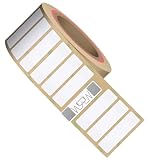
- 1.Crafted from premium PET material, these UHF RFID tags offer excellent waterproof performance and resistance to daily wear. Ideal for both indoor and outdoor use in humid or splash-prone environments.
- 2.Equipped with genuine 3M brand adhesive, these RFID stickers offer superior bonding power for long-lasting attachment. Perfect for smooth non-metallic surfaces like plastic, glass, and cardboard.
- 3.Each package includes 50 blank printable UHF RFID tags, making it ideal for bulk applications such as warehouse management, inventory tracking, and asset labeling.
- 4.RFID READER CONFIGURATION NOTICE – Tag data display may vary depending on RFID reader hardware, software, and memory-bank settings. For full unique tag identification, compatible readers should support complete EPC and/or full-length TID memory reading.
- 5.Please note: These tags are not suitable for metallic surfaces. For best results, apply only on non-metal materials.
Can you apply a dry inlay directly?
Not as a peel-and-stick item: a dry inlay has no pressure-sensitive adhesive layer. Its intended use generally involves a converter adding materials or embedding it in the target construction. If direct attachment is needed, a wet inlay or finished RFID label may avoid extra conversion steps.
What should you check when selecting one?
There is no universal dry inlay. Confirm the inlay’s specifications and how it will be incorporated into the final product before ordering. In particular, check:
Rank #3

- Type UHF RFID dry Inlay
- Frequency Band Universal 860-960Mhz
- Memory TID 64bits, EPC 96bits, User 512 bits
- Operating frequency and protocol, and the chip type.
- Antenna geometry and dimensions.
- Carrier or substrate material.
- Delivery format, such as roll or sheet, and compatibility with the converter’s equipment.
- The final mounting surface and the planned conversion or embedding process.
- Project quantities and whether the supplier can provide the required configuration.
Supplier model ranges illustrate why specifications matter: one UHF inlay supplier lists PX-40, PX-50, PX-62, and PX-90 models with different dimensions and dry or wet formats. Those are product examples, not universal recommendations; verify the current specification and suitability with the supplier.
Quick Recap
Best Value
- Supermarket/Ticket/Asset Management/Parts Tracking and sorting, and so on. Packing: For Applications: RFID labels are widely used
- in personnel management, Science, materials management, supply chain management, leasing and library management, retail supply chain
- anagement, anti-counterfeit protection, asset management, Factory automation, parcel, handling, fashion, consumer, enterprise and campus
- card, bus card, highway fees, parking, district management, micro-payment, e-purse and other fields.
- What's included: 100 Pcs Tags.
Rank #4

- 1. 15mm Ultra-Small Size Compact UHF RFID wet inlay with a 15mm form factor, perfect for small products, item-level tracking, retail labels, and compact packaging.
- 2. Waterproof PET Construction Made of durable PET material that provides flexibility and water resistance, ensuring reliable performance in various environments.
- 3. High Sensitivity Performance Engineered for fast identification and stable read range, supporting high-volume scanning in retail, logistics, and warehouse operations.
- 4. RFID READER CONFIGURATION NOTICE – Tag data display may vary depending on RFID reader hardware, software, and memory-bank settings. For full unique tag identification, compatible readers should support complete EPC and/or full-length TID memory reading.
- 5. 50-Pack Value & Not for Metal Surfaces Convenient 50-piece pack ideal for bulk usage. Designed for non-metal applications—performance may be reduced when placed on metal surfaces.
Product prices and availability are accurate as of the date/time indicated and are subject to change. Any price and availability information displayed on Amazon at the time of purchase will apply.

