
The Tool Desk
Outbyte Driver Updater FREEScan for outdated or missing drivers - takes under a minuteDriver Scan →Outbyte PC Repair FREEClear out junk files and repair common Windows errorsFree Scan →iTechGuides is reader-supported. When you buy through links on our site, we may earn an affiliate commission. As an Amazon Associate I earn from qualifying purchases. Learn more
Wave field synthesis (WFS) is a spatial-audio technique that uses a coordinated array of loudspeakers to recreate an intended sound field across a listening area. Rather than relying only on a listener hearing a phantom location between a few speakers, WFS drives many speakers together to approximate the wavefront of a virtual sound source or acoustic scene.
What is wave field synthesis?
Wave field synthesis is a method of sound-field reproduction: a renderer calculates signals for an array of loudspeakers so their combined output approximates the sound waves that would come from a chosen virtual source or scene. The Audio Engineering Society describes WFS as reconstruction of a sound field in a listening area using a loudspeaker array (AES overview of wavefield synthesis).
The concept is related to Huygens’ principle: a wavefront can be represented as the combined contribution of secondary sources. In WFS, the loudspeakers act as those sources. The idealized theory can describe a continuous distribution of sources, but a real installation has a finite number of separate speakers. The result is therefore an approximation, not a perfect copy of a sound field at every point.
Free tools Windows power users keep installed
One-click scans. No signup required.
How does wave field synthesis work?
- Define the desired sound. The system specifies a virtual source or acoustic scene, including relevant source and room information, which may be measured or modeled in the rendering process.
- Calculate speaker signals. A renderer derives the output needed from each loudspeaker so that their combined sound approximates the target wavefront across the listening region.
- Reproduce the field with an array. The speakers play their assigned signals together. Their outputs combine in the room to create the intended spatial impression.
Mathematical treatments may assume continuously distributed secondary sources. Practical systems instead use discrete speakers, so their spacing, array length, and geometry affect how closely the intended field can be reproduced. For an explanation of the theory-to-practice transition, see Jens Ahrens’ Microsoft Research talk summary on analytical methods of sound-field synthesis.
#1 Best Overall
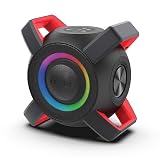
- Floats effortlessly on water for poolside and beach fun: Take your music directly to the pool, lake, or ocean without worry, as this speaker is designed to stay afloat, keeping the party going wherever the water takes you.
- IP67 waterproof and sandproof for worry-free outdoor use: Completely protected against immersion in water up to 1 meter for 30 minutes and impervious to sand and dust, making it the ideal companion for all your outdoor adventures, from beach days to camping trips.
- Wirelessly pair two speakers for a rich stereo sound experience: Amplify your audio and create a truly immersive soundscape by easily connecting two Wave Rider X speakers wirelessly, delivering powerful stereo separation and double the sound output for a more dynamic listening experience.
- Built-in FM radio with presets for listening to your favorite stations: Enjoy the convenience of tuning into your local FM radio stations directly through the speaker, complete with the ability to save your preferred channels for quick and easy access to news, music, and talk shows.
- Enjoy up to 10 hours of playtime on a single charge: Keep the music playing for hours on end thanks to the long-lasting rechargeable battery, ensuring your soundtrack accompanies you throughout your entire event or relaxation time without needing frequent recharges.
How is wave field synthesis different from stereo and Ambisonics?
| Approach | How it renders spatial sound | Practical distinction |
|---|---|---|
| Stereo stereophony | Uses a small speaker arrangement and interchannel level and timing cues to create perceived locations. | Typically creates phantom sources; it does not aim to reconstruct a full sound field across an area. |
| Wave field synthesis | Coordinates a loudspeaker array to approximate wavefronts over a listening region. | Requires a more complex array and processing; finite speaker spacing limits the ideal reconstruction. |
| Ambisonics | Represents and synthesizes a sound field using basis functions around a listener. | It is another spatial-audio approach, but uses a different formulation and system setup. See the AES overview of sound-field control. |
These methods make different engineering trade-offs. The most suitable one depends on the intended listening area, listener movement, array geometry, processing and room compensation, and the spatial accuracy required. The technical literature does not establish one method as universally superior.
What speakers does wave field synthesis use?
WFS uses multiple individually driven loudspeakers arranged as an array, alongside multichannel processing and amplification. Array geometry, channel count, speaker spacing, room acoustics, and installation design all influence the result. A single speaker cannot create a WFS system, and an ordinary consumer surround package should not be assumed to implement WFS.
Rank #2

- [HOW IT WORKS] The Wave Generator operates silently without producing any sound. Simply plug it in via the Micro USB port and it begins emitting 7.83Hz ultra-low frequency pulses. This device does not require connection to any additional equipment. It works by creating a stable electromagnetic field in your environment, which helps to neutralize disruptive frequencies and enhance spatial harmony. for those seeking a way to improve their surroundings.
- [RELAXING EFFECT] Experience deep relaxation with the 7.83Hz pure sine wave, scientifically aligned with the Earth's frequency. This Wave Generator effectively reduces electromagnetic and radio wave interference, creating a tranquil environment. Ideal for enhancing focus during music listening, meditation, or work. It also promotes better sleep by calming the mind and body, making it a great solution for insomnia and stress relief.
- [STABLE SIGNAL SOURCE] Built with advanced DSP signal synthesis technology, this generator delivers unmatched signal stability and precise frequency accuracy. The high-quality components ensure consistent performance, providing a reliable source of waves for your space. Whether for HIFI systems, meditation, or sleep improvement, this device maintains optimal functionality.
- [POWER SUPPLY & DESIGN] The Wave Generator is powered by a standard 5V Micro USB port, compatible with most phone chargers and power banks. Its sleek acrylic and PCB design includes a soothing breathing light indicator, adding a calming visual element to your environment. Compact and easy to place, it fits seamlessly into any room or office setup.
- [DUAL DIFFERENTIAL OUTPUT] Featuring a dual differential high-fidelity drive circuit, this audio resonator delivers powerful and distortion- waveform output. The enhanced output capacity ensures strong performance, making it effective for larger spaces. Whether used for HIFI speaker systems, AV setups, or personal relaxation, this generator provides clear and stable frequency coverage.
There is no universal minimum speaker count, spacing, or price established by the sources cited here. A setup must be designed as a system; choosing speakers alone is not enough to determine whether it can reproduce a useful sound field.
What’s actually slowing this PC down?
Pick the symptom - the matching free tool is one click away.
What are the limitations of wave field synthesis?
- Finite arrays approximate an ideal. Real installations cannot implement the continuous source distributions used in some theoretical descriptions.
- Spacing and array length matter. Discrete spacing and finite array extent constrain reconstruction and can introduce artifacts or reduce accuracy. An AES paper record on spatial sound-field reproduction by wave-field synthesis identifies finite array length and spacing as practical considerations.
- Rooms and system design affect playback. WFS does not eliminate room effects or guarantee identical sound at every position; processing and installation choices matter.
- It is a specialized installation. The array, amplification, processing, and room integration make it more involved than enabling a setting or adding one speaker.
Where is wave field synthesis used?
Technical literature discusses WFS in spatial-audio reproduction and production, including performance spaces, rooms, cinemas, and theaters. Researchers have also examined hybrid approaches that combine WFS with stereophony for greater flexibility in sound design and playback. These are documented application areas and research directions, not evidence that WFS is common in ordinary homes. Theile and Wittek review the concept, its constraints, and applications in “Wave field synthesis: A promising spatial audio rendering concept”.
Quick Recap
Product prices and availability are accurate as of the date/time indicated and are subject to change. Any price and availability information displayed on Amazon at the time of purchase will apply.

