
Recommended Free Tools
iTechGuides is reader-supported. When you buy through links on our site, we may earn an affiliate commission. As an Amazon Associate I earn from qualifying purchases. Learn more
Protein origami uses deliberately designed interactions between parts of a protein to guide it into a target structure. In coiled-coil protein origami (CCPO), peptide segments are joined in one chain and engineered to pair selectively, forming small polyhedral cages. Later work has expanded the idea to two-chain cages and larger assemblies built from separate protein components—but therapeutic uses remain prospective, not established products or treatments.
How a protein chain can fold into a designed shape
A protein’s amino-acid sequence influences how it folds. Protein origami takes advantage of that relationship by designing segments that interact in chosen ways, so the chain’s sequence and internal connections favor a planned geometry rather than relying only on naturally occurring folding patterns.
The analogy to DNA origami is helpful but limited. Both approaches use designed interactions among modules to guide assembly. In CCPO, however, the modules are peptide segments that form coiled-coil dimers, not DNA strands. Researchers choose a target shape, arrange coiled-coil modules to define its connections, and concatenate the segments into a polypeptide chain. Selective pairing then helps the chain fold into a cage. A review describes the coiled-coil modules as orthogonal building blocks for this kind of design. Nature Reviews Chemistry (2018)
Free tools Windows power users keep installed
One-click scans. No signup required.
What the original coiled-coil cages demonstrated
A 2017 study reported more than 20 single-chain cages in three shapes: tetrahedra, four-sided pyramids, and triangular prisms. The largest reported cage contained more than 700 amino-acid residues and measured 11 nm in diameter. The researchers compared the designs with assembled structures using solution small-angle X-ray scattering, electron microscopy, and biophysical analysis. Nature Biotechnology (2017)
#1 Best Overall

- FOR BASIC TEACHING TO ADVANCED SCIENCE: 444 pieces molecular model kit, including 136 atoms, 158 bonds and 150 parts for Carbon-60(Fullerene), provides to students from Grade 7 to Graduate level.
- TWO CHEMICAL STRUCTURE MODELS: The ball-and-stick models use spheres to represent atoms and sticks to represent chemical bonds. In the space-filling model, the spheres are drawn to scale and are next to one another as atoms are in real molecules.
- CHEMISTRY EDUCATIONAL MOLECULE MODEL IN 3D: It can display chemical structure, molecular bond, and bond angle in all directions. Demonstrate fundamental molecular geometry, chemical molecular structure, stereochemistry with 3D modeling studies.
- EASY TO LEARN: The universal standard adopted for each atom's color makes it easier for you to use and learn. Atoms and chemical bonds combine tightly and firmly and can be easily disassembled by disconnecting tools.
- If you’re not in love with it for whatever reason, we’ll give you a full replacement or refund—no questions asked. If you have any doubt, please tell us. With nothing to worry about, or even to share with your friends, try it now.
The study also reported self-assembly of a tetrahedral structure in bacteria, mammalian cells, and mice. The authors found no evidence of inflammation in those experiments. That result is limited to the tested settings: it does not establish human safety, therapeutic efficacy, or readiness for medical use.
How later designs extended the architecture
A two-chain cage with a conformational switch
A 2021 study reported a triangular-bipyramid fold made from 18 coiled-coil-forming segments using a two-chain assembly strategy. The researchers introduced a protease-cleavage site and masked interface segments, creating a proteolysis-mediated conformational switch in that design. This is a demonstrated feature of the reported construct, not a general property of protein origami. Nature Communications (2021)
Rank #2

- Package: Include 444 pieces chemistry molecular model kit, including 132 atoms, 158 bonds and 150 parts for Carbon-60(Fullerene), you can now understand 3D complex molecule structures
- High Quality Material: SOUJOY Chemistry model kit is made of high quality PP and LDPE to manufacture, feel smooth, no scraps or cutting edges from the holes, easy to remove and put on
- 3D Visual Active Learning: This organic and inorganic model kit is designed for easy chemistry learning for organic, inorganic, ochem and functional groups, you can now understand 3D complex molecule structures with ease by building your favorite molecules with them
- Perfect Gift for Learning: Our chemistry kit is modeling simple and small to more advanced and complex chemical structures for schools and college level, students of all ages, researchers and enthusiasts
- Easy to Storage: The atom parts and links are color coded to national standards for ease of identification, and the pieces come in a slim plastic box for convenient storage
Repeat-protein bricks and staples form superhelices
A separate 2023 approach used artificial αRep repeat proteins rather than concatenated coiled-coil segments. Complementary components called “brick” and “staple” were designed to associate directionally and assemble into macroscopic tubular superhelices. The report describes assembly at room temperature and structures that sustained temperatures as high as 75 °C. Researchers characterized the assemblies using small-angle X-ray scattering, transmission electron microscopy, and cryo-electron microscopy. This broadens the idea toward programmed protein assemblies, but it is not the same architecture as single-chain CCPO cages. PNAS (2023)
How the approaches differ
| Approach | Building blocks and assembly | Reported structure | Evidence described |
|---|---|---|---|
| 2017 CCPO | Coiled-coil peptide segments concatenated into a single chain | Polyhedral cages: tetrahedra, four-sided pyramids, and triangular prisms | More than 20 cages reported; structures analyzed by solution SAXS, electron microscopy, and biophysical methods |
| 2021 CCPO extension | 18 coiled-coil-forming segments in a two-chain assembly | Triangular bipyramid with a proteolysis-mediated conformational switch | A specific switch design was reported in the study |
| 2023 αRep assembly | Complementary artificial repeat-protein “brick” and “staple” components | Macroscopic tubular superhelices | Assembly reported at room temperature and sustained up to 75 °C; characterized by SAXS, TEM, and cryo-TEM |
What protein origami may—and may not—be used for
Designed cages and assemblies could eventually support research into drug delivery, molecular machines, or other biomedical applications. The cited studies establish design and assembly results, not a clinical treatment, validated drug-delivery system, or consumer product. The reported mouse and cell experiments do not bridge that gap; human safety and efficacy have not been established by the evidence described here.
Quick Recap
Rank #4

- Visualize Molecular: The molecular model kit simplifies complex chemistry concepts into tangible 3D structures improve learning efficiency, suitable for students from Grade 7 to Graduate level.
- 240 Pcs Complete Set: The atom model kit includes with 86 atoms and 154 bonds, explore most the molecules structures from simple compounds to complex polymers.
- Effortless Assembly: Embedded component design ensures easy to construct Ball-and-stick and Space-filling models that maximizes focus on exploration without complex assembly.
- Durable & Portable: Built to last, the chemistry set is crafted from high-quality materials. Plus, its portable design allows you to take your experiments learning anywhere, between the home, classroom and lab.
- Essential Study Tool: Whether you're studying organic chemistry, biochemistry, or molecular biology, molecule building kit is an perfect learning tool for you deeper comprehension of molecular science.
Rank #3
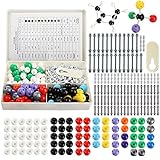
- YOPAY 240 pieces molecular model kit is your chemistry best friend, it includes 86 Atoms and 153 Links and 1 Short link remover tool, Covering 12 elements: hydrogen, carbon, oxygen, nitrogen, sulphur, phosphorus, fluorine, chlorine, bromine, iodine, metal and boron, you can now understand 3D complex molecule structures with ease to provide hands-on learning experience of molecular structures and functional groups.
- The Most Effective and Fun Way to Learn Chemistry - The chemistry molecular structure model kit can unlock and develop your chemistry genius, Models make science come to life! Use atom pieces to practice structures, cyclic compounds, empirical formula, stereo isomerism, and VSEPR theory. Explore chemistry and physics concepts. Visualize atomic structure with atoms, bonds, orbitals, and links.
- High Quality and Portable - It is extremely hard to damage our atom balls or bonds because we used the highest quality PP and LDPE to manufacture. It is made from high quality materials designed for easy assembly. The pieces are color coded to national standards and all kits come with a box for easy storage and transport with your other textbooks, notes, and books.Our model kit is deserve to serve you for years to come.
- For All Levels of Learning - The chemistry model kit utilize the ball and stick toys educational structure to teach students from grade 7 to the University Graduate Level (Over 12 years). Demonstrate fundamental molecular geometry, chemical and biology structure, stereo chemistry with 3D modelling studies.The perfect tool for memorizing organic, inorganic and functional group chemistry.
- 3D Visual Active Learning, Let's Build; Thanks to our universal standard color coded Atomic Balls, you can now understand 3D complex molecule structures with ease by building your favorite molecules with our 240 ball and stick models, The YOPAY Atom Model Kit is your chemistry best friend.
Product prices and availability are accurate as of the date/time indicated and are subject to change. Any price and availability information displayed on Amazon at the time of purchase will apply.

