
iTechGuides is reader-supported. When you buy through links on our site, we may earn an affiliate commission. As an Amazon Associate I earn from qualifying purchases. Learn more
Scientists infer molecular charge distribution by measuring how X-rays or electrons scatter and refining those measurements into a model of electron density. High-resolution X-ray diffraction can reveal bonding-related density in crystals; a method reported by the University of Vienna in 2025 uses electron diffraction and ionic scattering factor modelling to estimate atomic partial charges. Neither approach is a photograph of fixed charges: each produces evidence interpreted through a model.
Can scientists see electrons in a molecule?
Not as a conventional photograph. When X-rays interact with electrons in a crystal, they scatter into a pattern of intensities at different angles. Researchers use that pattern to infer the arrangement of atoms and, with suitable data and analysis, the distribution of electron density. The measurement is an inverse problem: a model is refined to account for the observed scattering.
As Yale professor Michael McBride explains, scattered rays reveal “where the atoms are in the molecule; more precisely, as you’ll see, where the electrons are in the molecule, or in the crystal.” Open Yale Courses’ X-ray diffraction lecture introduces this connection between diffraction and electron distribution.
Quick wins for a faster PC:
Clear out junk files and repair common Windows errorsFree Scan →Fix the driver behind crashes, sound loss and screen glitchesFind Drivers →Repair Windows errors before they cause bigger problemsFix Now →What X-ray diffraction reveals—and what routine refinement misses
In routine crystallography, the independent atom model (IAM) treats atoms as separate spherical scattering centers. It is useful for determining atomic positions and displacement parameters, but it does not adequately describe the subtle density between atoms where chemical bonding occurs.
#1 Best Overall

- FOR BASIC TEACHING TO ADVANCED SCIENCE: 444 pieces molecular model kit, including 136 atoms, 158 bonds and 150 parts for Carbon-60(Fullerene), provides to students from Grade 7 to Graduate level.
- TWO CHEMICAL STRUCTURE MODELS: The ball-and-stick models use spheres to represent atoms and sticks to represent chemical bonds. In the space-filling model, the spheres are drawn to scale and are next to one another as atoms are in real molecules.
- CHEMISTRY EDUCATIONAL MOLECULE MODEL IN 3D: It can display chemical structure, molecular bond, and bond angle in all directions. Demonstrate fundamental molecular geometry, chemical molecular structure, stereochemistry with 3D modeling studies.
- EASY TO LEARN: The universal standard adopted for each atom's color makes it easier for you to use and learn. Atoms and chemical bonds combine tightly and firmly and can be easily disassembled by disconnecting tools.
- If you’re not in love with it for whatever reason, we’ll give you a full replacement or refund—no questions asked. If you have any doubt, please tell us. With nothing to worry about, or even to share with your friends, try it now.
To examine that bonding-related density, researchers collect high-resolution X-ray diffraction data and use a multipole model (MM). Rather than assuming each atom is a perfect sphere, the model represents departures from spherical density. The resulting refined electron density can show how charge is distributed through a crystal’s bonds and other regions. The University of Göttingen’s charge-density overview explains the distinction between IAM and multipole refinement.
Temperature matters because atomic motion can blur the density being measured. Low-temperature diffraction reduces that motion, and very high resolution is important for experimental charge-density work. The measurements described in the literature here concern crystals, so the observed density reflects the crystalline environment as well as the molecule. The University of Milan’s overview of experimental charge-density analysis describes applications including intermolecular interactions, aromaticity, electron delocalization, hypervalence, conjugation and coordination.
Rank #2

- Visualize Molecular: The molecular model kit simplifies complex chemistry concepts into tangible 3D structures improve learning efficiency, suitable for students from Grade 7 to Graduate level.
- 444 Pcs Complete Set: The atom model kit includes with 136 atoms,158 bonds, and 150 fullerene model parts, explore most the molecules structures from simple compounds to complex polymers.
- Effortless Assembly: Embedded component design ensures easy to construct Ball-and-stick and Space-filling models that maximizes focus on exploration without complex assembly.
- Durable & Portable: Built to last, the chemistry set is crafted from high-quality materials. Plus, its portable Snap-Lock design allows you to take your experiments learning anywhere, between the home, classroom and lab.
- Essential Study Tool: Whether you're studying organic chemistry, biochemistry, or molecular biology, molecule building kit is an perfect learning tool for you deeper comprehension of molecular science.
What an electron-density map can tell you
A refined density is a basis for chemical analysis, not a self-explanatory picture. One common framework, QTAIM, examines features of the density and its derivatives. A bond critical point is a saddle point in the density between two atoms; a bond path connects atoms through that point. Density and its Laplacian can help characterize bonding, including covalent and ionic contributions. Valence-shell charge concentrations in nonbonding regions may correspond to lone-pair locations.
Outdated Drivers Are Slowing You Down
One free scan finds every outdated or missing driver and matches the right update for your exact hardware.Free scan · exact hardware matchWindows Errors? Fix Them Before They Spread
Repair common Windows errors and clear accumulated junk for a smoother, more stable PC - no reinstall needed.Free scan · no reinstallResearchers can also derive electrostatic-potential maps from the density. These maps help identify regions relevant to electrophilic or nucleophilic interactions. No single feature, such as a bond critical point, supplies a complete, context-free verdict on the nature of a chemical bond; interpretation depends on the density model and the chemical question.
Rank #3

- UNLOCK YOUR CHEMISTRY POTENTIAL: Our comprehensive molecular model kit includes 238 pieces, featuring 84 atoms, 153 bonds and a remover tool. Suitable for chemistry learners from beginners to advanced levels. Manufacturer recommended age: 15 years and up
- ORGANIZED STORAGE AND EASY LOCATING: Experience hassle-free organization with our storage box, complete with divided compartments and labeled sections. Say goodbye to clutter and quickly find the components you need
- EXTRA LEARNING MATERIALS FOR EXCELLENCE: Enhance your studies with our bonus 6-page learning guide and stencils. From grade 9 to college, from organic to inorganic, finish and master your assignments faster and create numerous molecular structures with ease
- IMMERSIVE 3D VISUAL LEARNING: Explore chemistry in a captivating way with our 3D visual learning approach. The universal color-coded Atomic Balls provide a better understanding of molecular structure, boosting your chemistry knowledge. It's also a perfect gift for someone who are going to learn those complex molecule
- EASY-TO-USE DESIGN: Crafted from smooth, burr-free plastic, our molecular science kit ensures easy assembly. With the included remover tool, disassembling is a breeze
How partial charges are estimated
A partial charge assigns a portion of a molecule’s electron distribution to an individual atom. It is useful in molecular modelling, but it is not a uniquely defined quantity that every valid method must assign identically. Computational methods may, for example, fit atomic charges to reproduce a molecular electrostatic potential (ESP charges) or partition the electron density itself. The result can vary with the charge-assignment algorithm.
On 21 August 2025, the University of Vienna reported a method developed by a team led by Tim Grüne and Christian Schröder that combines electron diffraction with ionic scattering factor modelling (iSFAC). In this approach, an atom is modelled jointly as neutral and charged species, and the diffraction data are used to quantify its partial charge. The team presented the method as a way to assess and refine theoretical charge models—not as proof that every molecule now has one universally agreed set of atomic charges. The University of Vienna’s 2025 announcement describes the reported technique and its motivation.
Rank #4
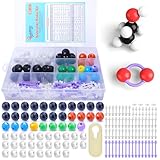
- ADVANCED LEARNING SCIENCE EDUCATION KIT --- Perfect chemistry model kit for modeling simple and small to more advanced and complex chemical structures for schools and college level, students of all ages, researchers and enthusiasts. Fun and interactive early learning molecular set for kids of all years and for use in the classroom.
- HIGH QUALITY --- Made from high quality durable materials designed for easy construction and perfect fit. These Molecular Model Kit pieces are color coded to national standards for easy ID. Organic Chemistry Model Kit includes box for easy storage and transport with your other textbooks, notes, and books. Excellent for the classroom.
- POWERFUL FUNCTIONS --- This Molecular Model Kit has a total of 136 pieces including short link remover tool. Super easy to build models for organic and inorganic chemistry, This model contains C, H, O, N, S and a variety of single and double bonds, Can be put high school, university chemistry in most of the organic or inorganic molecular structure model for the study of experimental operation.
- QUICK AND EASY ASSEMBLY OF COMPLEX STRUCTURES --- Atoms and bonds that are perfectly suited to being connected and disconnected easily without making your fingers hurt. We've also included a link remover to make the task of easy.
- CONVENIENT STORAGE --- The pieces come in a slim plastic box for convenient storage. See the pictures on this listing for a full understanding of what's inside
Which approach answers which question?
| Approach | What is measured or modelled | Useful result | Key qualification |
|---|---|---|---|
| Routine X-ray diffraction with IAM refinement | X-rays scattered by electrons; atoms modelled as spherical scattering centers | Atomic positions and displacement parameters | Does not adequately model subtle interatomic bonding density. |
| High-resolution X-ray diffraction with multipole refinement | Crystal diffraction data refined with a model that represents departures from spherical atomic density | Bonding-related electron-density distribution for further analysis | The density is refined through a model and measured in a crystalline environment. |
| Electron diffraction with iSFAC, reported in 2025 | Electron diffraction interpreted with ionic scattering factors for neutral and charged species | An experimental estimate of atomic partial charges | Reported as a means to evaluate and refine computational models; universal uniqueness or broad adoption is not established. |
Further reading
For a more detailed treatment of charge density and bonding, the University of Göttingen page cites Philip Coppens’s X-Ray Charge Density and Chemical Bonding.
Quick Recap
Best Value

- Visualize Molecular: The molecular model kit simplifies complex chemistry concepts into tangible 3D structures improve learning efficiency, suitable for students from Grade 7 to Graduate level.
- 240 Pcs Complete Set: The atom model kit includes with 86 atoms and 154 bonds, explore most the molecules structures from simple compounds to complex polymers.
- Effortless Assembly: Embedded component design ensures easy to construct Ball-and-stick and Space-filling models that maximizes focus on exploration without complex assembly.
- Durable & Portable: Built to last, the chemistry set is crafted from high-quality materials. Plus, its portable design allows you to take your experiments learning anywhere, between the home, classroom and lab.
- Essential Study Tool: Whether you're studying organic chemistry, biochemistry, or molecular biology, molecule building kit is an perfect learning tool for you deeper comprehension of molecular science.
Product prices and availability are accurate as of the date/time indicated and are subject to change. Any price and availability information displayed on Amazon at the time of purchase will apply.

