
What’s actually slowing this PC down?
Pick the symptom - the matching free tool is one click away.
iTechGuides is reader-supported. When you buy through links on our site, we may earn an affiliate commission. As an Amazon Associate I earn from qualifying purchases. Learn more
Adding a reactive sulfur compound during synthesis helped a research team produce cadmium-free zinc–selenium–tellurium quantum dots with purer blue emission and higher efficiency in a laboratory QLED prototype. The reported result is promising, but it does not show that cadmium-free quantum-dot displays are commercially ready.
What changed in the quantum dots?
Xuyong Yang’s team at Shanghai University modified zinc–selenium–tellurium (ZnSeTe) quantum dots by adding a reactive sulfur–triphenylphosphite reagent while the nanocrystals were being synthesized. The resulting material is described as ZnSeTeS. Quantum dots are semiconductor nanocrystals whose optical and electronic properties depend on their size, as University of Central Florida researcher Yajie Dong explains in Chemistry World’s March 25, 2025 report.
The proposed role of sulfur was to keep tellurium more evenly distributed rather than allowing it to collect in pockets. A more uniform crystal can have fewer defects that trap electrons. In the team’s fabricated QLED prototype, the sulfur-modified material produced purer blue light and improved efficiency compared with the original ZnSeTe material.
What did the prototype achieve?
Chemistry World reported these headline results for the ZnSeTeS QLED. They are figures attributed to that secondary report, which cites Q Wu and colleagues’ 2025 Nature paper, DOI 10.1038/s41586-025-08645-4; the full primary paper and supplementary methods were not available for independent verification here.
#1 Best Overall

- Optics Elements for Interference Diffraction Optical Physical Experiment.
- Single Slit/Double Slits Interference Diffraction.
- Suitable for: who are prepared for physics by understanding the interference and diffraction of light in advance.
- This kit is used in class to illustrate the phenomenon of light interference.
- This film is made of PET material, please do not use high power laser to avoid damage to the film.
| Measure | Reported result | What it indicates |
|---|---|---|
| External quantum efficiency | 24.7% | The report says this is more than double the quantum efficiency of the original ZnSeTe lattice. Dong described it as among the best-performing cadmium-free blue QLEDs. |
| Emission linewidth | 17 nm at 460 nm | A narrower emission band indicates more concentrated blue output and can support better color purity. Dong called the linewidth excellent for display applications. |
| Half-lifetime | 30,000 hours | The reported prototype lifetime is promising, but the report says stability and lifetime still need optimization for commercial electronics. |
These figures should not be read as a standardized product comparison. The report does not provide a full head-to-head table or enough test conditions to establish that the results are directly comparable with particular cadmium-based devices or other products.
Why does the sulfur modification matter for blue light?
Blue emission is a demanding target for quantum-dot displays: the emitted color needs to be sufficiently pure, while the device must also convert electrical input into light efficiently and remain stable over time. According to the report’s interpretation, sulfur addresses a materials problem—uneven tellurium distribution and resulting defects—rather than simply changing a display setting. Fewer electron-trapping defects and a more uniform crystal were linked to improved efficiency and narrower emission.
Rank #2
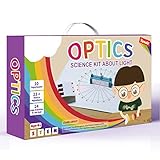
- Explore the Science of Light: Discover the fascinating world of optics with 15+ hands-on light experiments and learn how light travels, reflects, refracts, and forms images through real scientific exploration.
- Create Rainbows & Optical Effects: Use the included prism, lenses, mirrors, and transparent optical blocks to observe amazing optical phenomena such as rainbow formation, color mixing, and light refraction.
- Complete Optical Science Lab Kit: This STEM kit includes more than 25 experimental components, allowing kids to build their own mini physics laboratory and perform a wide variety of optics experiments at home or in school.
- Easy-to-Follow Experiment Guide: The 32-page full-color manual provides clear step-by-step instructions and explanations that help students understand key physics concepts while encouraging curiosity and scientific thinking.
- Perfect STEM Gift for Curious Kids: A fun and educational science kit designed for boys and girls ages 8-16, ideal for STEM learning, science projects, homeschooling, classroom demonstrations, birthdays, and holiday gifts.
Dong told Chemistry World that blue QLEDs could contribute to full-color displays alongside red and green QLEDs, or potentially serve as a backplane technology replacing blue organic LEDs. Those are possible applications, not evidence that this material is already being used in commercial screens.
Does “without cadmium” mean the material is safe?
No such conclusion follows from the reported results. The material is presented as heavy-metal-free and avoids cadmium, but the report does not establish that it is risk-free or provide a complete toxicological or lifecycle assessment. “Cadmium-free” describes a composition choice; it is not, by itself, a safety certification.
Rank #3

- Investigate the building blocks of life and learn the ABC's of DNA!
- Isolate plant DNA in a test tube.
- Learn about biological inheritance.
- Assemble a DNA model to see its elegant double-stranded helical structure.
- A 48-page, full-color manual guides you through 20 experiments and teaches about the basics of genetics and DNA.
Are cadmium-free quantum-dot displays ready to buy?
The work concerns synthesized nanocrystals and an experimental LED device, not a consumer product. The report identifies no available display, validated supplier, or purchasing route for this material. It also states that stability and lifetime require further optimization before commercial electronics use. The reported performance is therefore a research advance, not proof of commercial readiness.
Quick Recap
Best Value

- TOYS THAT TEACH: MindWare’s Zoom, Ooze & Explore Ultimate Science Lab is a Science Academy experiment kit that makes understanding science basics fun, easy and safe. Learn to hypothesize, measure and record your results!
- HANDS-ON SCIENCE: Experience amazing hands-on science! You’ll mix concoctions, send balloon rockets zooming across the room and much more.
- AMAZING CHEMISTRY: This Ultimate MindWare Lab explores chemistry with simple and safe experiments! Each activity, from DIY thermometers to bending water and more, gives hands-on lessons in chemistry and biology.
- GUIDEBOOK AND LAB STATION: The multi-level lab station will keep you organized as you go through the illustrated step-by-step instructions in the guidebook and learn mini lessons about the chemistry behind your experiments.
- INCLUDES: All ingredients and supplies needed for your chemistry experiments! All ingredients are safe and non-toxic. Includes safety goggles and latex-free gloves. (Ages 8 and up)
Rank #4

- This is a multi-functional learning kit,three power generation modes, energy conversion, circuit learning, and understanding of the conversion between sound, light and electricity.
- Solar power generation, using solar panels to convert the solar energy into electrical energy.
- Hand-cranked generator, kinetic energy is converted into electrical energy to light an LED or turn the fan
- The windmill generator,harness wind power and light an LED
- An excellent Family & Kids program,great for Primary and secondary schools projects,With Paper Instructions
Product prices and availability are accurate as of the date/time indicated and are subject to change. Any price and availability information displayed on Amazon at the time of purchase will apply.

