
iTechGuides is reader-supported. When you buy through links on our site, we may earn an affiliate commission. As an Amazon Associate I earn from qualifying purchases. Learn more
Developers can build useful businesses around voice AI by helping people complete real tasks—not just by making a system sound human. The clearest opportunities are task-focused agents, voice application infrastructure, integrations and deployment, and tools that test and improve production performance. Choosing among them starts with a specific user problem, a measurable outcome, and an architecture that can handle real conversations reliably.
Where developers can find voice AI opportunities
Voice is an interface, not a product strategy by itself. A strong product connects speech to a workflow, completes an action safely, and knows when to hand the conversation to a person. That leaves room for products at several layers of the stack:
- Task agents: Handle a narrow, repeatable workflow such as answering a support question, updating an account, or booking an appointment.
- Voice experiences: Make existing products more useful through spoken practice, coaching, or hands-free interaction.
- Developer infrastructure: Simplify streaming audio, speech recognition and synthesis, turn-taking, tool calls, or telephony.
- Evaluation and operations: Help teams test conversations, inspect failures, measure outcomes, and improve deployments.
- Integration and deployment: Connect agents to business systems and communications channels, or help organizations meet their deployment requirements.
These are opportunity areas, not guarantees of demand or profitability. A developer should validate a particular customer problem and the cost of solving it before treating market growth claims as evidence for a business plan.
Recommended Free Tools
What the market signals do—and do not—show
Deepgram and Opus Research’s 2025 State of Voice AI survey was based on 400 business leaders. Its results indicate interest among those respondents, but they are sponsor-reported survey findings, not universal measures of adoption:
#1 Best Overall

- ENHANCED CONTEXT WITH MULTIMODAL INPUT: Capture audio, type notes, add images, and press to highlight key moments for richer context. During recording, instantly mark key moments with a single button press. Simultaneously enrich your audio by snapping photos of important documents or typing in ideas
- CHAT WITH YOUR RECORDINGS USING "ASK Plaud": Unlock deeper insights with this interactive AI. Ask questions, extract key points, draft emails, and get next-step suggestions—all grounded in your original audio for reliable, ready-to-use answers
- INTELLIGENT RECORDING WITH AI DIRECTIONAL AUDIO: Enjoy seamless, intelligent recording with Plaud Note Pro. Its AI automatically switches between call and meeting modes while recording, while directional audio and real-time spatial awareness minimize noise to capture voices with crystal clarity
- Everything Included: Includes Plaud Note Pro, magnetic case, magnetic ring, charging cable, and a free Starter Plan with 300 transcription minutes per month. Upgrade anytime in the Plaud app to Pro Plan (1,200 min/mo) or Unlimited Plan(Up to 24 hours of transcription per user per day)
- PREMIUM ULTRA-SLIM DESIGN WITH INSTANTVIEW DISPLAY: Meticulously designed, the AI Note Taker is just 0.12 inches thin and 1.06 oz —about the size of a credit card. Its sleek aluminum body with a textured wave finish features a vivid AMOLED display, letting you check battery and recording status at a glance, while it seamlessly works with Apple Find My to ensure you never misplace it
- 92% said their organization captures speech data, and 56% said it transcribes more than half of its interactions.
- 67% considered voice AI core to product and business strategy.
- 80% used traditional voice agent systems, while 21% said they were very satisfied with them.
- 84% planned to increase voice AI budgets in the following 12 months.
- 50% used traditional voice agents for task or service automation and considered that the most compelling voice-agent use case.
- 46% cited model fine-tuning as a key to greater adoption.
The combination of reported use and low reported satisfaction suggests room to improve existing systems, but it does not prove that any particular product will find buyers. Treat the figures as a signal to interview potential users and test a specific workflow.
Coval’s Voice AI 2026 report makes several broader claims: speech-recognition accuracy improved by 54%, costs fell by 60–87% “across the entire stack,” and the market reached $10.3 billion with 51% year-over-year growth. The reviewed report material does not establish these as independently measured industry statistics, so they should be read as Coval’s claims rather than settled market measurements. The report also presents a 95% week-one success rate in controlled demos versus 62% with real customers; those are Coval-reported figures, not independently validated benchmark results. Read Coval’s 2026 report.
Product opportunities, from user workflow to developer tooling
Build a vertical agent that completes a task
Customer support and service automation are explicit use cases in the Deepgram survey, and OpenAI identifies customer support as an early voice application. The opportunity is not simply to put a microphone on an existing chatbot. Focus on a bounded workflow, such as checking an order, rescheduling an appointment, or resolving a common service request. The agent needs the right data and permissions, integrations that can carry out the action, clear confirmation before consequential changes, and an escalation route for exceptions.
Rank #2

- AI-POWERED TRANSCRIPTION & SUMMARIES: Plaud Note Pro is your professional voice transcriber, delivering high-accuracy transcription in 112 languages with auto speaker labels. Powered by top AI models and thousands of templates, Note Pro instantly creates structured summaries, mind maps, To-Do lists, and proposals tailored to your role and industry
- ENHANCED CONTEXT WITH MULTIMODAL INPUT: Capture audio, type notes, add images, and press to highlight key moments for richer context. During recording, instantly mark key moments with a single button press. Simultaneously enrich your audio by snapping photos of important documents or typing in ideas
- CHAT WITH YOUR RECORDINGS USING "ASK Plaud": Unlock deeper insights with this interactive AI. Ask questions, extract key points, draft emails, and get next-step suggestions—all grounded in your original audio for reliable, ready-to-use answers
- INTELLIGENT RECORDING WITH AI DIRECTIONAL AUDIO: Enjoy seamless, intelligent recording with Plaud Note Pro. Its AI automatically switches between call and meeting modes while recording, while directional audio and real-time spatial awareness minimize noise to capture voices with crystal clarity
- Everything Included: Includes Plaud Note Pro, magnetic case, magnetic ring, charging cable, and a free Starter Plan with 300 transcription minutes per month. Upgrade anytime in the Plaud app to Pro Plan (1,200 min/mo) or Unlimited Plan(Up to 24 hours of transcription per user per day)
A good initial use case has a recognizable success condition and a safe failure path. If the agent cannot verify identity, understand a request, or complete an action, it should explain what it can do next or transfer the case rather than improvise.
Create a voice-first experience within an existing product
OpenAI describes a language-learning app that uses real-time voice for role-play practice and a nutrition and fitness coaching app that pairs conversational voice with human specialists when needed. These are product examples, not evidence of market size. They point to a useful design pattern: voice can make practice or ongoing interaction feel more natural, while a human remains available for situations that need judgment or expertise.
Build tools that make voice systems easier to ship
Teams may need components for speech recognition, speech synthesis, real-time audio transport, telephony, orchestration, function calling, interruption handling, and deployment controls. A product can solve one difficult layer or provide a more integrated path. Deepgram describes an integrated voice-agent API with barge-in detection, turn prediction, function calling, and support for external models; these are provider-described capabilities and should be verified against an application’s actual requirements. See Deepgram’s Voice Agent API.
Rank #3
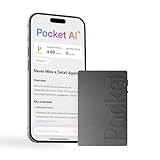
- YOUR AI PERSONAL ASSISTANT FOR EVERYDAY PRODUCTIVITY: More than a voice recorder, Pocket works as your AI personal assistant to capture, transcribe, and summarize meetings, calls, and ideas instantly. Core features are included out of the box, with optional advanced tools available for power users.
- ONE-TAP RECORDING FOR REAL-LIFE MOMENTS: Capture meetings, phone calls, and in-person conversations instantly with a simple tap, no typing, no interruptions, just effortless note-taking anywhere you go.
- SMART AI INSIGHTS & ORGANIZATION: Pocket automatically turns recordings into clear summaries, key action items and structured conversation maps so you can quickly review what matters without digging through audio.
- TURN CONVERSATIONS INTO ACTION WITH “ASK POCKET”: Don’t just record, understand. Instantly ask questions across your meetings, extract key insights and generate next steps in seconds. All grounded in your recordings, so answers stay accurate and reliable.
- MAGSAFE COMPATIBLE FOR SEAMLESS USE: Easily attach Pocket to your iPhone or other MagSafe compatible devices for convenient, hands-free recording on the go. Perfect for capturing meetings, calls, and ideas without needing to hold your device.
OpenAI’s Realtime API announcement describes direct streaming of audio inputs and outputs, along with function calling. It also describes integrations with LiveKit, Agora, and Twilio. These examples illustrate that a voice product may depend on a wider communications and application stack, not just a model endpoint. Read OpenAI’s Realtime API announcement.
Help teams evaluate and operate agents
Evaluation tooling can address test-case generation, call review, outcome tracking, and operational dashboards. Coval’s report argues for comprehensive testing, production monitoring, and continuous improvement, and frames performance around resolution rate, average handle time, human-agent productivity, outcomes after escalation, and the full customer journey. Coval also sells evaluation infrastructure, so its recommendations and performance claims should be understood as vendor perspective rather than independent validation.
For developers, the practical gap is often between a demo that sounds convincing and a deployed system that consistently completes customer tasks. Tools that expose failure patterns and connect them to actionable fixes can be valuable if they fit a team’s existing workflow and measure outcomes that matter to that team.
Rank #4
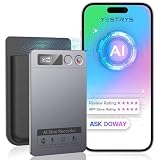
- Cutting-Edge AI Transcription & Summarization: Leverage GPT-4o’s advanced intelligence in this top-tier AI voice recorder for real-time, highly accurate speech-to-text conversion and contextual summarization. Experience natural language processing that delivers polished, instantly usable transcripts—eliminating manual editing. Ideal for professionals seeking efficient documentation
- 1-Year Unlimited Premium Suite: Unlock 12 months of free DOWAY premium access with your powerful voice recorder: Enjoy limitless transcription, AI-powered professional templates, and smart note-organization tools. Transform recordings into structured documents for business reports, academic notes, or content creation
- Global 152Language Comprehension: Seamlessly transcribe and summarize content across 152 languages with this intelligent AI recorder – from major business dialects to regional languages. Break communication barriers in international meetings, research, or travel without compromising accuracy
- Massive 64GB Storage + Military-Grade Cloud Sync: Store 500+ hours of high-fidelity audio internally (no cards needed) on this feature-packed voice recorder, with automatic backups to encrypted cloud storage. Access files securely worldwide through the DOWAY app—your data remains private yet universally available
Integrate and deploy voice systems for customers
There is also implementation work in connecting agents to customer systems, communications services, and specialized environments. Deepgram describes managed, single-tenant, VPC, and self-hosted deployment choices; the precise availability and suitability of any option should be confirmed with the provider. OpenAI’s examples of LiveKit, Agora, and Twilio integrations show some of the services teams may need to evaluate. Deployment, privacy, and data-residency requirements depend on the customer and jurisdiction, so confirm technical and regulatory requirements directly with providers.
Independent reader supportYour contribution helps us test, update, and keep practical guides available for everyone.Choose an architecture by the trade-off you need
Two broad implementation approaches are relevant. A modular pipeline gives the team control over component choices; a unified voice API can reduce the work of connecting components. Neither is automatically best: the right choice depends on latency, flexibility, integration effort, and the application’s operating requirements.
| Approach | What it combines | Main advantage | Main trade-off |
|---|---|---|---|
| Modular pipeline | Separate automatic speech recognition, language model, and text-to-speech services | Choose or replace components independently | The developer must coordinate streaming, turn-taking, interruptions, and latency across services |
| Unified voice API | A provider-integrated voice experience, potentially including recognition, orchestration, and synthesis | Can reduce integration work and provide built-in voice-agent controls | Provider capabilities, model flexibility, deployment options, and performance must be checked against the use case |
OpenAI’s announcement describes the earlier multi-step pattern and contrasts it with direct audio streaming in its Realtime API. Deepgram’s product page describes an integrated API while allowing external model use. Those product descriptions are starting points, not substitutes for application-specific testing. Compare candidate approaches on:
Best Value

- Plaud Intelligence: Capture conversations in 112 languages and generate accurate transcripts with the Plaud App and Web. Plaud Intelligence uses leading models like GPT-5.5, Claude Sonnet 4.6, and Gemini 3.1 Pro to transform raw audio into structured insights. Choose from over 10,000 professional templates to generate mind maps and to-do lists, turning hours of discussion into immediate clarity
- Multiple Ways To Wear With Included Accessories: Adapt Plaud NotePin S to any workflow instantly with four included accessories. Wear your device effortlessly as a necklace, wristband, clip, or pin. Plaud NotePin S features a dedicated physical record button for precise, tactile control. Stay professional and keep your intelligence within reach all day
- Enterprise-grade Privacy: Built to the highest standards with ISO 27001/27701, SOC 2, HIPAA, GDPR, and EN18031 compliance. Every conversation is secure and protected. It is the trusted choice for creative, medical, and business professionals handling sensitive info
- Multimodal Input & Multidimensional Summaries: Capture audio, type notes, add images, and press/tap to highlight for richer context with multimodal input. Press the record button to mark key moments in real time. Plaud transforms a single conversation into multiple perspectives, providing faster, clearer insights, and unifies these inputs to deliver role-specific summaries that reflect your intent and priorities
- Lightweight Power and Peace of Mind: Weighing only 0.61 oz, Plaud NotePin S delivers 20 hours of continuous recording and 40 days of standby time. Store up to 64GB of audio locally, ensuring you capture every insight even without an internet connection
- End-to-end latency and how the system handles turn-taking and interruptions.
- Recognition quality for the intended languages, accents, background noise, and domain terminology.
- Generated voice quality and control over how speech is produced.
- Model choice, orchestration flexibility, and the ability to call tools safely.
- Telephony and application integrations, along with deployment and data-residency requirements.
- Observability, evaluation, escalation, and recovery behavior when a request cannot be completed.
- Total cost under realistic concurrency and call duration.
Do not make a durable cost comparison from launch-era prices or a product-page rate alone. OpenAI’s launch article includes historical pricing and limits; Deepgram’s product page displays $4.50 per hour for its full stack. Those are volatile provider facts, not a like-for-like cost comparison. Check current pricing, what the charge covers, and the billing unit directly with each provider before estimating unit economics.
Design for production, not only a convincing demo
A useful evaluation asks whether the agent resolves the task, how long completion takes, what happens when it fails, and whether a handoff helps or harms the customer journey. Voice naturalness matters, but it cannot stand in for these outcomes.
- Define the successful outcome. Specify what counts as a resolved task, including the cases that should be escalated instead of handled autonomously.
- Build representative tests. Include ordinary requests, interruptions, ambiguous wording, relevant terminology, noisy audio, and cases in which an integration fails or returns incomplete information.
- Measure the full interaction. Track resolution rate, latency, average handle time, escalation quality, post-escalation outcomes, and the cost of realistic usage—not just whether the model produced a plausible response.
- Review real conversations responsibly. Use production observations to identify recurring failures and improve prompts, tools, routing, or models. Apply the customer’s privacy and data-handling requirements to recordings and transcripts.
- Keep recovery visible. Give the user a way to repeat, clarify, switch channels, or reach a person when the system cannot safely finish.
Coval’s report argues that controlled demonstrations can overstate deployment results and recommends systematic testing, orchestration across models, and learning from production conversations. Those recommendations are consistent with building an improvement loop, but the report’s own figures should not be treated as independent performance benchmarks.
The Tool Desk
Outbyte Driver Updater FREEFix the driver behind crashes, sound loss and screen glitchesFind Drivers →Outbyte PC Repair FREEClear out junk files and repair common Windows errorsFree Scan →Test business models against actual usage
A voice product’s economics depend on how much audio it processes, how long sessions run, how often people use it, and what human support or integrations cost. AWS Startups’ August 18, 2025 article says future monetization is likely to combine platform fees with usage-based components. That is a model to test, not a guarantee of healthy margins. Estimate costs at realistic call durations and concurrency, then compare them with the value of a successfully completed workflow and any continuing operational costs.
What to build first
For a developer or founder choosing a starting point, the most defensible sequence is to narrow the workflow before choosing the stack:
- Find a repeated, costly interaction. Talk with the people who perform or receive it and identify where voice is genuinely preferable to a form, chat, or existing call flow.
- Limit the agent’s responsibility. Choose a task with accessible data, clear authorization, and a human fallback for exceptions.
- Prototype competing architectures. Compare a modular pipeline and a unified API using the same representative conversations and success criteria.
- Connect one real action. Test the system against the customer workflow it is supposed to change, including permissions and failure handling.
- Decide from measured results. Expand only when task completion, user experience, operational burden, and cost are acceptable under realistic conditions.
The opportunity is broad, but the product test is specific: can the system complete a valuable task reliably enough to justify its cost and place in the workflow?
Quick Recap
Product prices and availability are accurate as of the date/time indicated and are subject to change. Any price and availability information displayed on Amazon at the time of purchase will apply.
What’s actually slowing this PC down?
Pick the symptom - the matching free tool is one click away.

