
Recommended Free Tools
iTechGuides is reader-supported. When you buy through links on our site, we may earn an affiliate commission. As an Amazon Associate I earn from qualifying purchases. Learn more
Yes—software can reduce the electricity needed for some AI workloads and help data centers schedule flexible jobs around power and grid conditions. It is a practical control layer that can be changed faster than major hardware or infrastructure, but it is not a standalone fix: savings depend on the workload and configuration, and lower energy per task does not guarantee lower total electricity use.
Why software is part of the power problem—and the response
AI data centers need more than fast processors: they need enough electrical capacity to run servers and keep equipment cool. The International Energy Agency’s 2025 base case projects global data-center electricity consumption of about 945 TWh in 2030. That is a projection for all data centers, not an AI-only forecast, and the IEA presents alternative scenarios that differ substantially as AI uptake, efficiency and supply constraints change. IEA, Energy and AI


Servers account for around 60% of electricity demand in modern data centers, according to the IEA. Cooling’s share varies considerably: about 7% in efficient hyperscale facilities, but over 30% in less-efficient enterprise facilities. Software can influence how much work servers perform, how they use power and when flexible jobs run. It cannot, by itself, build new electricity supply or remove every facility bottleneck.
Do these 3 things before closing this tab:
1Repair Windows errors before they cause bigger problems2Scan for outdated or missing drivers - takes under a minute3Clear out junk files and repair common Windows errorsSoftware methods that can lower energy per task
The useful comparison is not simply whether a system uses less power at a moment. Operators need to consider electricity per completed task alongside accuracy, throughput, latency and facility-level demand. A technique that saves energy but harms answer quality or misses a service deadline may not be acceptable.
#1 Best Overall
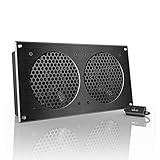
- An ultra-quiet UL-certified fan system designed for cooling cabinets that requires minimal noise.
- Features a multi-speed controller to set the fan’s speed to optimal noise and airflow levels.
- Contains a CNC machined aluminum frame with a modern brushed black finish.
- Powered by wall outlet or USB port, included Turbo Adapter increases performance by 25%.
- Dimensions: 11.69 x 6.3 x 1.3 in. | Total Airflow: 104 CFM | Total Noise: 19 dBA | Bearings: Dual Ball
Choose models and numerical precision carefully
Using a smaller model or a lower-precision numerical format can reduce the computation needed for some tasks. But results depend on the model, hardware, workload and quality threshold; a lower-precision run is useful only if its output remains fit for purpose.
Tom’s Hardware reported that ML.Energy tests of Qwen 3 235B A22B Thinking used a third less energy with FP8 than with bfloat16 on problem-solving tasks. That is a result for those reported tests, not a general saving for all models or requests. The ML.Energy Initiative describes its work on measuring and optimizing machine-learning energy use, but the specific comparison is reported by Tom’s Hardware.
Rank #2
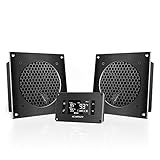
- An ultra-quiet UL-certified dual fan system designed for cooling cabinets that requires minimal noise.
- Features an on-board processor that provides a digital read-out of the cabinet’s temperatures.
- Programming includes thermostat control, fan speed control, and SMART energy saving mode.
- Two fan units with controller, containing CNC machined aluminum frames with a modern brushed black finish.
- Each Unit's Dimensions: 6.3 x 6.3 x 1.3 in | Total Airflow: 104 CFM | Total Noise: 19 dBA | Bearings: Dual Ball
Reduce avoidable work in serving
Operators can also examine whether the system is doing work that a user or service does not need. Caching repeated results can avoid recomputing them; batching compatible requests can improve hardware utilization; routing a request to a less demanding model may be sufficient for routine tasks; and limiting unnecessary prompt or output tokens can avoid extra generation. These are workload-management levers, not guaranteed savings: caching depends on repeat requests, batching must respect latency needs, and model or token changes must preserve acceptable quality.
What’s actually slowing this PC down?
Pick the symptom - the matching free tool is one click away.
Optimize training jobs
Training optimization targets long-running jobs, where small per-step savings can accumulate. Tom’s Hardware reported that the Perseus training optimizer reduced training energy by up to 30% without reducing throughput or changing hardware. This is a reported result for the optimizer and tested conditions, not a universal expectation for every training run. ML.Energy’s project page provides context for its optimization work, including Perseus; the specific figure is reported in the feature.
Power controls can trade peak demand against performance
Software controls can tune how accelerators use available power. NVIDIA’s Power Profiles are intended to help manage AI and high-performance-computing workloads at data-center scale. NVIDIA’s technical description is available in its Power Profiles blog.
Tom’s Hardware reports NVIDIA’s estimate that Blackwell power profiles can save up to 15% energy while retaining at least 97% of performance, and can increase throughput by as much as 13% in power-constrained facilities. These are vendor-attributed estimates, not an independently established outcome for every deployment. Operators would need to validate the trade-off against their own hardware, workload, latency targets and power limits.
Scheduling can shift when and where electricity is used
Not every workload must run immediately or in a particular data center. A scheduler may delay flexible batch work until a facility has more available capacity, or route it to a region with available capacity or lower-carbon electricity. This can ease local peak demand or reduce the emissions associated with electricity use, but moving a job in time or location does not automatically reduce the total electricity it consumes.
The Tool Desk
Outbyte PC Repair FREEClear out junk files and repair common Windows errorsFree Scan →Outbyte Driver Updater FREEFix the driver behind crashes, sound loss and screen glitchesFind Drivers →There are practical limits. Data sovereignty rules can restrict where information is processed, and moving large datasets between regions can add network costs and operational complexity. Real-time services have less room to wait than flexible training or batch jobs. Sophie Hall of ETH Zurich’s Automatic Control Laboratory described the operational question as: “It’s more like: when do they use it, where do they use it, and how is it interacting with the grid?” The quote was reported by Tom’s Hardware.
Best Value

- An ultra-quiet UL-certified fan system designed for cooling cabinets that requires minimal noise.
- Automated programming that self-adjusts cooling power in response to changing temperatures.
- Features a LCD display with an alarm system, display lock, six fan speeds, two buffer options, and memory.
- Fan and controller contain CNC machined aluminum frames with a modern brushed black finish.
- Dimensions: 17.28 x 6.3 x 1.3 in. | Airflow: 156 CFM | Noise: 21 dBA | Bearings: Dual Ball
Why PUE is not enough to judge software savings
Power usage effectiveness, or PUE, compares a data center’s total facility energy with the energy used by its IT equipment. It can help describe overhead such as cooling and power delivery, but it does not measure how much useful computing work the facility gets from each watt. A lower PUE alone therefore cannot show whether a model, training run or inference service has become more energy-efficient.
Uptime Institute’s 2025 survey summary says average PUE levels showed little change for the sixth consecutive year, with progress constrained by legacy infrastructure and regional cooling barriers. Uptime Institute Global Data Center Survey 2025
For software changes, operators should track energy per useful task as well as facility electricity and peak power. They also need to monitor service quality, throughput and latency. That wider view helps distinguish a genuine efficiency improvement from a change that merely moves demand elsewhere or compromises the service.
Efficiency helps, but does not guarantee lower total demand
More efficient computation can make AI cheaper or easier to deploy, which can encourage more use. If the number of requests, generated tokens or training runs grows enough, total electricity use can rise even as energy per task falls. This rebound effect is why a workload-level saving should not be presented as an equivalent reduction in data-center or grid demand.
Software is most useful as one part of a broader response: it can make better use of installed equipment, reduce waste and give operators more control over timing and power. Hardware efficiency, facility improvements and adequate electricity supply address related but different parts of the challenge.
Quick Recap
What operators should verify before deploying an optimization
- Energy per useful result: measure electricity for a defined inference, training job or completed task, with the model, precision, hardware and workload recorded.
- Quality and service: check accuracy or task quality, throughput and latency against requirements, not just power draw.
- Facility impact: determine whether the change reduces peak power, total electricity or only energy per task—and watch for increased usage that offsets savings.
- Deployment burden: account for software and hardware compatibility, tuning effort and the workload’s flexibility.
- Timing and location: include grid conditions, carbon intensity, data-sovereignty rules and the cost of moving data.
Product prices and availability are accurate as of the date/time indicated and are subject to change. Any price and availability information displayed on Amazon at the time of purchase will apply.

