
Do these 3 things before closing this tab:
1Fix the driver behind crashes, sound loss and screen glitches2Repair Windows errors before they cause bigger problems3Scan for outdated or missing drivers - takes under a minuteiTechGuides is reader-supported. When you buy through links on our site, we may earn an affiliate commission. As an Amazon Associate I earn from qualifying purchases. Learn more
Pairing a phone, tablet, or laptop with a Yamaha AV receiver usually takes a few minutes once the receiver is in pairing mode. The exact buttons, menu names, and supported Bluetooth functions depend on the model, so start by finding your receiver’s model number and its official owner’s manual.
Find the manual for your exact model
Yamaha publishes a separate owner’s manual for each receiver, and Bluetooth features are not identical across its AV receiver lineup. A button sequence that works on one model may not exist on yours. To get the right instructions, open the Yamaha AV SETUP GUIDE, select your receiver model, and open its owner’s manual. The model number is printed on the front panel and on the rating label on the rear or underside of the unit.
Pair a device for audio playback
The steps below follow Yamaha’s owner’s manual for the RX-V381, which is used here only as a worked example. Your receiver’s manual may use different labels or a different order, so treat these steps as a pattern to check against your own manual.
- On the receiver, select Bluetooth as the input source.
- Start pairing from the receiver. The manual’s pairing mode must be active before the source device can see the receiver.
- On the phone, tablet, or laptop, turn on Bluetooth and open the Bluetooth device list.
- Select the Yamaha receiver name from the list.
- If a passkey is requested, enter 0000, the value given in the RX-V381 manual.
- Complete the pairing within 30 seconds, the time limit the RX-V381 manual specifies.
The source device must support the A2DP profile for audio playback. The RX-V381 manual states this directly: “The Bluetooth device must support A2DP.” Most modern phones, tablets, and laptops support A2DP, but a device that only supports hands-free calling profiles will not stream music to the receiver. Once pairing succeeds, play audio from the source device and confirm the sound comes from the receiver.
#1 Best Overall

- Beyond the basics - This 5.2-channel home theater AV receiver delivers standout performance and value with Dolby Atmos, 4K120/8K60 HDMI, Bluetooth Multipoint and effortless setup. Delivers 70W of authoritative power and flexible speaker layouts including 3.1.2-ch. with up-firing or in-ceiling heights.
- Step into lifelike sonic worlds - Dolby Atmos and DTS Virtual:X for deeply dimensional, lifelike sound that draws you into every moment of your favorite entertainment, plus crystal-clear dialogue so you can hear every word.
- Stunning visual realism - Supports ultra-high definition 4K/120 and 8K/60 video, high-performance HDMI switching, advanced Dolby Vision and HDR10+ dynamic range technologies, HDMI eARC/ARC and next-gen gaming features like ALLM and VRR.
- Room Correction - Experience perfect sound in any room. An included setup microphone measures your room’s acoustics and speaker characteristics, allowing the receiver to automatically optimize sound performance.
- Easy streaming with Bluetooth Multipoint - Stream all your favorite music, podcasts and audiobooks wirelessly. Built-in Bluetooth Multipoint lets you pair two source devices and instantly switch between them.
Choose the right direction: receive or transmit
Bluetooth on an AV receiver can work in two directions, and readers often need only one. Receiving sends audio from a phone or laptop to the receiver’s speakers. Transmitting sends the receiver’s audio out to Bluetooth headphones or speakers. These are separate capabilities, and Yamaha documents them separately.
| Direction | What it does | What to check |
|---|---|---|
| Receive (phone or laptop to receiver) | Plays audio from a Bluetooth source through the receiver’s speakers or outputs. Setup follows the pairing steps above. | The receiver’s manual lists a Bluetooth input and pairing procedure. Confirm the A2DP requirement on the source device. |
| Transmit (receiver to headphones or speakers) | Sends the receiver’s output to a Bluetooth headphone or speaker. Yamaha’s RX-V485 documentation lists this as a separate “Bluetooth Transmission function.” | Not stated for every receiver. Check the Additional Features document on your model’s support page, because transmission is not confirmed for all Yamaha receivers. |
To confirm which direction your model supports, open the model’s support and downloads page. For the RX-V485, that page is the RX-V485 Support and Downloads page.
Rank #2
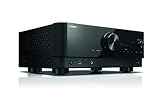
- HDMI with HDCP 2.3 and eARC (7 in / 1 out)
- 4K60, 4K120AB and 8K60B HDMI 2.1 with HDCP 2.3 and eARC (Three 8k + 4 (7) in/1 out)
- Wi-Fi, Bluetooth, AirPlay 2, Spotify Connect, Voice Control and MusicCast multi-room
- Voice control with Alexa and Google Assistant devices or Siri via AirPlay 2
- Pandora, Spotify, Napster, SiriusXM, TIDAL, Deezer, Qobuz, Amazon Music HD
Bluetooth standby and power use
On some models, Bluetooth standby is a setting that can turn the receiver on when a paired Bluetooth device connects. For the RX-V485, Yamaha documents an enable/disable setting for Bluetooth and a separate Bluetooth standby setting under its Bluetooth audio-receive settings. Yamaha notes that Bluetooth standby uses more power than leaving the setting off. The same manual says the setting is unavailable when Network Standby is off. The RX-V385 manual also documents Bluetooth and Bluetooth standby settings, but its menu paths should be checked in that manual rather than assumed to match the RX-V485.
Quick wins for a faster PC:
Fix the driver behind crashes, sound loss and screen glitchesFind Drivers →Repair Windows errors before they cause bigger problemsFix Now →Scan for outdated or missing drivers - takes under a minuteDriver Scan →- If you want the receiver to wake automatically for a phone connection, enable Bluetooth standby in your model’s manual.
- If you care about standby power consumption, leave it off and turn the receiver on manually before playback.
- If the setting does not appear in your menu, check whether Network Standby is enabled, since the RX-V485 manual makes the setting unavailable without it.
The RX-V485 owner’s manual is available through the RX-V485/RX-D485 Owner’s Manual link, and the RX-V385 manual is available as the RX-V385 Owner’s Manual.
Rank #3

- HDMI with HDCP 2.3 and eARC (4 in / 1 out)
- 4K60, 4K120AB and 8K60B HDMI 2.1 with HDCP 2.3 and eARC (4 in/1 out)
- Wi-Fi 2.4 GHz/5 GHz, AirPlay 2, MusicPlay (iOS and Android) and Spotify Connect
- Voice control with Alexa and Google Assistant devices or Siri via AirPlay 2
- Pandora, Spotify, Napster, SiriusXM, TIDAL, Deezer, Qobuz, Amazon Music HD
When the source device cannot find the receiver
If your phone or laptop does not list the receiver, work through these checks in order. The distance figure comes from Yamaha’s RX-V765 manual and applies to that model; it is not a guaranteed range for every receiver or source device.
- Confirm the receiver is in pairing mode. Start pairing again from the receiver, then refresh the source device’s Bluetooth list.
- Keep the source device within 10 m of the receiver, as the RX-V765 manual advises when a Bluetooth component is not found.
- Check whether another device is already connected to the receiver where your model’s manual says only one connection is allowed, and disconnect it first.
- Make sure Bluetooth is turned on at the source device and that the source device supports A2DP.
- If pairing still fails, restart the receiver and repeat the pairing steps. Then consult the troubleshooting section of your exact model’s manual for further remedies.
The RX-V765 manual is available as the RX-V765 Owner’s Manual. Use it only as a reference for that model.
Rank #4

- AVENTAGE: our top-tier line featuring premium build quality and sound performance
- 7.2-channel AV receiver with Zone 2. Dolby Atmos and DTS:X immersive audio
- 7-in/3-out HDMI with HDCP 2.3 and eARC. All HDMI inputs support 8K60 and 4K120 (40 Gbps). ALLM and VRR for next-gen gaming
- Dolby Vision, HDR10+, HLG and BT.2020 for state-of-the-art video quality
- Advanced room calibration: YPAO R.S.C. with 3D, multipoint measurement, precision EQ and low frequency mode
Before you buy any accessory
Pairing a phone to a Yamaha receiver does not require an adapter or accessory. The only requirements are a receiver whose manual lists Bluetooth input, a source device with A2DP support, and the pairing steps for your model. Check the manual before purchasing any Bluetooth accessory, because transmit-direction features and their setup vary by model.
Yamaha’s current manuals are the authoritative source for your receiver. Manuals may be revised over time, so compare the model number and the manual’s publication date with the version on Yamaha’s site before following any menu path.
Quick Recap
Product prices and availability are accurate as of the date/time indicated and are subject to change. Any price and availability information displayed on Amazon at the time of purchase will apply.

