
Crashes, No Sound, or Screen Glitches?
Random freezes, missing sound and display glitches usually trace back to one bad driver. Find and replace yours safely.Free scan · under a minuteWindows Errors? Fix Them Before They Spread
Repair common Windows errors and clear accumulated junk for a smoother, more stable PC - no reinstall needed.Free scan · no reinstalliTechGuides is reader-supported. When you buy through links on our site, we may earn an affiliate commission. As an Amazon Associate I earn from qualifying purchases. Learn more
Surface-mount technology (SMT) is a method of assembling electronic circuits in which components sit directly on conductive pads on the surface of a printed circuit board (PCB), instead of having their leads pushed through drilled holes. The components themselves are called surface-mount devices (SMDs). SMT names the assembly process; SMD names the part that the process attaches.
How an SMT assembly line works
Most SMT lines follow the same basic sequence. The process resource published by Surface Mount Process in its introduction to SMT describes solder-paste printing, component placement, and reflow as the core stages. Individual factories add or change steps, so treat the sequence below as the common pattern rather than a fixed standard.
- Print solder paste onto the pads. A stencil deposits a controlled amount of solder paste on each pad where a component will sit.
- Place the components. A pick-and-place machine positions each SMD on its paste deposit. The paste holds the part in position until soldering.
- Reflow the assembly. The board passes through a controlled heating profile. The paste melts, wets the component terminals and pads, and solidifies into the electrical and mechanical joints.
- Inspect. Automated optical inspection is commonly used after reflow, though not every line includes it or uses it at the same point.
Reflow is the step that turns a loosely held assembly into a finished board, so the heating profile matters as much as the placement accuracy. A technical overview on ScienceDirect Topics also notes that eliminating component-lead holes can simplify board fabrication, and that components may be mounted on either side of the board where the design and process allow it. These are capabilities and common advantages, not guaranteed results for every design.
SMT compared with through-hole technology
Through-hole technology inserts component leads into drilled holes and solders them on the opposite side. SMT removes the holes for the component leads and solders parts to the surface. The differences show up in package size, density, automation, and mechanical behavior.
#1 Best Overall
![EGSCST [2 Pack] SMD Soldering Practice Kit, SMT Components Solder Training Kits for Electronics, PCB Board Soldering Practice for Beginners and Adults, DIY Electronic Project](https://m.media-amazon.com/images/I/51PazW2iQpL._SL160_.jpg)
- 【EGSCST 2-Pack Double Value】This value set includes 2 complete soldering practice kits. Having two sets allows beginners to learn from the first attempt and achieve perfection on the second board. It is the most cost-effective solution for solder training and repetitive skill-building.
- 【Professional SMT Components Training】Each EGSCST soldering kit features a wide variety of SMD components, including 0805, 0603, Diode, Transistor,and IC chips. This electronics practice kit is designed to help you master surface mount technology, moving you from basic to advanced soldering skills.
- 【High-Quality PCB with Clear Markings】Our practice soldering board is made of high-grade green PCB, featuring clearly labeled footprints for every component. This PCB soldering kit ensures that even beginners can easily follow the layout and improve their soldering accuracy with confidence.
- 【Advanced Electronic Kit for Adults】Perfect for adults, hobbyists, and students, this EGSCST soldering project offers a real-world challenge. Unlike basic kits, these advanced electronic project kits simulate professional circuit board assembly, making it an essential training tool.
- 【Essential Soldering Starter Kit】Whether you are an aspiring electrician or a DIY enthusiast, this solder project kit provides an excellent hands-on learning experience. Each of the 2 sets is a perfect addition to your laboratory bench or home workshop for learning electronics.
| Factor | Surface-mount (SMT/SMD) | Through-hole |
|---|---|---|
| Attachment | Terminals soldered to pads on the board surface | Leads inserted through drilled holes and soldered |
| Board fabrication | No holes needed for component leads, which can simplify fabrication | Requires drilling for every lead |
| Typical package size and density | Associated with smaller packages and closer spacing | Larger packages; lower placement density |
| Automation | Well suited to high-volume automated placement and reflow | Automation possible, but often combined with manual or wave-soldering steps |
| Mechanical demands | Not suited to every part; some mechanical requirements favor through-hole | Retained for parts that need stronger mechanical anchoring |
| Repair and rework | Requires specialized soldering and desoldering skills or equipment; exact constraints not stated in the cited sources | Leads are generally accessible for hand soldering; specific rework effort not stated in the cited sources |
| Mixed boards | Commonly combined with through-hole parts on one board | Commonly combined with SMDs on one board |
The sources describe these as tradeoffs. Neither method is universally cheaper or better, and the sources do not establish a single cost ratio between them.
Advantages of SMT and their limits
- Compact layouts. SMD packages are generally smaller and can be spaced more closely, which helps when board area is limited. A smaller footprint does not automatically mean a smaller product, because enclosure, thermal, and connector requirements still apply.
- Automated assembly. Placement and reflow suit high-volume production. Low volumes, prototypes, and one-off repairs may not gain the same benefit.
- Simpler drilling. Omitting component-lead holes reduces drilling work. The overall fabrication saving depends on the board design and the number of holes it would otherwise need.
- Two-sided mounting. Components can go on both faces where the design and reflow process allow it. Parts on the second side must survive the heating of the first side’s reflow.
Choosing between SMT and through-hole
Use these questions to decide which method suits a given part or board:
Rank #2

- 【SMD/SMT Components Soldering Practice Board】: Input voltage: DC5V. The positive pole is connected to +, and the negative pole is connected to -. After the SMD components are soldered, power on to form a running water lamp to detect the effect of the soldering.
- 【With English Installation Instructions】: This electronic kit is not a finished product, it need to be soldered by yourself. You can get detailed and clear instructions by scanning the QR code that comes with the package. If you have any questions, please contact us first for professional help.
- 【Great Soldering Science Project】: This soldering DIY kit help you understand the basics of working with printed circuit boards and become familiar with a variety of electronic components, and practice soldering skills enjoyably for you and your kids, or students, or DIYers.
- 【Easy to Assemble】: The connection that was clearly mapped and labeled on the board makes it easy to assemble. And you can refer the marks on PCB board to soldering each component. If it can't work after soldering, please contact us for support.
- 【Perfect After-Sale Service】: Please read the User Manual before installing. If any components are missing, please contact us for replacements.
- Is a suitable SMD package available for the component, and does it meet the electrical and thermal requirements?
- Does the part carry mechanical load, such as connectors or parts that are pulled or pressed often? If so, check whether through-hole mounting is the better fit.
- Is board area or height the main constraint, favoring SMT?
- Will the assembly volume justify automated placement and reflow equipment?
- How often will the board need repair, and does the team have the tools and skills for surface-mount rework?
Many practical boards answer these questions differently for different parts, which is why mixed-technology designs are common.
Learning SMD soldering and desoldering
Readers who want to practice SMT by hand have a documented route. The Bharat Skills vocational material from the Government of India, titled Electronics Mechanic: Surface Mount Technology and dated 2022, covers SMD soldering and desoldering as part of its training. A 2009 arXiv paper, Reflow Soldering of Surface Mount Electronic Components in a Laboratory, describes reflow soldering and surface-mount prototyping in a laboratory setting. Both sources describe methods and training context rather than specific tools or settings, so check your equipment documentation for temperatures and times.
Rank #3
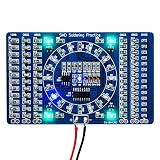
- Instant Visual Feedback: After welding, simply connect electricity (3-12V) to see the effect and quickly judge the welding quality. The completed project creates a beautiful water lamp circuit
- Built-in Measurement Tool: The back of the board features mm/Inch ruler markings for easy and convenient component measurement during assembly
- Clear Component Markings: High quality PCB with clearly marked electronics components enables even beginners to solder successfully with confidence
- Precision Assembly Recommendation: Since the accessories are very small, it is recommended to use a pointed clip to assist with the welding process
- SMD SMT Practice Board: Designed specifically for surface mount device and surface mount technology welding practice to enhance your soldering capabilities
What the sources do and do not establish
The definitions above are consistent across the technical overviews, vocational training material, and laboratory paper consulted. No industry-wide percentage of boards that use SMT was found in these sources, so this article does not give a market-share figure. Current capabilities of individual PCB assembly providers were also not verified, so check any provider’s stated SMT capability directly before relying on it.
Quick Recap
Best Value
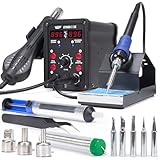
- 2-IN-1: With this soldering iron station you get both the soldering station with hot air rework station in one. This unit comes with individual digital temperature read-out(°F), power switches, adjustable hot air volume, and temperature controls.
- Soldering Kit for electronics: This soldering iron kit includes a pack of solder wire, desoldering pump, tweezers, 3 hot air nozzles,5 soldering tips (I/B/K/3.2D/3C). You can start soldering as soon as you receive this solder kit.
- Soldering Station: Adjustable temperature from 392-896°F, with PID stabilization function. Comes with 10-minute sleep mode to reduce wear when non-use for longer than 10 minutes, making your solder iron tips and heating elements last longer.
- Hot air station: Adjustable temperature from 212-896°F, with PID stabilization function. Comes with hot air standby mode, when the hot air gun is inside the holder, the station cools hot air gun to 212°F and stops heating. This provides better user safety, longer heating element lifespan.
- This Hot Air Rework Station Kit is covered by our exclusive 1-year USA technical support, with 24-hour assistance from our dedicated team. Note: This product is rated for 110-127V USA specifications. Do not connect this iron to a 220V power socket.
Rank #4

- ✅3 SETS of SUPER VALUE.From easy to difficult SMD components soldering practice kit, high challenge PCB SMD welding skills competition.
- ✅Professional skills, complete this kit, need a certain professional knowledge base, practical training experience.
- ✅High quality material, high-quality double-sided spray tin FR-4 circuit board, easy to solder, not easy to oxidize, contribute to success.
- ✅Technical support, including component list, circuit diagram, principle description and finished product diagram. Please contact us for information.
- ✅Super quantity components: there are many kinds of components, nearly 20 different kinds of electronic components. There are more than 1400 solder joints and more than 500 components.
Product prices and availability are accurate as of the date/time indicated and are subject to change. Any price and availability information displayed on Amazon at the time of purchase will apply.

