
Recommended Free Tools
iTechGuides is reader-supported. When you buy through links on our site, we may earn an affiliate commission. As an Amazon Associate I earn from qualifying purchases. Learn more
BadUSB 2.0 is a 2016 research proof of concept for placing bespoke hardware inline between a USB keyboard and a computer to observe and alter USB traffic. It is distinct from the earlier BadUSB approach discussed in the paper, which targeted USB device firmware. The research reports laboratory demonstrations of keyboard-traffic attacks, but the project repository describes an alpha proof of concept and says its BadUSB device-emulation component was not implemented.
What is BadUSB 2.0?
In BadUSB 2.0: Exploring USB Man-In-The-Middle Attacks (2016), David Kierznowski and Keith Mayes describe an active man-in-the-middle approach to USB fixed-line communications. Instead of changing a keyboard’s firmware, the attack places bespoke hardware in the physical connection between a keyboard and its host. The equipment can observe and modify messages travelling between them.
The authors describe BadUSB2 as an evaluation tool: “The evaluation tool, BadUSB2, was developed as a means to evaluate the compromise of USB fixed-line communications through an active Man-In-The-Middle (MITM) attack.” The project repository presents the same basic idea as an active MITM tool, while making clear that the code is an early proof of concept.
How does a USB man-in-the-middle attack work?
A conventional keyboard sends USB-HID traffic to the computer. In the BadUSB2 model, an inline implant sits on that connection and can act on traffic passing between the legitimate keyboard and host. Because the legitimate keyboard can remain visible to the operating system, the attack may not appear as a newly attached keyboard. Detection may therefore require looking beyond the list of connected devices.
#1 Best Overall

- 【Combination set】: More affordable, The data blocker combination kit shown in the main image, which can meet your daily use needs, suitable for any mobile phones and electronic devices with USB A and USB C interfaces.
- 【PROTECT YOUR PHONE / TABLET】 : Think about that Traveling or going out in public areas one time when you needed a charge at an airport but were too scared to get juice jacked. That is why we brought this data blocker for you. Charge your device with this powerful USB data blocker without worrying about any hacker getting in your device.
- 【HIGH SPEED CHARGING】: USB defenders are made for blocking the hacker as well as fast charging, The 4th generation design chip can be used for the universal charging standards automatically switch to, Compatible with Various brands of smartphones, ensure compatibility with your device. and charge at up to 2.4 Amps.
- 【to make high quality safety products】:Advance manufacturing process design The metal shell material has multiple safety protection functions such as heat dissipation and fire safety, USB Data Blocker are used by the governments of the USA, Canada, UK and New Zealand as well as 100s of corporations around the world to secure their devices,100% guarantee against hacker attack.
- 【Perfect Compatibility】: We USB-C to USB-C and USB-A to USB-C data blocker ensures seamless data security across all your Type-C tech gadgets including iPhone 15 and 16 series, Galaxy S25 S24 S23 S22 S21 S10, USB-C iPad, Android Tablets, MacBooks, and more
The paper’s laboratory work covers observing keyboard input, replaying captured login input, changing characters in transit, injecting keystrokes, and fabricating traffic. It also discusses moving data over USB-HID and using the channel for an interactive shell. These are demonstrations described by the researchers, not evidence of a reliable off-the-shelf product or compatibility with current computers and operating systems.
What the repository implementation says it can do
The repository describes rudimentary functions including recording keystrokes, replaying captured login input, and sending commands as keyboard input. It also includes a PowerShell exfiltration proof of concept that signals data through keyboard lock-key LEDs using a Morse-code-like method; the README says this is very slow. The repository explicitly says that the BadUSB device-emulation part was not implemented and labels the code alpha, “only a proof of concept.”
Rank #2
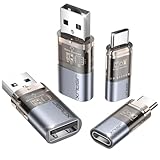
- The Ultimate Data Guardian: Worried about the risk of mobile phone data leakage or viruses when using public charging stations? A data blocker is an effective way to reduce these risks. By physically blocking data transfer, it helps protect your device from potential spyware or hacking attempts while charging
- Only for Charging: With our USB data blocker, you can charge your device without any risk of data transfer. It allows only the charging function while blocking data transfer and syncing. Your phone will not receive pop ups requesting data transmission
- Fast Charging for USB C Data Blocker: JSAUX USB C Data Blocker adopts PD 3.0/2.0 fast charging technology, supports 100W fast charging (20V/5A), and is also compatible with charging power of 240W/140W/60W/45W/36W/27W/15W, etc. The USB Data Blocker supports up to 2.4A charging. (NOTE: The actual charging speed depends on your device and wall charger.)
- Compact Design for Travel and Daily Use: Small and lightweight for easy carrying in pockets, backpacks, or keychains. Ideal for travelers, commuters, and anyone who frequently uses public charging stations. The transparent casing provides a modern and durable look
- USB & USB C Data Blockers 4 Pack: We offer you two USB Data Blockers and two USB C Data Blockers, compatible with iPhone 18 Pro/18 Pro Max, iPhone Duo, iPhone 17/17e/Air/17 Pro/17 Pro Max, iPhone 16/16 Plus/16 Pro/16 Pro Max, iPhone 15/15 Plus/15 Pro/15 Pro Max, Samsung, iPad, Macbook and other devices. Works with both USB and USB C ports, ideal for safe charging at airports, hotels, and public charging stations
How is BadUSB 2.0 different from firmware BadUSB and a USB Rubber Ducky?
The key distinction is where the attack sits and what it is intended to do. The 2016 paper contrasts its cable-level MITM approach with the BadUSB attack released in 2014, which targeted USB firmware. A keyboard emulator, such as a USB Rubber Ducky, is a useful comparison for understanding injected keystrokes, but it is not the same attack model as an inline device that can observe and alter traffic between an existing keyboard and the host.
What’s actually slowing this PC down?
Pick the symptom - the matching free tool is one click away.
| Approach | Where it acts | What the host may see | Scope established by these sources |
|---|---|---|---|
| Firmware BadUSB | USB device firmware | The USB device can present itself in a way determined by its firmware; the paper distinguishes it from the inline model. | The paper identifies the 2014 BadUSB approach as firmware-targeting. It does not establish a complete comparison of specific products or implementations. |
| Keyboard emulator (for example, a USB Rubber Ducky) | Acts as a keyboard-like input device to send keystrokes | May appear as an additional USB keyboard; this is the kind of added-device case for which whitelisting and secondary-device detection can help. | Included here as a conceptual comparison, not as a tested device or a claim about a particular model’s capabilities. |
| BadUSB 2.0 research model | Bespoke hardware inline between a keyboard and host | The legitimate keyboard may remain visible without a second keyboard appearing to the operating system. | The paper reports laboratory MITM demonstrations. The repository implementation is alpha, and device emulation was not implemented. |
The paper gives a historical estimate of around $100 per bespoke USB hardware device in 2016. That figure is the study’s estimate at the time, not a current price or a verified bill of materials.
Rank #3

- ✨ Absolutely Safe: Features an internal physical data line cut design, permanently disconnecting the data pins in the USB interface, leaving only the power pathway, effectively eliminating the risk of data leakage.
- ⚡ Fast Charging Without Slowdown:The usb data blocker Adapter supports charging up to 100W and is compatible with multiple fast charging protocols. Charging speed is the same as the original charger, ensuring both safety and efficiency.
- 🔗 Wide Compatibility: Suitable for all devices that use various charging interfaces. Whether it’s iPhone, Android phones, iPad, tablets, Bluetooth headsets, or power banks, just plug and play.
- 👌 Compact and Portable: The lightest model weighs only 2.2g, as compact as a USB drive. Protects safe charging anytime, anywhere.
- 🎯 Plug and Play: No drivers, no apps, no complicated setup required. Simply insert into a public USB port and connect your charging cable to start safe charging.
Can USB device whitelisting detect an inline hardware implant?
Not necessarily. Device whitelisting and detection of newly attached peripherals can help organizations spot rogue USB devices, including attacks that introduce an extra keyboard. In the BadUSB2 inline model, the host may continue to see the legitimate keyboard rather than an additional device, so ordinary endpoint device controls alone may not expose the implant.
The published setup depends on physical access to the USB connection and is a research proof of concept. The paper speculates that a weaponized design could add wireless capability, but that is a hypothetical extension, not a demonstrated BadUSB2 feature.
Rank #4

- Special Attention: For optimal charging speeds, ensure the entire connection is USB-C to USB-C from end to end. Using this Data Blocker with a USB-A to USB-C cable may result in slow charging or no charging due to the absence of data pins.
- No Loopholes Data Security: Hackers are everywhere—don't let your USB-C devices fall prey! Our blocker ensures comprehensive protection against malware, viruses, and hacking threats, guaranteeing data integrity and privacy, thanks to its no data pins feature
- Juice Jacking Shield: Our robust solution stands guard against data theft, ensuring your personal information remains secure from unauthorized access
- Perfect USB C-to-C Compatibility: Our USB C male to USB C female data blocker ensures seamless data security across all your Type-C tech gadgets including iPhone 15, 16 & 17 series, Galaxy S25 S24 S23 S22 S21, Fold & Flip Series, USB-C iPad, Android Tablets, MacBooks, and more
- Safe and Uncompromised Fast Charging: Experience worry-free charging of up to 240W PD, whether you're at hotels, airports, university libraries, or outdoor charging stations. With fast charging capabilities, your devices remain safeguarded wherever you go.
What defenses does the paper recommend?
The authors’ recommendations are layered: combine endpoint software controls with USB-HID behavior monitoring, setup-level checks, user awareness, and attention to physical connections. No one listed measure should be treated as a complete defense against an inline implant.
The Tool Desk
Outbyte PC Repair FREEClear out junk files and repair common Windows errorsFree Scan →Outbyte Driver Updater FREEFix the driver behind crashes, sound loss and screen glitchesFind Drivers →- Antivirus and application whitelisting: use endpoint controls to detect or restrict code that an attacker attempts to type onto a host.
- Behavioral monitoring: look for unusual USB-HID activity, including excessive signaling through lock-key indicators.
- USB setup heuristics: monitor for unexpected changes to endpoint numbers during device setup.
- User awareness and physical inspection: help users recognize suspicious changes to cables and connections, and inspect them where appropriate.
- Cryptographic protection: the paper points to a cryptographic solution as a stronger mitigation direction, rather than claiming ordinary device controls fully solve the problem.
What the BadUSB 2.0 proof of concept does not establish
The paper’s lab demonstrations and the repository’s implementation notes describe different levels of scope. The paper says it practically demonstrated the attacks it describes except for BadUSB, which was out of scope. The repository, meanwhile, describes its code as an alpha proof of concept, notes that its LED-based exfiltration is very slow, and says the BadUSB emulation component was not implemented. Neither source establishes that the work is a current commodity attack kit, that it works reliably on present-day systems, or that a wireless version was built.
Best Value
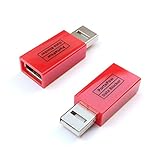
- Attach between your USB cable and charger to physically block data transfer / syncing; Charge mobile devices without any pop-ups or risk of hacking / uploading viruses in cars, airports etc
- This is our USB-A to A version, USB-C and others available; Read below if its the right one for your device
- The only data blocker to physically show you that its blocking data and several other great features; See full details below
- Allows charging without any risk of hacking / uploading viruses, can charge from an office PC even if USB socket has been disabled without breaking IT policy
For readers assessing risk, the useful lesson is not that every USB cable is compromised; it is that controls which only inventory attached devices can miss an attack that operates inside an existing connection. The paper’s defensive direction is to combine device controls with behavior, setup, endpoint, and physical checks.
Quick Recap
Product prices and availability are accurate as of the date/time indicated and are subject to change. Any price and availability information displayed on Amazon at the time of purchase will apply.

