
Quick wins for a faster PC:
Fix the driver behind crashes, sound loss and screen glitchesFind Drivers →Repair Windows errors before they cause bigger problemsFix Now →Scan for outdated or missing drivers - takes under a minuteDriver Scan →iTechGuides is reader-supported. When you buy through links on our site, we may earn an affiliate commission. As an Amazon Associate I earn from qualifying purchases. Learn more
The 8 best ETL tools in 2026 are Fivetran for low-maintenance managed ingestion, Airbyte for open-source flexibility, Hevo for managed event-based pipelines, AWS Glue for AWS-native ETL, Azure Data Factory for Microsoft environments, Matillion for visual cloud ELT, Qlik Talend Cloud for governed hybrid integration, and Informatica for complex enterprise data programs.
That is a use-case shortlist, not a universal ranking. ETL software moves data from databases, SaaS applications, APIs, files, or event streams into warehouses, lakes, lakehouses, and other destinations. The right choice depends on your sources, destinations, latency requirements, cloud environment, governance needs, engineering capacity, and data-volume pricing model.


Key takeaways
- Fivetran is the best default for teams that prioritize maintained connectors and minimal pipeline operations.
- Airbyte is the strongest choice for self-hosting, custom connectors, and deployment control, but self-hosting adds infrastructure and maintenance work.
- Hevo is a strong managed alternative for mid-market teams, although event-based billing makes inserts, updates, deletes, and backfills important cost variables.
- AWS Glue and Azure Data Factory are usually better choices inside their respective cloud ecosystems than for simple, cloud-neutral SaaS replication.
- Matillion is strongest for visual, warehouse-centered ELT, while Qlik Talend Cloud and Informatica fit governed hybrid and enterprise integration programs.
- dbt and Airflow are usually complementary tools for transformation and orchestration rather than complete replacements for an ingestion platform.
Quick comparison of the 8 best ETL tools
| Tool | Best for | Deployment | ETL or ELT orientation | Pricing signal | Main drawback |
|---|---|---|---|---|---|
| Fivetran | Low-maintenance managed pipelines | Managed cloud | Managed ingestion and ELT | Free plan; usage-based paid plans | High row churn can make costs difficult to forecast |
| Airbyte | Open-source flexibility and custom connectors | Self-managed or cloud | Ingestion and replication | Self-managed Core is free; cloud plans have volume or capacity pricing | Self-hosting transfers operations to the buyer |
| Hevo Data | Managed pipelines for mid-market analytics teams | Managed cloud | Replication and ELT | Free tier; event-based paid tiers | Updates and deletes can increase event volume |
| AWS Glue | AWS-native data lakes and Spark ETL | AWS managed service | Serverless ETL and ELT | Usage-based AWS billing | More engineering-intensive than SaaS connector products |
| Azure Data Factory | Azure, Microsoft, and hybrid environments | Azure managed service | Pipeline orchestration and ETL | Activities, runtimes, data movement, and operations | Several billing dimensions must be modeled |
| Matillion | Visual, cloud-warehouse-centered ELT | Managed cloud | Visual ELT and transformation | Plan and usage or contract dependent | Less compelling for simple replication |
| Qlik Talend Cloud | Governed hybrid integration and data quality | Cloud and hybrid enterprise | Integration, transformation, and quality | Sales-led or contract-dependent | Broad packaging and higher implementation overhead |
| Informatica IDMC | Complex enterprise integration and governance | Cloud and hybrid enterprise | Enterprise integration and data management | Usually quote-based | Often excessive for a small warehouse-ingestion project |
The list includes traditional ETL services and adjacent ELT or data-integration platforms because buyers commonly compare them for the same data movement project. Connector counts are not directly comparable: a connector may be fully vendor-managed, community-maintained, a generic API adapter, or a basic destination connector.
What is an ETL tool?
An ETL tool extracts data from operational systems, transforms the data into a usable shape, and loads the result into a destination such as a data warehouse, data lake, lakehouse, database, or analytics platform.
#1 Best Overall
- Extract: collect data from databases, SaaS applications, APIs, files, applications, or streams.
- Transform: clean, validate, join, standardize, enrich, mask, or reshape the data.
- Load: write the processed data to the target system.
Modern cloud products are often closer to ELT than traditional ETL. ELT extracts data, loads raw or lightly processed records into a scalable warehouse or lakehouse, and performs transformations afterward using SQL, Spark, the destination engine, or a tool such as dbt. ELT does not eliminate transformation; ELT separates ingestion from warehouse transformation.
What is the difference between ETL and ELT?
ETL transforms data before loading, while ELT loads data first and transforms it inside or near the destination. The better architecture depends on the destination’s processing capability, data-retention requirements, governance rules, and operational constraints.
| Consideration | ETL | ELT |
|---|---|---|
| Transformation location | Before the destination receives the data | After raw or lightly processed data reaches the destination |
| Useful when | The destination cannot efficiently process raw data | The warehouse or lakehouse has scalable compute |
| Data sent to destination | Can be reduced before loading | Often includes raw data for later use |
| Replay and new models | May be harder if raw data is discarded | Raw retention can support replay and new transformations |
| Common market category | Traditional enterprise ETL suites | Cloud ingestion and modern data-stack tools |
How were these ETL tools evaluated?
The shortlist weighs connector quality, destination support, batch and CDC capabilities, streaming or micro-batch support, transformation options, monitoring, recovery, security, governance, operating effort, pricing transparency, deployment control, and cloud fit. The ranking is editorial and use-case based; it is not a hands-on performance benchmark.
Do these 3 things before closing this tab:
1Clear out junk files and repair common Windows errors2Fix the driver behind crashes, sound loss and screen glitches3Repair Windows errors before they cause bigger problemsEvaluate the exact connector rather than the vendor’s total connector count. Confirm whether the connector supports incremental sync, log-based CDC, deletes, nested data, schema evolution, custom fields, source-specific API limits, and the sync modes included in your chosen plan.
1. Fivetran: best for low-maintenance managed pipelines
Fivetran is the best overall default for teams that want maintained connectors and do not want to operate pipeline infrastructure. Fivetran is particularly well suited to SaaS-to-warehouse ingestion and modern ELT architectures.
What Fivetran does well
- Provides a large catalog of managed source and destination connectors.
- Automates scheduling, synchronization, monitoring, and much of the connector maintenance.
- Fits common destinations including Snowflake, BigQuery, Redshift, Databricks, and similar cloud platforms.
- Works well for analytics teams with limited data-platform capacity.
- Can be paired with dbt or another transformation layer when ingestion alone is not enough.
Fivetran’s current pricing page advertises a free plan, more than 700 fully managed connectors, more than 200 activation destinations, 15-minute syncs on the Standard plan, and dbt Core integration. Those details are plan- and date-sensitive, so verify the current allowance before purchase.
What are Fivetran’s limitations?
Fivetran’s consumption-based pricing can be difficult to forecast when sources have frequent updates, deletes, retries, historical reloads, or high row churn. Model cost from changed-row volume rather than the total size of the source database. Connector availability also does not guarantee identical connector depth or support for every CDC, schema, or API feature.
Fivetran is a weaker fit when strict self-hosting is mandatory, the source is highly bespoke, or a simple one-time migration can be handled more cheaply with a custom script. Fivetran is also not a complete replacement for complex warehouse transformation logic.
Choose Fivetran if: minimal maintenance and reliable managed connectors matter more than maximum deployment control.
Consider Airbyte instead if: self-hosting, custom connectors, or portability are more important than low operational effort.
2. Airbyte: best for open-source flexibility and custom connectors
Airbyte is the strongest choice for engineering-led teams that need self-hosting, unusual connectors, or deployment control. Airbyte offers both a self-managed Core product and managed cloud plans.
What Airbyte does well
- Offers an open-source, self-managed option.
- Supports connector customization through its Connector Builder and API-oriented extensibility.
- Provides broad source and destination coverage.
- Can integrate with orchestrators such as Airflow, Dagster, and Prefect.
- Allows organizations to keep more control over runtime, networking, and data residency than managed-only products.
Airbyte’s current pricing page describes self-managed Core as always free, shows managed Standard pricing from $10 per month as a starting point, and presents higher plans using volume or capacity structures. Airbyte’s cloud product page advertises more than 600 connectors. The headline connector total and starting price should not be treated as an all-in cost.
What are Airbyte’s limitations?
Free software is not the same as free operation. A self-managed Airbyte deployment can require compute, storage, networking, upgrades, observability, security controls, worker management, backups, and incident response. Connector quality and maintenance can also vary by connector.
Airbyte is a poor fit for a small team with no infrastructure owner or for a buyer seeking a support-heavy, fully managed experience. Managed-plan pricing must be evaluated using the relevant volume, credit, or capacity definition, not by comparing the plan name with a competitor’s subscription tier.
Choose Airbyte if: control, custom connectors, or self-hosting justify the added operational work.
Recommended Free Tools
Consider Fivetran or Hevo instead if: the team wants the vendor to absorb most connector and infrastructure maintenance.
Rank #2
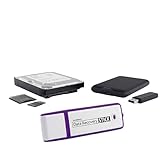
- The Data Recovery Stick requires no technical skills — simply plug it into your Windows computer, click Start, and the software automatically begins scanning and recovering lost files within minutes. Compatible with Windows Vista, 7, 8, 10, & 11, it's designed to be a reliable first step when accidental deletion occurs.
- Recover photos (JPG, BMP, PNG, TIFF), Microsoft Office documents (Word, Excel, PowerPoint, Publisher, Access), Open Office files, MP3 music files, PDFs, RTF documents, AutoCAD files, and HTML web pages. Whether it's personal memories or critical business files, the Data Recovery Stick covers the file types that matter most.
- Works with hard drives, USB drives, SD cards, memory sticks, and other common storage formats that use FAT or NTFS file systems — making it a single solution for hard drive recovery, USB drive recovery, SD card recovery, and more. Note: a media reader is required for micro SD cards and some mass storage devices.
- No Installation Required - The Data Recovery Stick runs entirely from the USB drive with no software installation on your computer — helping prevent new data from overwriting the files you're trying to recover. This also makes it ideal for use across multiple computers or in emergency situations where installation isn't practical.
- Use the Data Recovery Stick on as many computers as often as needed — simply clear the recovered data between uses to free up storage space. Software updates keep the tool compatible with newer systems and devices, backed by 25+ years of data software expertise from Paraben Consumer Software.
3. Hevo Data: best managed alternative for mid-market teams
Hevo Data is a strong managed option for mid-market analytics teams that want public consumption signals and do not want to run ingestion infrastructure. Hevo fits common SaaS and database replication workloads and can support more advanced capabilities on higher tiers.
What Hevo Data does well
- Provides managed pipelines for common SaaS and database sources.
- Uses event-based consumption, which can be modeled when inserts, updates, and deletes are known.
- Offers a free tier for limited workloads.
- Adds capabilities such as streaming, API automation, RBAC, SSO, and VPC peering on higher plans.
- Works well when the buyer wants a managed alternative to Fivetran.
Hevo’s current pipeline pricing page shows a free tier of up to 1 million events per month and a Starter tier listed at $299 per month on monthly billing. Hevo’s consumption pricing explanation describes event-based billing that includes changed data such as rows added, edited, or deleted. Prices, features, and billing terms can vary by plan and contract.
What are Hevo Data’s limitations?
Event-based billing can rise quickly for high-churn sources because repeated updates and deletes may count even when the number of business entities appears stable. Historical loads, retries, and backfills also need to be included in the estimate.
Free tools Windows power users keep installed
One-click scans. No signup required.
Advanced security, governance, and network controls may require higher tiers. Hevo is less appropriate when the project needs highly complex Spark-based transformations or broad on-premises deployment options.
Choose Hevo if: managed ingestion and a visible event-based pricing model suit a mid-market workload.
Consider Fivetran instead if: connector breadth and minimum operational involvement are the top priorities.
4. AWS Glue: best AWS-native serverless ETL service
AWS Glue is the best fit when Amazon Web Services is already the center of the data architecture and the team can operate Spark- and Python-based jobs. AWS Glue supports ETL and ELT workloads across batch, micro-batch, and streaming patterns.
What’s actually slowing this PC down?
Pick the symptom - the matching free tool is one click away.
What AWS Glue does well
- Provides serverless Spark-based processing.
- Integrates with AWS services such as S3, Redshift, Athena, and Lake Formation.
- Supports data-lake and lakehouse processing patterns.
- Works with AWS identity, networking, regional, and governance controls.
- Supports large-scale batch processing and more advanced engineering workflows.
AWS describes Glue as a serverless data integration service for ETL and ELT workloads. AWS documentation for the service states that AWS Glue 5.1 uses Apache Spark 3.5.6, Python 3.11, and Scala 2.12.18, and describes a built-in Snowflake connector. Consult the official AWS pricing information for current service details and usage assumptions.
What are AWS Glue’s limitations?
AWS Glue is more engineering-oriented than a managed SaaS connector service. Teams need to understand Spark jobs, workers, retries, partitioning, permissions, VPC networking, and cloud cost controls.
The central Glue charge is not necessarily the total pipeline cost. Storage, requests, catalog usage, data transfer, logs, and downstream AWS services can also contribute. AWS Glue can be a poor choice for a small company that only needs to copy Salesforce, Stripe, or HubSpot into a warehouse without AWS or Spark expertise.
Choose AWS Glue if: AWS-native integration, data-lake processing, and engineering control are central requirements.
Consider Fivetran or Hevo instead if: the project is mostly low-maintenance SaaS replication.
5. Azure Data Factory: best for Azure and Microsoft environments
Azure Data Factory is the best choice for Azure-centered organizations, Microsoft-heavy data estates, and hybrid pipelines involving on-premises systems. Azure Data Factory provides visual pipelines, copy activities, triggers, integration runtimes, and managed SQL Server Integration Services support.
What Azure Data Factory does well
- Integrates with Azure Data Lake, Synapse, SQL Server, and related Microsoft services.
- Supports cloud and hybrid connectivity.
- Provides managed and self-hosted integration runtimes.
- Offers a visual pipeline experience for scheduled batch integration and orchestration.
- Provides a migration path for organizations with existing SSIS investments.
Microsoft describes Azure Data Factory as a managed data-integration service for cloud and hybrid environments. Microsoft’s Data Factory pricing documentation says estimates depend on data movement, activity runs, integration runtime, operations, and the customer’s agreement or currency.
What are Azure Data Factory’s limitations?
Azure Data Factory does not have one simple monthly price. Activity runs, runtime use, data movement, debugging, monitoring, and operations all need to be included in the estimate. A large pipeline estate can also become difficult to manage without consistent naming, deployment, testing, and monitoring conventions.
Azure Data Factory is not automatically the best choice merely because an organization uses Microsoft 365. A team operating mainly outside Azure may find a cloud-neutral managed ingestion platform more natural, while a small SaaS-only project may not justify Data Factory’s broader pipeline model.
Rank #3
Choose Azure Data Factory if: Azure, SQL Server, Synapse, Power BI, or SSIS investments shape the architecture.
Consider AWS Glue instead if: the organization is deeply invested in AWS and its lake services.
6. Matillion: best visual cloud ELT platform
Matillion is strongest for teams that already use a cloud warehouse or lakehouse and want to build ingestion and transformation pipelines visually. Matillion is more than a simple replication service: its value is highest when analysts and data engineers need visual pipeline development around cloud data platforms.
The Tool Desk
Outbyte PC Repair FREEClear out junk files and repair common Windows errorsFree Scan →Outbyte Driver Updater FREEFix the driver behind crashes, sound loss and screen glitchesFind Drivers →What Matillion does well
- Provides visual pipeline development for cloud data integration.
- Supports AWS, Azure, and Google Cloud environments.
- Works with destinations and systems including Snowflake, Redshift, Databricks, Azure Synapse, BigQuery, SQL and NoSQL systems, APIs, files, and relational databases.
- Supports Git integration and reusable pipeline components.
- Combines ingestion, transformation, orchestration, and documentation in a user-facing workflow.
Matillion describes its Data Productivity Cloud as a managed data-integration and visual pipeline platform. Its pricing page provides buying information, while Matillion’s buyer’s guide describes supported cloud warehouses, lakehouses, databases, APIs, files, and integration capabilities.
What are Matillion’s limitations?
Matillion is less compelling when the only requirement is simple managed replication. The platform also assumes that a suitable warehouse or lakehouse will provide the target compute layer. Visual abstractions can become difficult to govern if teams do not establish conventions for naming, testing, version control, promotion, and ownership.
Matillion may be a poor fit for on-premises-first environments or teams that prefer exclusively code-defined pipelines. A lightweight connector product can be more economical for a small number of straightforward syncs.
Choose Matillion if: visual ELT and cloud-warehouse-centered transformations are important.
Windows Errors? Fix Them Before They Spread
Repair common Windows errors and clear accumulated junk for a smoother, more stable PC - no reinstall needed.Free scan · no reinstallCrashes, No Sound, or Screen Glitches?
Random freezes, missing sound and display glitches usually trace back to one bad driver. Find and replace yours safely.Free scan · under a minuteConsider dbt plus a separate ingestion tool if: the team prefers SQL- and code-defined transformation workflows.
7. Qlik Talend Cloud: best for governed hybrid integration
Qlik Talend Cloud is best for enterprises that need data quality, governance, transformation, and hybrid integration rather than basic SaaS replication. Talend products are now presented within Qlik’s product family.
What Qlik Talend Cloud does well
- Builds on Talend’s long-standing enterprise data-integration capabilities.
- Supports data-quality and governance programs.
- Fits hybrid cloud and on-premises integration requirements.
- Offers broader integration scope than a simple SaaS ingestion service.
- Can suit organizations with existing Talend estates and formal data operating models.
Qlik’s Talend data-integration product information describes Qlik Cloud Data Integration and Talend Cloud Data Integration capabilities. Qlik’s product descriptions provide additional detail on the applicable Qlik Cloud offerings.
What are Qlik Talend Cloud’s limitations?
Qlik Talend Cloud’s packaging and licensing are harder to compare with simple per-row or per-event products. Buyers need to confirm which edition includes the required connectors, governance, quality features, runtimes, support, and deployment options.
What’s actually slowing this PC down?
Pick the symptom - the matching free tool is one click away.
The platform may be unnecessary for a startup that needs a few daily SaaS-to-warehouse syncs. The implementation effort makes more sense when governance, lineage, quality, hybrid deployment, or an existing Talend investment is a material requirement.
Choose Qlik Talend Cloud if: governed hybrid integration is more important than self-service simplicity.
Consider Informatica if: the organization needs an even broader enterprise data-management program with complex governance and integration requirements.
8. Informatica Intelligent Data Management Cloud: best for complex enterprise integration
Informatica Intelligent Data Management Cloud is best for large organizations managing heterogeneous systems, formal governance, lineage, compliance, and multi-business-unit integration. Informatica is a platform choice for a data-management program, not merely a convenient way to load a few SaaS tables.
Quick wins for a faster PC:
Clear out junk files and repair common Windows errorsFree Scan →Fix the driver behind crashes, sound loss and screen glitchesFind Drivers →What Informatica does well
- Provides a broad enterprise data-integration portfolio.
- Supports governance, metadata, quality, security, and hybrid data-management programs.
- Fits complex application, data, and master-data integration initiatives.
- Can serve organizations with multiple business units and heterogeneous systems.
- Works well when the organization already has Informatica skills, standards, or contracts.
Informatica’s data-integration portfolio is aimed at enterprise integration, governance, quality, application integration, and cloud or hybrid deployment. The product’s breadth means that meaningful pricing and implementation requirements need to be confirmed for the specific edition and workload.
Rank #4
What are Informatica’s limitations?
Informatica pricing is generally qualification- or quote-based, and implementation may require specialist skills or consulting. Platform breadth can create more cost and administration than a focused ingestion service.
Informatica is usually a poor fit for a small team seeking a quick trial, simple monthly pricing, or inexpensive incremental replication. Informatica becomes more defensible when governance, lineage, security, compliance, and complex integration justify enterprise platform overhead.
Choose Informatica if: the project belongs to a large, governed, multi-system data-management program.
Consider Qlik Talend Cloud if: the organization needs governed hybrid integration but has a stronger fit with the Qlik and Talend ecosystem.
Which ETL tool is best for each use case?
| Use case | Recommended starting point | Why | Important qualification |
|---|---|---|---|
| Lowest maintenance managed ingestion | Fivetran | Managed connectors and operational simplicity | Model changed-row consumption carefully |
| Open-source or self-hosted integration | Airbyte | Deployment control and connector extensibility | Budget for infrastructure and engineering ownership |
| Managed mid-market pipelines | Hevo Data | Managed service with public event-based pricing signals | Estimate updates, deletes, retries, and backfills |
| AWS data lake or Spark workload | AWS Glue | Native AWS services, serverless Spark, and data-lake fit | Include surrounding AWS charges and engineering time |
| Azure, Microsoft, or SSIS environment | Azure Data Factory | Azure integration and hybrid runtime options | Model activities, runtimes, movement, and operations |
| Visual cloud warehouse ELT | Matillion | Visual pipelines and warehouse-centered transformation | Requires suitable destination compute and governance |
| Governed hybrid integration | Qlik Talend Cloud | Data quality, governance, and enterprise integration scope | Confirm edition, connectors, and contract terms |
| Large enterprise data management | Informatica IDMC | Broad integration, metadata, governance, and quality capabilities | Implementation and licensing may be substantial |
How should you choose an ETL tool?
Choose an ETL tool by mapping the real workload before comparing brand names or headline connector counts.
1. Verify the exact source and destination
List every source, destination, database, SaaS API, file format, and target region. Confirm whether the exact connector supports incremental sync, CDC, deletes, nested objects, custom fields, schema evolution, and the required authentication method.
2. Decide whether you need batch, micro-batch, CDC, or streaming
Ask for the actual latency and delivery semantics rather than accepting a generic real-time label. Verify minimum sync interval, polling versus log-based CDC, streaming behavior, event ordering, exactly-once or at-least-once semantics, replay, backfill, and performance during source or destination load.
Free tools Windows power users keep installed
One-click scans. No signup required.
3. Determine where transformations should run
Use pre-load ETL when data must be filtered or reshaped before reaching the destination, or when the destination cannot process raw data efficiently. Use ELT when the warehouse or lakehouse has suitable compute and retaining raw data for replay, audit, and future models is valuable.
4. Test failure recovery, not only the happy path
Ask whether the tool provides retries, exponential backoff, checkpointing, idempotent writes, partial-failure recovery, dead-letter handling, replay, backfill controls, schema-drift alerts, and useful per-record or per-batch error visibility.
5. Evaluate observability and data quality
Check for run history, logs, freshness monitoring, volume anomaly detection, schema-change notifications, audit logs, metrics export, and alerts through the channels your team actually monitors. Add tests for nulls, uniqueness, referential integrity, freshness, duplicate records, type conversion, time zones, currencies, and locale handling.
6. Confirm security and residency requirements
Verify encryption, SSO, RBAC, customer-managed keys, private networking, regional processing, secrets management, masking, audit logs, and required compliance attestations. Security features are frequently tier-gated. For example, Hevo lists RBAC, SSO, VPC peering, and advanced certificates among higher-tier capabilities, while Airbyte places governance and security features in upper-tier plans; confirm the current plan documentation before relying on a feature.
7. Include the full operating model
Compare subscription fees, row or event charges, compute, storage, data transfer, orchestration, transformation, monitoring, support, implementation, maintenance, incident response, migration, and exit costs. A self-hosted platform with no license fee can still cost more than a managed service after infrastructure and engineer time are included.
Independent reader supportYour contribution helps us test, update, and keep practical guides available for everyone.How do ETL tools charge?
ETL pricing may be based on rows, events, monthly active rows, processing compute, provisioned capacity, pipeline activities, runtime, data movement, or a negotiated enterprise contract. Those billing units are not interchangeable.
| Pricing model | What can increase the bill | Typical modeling question |
|---|---|---|
| Rows or events | Inserts, updates, deletes, retries, historical loads, and full resyncs | How many source changes occur each month? |
| Monthly active rows | Records updated or synchronized during the billing period | What is the expected changed-row volume rather than database size? |
| Compute or capacity | Runtime, workers, processing duration, concurrency, and capacity commitments | How much compute is needed for normal and peak workloads? |
| Activities and orchestration | Pipeline runs, data movement, integration runtime, monitoring, and operations | How many activities and scheduled runs will execute? |
| Enterprise contract | Edition, connectors, environments, users, governance, support, and implementation | Which specific capabilities are included in the quote? |
Fivetran’s pricing page uses monthly active rows for some allowances and distinguishes source connections from activation destinations. Hevo describes event-based billing. AWS Glue uses AWS usage-based pricing, while Azure Data Factory pricing includes several activity, runtime, movement, and operations dimensions. Do not compare those numbers as though they measured the same thing.
A practical ETL cost model
- Estimate source records and the size of the initial historical load.
- Estimate monthly inserts, updates, and deletes separately.
- Identify the required sync frequency and latency.
- Add retries, backfills, schema changes, and likely high-volume months.
- Include warehouse compute, storage, transformation, orchestration, monitoring, and data transfer.
- Ask vendors for a workload-specific estimate and clarify currency, region, billing period, annual commitment, and promotional terms.
- Test a failed run, a schema change, and a historical backfill before signing a long-term contract.
What failure modes should an ETL evaluation test?
Schema drift
Source systems can add, rename, remove, or change columns. Test whether new columns are propagated automatically, type changes fail safely, destructive changes are blocked, downstream models receive alerts, and the affected table and column are identified.
API rate limits
SaaS connectors may be constrained by quotas, pagination, historical endpoint limits, expiring OAuth tokens, vendor throttling, and API-version changes. A large connector catalog does not guarantee good behavior for every API.
Best Value

- Used Book in Good Condition
Deletes and hard deletes
Confirm whether the tool captures hard deletes, emits tombstones, requires a soft-delete field, reconciles destination tables, or relies on periodic full refreshes. Delete behavior can materially affect both correctness and usage-based pricing.
Initial historical loads
The first synchronization can cost much more than ordinary incremental operation. Test parallelism, backfill controls, rate-limit impact, pause-and-resume behavior, destination write performance, and the price of historical rows or events.
Duplicates and partial writes
Ask how the platform handles retries after partial writes, non-unique source keys, out-of-order updates, at-least-once delivery, repeated webhook events, and destination upserts. A pipeline can report success while producing duplicate or stale records if idempotency is not designed correctly.
Crashes, No Sound, or Screen Glitches?
Random freezes, missing sound and display glitches usually trace back to one bad driver. Find and replace yours safely.Free scan · under a minuteWindows Errors? Fix Them Before They Spread
Repair common Windows errors and clear accumulated junk for a smoother, more stable PC - no reinstall needed.Free scan · no reinstallData quality
A successful pipeline run proves that data moved, not that the data is correct. Test null and uniqueness constraints, referential integrity, freshness, row-count changes, duplicates, type conversions, time zones, currencies, and locale normalization.
Residency, private networking, and exit
Regulated workloads should verify where data, logs, and metadata are processed and stored, whether private connectivity is available, whether a self-hosted runtime is supported, and whether support personnel can access customer data. For portability, ask whether configurations can be exported, mappings are code-defined or proprietary, raw data remains independently usable, and another tool can take over incrementally.
Are dbt and Airflow ETL tools?
dbt and Airflow are usually complementary components rather than complete replacements for an ingestion platform. dbt primarily handles SQL-based transformation, testing, and documentation in the destination, while Airflow primarily orchestrates tasks and dependencies.
A modern data stack may combine Fivetran, Airbyte, or Hevo for ingestion; dbt for transformation; Airflow, Dagster, Prefect, or a cloud scheduler for orchestration; data-quality tests for validation; and Snowflake, BigQuery, Databricks, Redshift, or Synapse for storage and compute.
Other alternatives can fit narrower requirements. Kafka or another streaming platform may be better for event streaming, native database replication may suit a migration, and a custom Python or SQL pipeline may be the most economical option for a small, stable source. Meltano, Singer, Apache NiFi, and similar open-source approaches can also be relevant when the team accepts more engineering responsibility.
What do ordinary ETL comparisons often get wrong?
- They treat ingestion, transformation, orchestration, reverse ETL, streaming, and data quality as interchangeable. These are related but distinct parts of a data architecture.
- They rank connector counts instead of connector quality. CDC, deletes, schema changes, nested data, API throttling, maintenance ownership, and plan availability matter more than a headline total.
- They repeat outdated prices. Pricing pages can change by date, region, billing period, promotion, and contract. The official vendor page should be checked before purchase.
- They call open source free without counting operations. Infrastructure, upgrades, observability, security, support, and engineer time are real costs.
- They ignore cloud fit. AWS Glue and Azure Data Factory can be excellent in their native ecosystems but less natural for cloud-neutral SaaS ingestion.
- They give enterprise platforms the same decision criteria as lightweight SaaS tools. Talend and Informatica should be judged on governance, lineage, data quality, hybrid deployment, and operating model.
- They assume one tool must do everything. Modular architectures often use one product for ingestion, another for transformation, and another for orchestration or quality.
Final recommendations
Choose Fivetran when the priority is the least pipeline maintenance and the organization accepts usage-based pricing. Choose Airbyte when self-hosting, custom connectors, and deployment control matter enough to justify operating the platform. Choose Hevo when a managed mid-market service and event-based pricing are attractive.
Choose AWS Glue when AWS, S3, Spark, and data-lake services already define the architecture. Choose Azure Data Factory when Azure, Microsoft systems, hybrid connectivity, or SSIS migration are central. Choose Matillion when a cloud warehouse already exists and visual ELT is valuable.
Choose Qlik Talend Cloud for governed hybrid integration and data quality. Choose Informatica when integration is part of a large enterprise data-management and governance program. No product is universally best: the winning ETL tool is the one whose connectors, delivery semantics, security model, operating burden, and pricing match the actual workload.
Frequently Asked Questions
Which ETL tool is best overall?
Fivetran is the best default managed ETL or ELT choice for teams that prioritize maintained connectors and minimal pipeline operations. Fivetran is not universally best because Airbyte offers more deployment control, AWS Glue and Azure Data Factory fit their native clouds better, and enterprise platforms such as Informatica target broader governance programs.
Is Airbyte really free?
Airbyte’s self-managed Core product is described as always free, but running Airbyte still requires infrastructure, storage, networking, upgrades, monitoring, security, and engineering time. Airbyte Cloud has separate volume- or capacity-based pricing.
What is the difference between Fivetran and Hevo?
Fivetran emphasizes managed connector breadth and low maintenance, while Hevo is a managed alternative with public event-based pricing signals. Fivetran costs should be modeled around changed-row usage, and Hevo costs should include inserts, updates, deletes, retries, and backfills.
Are dbt and Airflow alternatives to ETL tools?
dbt and Airflow are usually complements to ETL tools rather than direct substitutes. dbt primarily performs destination-side transformation and testing, while Airflow primarily orchestrates tasks and dependencies; a separate ingestion service may still be required.
The Tool Desk
Outbyte PC Repair FREERepair Windows errors before they cause bigger problemsFix Now →Outbyte Driver Updater FREEFix the driver behind crashes, sound loss and screen glitchesFind Drivers →How should ETL pricing be compared?
Compare ETL pricing using a workload model that includes initial historical loads, monthly inserts, updates, deletes, sync frequency, retries, backfills, compute, storage, transformation, orchestration, monitoring, support, and engineering time. Rows, events, monthly active rows, compute, capacity, and pipeline activities are different billing units and cannot be compared directly.
The Bottom Line
Bottom line: Start with Fivetran for low-maintenance managed ingestion, Airbyte for control and customization, Hevo for managed event-based pipelines, AWS Glue or Azure Data Factory for native-cloud environments, Matillion for visual warehouse ELT, Qlik Talend Cloud for governed hybrid integration, and Informatica for complex enterprise data management. Validate connector behavior, failure recovery, security, residency, and total cost using your real workload before committing.
Quick Recap
Product prices and availability are accurate as of the date/time indicated and are subject to change. Any price and availability information displayed on Amazon at the time of purchase will apply.

