
Windows Errors? Fix Them Before They Spread
Repair common Windows errors and clear accumulated junk for a smoother, more stable PC - no reinstall needed.Free scan · no reinstallOutdated Drivers Are Slowing You Down
One free scan finds every outdated or missing driver and matches the right update for your exact hardware.Free scan · exact hardware matchiTechGuides is reader-supported. When you buy through links on our site, we may earn an affiliate commission. As an Amazon Associate I earn from qualifying purchases. Learn more
400G Ethernet is a standardized 400-gigabit-per-second Ethernet rate, and 800G is standardized too. The next major step in the IEEE roadmap is work covering rates up to 1.6 Tb/s—but that is not the same as saying 1.6T products are ready to deploy. For a network buyer, the right choice depends on the port rate, compatible equipment, link medium and distance, and the capacity the network actually needs.
What 400G Ethernet means
400G Ethernet—also written as 400 Gb/s Ethernet—describes an Ethernet link rate of 400 gigabits per second. It is an aggregate link rate, not necessarily the signaling rate of one individual electrical lane inside the equipment.
IEEE 802.3df-2024 added the MAC, physical-layer and management parameters for Ethernet at 400 Gb/s and 800 Gb/s. IEEE approved the amendment on February 15, 2024, and published it on March 15, 2024. That makes 400G and 800G standardized rates, rather than merely proposed roadmap targets.
Free tools Windows power users keep installed
One-click scans. No signup required.
Ethernet has advanced from the 10 Mb/s rate in the original 1985 IEEE 802.3 standard to 400 Gb/s and beyond. The increase is relevant to infrastructure that moves large volumes of data: IEEE identifies data centers, telecommunications, servers, network storage and high-performance computing as environments for high-rate Ethernet.
#1 Best Overall

- Flat-top OSFP for InfiniBand and Ethernet; Used in ConnectX-7/OSFP adapters linked to Twin-port transceivers in 2x400G IB/EN switches; ConnectX-7 adapters are offered on both OSFP and QSFP112; BlueField-3 adapters only accept QSFP112 devices
- 400G SR4 multimode transceiver; 4-channels of 100G-PAM4 electrical and optical modulation; Single MPO-12/APC optical connector; Operates as a 200Gb/s NDR200 transceiver with 2-fiber splitter ends
- Maximum reach: 30m @OM3 fiber; 50m @OM4 fiber
- 8.5 Watts (max) power using 4-channels & 5.5 Watt (max) low-power using 2-channels; Single 3.3V power supply
- OSFPmsa.org compliant; IEEE 802.3ck; CMIS 4.0 compliant; Class 1 laser safety compliant; Case temperature range 0°C to +70°C
Which Ethernet speeds come after 400G?
800G is already covered by IEEE 802.3df-2024. IEEE’s P802.3dj project page, updated July 24, 2025, describes ongoing standards work covering 200G, 400G, 800G and 1.6 Tb/s Ethernet. A project scope signals standards development; it does not establish that every rate in that scope is a completed standard or is broadly available as a deployable product.
| Rate | What the cited IEEE material establishes |
|---|---|
| 400 Gb/s | Included in published IEEE 802.3df-2024, approved February 15, 2024 and published March 15, 2024. |
| 800 Gb/s | Included in published IEEE 802.3df-2024, approved February 15, 2024 and published March 15, 2024. |
| 200 Gb/s | Included in the scope of IEEE P802.3dj work; the cited project-page information does not establish a completed standard or product availability for this rate. |
| 1.6 Tb/s | Included in the scope of IEEE P802.3dj work; the cited project-page information does not establish a completed standard or product availability for this rate. |
These rates describe Ethernet evolution, not an automatic upgrade path for an existing network. Each step still requires compatible ports, links and supporting equipment.
Rank #2

- 400G QSFP-DD to QSFP-DD DAC Direct Attach Copper Twinax Cable, MCU, Passive, 0.5-meter(1.64ft),30AWG, OD=2x6.6mm
- Maximum insertion loss at 13.28Ghz -17.16dB, Minimum insertion loss at 13.28Ghz -8dB
- QSFP-DD to QSFP-DD copper direct-attach 400G cables are suitable for very short links and offer a cost-effective way to establish a 400-Gigabit link between QSFP-400G ports of switches within racks and across adjacent racks.
- 100% Compatible with Mellanox. 10Gtek owns Compatibility LAB to meet the coding requirements for various brands of switches and routers. Each cable is individually tested before delivery.
- 10Gtek offer more compatible options, if your brands not listed above, pls contact us.
Why lane rates matter
A port’s aggregate rate is built from signaling across lanes. The number and speed of those lanes affect the design of the host interface and link hardware, so a 400G label alone does not tell you the detailed lane arrangement or whether a module will work in a particular switch.
Recommended Free Tools
IEEE’s explanation of 802.3ck describes a 100 Gb/s-per-electrical-lane approach intended to lower cost per bit and power per bit. IEEE also says that approach supports later 800G and 1.6T systems. This is an engineering direction, not a promise that equipment using different standards or lane layouts is interchangeable. Check the host port and the exact module or cable specification together.
Rank #3

- Fully Compatible with Cisco QDD-400G-SR8-S
- Hot-Pluggable QSFP-DD Optical Transceiver, 400Gb/s data rate
- 400GBASE-SR8 400G Ethernet, Multimode Fiber (MMF)
- Up to 100m Reach over OM4, 850nm Wavelength, MPO-16 APC Connector
- 5 YEAR WARRANTY
Should you choose 400G or 800G?
Choose based on the network’s required capacity and the equipment it must connect to—not simply because a higher rate exists. A 400G port is a standardized option; moving to 800G may suit a deployment that needs more aggregate capacity, but it also requires compatible 800G-capable equipment and a suitable link.
- Start with demand: estimate the traffic the connection must carry and whether the need is immediate or part of a planned capacity increase.
- Check both endpoints: confirm the switch, server, storage system or other devices support the intended rate and interface. A faster transceiver cannot make an incompatible host port operate at that rate.
- Check the complete link: match the transceiver or cable to the port, link medium, required distance and any breakout arrangement specified by the equipment vendors.
- Compare operating constraints: account for power, cooling, cost per bit and interoperability testing as well as nominal bandwidth.
- Plan for standards maturity: distinguish published standards from rates still described as project work, and verify that the exact products you plan to deploy are available and tested together.
The cited material does not provide a universal traffic threshold at which 800G becomes preferable to 400G, nor comparative prices, power figures or reach limits. Those choices depend on the specific equipment and deployment.
Rank #4

- HIGH-SPEED 400G CONNECTIVITY: QSFP-DD transceiver delivers 400 Gbps data transfer rate using 8x 50G PAM4 electrical and 4x 100G PAM4 optical signaling for next-generation data center interconnects
- EXTENDED REACH TRANSMISSION: 1310nm CWDM4 wavelength technology supports distances up to 2 km (1.24 miles) over single-mode fiber with duplex LC connector
- SIMPLIFIED CABLING: FR4 standard uses CWDM with four wavelengths (1271nm, 1291nm, 1311nm, 1331nm) to transmit 400G over just two fibers, reducing complexity compared to parallel fiber solutions
- TAA COMPLIANT: Manufactured in USA or UK to meet strict federal government, military (DoD), and GSA-schedule project requirements for hardware origin compliance
- EFFICIENT MONITORING: Low power consumption under 12 watts with Digital Optical Monitoring (DOM) support for real-time performance tracking and network management
How to select a 400G transceiver or cable
There is no single “400G transceiver” that fits every 400G port. Optical modules and active optical cables (AOCs) are modular link products, and compatibility depends on more than the headline rate. The Ethernet Alliance’s 2026 roadmap lists 400G and 800G optical interfaces, transceiver form factors and AOCs. It describes AOCs as integrating fiber optics and embedded transceivers for short- to medium-range links.
The Tool Desk
Outbyte PC Repair FREEClear out junk files and repair common Windows errorsFree Scan →Outbyte Driver Updater FREEScan for outdated or missing drivers - takes under a minuteDriver Scan →- Identify the host interface: record the exact switch or adapter model, port type and supported module form factor. QSFP-DD and OSFP are examples of form factors, not interchangeable guarantees; verify the device’s supported options.
- Determine the link medium and distance: decide whether the connection uses a compatible electrical/copper path, single-mode fiber, multimode fiber or an AOC. The cited roadmap does not establish exact reach values, so use the equipment and module specifications for the required distance.
- Match lanes and optics: verify lane count, signaling, wavelength plan and any breakout support against both endpoints. Do not infer these details from “400G” alone.
- Confirm interoperability: check vendor qualification lists and test the intended module or cable with the actual host equipment before relying on it in production.
- Compare the whole operating cost: weigh purchase cost, power, cooling, reach and servicing needs; a lower-cost link is not a saving if it fails the distance or compatibility requirement.
For a marketplace search, “400G Ethernet optical transceiver” is a useful category phrase, and “400G active optical cable (AOC)” may help find integrated short- to medium-range links. Treat either as a starting point, not a compatibility specification: verify the exact form factor, host support, medium, distance, lane and wavelength details before ordering.
Quick Recap
Best Value
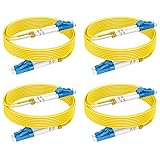
- 【10ft/3m 4pack OS2 Fiber Optic Patch Cable】 As AI continues to advance at an unprecedented pace, having reliable and efficient connectivity is crucial.RamboCables offers a cost-effective solution for your AI infrastructure with the 4-Pack OS2 LC-LC Single Mode Fiber Patch Cables. These high-quality fiber optic patch cords are designed to provide reliable and efficient connectivity for your AI applications.
- 【Wide Application】Whether you're using AI for data processing, machine learning, or other applications, the OS2 LC-LC Single Mode Duplex Fiber Patch Cable is ideal for connecting high-speed transceivers such as 10G SR, 40G BIDI SR, QSFP+, SFP+, and more. It is suitable for 1G/10G/40G/100G/400G Ethernet connections, making it a versatile choice for data centers, cloud storage networks, server farms and any other environments where reliable fiber optic connectivity is essential.
- 【Max Transmission Distance】With the OS2 Single Mode Optic Fiber Cable, you can transmit data for up to 10km at 1310nm or up to 40km at 1550nm. It offers excellent bandwidth at 1310nm-1550nm, with a low attenuation rate of 0.36 dB/km-0.22 dB/km, and can operate in a wide temperature range of -20~70°C, ensuring reliable performance even in harsh environments.
- 【Industry Standard】The OS2 LC-LC Fiber Patch Cords are built to industry standards. With LSZH (Low Smoke Zero Halogen) jacket, LC/UPC to LC/UPC connectors, 9/125μm high-rated fiber cladding, and a 2.0mm cable diameter, feature an LSZH environmentally friendly jacket, Zirconia Ceramic Ferrule, and 15mm minimum bend radius, all in accordance with EIA/TIA 604-2 standards, ensuring optimum insertion loss (IL) and return loss (RL) performance.
- 【Standards & Reliability】With over 15 years of experience manufacturing fiber patch cords, RamboCables are dedicated to supplying high-quality products and services. Our fiber patch cables comply with industry standards to enable efficient network transmission.
What to verify before deployment
- The target rate is supported by both connected devices.
- The module form factor is explicitly supported by the host port.
- The selected medium and reach meet the actual link requirement.
- Lane configuration, wavelength plan and breakout behavior match end to end.
- Power, cooling, cost and interoperability have been evaluated for the intended environment.
- The claimed standard status is clear: IEEE 802.3df-2024 is published for 400G and 800G, while the cited P802.3dj page describes standards work that includes 1.6T.
Product prices and availability are accurate as of the date/time indicated and are subject to change. Any price and availability information displayed on Amazon at the time of purchase will apply.

