
iTechGuides is reader-supported. When you buy through links on our site, we may earn an affiliate commission. As an Amazon Associate I earn from qualifying purchases. Learn more
Deleting a file usually removes its entry from the file system and makes its storage space available; it does not, by itself, prove that every physical copy of the data on an SSD has been erased. The SSD controller manages flash storage behind the addresses your computer can see, so a host-side deletion and a verified device sanitization are different things. That does not mean every SSD keeps a recoverable copy: what may remain depends on the drive, its firmware, the operating system and storage stack, and what happens after deletion.
What “hiding” means on an SSD
The title’s “hiding” is a metaphor for the gap between what the computer can address and how the SSD manages its physical flash. When you delete a file, the file system can mark its blocks as available for reuse. If the operating system and storage stack support and send TRIM or an equivalent deallocation notification, the drive can also be told that certain logical blocks are no longer needed.
The controller translates host-visible logical addresses into locations on NAND flash and manages operations such as garbage collection and wear management. The NVM Express Base Specification Revision 2.1 notes that a drive may have more physical storage than is exposed as user-addressable capacity, for example because of overprovisioning. The host therefore cannot infer from a file operation that every physical location associated with the data has been erased. NVM Express Base Specification Revision 2.1, dated August 5, 2024.
This does not establish that a deleted file remains readable. TRIM, later writes, garbage collection, firmware, and controller behavior can all affect what is accessible. A 2011 forensic study describes these dependencies, including differences among controllers; it cannot be used as a current recovery rate or as proof that a modern drive will retain recoverable data. DFRWS study on reliably erasing data from flash-based SSDs.
#1 Best Overall
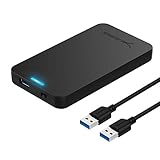
- Tool free design, easy to install,Transfer Rates Up to 480 Mbps when connected to a USB 2.0 port,Transfer Rates Up to 5 Gbps when connected to a USB 3.0 port.
- Suitable for 2.5” SATA/SSD;Supports Standard Notebook 2.5″ SATA and SATA II Hard drives
- Optimized for SSD, Supports UASP SATA III,Backwards-Compatible with USB 2.0 or 1.1
- Hot-swappable, plug and play, no drivers needed
- Operating System:Supported Operating Systems:Mac,Windows;Supported Windows Versions :Windows 7, Windows 8, Windows Vista, Windows XP; Supported Mac Versions: Mac OS X and Higher
Can deleted files be recovered from an SSD?
Sometimes recovery may be possible, but there is no reliable yes-or-no answer for every SSD. The outcome depends on the device and firmware, whether deallocation notifications are supported and issued, time and subsequent activity, and the surrounding storage stack. The available evidence does not establish a general success rate or guarantee that a recovery lab can retrieve a deleted file.
If an accidentally deleted file matters, stop writing to the drive: continued activity can change the state of storage that might otherwise be recoverable. Consult a reputable recovery professional rather than assuming a consumer recovery tool will work on your model.
Rank #2

- Feature - BENFEI Type-C/Type-A 2.5 inch Hard Drive Enclosure easily hook up your 2.5 inch SATA I/II/III hard drive to transfer files from one PC to another PC, laptop, PS4 or as a USB external hard drive.
- Speed - Up to 5 Gbps data transfer rate with supports UASP SATA III transmission protocol, which is 70% faster than traditional USB3.0. Backward compatible with USB 2.0 or 1.1 ports.
- Design - With USB Type-C/Type-A plug design, provide a easy connection option to laptop/phone/pad. Tool free installation, Plug & Play, No driver needed for this SATA enclosure. Just push out the cover, plug in the drive, close the cover and go. Hot-Swappable.
- Compatibility - BENFEI Hard Drive Enclosure supports Windows, LINUX, MacOS 8.0, and above. Specifically designed for 7/9.5mm thick, 2.5 inches, 6TB HDD & SSD. Compatible with Western Digital, Seagate, Toshiba, Samsung, Kingston, Crucial, Hitachi, and more.
- Warranty - Exclusive BENFEI Unconditional 18-month Warranty ensures long-time protection of your purchase; Friendly and easy-to-reach customer service to solve your problems timely.
Does TRIM erase deleted files?
TRIM, or an equivalent deallocation notification, tells a drive that specified logical blocks are no longer needed by the host. It is not the same as proof that NAND cells were instantly erased. The controller decides how to manage physical flash, including through garbage collection, and the host cannot directly inspect every physical location through ordinary file-system operations.
Do these 3 things before closing this tab:
1Repair Windows errors before they cause bigger problems2Fix the driver behind crashes, sound loss and screen glitches3Clear out junk files and repair common Windows errorsDo not assume every operating system, drive, or storage path handles TRIM identically, or that a notification guarantees a particular recovery or erasure outcome. The behavior is device- and configuration-dependent.
Rank #3

- 10Gbps NVMe Enclosure: With the latest USB 3.2 Gen2, this M.2 enclosure can achieve a data transfer rate of 10Gbps. Backward compatible with USB 3.1 and USB 3.0. Note: 10G speeds need to be matched with a USB C 3.2 GEN2 data cable
- Tool-free SSD Enclosure: Tool-free NVMe SSD enclosure for quick and easy installation. Plug and play, no drivers required. The buckle design of the M.2 SSD enclosure can ensure stable and fast transfer
- Broad Compatibility: The UGREEN M.2 NVMe SSD enclosure is specially designed to support NMVe protocol M/B&M keys and for 2230/ 2242/ 2260/2280 size SSDs up to 8TB. The M.2 NVMe enclosure is applicable for Windows, Mac OS (Mac Mini M4/M5 Pro/M6), Linux, Android, IOS systems.(Does not support SATA NGFF SSD or mSATA SSD)
- Security & Stability: USB C NVMe enclosure adopts advanced RTL9210 chip with short-circuit, over-current and multi-protection to ensure the safety of your SSD and valuable data, and supports UASP/ Trim with high transfer speed
- Compact & Portable: This ultra-slim aluminium external NVMe enclosure with extra silicone case is portable yet durable, and much easier to carry with this M.2 to USB adapter, making it ideal for travelling
Deleting a file is not sanitizing an SSD
NIST SP 800-88 Rev. 2 defines the goal this way: “Media sanitization refers to a process that renders access to target data on the media infeasible for a given level of effort.” The definition makes sanitization a stronger and contextual standard than removing a file-system entry or marking blocks as available. NIST SP 800-88 Rev. 2.
Rev. 2, published in September 2025, supersedes NIST SP 800-88 Rev. 1. The older revision warned that flash behavior, spare cells, and implementation variability could affect the assurance of erase methods; it is historical context, not current standalone instructions. For current guidance, use Rev. 2 and the drive maker’s instructions for the specific device.
Rank #4

- Flip-Open Tool-Free Design: Open the cover, insert your NVMe SSD, lock it in place, and close—no screws or tools required. Fast and simple for upgrades, cloning, troubleshooting, and portable tech work.
- Cooler 10Gbps Performance: The aluminum enclosure presses the thermal pad directly against your SSD for better heat transfer and more stable 10Gbps speeds than slide-in enclosures. Ideal for long transfers and heavy workloads.
- NVMe Only for Maximum Speed: Supports M.2 NVMe SSDs in sizes 2230, 2242, 2260, and 2280 up to at least 8TB. Not compatible with M.2 SATA SSDs.
- USB C Plug-and-Play: Connect with USB C for up to 10Gbps using USB 3.2 Gen 2. No drivers or external power needed. Works with laptops, desktops, gaming handhelds, and USB C devices.
- Portable and Durable Aluminum Build: Reinforced ABS frame with an aluminum alloy top keeps your SSD protected and cool. Slim, lightweight, and perfect for creators, gamers, and anyone needing fast portable storage.
How to prepare an SSD for transfer or disposal
For sensitive data, choose a sanitization approach based on the specific device and the information you need to protect. NIST Rev. 2 emphasizes a sanitization program and validation; no single command can be treated as guaranteed for every SSD. NVMe specifications include sanitize mechanisms, but the relevant method and its availability depend on the drive and interface.
- Identify the exact drive and connection. Record the model and determine whether it is connected through NVMe, SATA, or another interface. Confirm that the procedure you are considering applies to that device.
- Consult current instructions. Read the manufacturer’s guidance for the exact model and follow current NIST SP 800-88 Rev. 2 guidance. Do not rely on a generic command or on the superseded Rev. 1 table as a current procedure.
- Match the method to the risk. Consider whether the method covers the intended media and data, whether its implementation can be trusted and validated, and how sensitive the information is.
- Validate the result appropriately. Follow the device maker’s and current guidance’s validation process. A completed file deletion or a command reporting success is not, on its own, the same as validated sanitization.
If you cannot establish that a procedure is appropriate for the drive or the data is especially sensitive, seek qualified media-sanitization or electronics-disposal help. No provider or service can be assumed suitable without checking its process and coverage.
Quick Recap
Best Value

- Feature - BENFEI 2.5 inch Hard Drive Enclosure easily hook up your 2.5 inch SATA I/II/III hard drive to transfer files from one PC to another PC, laptop, PS4 or as a USB external hard drive. USB Type-C/Type-A 10Gbps cable is included in the package.
- Speed - Adopts advanced JMS580 chipset, support up to 6 Gbps data transfer rate with more stable and realiable data speed transmission compared with other solution. Supports UASP SATA III transmission protocol, which is 70% faster than traditional USB3.0, Backward compatible with USB 2.0 or 1.1 ports.
- Design - Tool free installation, Plug & Play, No driver needed for this SATA enclosure. Just push out the cover, plug in the drive, close the cover and go. Hot-Swappable.
- Compatibility - BENFEI Hard Drive Enclosure supports Windows, LINUX, MacOS 8.0, and above. Specifically designed for 7/9.5mm thick, 2.5 inches, 6TB HDD & SSD. Compatible with Western Digital, Seagate, Toshiba, Samsung, Kingston, Crucial, Hitachi, and more.
- 【18 MONTH WARRANTY】 Exclusive BENFEI Unconditional 18-month Warranty ensures long-time satisfaction of your purchase; Friendly and easy-to-reach customer service to solve your problems timely.
What the evidence does—and does not—show
- It establishes that file deletion and sanitization are different operations, and that the SSD controller manages physical flash behind host-visible addresses.
- It supports device-dependent effects from TRIM, garbage collection, wear management, overprovisioning, and controller behavior.
- It does not establish that all SSDs retain deleted data, that all deleted files can be recovered, or that a particular consumer tool or universal command will securely erase every model.
Product prices and availability are accurate as of the date/time indicated and are subject to change. Any price and availability information displayed on Amazon at the time of purchase will apply.

