
iTechGuides is reader-supported. When you buy through links on our site, we may earn an affiliate commission. As an Amazon Associate I earn from qualifying purchases. Learn more
There is no proven universal winner. Outdoor life depends on the individual clothespin’s construction, direct ultraviolet exposure, rain, and whether you leave it on the line between laundry days. For a line in prolonged sun, an explicit UV-protection claim is a sensible filter. A wooden pin can also be sold for outdoor use, but that sales description is not a head-to-head durability test. No reviewed source provides a controlled lifespan comparison or a reliable number of seasons for either material.
What the available evidence actually shows
The broad labels “wooden” and “plastic” are too coarse to predict service life. A plastic pin may use ordinary polymer, or it may be formulated and labeled for ultraviolet exposure. A wooden pin may have a treated or untreated body, and its spring may be made from a different material altogether. The spring, hinge, loop, finish, and the way you store the pin can determine whether the body’s material is even the first part to fail.
The sources reviewed are product listings, a buying guide, and individual consumer comments. None is a controlled outdoor exposure study that places wooden and plastic pins side by side under the same sun, rain, wind, loads, and storage routine. The buying guide specifically says it did not test the products it discusses. Consequently, it would be misleading to promise that one material will last five years, ten years, or any fixed number of seasons.
Consumer comments illustrate why experiences differ. In a Reddit discussion titled “Clothespins that have lasted over six years,” one commenter wrote, “The ones that were exposed to UV died in a year,” while another observed, “Leaving them out in the rain isn’t helping.” These are personal reports, not representative measurements. They are useful as warnings about exposure, not as a lifespan chart for every plastic or wooden pin.
#1 Best Overall

- Mr. Pen wooden clothes pins come in a 50-pack, offering a reliable and sturdy solution for a variety of tasks around the home or office.
- Made from high-quality natural wood, these clothes pins are durable and designed to withstand frequent use, with a rust-resistant galvanized coil for long-lasting performance.
- Each pin measures 2.9 inches, making them perfect for holding laundry, organizing items, or even for use in crafts and DIY projects.
- The natural wood finish offers a classic look while maintaining the practical functionality needed for everyday tasks.
- These versatile pins are ideal for use in crafts, holding food bags, hanging pictures, or adding a decorative touch to DIY projects.
How the two material categories differ in practice
Plastic: look for a specific UV claim
“Plastic” does not automatically mean outdoor-safe. The strongest example in the reviewed material is IKEA’s SLIBB clothes pin, model 305.677.32. IKEA lists a polypropylene clamp, an acetal spring, and a polyamide loop, and describes the peg as “UV-light protected, which helps the plastic last longer.” That statement is a product description, not an independent test. IKEA does not publish a UV rating, exposure protocol, or expected service life for the pin.
This makes the UV wording useful for screening but not for predicting a date when replacement will be needed. A UV-protected pin is a reasonable candidate for a sunny line because the manufacturer has addressed sunlight in its design description. It is not proof that this pin will outlast every wooden pin or every other plastic formulation.
A second example comes from Dutchman’s Store. Its PolyGrip clothespins are described by the seller as UV-resistant molded poly with a stainless-steel spring. The stainless spring is relevant where moisture could cause corrosion, while the UV-resistant wording addresses sunlight. Both statements remain seller-provided claims; the listing does not establish a standardized test result or service-life figure.
Wood: outdoor suitability is a listing claim, not a lifespan guarantee
The Home Depot listing for Everbilt Natural Wood Clothespins, model 72966, identifies a 50-pack for indoor and outdoor use. It describes the wood as rust resistant and non-staining. Those words address intended use and certain material characteristics, but the listing does not establish how long the complete pin lasts outdoors, how the wood is finished, or how its spring performs after repeated wetting and drying.
Rank #2

- Premium Natural Wood: Crafted from natural birch with rust-resistant metal springs, these strong laundry clothespins won't snap. When looking for clothes pins wooden material is key for lasting daily use
- 50 PCS: At 2-7/8" long, these wooden clothespins are perfectly sized, sturdy, and durable. Get 50 smoothly sanded solid wooden clips for DIY crafts or to hang and grip items securely
- Great for Crafts & Classrooms: Use these for school DIY projects, student classroom art, and photo displays. While strong enough as wooden clothespins for laundry or laundry pins, these clothes pegs fit all your craft needs
- Rust‑proof Spring: Made of premium stainless steel, it keeps the clothespins durable and reliable even in damp environments like laundry rooms. The natural wood grain adds an eco‑friendly and sophisticated touch, making it a great choice for both schools and offices
- Paper box packaging: To actively reduce pollution, our sturdy clothespins come packed in a recyclable mini paper box. Whether searched as close pins or clothes pins, you enjoy zero plastic waste
In other words, a wooden pin marketed for outdoor use should not be dismissed automatically. It also should not be treated as proven to outlast a UV-protected plastic pin. The product page gives no controlled comparison, and it does not supply a measured lifetime for either the wooden body or the spring.
Comparison at a glance
| Decision factor | Wooden clothespin | Plastic clothespin | What is established |
|---|---|---|---|
| Direct sun and UV | Outdoor suitability may be stated, but no reviewed source gives a UV rating or exposure life. | Some products make an explicit UV-protection or UV-resistance claim; ordinary plastic may make no such claim. | Product-specific wording matters more than the category label. |
| Rain and wet/dry cycles | The Everbilt listing calls the wood rust resistant and non-staining; it does not state a full-pin lifespan. | Construction varies. A stainless-steel spring is advertised for PolyGrip; other spring materials differ. | No comparable wet-weather test was found. |
| Spring material | Not stated for the Everbilt listing. | SLIBB lists an acetal spring; PolyGrip is described with a stainless-steel spring. | The reviewed sources do not compare spring fatigue or corrosion rates. |
| Grip force and load | No standardized grip measurement supplied. | No standardized grip measurement supplied. | Choose by how securely the actual pin holds your fabric and line. |
| Cost per pin | The reviewed material identifies a 50-pack but gives no price to calculate a current unit cost. | The reviewed material gives no comparable current price. | Check the price on the date and in the region where you buy. |
| Published service life | Not stated. | Not stated; SLIBB’s UV wording is not a service-life specification. | No reliable comparative statistic was found. |
| Storage guidance | Keeping pins dry between uses is sensible. | Keeping pins out of sun and rain is sensible, including UV-protected models. | A guide recommends a storage bag but does not measure extra years gained. |
Which should you choose for your line?
Choose a UV-claimed plastic pin when sunlight is the main stress
If your line sits in direct sun for much of the day and you want to leave pins outside, start by checking for an explicit UV-protection or UV-resistance statement. The SLIBB listing is an example of a manufacturer identifying UV-light protection; the PolyGrip listing is an example of a seller describing UV-resistant molded poly. Treat these as selection clues rather than guarantees.
Also inspect the spring specification. An acetal spring, as listed for SLIBB, is a different design choice from the stainless-steel spring described for PolyGrip. The available sources do not establish which spring lasts longer, so match the choice to your concern: sunlight claims for the body and a stated corrosion-resistant construction where wet conditions are persistent.
Choose a wooden pin when you prefer its handling and can manage exposure
A wooden clothespin can be a reasonable outdoor option, particularly when you can remove it after use or keep it under cover. The Everbilt listing explicitly says indoor and outdoor use and describes the wood as rust resistant and non-staining. Those are useful product attributes if avoiding marks on clothing matters.
Rank #3
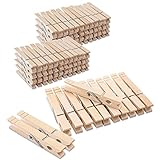
- 【Standard Natural Wooden】:Made of 100 percent natural wood,naturally resistant to moisture,Great for outdoor or indoor drying
- 【FEATURES】:Rust resistant wire springs, Non-slip finger grips
- 【USAGE】:Hanging and drying clothing Handy for securing opened snack packages and bread bags.Perfect for a wide variety of craft/school projects. hanging Christmas tree ornaments and home decorations
- 【SIZE】:3.5 X 0.4 X 0.8 Inch,100pack/one bag.
- 【After-Sales】: If you have any questions, please contact us immediately, we can solve it for you
Do not infer a guaranteed lifetime from the 50-pack format or from the outdoor-use label. The listing does not identify a measured exposure duration, treatment schedule, or spring life. If your line is permanently exposed, evaluate the actual pin after several wet/dry cycles instead of assuming that all wooden pins behave alike.
Use storage to reduce exposure regardless of material
A clothespin guide recommends keeping pins in a bag when they would otherwise remain clipped to an outdoor line. The recommendation is practical: removing a pin from direct sun and rain reduces the time it spends in those conditions. The guide does not test a bag’s effect, so present storage as a maintenance habit, not as a promise of a specific number of extra years.
A buying checklist that works better than “wood versus plastic”
- Identify the exposure pattern. Note whether the line receives full midday sun, only morning or evening light, frequent rain, freezing weather, or sheltered air. A pin used under a roof is not facing the same duty as one left on an open hillside.
- Read the exact UV language. “UV-light protected” or “UV-resistant” is more informative than a generic plastic label. Record whether the statement comes from the manufacturer or a retailer, because the reviewed claims are not independent test results.
- Find the spring material. Look for a named material such as acetal or stainless steel. If the listing does not say, mark it as unknown rather than assuming that the spring matches the body.
- Check the loop and hinge. A loop can make storage easier, while a hinge that binds or twists can reduce usable grip. The reviewed sources do not provide standardized hinge or grip measurements, so inspect the pin’s movement and alignment.
- Match grip to the laundry. Test a pin on the heaviest item you routinely hang and on a lightweight garment. A pin that holds a towel but marks a delicate shirt may not be a good all-purpose choice.
- Calculate real unit cost. Divide the pack price by the number of usable pins, and include replacements you typically discard. The available listings do not provide a common price or region, so calculate with the current price where you shop.
- Decide whether you will store them. If you can bring pins indoors after each load, material differences may matter less than if the pins remain outdoors continuously. Plan a container or clothespin bag before buying a large quantity.
- Look for a service-life or test specification. None of the reviewed products publishes a comparable outdoor lifetime. If a future listing supplies a test method, check what exposure, load, and failure definition it used before comparing it with another product.
How to run a fair household comparison
You can learn which of two specific products suits your conditions without pretending that a home trial is a laboratory test. The goal is to compare your routine, not to create a universal lifespan claim.
Quick wins for a faster PC:
Repair Windows errors before they cause bigger problemsFix Now →Scan for outdated or missing drivers - takes under a minuteDriver Scan →Clear out junk files and repair common Windows errorsFree Scan →- Buy or set aside equal numbers of the two specific models. Record model numbers, pack size, purchase date, and the material claims printed on each listing.
- Use the same line, location, and laundry loads. Do not place one group in shade and the other in full sun if you want an exposure comparison.
- Mark each pin or keep groups in separate containers so replacements are traceable. Photograph the spring, hinge, and body before the trial.
- At each laundry day, inspect for cracks, whitening, brittleness, swelling, rust, bent springs, and loss of grip. Note weather conditions and whether the pins stayed outside between loads.
- Retire a pin when it no longer holds the intended item safely or when a crack creates a breakage hazard. Record the reason rather than counting every cosmetic change as failure.
- After a defined period, compare usable-pin percentage, grip on your heaviest item, and time spent storing or replacing pins. Label the result as your household observation, not proof that one material always wins.
Care and storage routine
After each load
- Remove pins from the line if you will not use them again soon.
- Shake off visible water and place them in a ventilated bag or container.
- Separate visibly damaged pins so a cracked body or weakened spring is not reused by mistake.
During storage
- Keep the container out of direct sunlight and away from standing water.
- Do not seal visibly wet wooden pins in an airtight container; let them dry first.
- Avoid compressing a large pile in a way that permanently bends loops or springs.
On the line
- Use enough pins for windy or heavy items rather than overloading one pin.
- Position the grip on a sturdy seam or hem when possible.
- Remove pins before severe weather if the line and clothing would otherwise remain exposed for an extended period.
These habits reduce exposure and misuse, but no reviewed source quantifies how many additional months or years they provide.
Rank #4

- Value Pack: This set includes 100-pack of 2.9 inch wooden clothespins. Each is crafted from natural hardwood and sanded smooth for a splinter‑free finish, making these clothes pins safe on delicates as laundry clips, clothespins for crafts, or chip clips
- Rust‑Proof Grip: Sturdy rust‑resistant springs turn these into clothes pins heavy duty outdoor. They hold firmly on clotheslines in sun or wind without losing tension. Use these clothesline clips to secure towels, sheets, and light garments with confidence every washday
- Solid Hardwood: Made from sustainably sourced hardwood, these wooden clothespins bring eco‑friendly durability. The smooth grain and uncoated surface mean no plastic and no rough edges—a reliable clothes pin for laundry, crafts, and everyday tasks around the home
- Multi‑Purpose: Beyond drying, use these clothespins for crafts like photo walls, string light displays, or giftless DIY projects. They also work as chip clips for snack bags or a clothing clip to organize light fabrics, accessories, and small household items
- Gentle Hold: Designed for light fabrics, these clothes pins wooden grip silk, scarves, and socks without leaving marks. Use them as clothesline clips for delicates outdoors or for hanging small organizers and decorations, keeping everything neatly in place
Recognizing failure before a pin drops laundry
Plastic body changes
Look for cracks, chalky or brittle surfaces, distortion around the hinge, and a loop that no longer aligns with the body. A UV-protection claim does not make a pin immune to damage; it only identifies a design intention in the listing.
Wood body changes
Inspect for splits, raised fibers, swelling, soft spots, and stains transferred to fabric. The Everbilt description says its wood is non-staining, but any pin that is visibly damaged should be removed from service rather than judged by the original listing.
Spring and grip changes
A pin that opens unevenly, fails to close, or slips from fabric has reached the end of its useful life for that task, even if the body looks intact. The available sources do not provide a grip-force threshold, so use the actual load and conditions as your safety test.
The Tool Desk
Outbyte Driver Updater FREEScan for outdated or missing drivers - takes under a minuteDriver Scan →Outbyte PC Repair FREERepair Windows errors before they cause bigger problemsFix Now →Common mistakes and how to correct them
Assuming every plastic pin is UV-safe
Why it fails: The word plastic says nothing about a particular formulation or protection level. Correction: look for an explicit UV statement and identify who makes it.
Best Value

- Our 100 pack heavy duty clothespins are made of natural wood and strength stainless steel spring, perfitly for laundry clothes, classrooms, and outdoors
- Widely use for crafts, school projects,summer wedding card holder, clothesline hanging clothes, sheet
- Helping keep closed storage your snack, bread bags, chips
- Strong and sturdy heavy duty wooden clothespins for long lasting
- Dimensions: 3 x 0.5 x 0.5inch
Treating “outdoor use” as a tested lifetime
Why it fails: A retailer can describe intended use without publishing exposure hours, weather cycles, or failure criteria. Correction: treat the label as a suitability claim and inspect the construction.
Ignoring the spring
Why it fails: The body may survive while the spring corrodes, fatigues, or loses alignment. Correction: check whether the listing names the spring material; SLIBB lists acetal, while PolyGrip is described with stainless steel.
Leaving pins clipped to the line indefinitely
Why it fails: Continuous sun and rain add exposure even when no laundry is hanging. Correction: use a storage bag or container and bring pins in between loads when convenient.
What’s actually slowing this PC down?
Pick the symptom - the matching free tool is one click away.
Turning anecdotes into a guarantee
Why it fails: Individual comments such as a pin lasting six years or failing after one year of UV exposure do not represent all climates, products, or routines. Correction: use anecdotes to identify questions, then judge the exact model in your own conditions.
What is still unknown
No reliable, named comparative statistic establishes that wooden clothespins outlast plastic ones outdoors, or the reverse. No reviewed source supplies a standardized grip-force result, corrosion test, UV-hour rating, or expected service life for the complete pin. The available product language is therefore best used to compare design details and care requirements, not to calculate a replacement schedule.
When a listing provides more information, ask whether it identifies the test method, exposure intensity, temperature and moisture cycles, applied load, sample size, and definition of failure. Without those details, two claims of “outdoor durable” may describe very different conditions.
Bottom-line buying decision
For a permanently sunny line, investigate a plastic model with an explicit UV-protection or UV-resistance claim and a clearly described spring. For a line where pins are collected after use, a wooden model marketed for indoor and outdoor use can be a sensible choice, especially if you value its handling and non-staining description. In either case, storage out of sun and rain is the most practical step you can control. Choose by the exact product construction and your exposure routine, not by the material name alone.
Quick Recap
Product prices and availability are accurate as of the date/time indicated and are subject to change. Any price and availability information displayed on Amazon at the time of purchase will apply.

