
Quick wins for a faster PC:
Repair Windows errors before they cause bigger problemsFix Now →Fix the driver behind crashes, sound loss and screen glitchesFind Drivers →Clear out junk files and repair common Windows errorsFree Scan →iTechGuides is reader-supported. When you buy through links on our site, we may earn an affiliate commission. As an Amazon Associate I earn from qualifying purchases. Learn more
Short answer: A good 2.4 GHz wireless gaming mouse or headset usually does not have a noticeable latency disadvantage compared with wired gear. The important distinction is the connection: proprietary USB receivers are designed for low-latency play, while Bluetooth is generally slower and better suited to ordinary use or battery saving. Wired devices never need charging and remove radio variables, but wireless devices eliminate cable drag and provide much more freedom to move.
Neither connection is automatically more comfortable. Shape, weight, grip, headband pressure and ear-cushion fit matter more than the presence of a cable. Choose the mode and physical design for the games you play, your hardware and how much charging you are willing to manage.
Do wireless gaming peripherals still have noticeable latency?
Usually not when a gaming mouse or headset uses its dedicated 2.4 GHz USB receiver. RTINGS identifies wired and proprietary receiver connections as the low-latency choices in its gaming-mouse testing. It also reports that many receiver-based gaming mice can match or even beat wired models in measured click latency. That finding is model-specific: it does not mean every wireless mouse is as fast as every wired mouse.
Bluetooth is a different case. In the same testing guidance, Bluetooth generally produces the highest click latency of the connection types reviewed. A Bluetooth mouse can feel fine for a laptop, office work or turn-based games, but it is the wrong default when rapid clicks and consistent timing are priorities. Select the receiver mode for gaming and reserve Bluetooth for convenience or extending battery life.
#1 Best Overall

- The next-generation optical HERO sensor delivers incredible performance and up to 10x the power efficiency over previous generations, with 400 IPS precision and up to 12,000 DPI sensitivity
- Ultra-fast LIGHTSPEED wireless technology gives you a lag-free gaming experience, delivering incredible responsiveness and reliability with 1 ms report rate for competition-level performance
- G305 wireless mouse boasts an incredible 250 hours of continuous gameplay on just 1 AA battery; switch to Endurance mode via Logitech G HUB software and extend battery life up to 9 months
- Wireless does not have to mean heavy, G305 lightweight mouse provides high maneuverability coming in at only 3.4 oz thanks to efficient lightweight mechanical design and ultra-efficient battery usage
- The durable, compact design with built-in nano receiver storage makes G305 not just a great portable desktop mouse, but also a great laptop travel companion, use with a gaming laptop and play anywhere
For headsets, a 2.4 GHz dongle normally offers lower latency and more stable performance than Bluetooth. Wired playback can be the simplest option, but whether a headset works passively over its cable varies by model; some still require battery power for active electronics, wireless features or processing.
“Wireless” covers three materially different connection modes
Proprietary 2.4 GHz USB receiver
A gaming receiver creates a dedicated radio link between the peripheral and a small USB dongle. The manufacturer controls the radio protocol, buffering and firmware, so it can prioritize short, predictable input intervals instead of Bluetooth’s broad compatibility and power-saving behavior. This is the wireless mode to look for in a competitive mouse or headset.
Receiver performance still depends on the individual product. Antenna design, firmware, polling settings, interference and the quality of the USB receiver all affect results. A receiver that ships with a gaming mouse is not interchangeable with a generic Bluetooth adapter.
Bluetooth
Bluetooth is convenient because many computers and tablets already support it, and one device can often pair with several hosts. Its general-purpose design favors compatibility and energy efficiency. The trade-off is higher and sometimes less consistent click latency than wired or proprietary receiver operation. Bluetooth is useful for travel, office work and conserving the main battery, not as the first choice for latency-sensitive play.
Dual-mode devices
Many gaming mice and headsets include both a proprietary receiver and Bluetooth, plus a wired USB mode. This arrangement lets one device cover a desktop, laptop and console, but each mode has its own behavior. A product’s advertised battery figure may apply only to a particular mode, lighting setting or performance profile. Check the manual for how to switch modes and whether charging and play can occur simultaneously.
Rank #2

- ICONIC ERGONOMIC FORM WITH 9 CUSTOMIZABLE CONTROLS — Favored by millions worldwide, the mouse’s signature shape perfectly supports different grips, while its numerous easy-access buttons allow for an endless combination of commands and macros
- RAZER HYPERSPEED WIRELESS AND BLUETOOTH — Unleash seamless, low-latency performance that's faster than other wireless tech or switch to Bluetooth for longer hours of gaming. Outfitted with multi-device support for a streamlined setup
- UP TO 285 HOURS OF BATTERY LIFE — With up to 535 hours on Bluetooth and 285 hours on Razer HyperSpeed Wireless, last longer in the heat of battle with a mouse designed to play the long game. May vary depending on usage conditions
- RAZER 5G ADVANCED 18K OPTICAL SENSOR — Tailor the mouse to the playstyle with a new, robust set of sensitivity settings. Enjoy responsive, pixel-precise aim with an ultra-reliable sensor that tracks movement with zero spinouts
- RAZER MECHANICAL MOUSE SWITCHES GEN-2 — With new gold-plated contact points, the switches are less prone to degrading and have a longer lifespan of up to 60-million clicks, so gamers can enjoy crisp execution that’s just as consistent
| Connection | Latency expectation | Battery or power behavior | Best fit |
|---|---|---|---|
| USB cable | Low and consistent; no radio link | No internal battery required while connected | Competitive play, permanent desk setups, users who never want to charge |
| Proprietary 2.4 GHz receiver | Generally low; many tested models match or exceed wired mice | Requires charging; runtime depends on model and settings | Competitive gaming with freedom from cable drag |
| Bluetooth | Generally the highest click latency among the modes discussed | Often efficient, but not optimized for the lowest input delay | Office use, travel, secondary devices and battery saving |
How latency is measured—and what you will actually feel
“Latency” is not one number. A mouse click passes through the switch, the mouse controller, the connection, the computer’s USB stack and the game before an action appears on screen. Display refresh, frame time and the game engine add more delay. A headset has separate input and output paths: microphone transmission, audio encoding, radio buffering and decoding all contribute to the time between an event and the sound reaching your ears.
RTINGS’ mouse testing uses a gaming PC, a capture PC, a USB analyzer and controlled actuation hardware. Its updated testing page (August 11, 2025) is useful because it compares connection modes under a defined procedure rather than relying on anecdotes. Results should still be read per model: a fast receiver mouse does not prove that all wireless mice perform identically.
Polling rate and click timing
A higher polling rate can reduce the interval between reports and may lower measured click latency. It also increases USB traffic, wireless workload and battery consumption. Battery-saving features, reduced performance modes and long idle intervals can work against the lowest-latency settings. Use the manufacturer’s gaming profile when timing matters, then lower the rate only if you need longer runtime or your computer struggles with the workload.
Extremely high reporting rates require host support. Razer notes that some CPUs may not support 8,000 reports per second. That is manufacturer-specific guidance, not a universal requirement: ordinary 1,000 Hz operation is far less demanding, while 4,000 or 8,000 Hz modes should be validated on your own system.
Headset latency and synchronization
For a headset, a small delay is most noticeable when a sound must line up with an on-screen event, such as a weapon report, rhythm-game note or voice conversation. A 2.4 GHz gaming dongle normally minimizes this delay compared with Bluetooth. Wired operation removes the radio hop, but a USB headset can still include digital processing that adds delay. An analog 3.5 mm connection is often the simplest path, provided the headset and controller support it.
Rank #3

- Designed With Pros, Engineered to Win: Designed alongside the world’s best esports athletes, the Logitech G PRO X2 SUPERSTRIKE wireless gaming mouse delivers the fastest, fully customizable click
- Dominate with industry-leading speed: 30 ms faster clicks for peak performance in every esports match and deep customization with 10-level actuation points and 5-level rapid trigger reset
- Haptic Feedback: This breakthrough haptic gaming mouse with Haptic Inductive Trigger System (HITS) gives real-time feedback for an unmatched immersive experience for any game scenario or play style
- Precision from Within: The HERO 2 sensor in this PC gaming mouse delivers tracking at over 888 IPS, 88 g-force, and up to 44,000 DPI — ensuring the pinpoint accuracy that champions rely on for every play
- Play Longer : With 60-90 hours battery life and LIGHTSPEED Wireless, this rechargeable gaming mouse(with included USB-A to USB-C cable) delivers lag-free 8 kHz polling for uninterrupted focus
Battery life is a real trade-off, not a universal specification
Wireless convenience moves the power problem from your computer to the peripheral. Runtime depends on lighting, polling rate, radio mode, sleep timers, volume, microphone use and battery age. Compare figures only when the test conditions are comparable.
What’s actually slowing this PC down?
Pick the symptom - the matching free tool is one click away.
| Published figure or guidance | What it actually establishes | How to use it |
|---|---|---|
| Up to 24 hours for the DARK CORE RGB mouse | CORSAIR’s advertised maximum for that model; manufacturer claim accessed October 13, 2026 | Treat it as a model-specific ceiling, not a cross-brand benchmark. Lighting and performance settings can reduce it. |
| Modern wireless mice may exceed 100 hours | HP guide, 2026; broad guidance without a controlled test method in the cited passage | Use as an indication that some products offer long runtimes, not as a guaranteed result for a particular mouse. |
| Wireless headsets typically last 30–60 hours per charge | HP guide, 2026; broad estimate without an independently described test procedure | Check the exact model’s conditions, volume, microphone and lighting before relying on the number. |
Charging approaches
- USB charging while playing: Some devices remain usable when connected, effectively becoming wired until you unplug them. Confirm this behavior before purchase; a cable may charge without carrying data or audio.
- Dock or magnetic contact: A charging dock makes maintenance easy but occupies desk space and may be an additional accessory.
- Replaceable batteries: Removable cells can restore full runtime quickly, but add weight and require spare batteries or a charger.
- Sleep and lighting controls: Automatic sleep, lower polling and disabled RGB lighting can extend a charge. These settings may reduce convenience or visual effects, and the lowest-power profile is not always the lowest-latency profile.
Wired peripherals avoid this entire cycle. They draw power from the computer, so they do not interrupt a session for charging and do not lose capacity as an internal battery ages. The price is a cable that must reach the device and remain out of your way.
Comfort depends on physical design, not the radio
Wireless removes cable drag and lets a mouse move across a larger surface without the cable catching on a monitor stand or desk edge. A wireless headset also lets you stand up or move around without disconnecting. Those are meaningful comfort benefits, especially for low-sensitivity mouse users who make broad sweeps.
A cable can nevertheless be unobtrusive when it is light, flexible and routed through a bungee or under the desk. A heavy wireless battery can offset the benefit of no cable. Shape, weight distribution and button placement often matter more to a mouse than its connection. For a headset, headband pressure, clamp force, ear-cup depth, pad material and heat determine whether long sessions remain comfortable.
Mouse fit checklist
- Measure your hand and match the shell length and width to your grip style: palm, claw or fingertip.
- Check total weight and where the battery sits. A centered battery usually feels less tiring than a device that is noticeably rear- or front-heavy.
- Look at the cable only after fit and weight. Cable drag is a real nuisance, but a poorly shaped or heavy mouse cannot be fixed by removing the wire.
- Confirm that the receiver, charging port and power switch do not interfere with your normal grip.
Headset fit checklist
- Check whether the ear cushions fully surround your ears and leave enough depth for your ears.
- Compare the headset’s mass and clamping force with your tolerance for pressure during long sessions.
- Consider heat and sweat: sealed pads can isolate sound well but feel warmer than breathable materials.
- Decide whether you need to walk away from the desk. If not, a wired model may provide equal comfort without a battery.
No reviewed source establishes a universal comfort winner for wired versus wireless devices. Personal fit and the specific model determine the result.
Rank #4
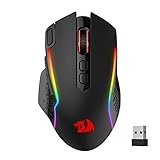
- Wireless for Boundless Winning - Cables truly will affect your detailed battle reaction, Redragon M810 pro wireless gaming mouse with 2.4Ghz nano receiver offers you the purest mouse moving experience and hype your KDA rise again.
- Adjustable DPI to 10000 - Geared with 5 on-board DPI levels (500/1000/2000/3000/10000) which allow your mouse movements to be registered to each pinpoint location. 5 DPI levels are free to DIY with software, for gamers to switch swiftly in game.
- Easy Keybinding with Macro - All 8 programmable buttons are all editable with customizable tactical keybinds in whatever game or work you are engaging. 1 rapid fire + 2 side macro buttons offer you a better gaming and working experience.
- Ultra Long-lasting Core - Equipped with the PAW3325 Optical Pixart sensor, the mouse consumption is further optimized with 1000Hz Polling Rate in dual mode. Rechargeable battery keeps the mouse working up to 45 hours at maximum (eco-mode).
- Adjustable True Color - With Redragon Pro driver, DIY endless style like dynamic streaming, breathing, waving. The game closely linked with various lighting modes makes your room full of competitive vibe.
Receiver placement can matter at high polling rates
Place a gaming receiver where it has a clear path to the peripheral. Razer’s guidance for its HyperPolling dongle recommends line of sight and a distance within 30 cm. It also advises keeping the dongle away from nearby USB 3 hubs, which can generate noise in the 2.4 GHz range. These are instructions for that dongle, not a universal distance rule for every wireless product.
- Connect the receiver to a stable USB port on the computer rather than an overloaded hub.
- Use the supplied extension cable or cradle to move the receiver onto the desk if the computer is under it or behind a metal panel.
- Keep the receiver separated from USB 3 hubs, external drives and other high-speed devices when possible.
- Install the device’s current firmware and select the 2.4 GHz gaming mode in its software.
- Test the device where you play. If the cursor stutters or audio drops, move the receiver first, then reduce nearby radio congestion before changing performance settings.
Setup guide for a low-latency wireless mouse
- Charge before pairing. Start with a full charge so a low-battery performance mode does not confuse troubleshooting.
- Install the manufacturer’s control software only if needed. Use it to update firmware, choose the receiver mode, set polling rate and configure sleep behavior.
- Connect the receiver directly or through its extension cradle. Keep it close to the mouse and away from USB 3 equipment.
- Pair the mouse in 2.4 GHz mode. Do not select Bluetooth simply because it appears first in the operating system’s device list.
- Set a sensible polling rate. Start at the default gaming rate. Increase it only when your CPU and game remain stable; high reporting rates can raise power use and may not be supported by every processor.
- Verify in a real game. Check for missed clicks, cursor skips and inconsistent aim, not only the operating system’s pairing message.
- Keep the cable available. If the battery runs low, connect the mouse and continue playing while it charges when the model supports wired use.
Setup guide for a wireless gaming headset
- Check platform support first. Confirm that the included dongle works with your PC, console or both. USB audio support differs between platforms.
- Use the 2.4 GHz dongle for games. Pair Bluetooth separately for phones, tablets or general listening if the headset supports dual connections.
- Choose the correct output and microphone device. In the operating system and game, select the headset rather than the monitor’s speakers or a webcam microphone.
- Test wired behavior. Determine whether the headset plays audio with the battery off, whether the microphone remains available and whether active processing is disabled over the cable.
- Place the dongle in a clear position. Avoid hiding it behind a desktop case or next to a crowded USB 3 hub.
- Set a charging routine. Charge after sessions or use a dock, but do not assume a published maximum runtime will match your volume, microphone and lighting settings.
Compatibility questions to answer before buying
PC and console support
A USB receiver that works on a PC may not work on every console, and a console may support only certain USB audio or controller paths. Check the exact platform list for the model. If you switch between a desktop and a laptop, dual-mode Bluetooth can be useful for the second device, but use the dedicated receiver for gaming.
Wired fallback
“Works wired” can mean several things: charging only, USB data and audio, analog audio through a 3.5 mm cable, or full operation with the battery disabled. Read the manual for the exact behavior. A headset that needs its battery for amplification will not be a true no-charge fallback even if it has a cable socket.
Software dependence
Basic input may work without vendor software, but firmware updates, remapping, lighting controls and polling-rate selection often require it. If you use multiple computers, decide whether your settings are stored in onboard memory or must be reconfigured each time.
Recommended Free Tools
Which connection fits your gaming style?
| Your priority | Most suitable default | Reason | Watch for |
|---|---|---|---|
| Lowest-risk competitive mouse setup | Wired or high-quality 2.4 GHz receiver | Both are the low-latency options identified by RTINGS | Receiver placement, firmware and model-specific results |
| Freedom to make wide mouse movements | 2.4 GHz wireless | Removes cable drag while retaining a gaming-oriented link | Battery charging and added device weight |
| Travel and office use | Bluetooth or dual-mode | Pairs easily with many hosts and can conserve power | Higher click latency than receiver mode |
| Long sessions with no charging routine | Wired mouse or headset | Power comes from the computer | Cable routing and connector reach |
| Moving between PC and console | Dual-mode receiver plus confirmed console support | One device can cover different hosts | Mode switching, platform limits and wired fallback details |
A practical buying checklist
- Connection: Identify whether the product has a dedicated 2.4 GHz receiver, Bluetooth, a cable, or all three.
- Latency evidence: Look for model-specific measurements or a clearly defined testing method. Do not treat “wireless” as a complete performance specification.
- Battery conditions: Record whether the runtime includes RGB lighting, a particular polling rate, continuous audio or a low-power mode.
- Charging: Confirm connector type, whether you can play while charging and whether a dock is included.
- Physical fit: Compare dimensions, weight, grip shape, headband pressure and cushion material before prioritizing radio features.
- Receiver placement: Check whether an extension cable or cradle is supplied and leave a clear path between receiver and device.
- Compatibility: Verify operating systems, consoles, USB requirements and any restrictions on simultaneous Bluetooth and receiver connections.
- Support: Check firmware-update tools, onboard-memory behavior and battery replacement or warranty terms.
Troubleshooting latency, dropouts and charging problems
The cursor feels delayed
- Confirm the mouse is in 2.4 GHz receiver mode rather than Bluetooth.
- Move the receiver closer using its extension cable and separate it from USB 3 hubs.
- Update firmware and return polling and power settings to the manufacturer’s gaming defaults.
- Test with another USB port and close software that may be imposing a low-power profile.
- Compare wired mode, if available. If wired is normal but receiver mode remains delayed, the issue is likely radio, firmware or the specific model rather than the game alone.
The headset audio cuts out
- Reposition the dongle so the computer case or desk is not blocking it.
- Remove nearby USB 3 devices temporarily to identify interference.
- Check that the headset has not switched to Bluetooth or a low-power multi-device mode.
- Confirm that the console or PC is using the correct USB audio endpoint.
- Test a wired connection to separate radio problems from a game or operating-system audio issue.
The battery does not last as advertised
Compare your settings with the conditions behind the published figure. RGB lighting, maximum polling, high volume, an active microphone and short sleep timers can all consume more power. If runtime has fallen sharply after many charge cycles, battery aging may be the cause; use the manufacturer’s service or replacement guidance rather than assuming a software setting will restore capacity.
Best Value

- The next-generation optical HERO sensor delivers incredible performance and up to 10x the power efficiency over previous generations, with 400 IPS precision and up to 12,000 DPI sensitivity
- Ultra-fast LIGHTSPEED wireless technology gives you a lag-free gaming experience, delivering incredible responsiveness and reliability with 1 ms report rate for competition-level performance
- G305 wireless mouse boasts an incredible 250 hours of continuous gameplay on just 1 AA battery; switch to Endurance mode via Logitech G HUB software and extend battery life up to 9 months
- Wireless does not have to mean heavy, G305 lightweight mouse provides high maneuverability coming in at only 3.4 oz thanks to efficient lightweight mechanical design and ultra-efficient battery usage
- The durable, compact design with built-in nano receiver storage makes G305 not just a great portable desktop mouse, but also a great laptop travel companion, use with a gaming laptop and play anywhere
What the available evidence does—and does not—prove
Controlled mouse testing supports a clear connection-level conclusion: wired and proprietary receiver modes are the low-latency choices, while Bluetooth is generally slower. It does not establish that every receiver mouse beats every wired mouse, nor does it provide a universal comfort score.
Manufacturer battery figures are useful for identifying the intended scale of a product’s runtime, but “up to” values are not independent cross-model tests. HP’s 2026 estimates for more than 100 hours on some modern wireless mice and 30–60 hours for typical wireless headsets are broad guidance without a controlled method in the cited passage. Use the exact model’s conditions when planning charging.
Radio-placement advice is similarly specific. Razer’s 30 cm line-of-sight recommendation and warning about USB 3 noise apply to its HyperPolling dongle. They illustrate good troubleshooting practice, not a mandatory distance for all receivers.
Do these 3 things before closing this tab:
1Repair Windows errors before they cause bigger problems2Fix the driver behind crashes, sound loss and screen glitches3Clear out junk files and repair common Windows errorsVerdict: choose the mode, then choose the hardware
For latency-sensitive gaming, buy a wired peripheral or a well-tested 2.4 GHz receiver model and use its gaming connection. Avoid Bluetooth when every millisecond matters. Choose wired if uninterrupted power and the simplest setup outweigh cable drag; choose wireless if unrestricted movement is worth charging and a little more configuration.
Make comfort a separate decision. Compare weight, balance, shell shape, grip, headband pressure and ear-cushion fit for the actual model. The best setup is the one whose connection meets your latency needs and whose physical design you can use for a full session without distraction.
Quick Recap
Product prices and availability are accurate as of the date/time indicated and are subject to change. Any price and availability information displayed on Amazon at the time of purchase will apply.

