
iTechGuides is reader-supported. When you buy through links on our site, we may earn an affiliate commission. As an Amazon Associate I earn from qualifying purchases. Learn more
Wi-Fi 6E’s main advantage over Wi-Fi 6 is access to the 6 GHz band. That adds spectrum and channel options for compatible devices, which can help in crowded networks and support high-throughput connections near the router. It does not guarantee faster internet or better whole-home coverage: 6 GHz has shorter range and weaker wall penetration than 2.4 GHz and 5 GHz, and both the router and client device must support Wi-Fi 6E.
What Wi-Fi 6E adds to Wi-Fi 6
Wi-Fi 6E is an extension of Wi-Fi 6, not a separate generation of Wi-Fi features. Wi-Fi 6E carries Wi-Fi CERTIFIED 6 capabilities—including OFDMA, target wake time and MU-MIMO—into the 6 GHz band. Ordinary Wi-Fi 6 products use 2.4 GHz and 5 GHz; Wi-Fi 6E adds 6 GHz support for compatible equipment.
The additional band matters because it creates more spectrum for wireless traffic. In a January 2020 announcement, the Wi-Fi Alliance described the potential for 14 additional 80 MHz channels and seven additional 160 MHz channels. Those figures describe potential channelization, not a channel inventory every user can expect: local rules, device class and configuration affect what is available. Wi-Fi Alliance’s 2020 announcement explains the capacity rationale.
Do these 3 things before closing this tab:
1Scan for outdated or missing drivers - takes under a minute2Repair Windows errors before they cause bigger problems3Fix the driver behind crashes, sound loss and screen glitchesWi-Fi 6 and Wi-Fi 6E compared
| Feature | Wi-Fi 6 | Wi-Fi 6E |
|---|---|---|
| Wi-Fi bands | 2.4 GHz and 5 GHz | 2.4 GHz, 5 GHz and 6 GHz, when the router and client support it |
| Potential benefit | Wi-Fi 6 capabilities on supported bands | More spectrum and channel choices for compatible devices; can help in congested deployments |
| Range and walls | Can use lower-frequency bands that generally reach farther and pass through walls more effectively than 6 GHz | 6 GHz has shorter range and weaker wall penetration than 2.4 GHz and 5 GHz |
| Device compatibility | Works with Wi-Fi 6 devices on supported bands | 6 GHz requires both a Wi-Fi 6E access point and a Wi-Fi 6E client |
| Local availability | Depends on local Wi-Fi rules and product support | 6 GHz channels and device permissions depend on local regulations and device class |
When the 6 GHz band can make a difference
Busy wireless environments
In a crowded home, office or apartment building, extra spectrum can give compatible devices more room to communicate. A Wi-Fi 6E network may therefore improve capacity or performance in a suitable deployment, especially when the client is near the access point. The benefit depends on congestion, router and client capabilities, distance and network configuration; Wi-Fi 6E is not a guaranteed speed multiplier.
#1 Best Overall

- Tri-Band WiFi 6E Router - Up to 5400 Mbps WiFi for faster browsing, streaming, gaming and downloading, all at the same time(6 GHz: 2402 Mbps;5 GHz: 2402 Mbps;2.4 GHz: 574 Mbps)
- WiFi 6E Unleashed – The 6 GHz band brings more bandwidth, faster speeds, and near-zero latency; Enables more responsive gaming and video chatting
- Connect More Devices—True Tri-Band and OFDMA technology increase capacity by 4 times to enable simultaneous transmission to more devices
- Unique Design, More RAM, Better Processing - A unique housing design provides optimal heat dissipation, combined with a 1.0 GHz dual-core CPU and 512 MB High-Speed Memory, the AXE75 is designed for long-term reliability and performance.
- EasyMesh-compatible - Extend network range even more by adding EasyMesh-compatible routers, extenders, or wireless powerline adapters for a seamless, whole-home connection. Eliminate dead zones, drops, and lag as you move across your home.
High-throughput tasks near the router
A strong 6 GHz connection can suit demanding activity close to the router, such as gaming, streaming and video calls. Microsoft Support notes that 6 GHz can provide the best network performance when a device is near the router, while also warning that many older devices do not support it. Microsoft’s guidance on Wi-Fi and home layout describes the differences among bands.
What it will not fix
6 GHz is not a remedy for weak coverage through multiple walls or across a large home. Its shorter range and weaker wall penetration can make it less suitable than lower-frequency bands for distant rooms. Nor can Wi-Fi 6E exceed the practical limits of the broadband connection, router, client or configuration. The cited sources do not establish a universal speed gain or latency improvement for every home.
Rank #2

- 𝐅𝐮𝐭𝐮𝐫𝐞-𝐏𝐫𝐨𝐨𝐟 𝐘𝐨𝐮𝐫 𝐇𝐨𝐦𝐞 𝐖𝐢𝐭𝐡 𝐖𝐢-𝐅𝐢 𝟕: Powered by Wi-Fi 7 technology, enjoy faster speeds with Multi-Link Operation, increased reliability with Multi-RUs, and more data capacity with 4K-QAM, delivering enhanced performance for all your devices.
- 𝐁𝐄𝟑𝟔𝟎𝟎 𝐃𝐮𝐚𝐥-𝐁𝐚𝐧𝐝 𝐖𝐢-𝐅𝐢 𝟕 𝐑𝐨𝐮𝐭𝐞𝐫: Delivers up to 2882 Mbps (5 GHz), and 688 Mbps (2.4 GHz) speeds for 4K/8K streaming, AR/VR gaming & more. Dual-band routers do not support 6 GHz. Performance varies by conditions, distance, and obstacles like walls.
- 𝐔𝐧𝐥𝐞𝐚𝐬𝐡 𝐌𝐮𝐥𝐭𝐢-𝐆𝐢𝐠 𝐒𝐩𝐞𝐞𝐝𝐬 𝐰𝐢𝐭𝐡 𝐃𝐮𝐚𝐥 𝟐.𝟓 𝐆𝐛𝐩𝐬 𝐏𝐨𝐫𝐭𝐬 𝐚𝐧𝐝 𝟑×𝟏𝐆𝐛𝐩𝐬 𝐋𝐀𝐍 𝐏𝐨𝐫𝐭𝐬: Maximize Gigabitplus internet with one 2.5G WAN/LAN port, one 2.5 Gbps LAN port, plus three additional 1 Gbps LAN ports. Break the 1G barrier for seamless, high-speed connectivity from the internet to multiple LAN devices for enhanced performance.
- 𝐍𝐞𝐱𝐭-𝐆𝐞𝐧 𝟐.𝟎 𝐆𝐇𝐳 𝐐𝐮𝐚𝐝-𝐂𝐨𝐫𝐞 𝐏𝐫𝐨𝐜𝐞𝐬𝐬𝐨𝐫: Experience power and precision with a state-of-the-art processor that effortlessly manages high throughput. Eliminate lag and enjoy fast connections with minimal latency, even during heavy data transmissions.
- 𝐂𝐨𝐯𝐞𝐫𝐚𝐠𝐞 𝐟𝐨𝐫 𝐄𝐯𝐞𝐫𝐲 𝐂𝐨𝐫𝐧𝐞𝐫 - Covers up to 2,000 sq. ft. for up to 60 devices at a time. 4 internal antennas and beamforming technology focus Wi-Fi signals toward hard-to-reach areas. Seamlessly connect phones, TVs, and gaming consoles.
What you need to use Wi-Fi 6E
- A Wi-Fi 6E router or access point: It must support operation in 6 GHz.
- A Wi-Fi 6E client device: The laptop, phone, tablet or other device must also support 6 GHz. A Wi-Fi 6-only device does not gain 6 GHz access just because the router supports it.
- Compatible PC hardware and software, where relevant: Intel’s PC guidance specifies a Wi-Fi 6E/7-capable client product and Windows 11 with current updates for its described PC use case. Check the device maker’s requirements for the particular computer, adapter and operating system.
- Permitted local use: 6 GHz channels and device classes are subject to regional rules. The FCC’s provisions address the United States and should not be treated as global permissions.
Wi-Fi 6E certification also has a security distinction: the Wi-Fi Alliance’s January 2021 announcement says the certification uses WPA3. This does not mean that merely owning a Wi-Fi 6E router makes every device or network configuration secure; use supported security settings and compatible clients. The Wi-Fi Alliance certification announcement describes the certification and its carried-over Wi-Fi 6 capabilities.
Is upgrading to Wi-Fi 6E worth it?
Consider Wi-Fi 6E when you have compatible devices, encounter wireless congestion or need a high-throughput connection near a favorably placed router. It is less compelling if most of your devices support only Wi-Fi 6 or older Wi-Fi, or if the main problem is coverage through walls. Replacing only the router cannot make older client devices use 6 GHz.
Rank #3
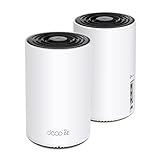
- WiFi 6E Tri-Band Mesh WiFi – Cover up to 5,500 Sq.Ft with next-gen seamless WiFi and make dead zones and buffering a thing of the past
- New 6 GHz Band – The latest Wi-Fi frequency, eliminates interference from legacy devices. The 6 GHz band can work as a backhaul for stable connections between nodes by default. Switch to Wi-Fi mode and connect your WiFi 6E devices to the 6GHz Network³
- True Tri-Band Speed – All three WiFi bands work together to unleash your network’s total speeds up to 5,400 Mbps for 200 devices(6 GHz: 2402 Mbps (HE160);5 GHz: 2402 Mbps (HE160);2.4 GHz: 574 Mbps)
- Our Cybersecurity Commitment - TP-Link is a signatory of the U.S. Cybersecurity and Infrastructure Security Agency’s (CISA) Secure-by-Design pledge. This device is designed, built, and maintained, with advanced security as a core requirement.
- Unlock the Full Potential of WiFi 6E - Opening the 6GHz band changes the game for WiFi 6 bringing upgraded performance in network efficiency and capacity. The 6GHz band is available only for WiFi 6E, allowing WiFi 6 to achieve its full potential
Before upgrading, check the Wi-Fi specifications for both ends of the connection and confirm whether 6 GHz is permitted for your location and equipment. If coverage is the problem, assess router placement and the layout before assuming an added band will solve it. A Wi-Fi network analyzer that displays nearby networks can help examine congestion; Microsoft Support mentions this approach, but its guidance does not endorse a particular app.
Quick Recap
Best Value

- Tri-band 2.4GHz + 5GHz + 6GHz; latest WiFi 6E supports 8-streams on tri-band simultaneously, up to 6.6Gbps speed
- AI QoS; satisfies all users' needs by automatically prioritizing data packets
- Powerful processor; 1.8 GHz quad core processor delivers ultra fast and reliable connections
- Mystic light; sync RGB light effects with mystic light compatible products
- Game accelerator; provides an uninterrupted WiFi connection for immersive gaming experiences
Rank #4

- DUAL-BAND WIFI 6 ROUTER: Wi-Fi 6(802.11ax) technology achieves faster speeds, greater capacity and reduced network congestion compared to the previous gen. All WiFi routers require a separate modem. Dual-Band WiFi routers do not support the 6 GHz band.
- AX1800: Enjoy smoother and more stable streaming, gaming, downloading with 1.8 Gbps total bandwidth (up to 1200 Mbps on 5 GHz and up to 574 Mbps on 2.4 GHz). Performance varies by conditions, distance to devices, and obstacles such as walls.
- CONNECT MORE DEVICES: Wi-Fi 6 technology communicates more data to more devices simultaneously using revolutionary OFDMA technology
- EXTENSIVE COVERAGE: Achieve the strong, reliable WiFi coverage with Archer AX1800 as it focuses signal strength to your devices far away using Beamforming technology, 4 high-gain antennas and an advanced front-end module (FEM) chipset
- OUR CYBERSECURITY COMMITMENT: TP-Link is a signatory of the U.S. Cybersecurity and Infrastructure Security Agency’s (CISA) Secure-by-Design pledge. This device is designed, built, and maintained, with advanced security as a core requirement.
Product prices and availability are accurate as of the date/time indicated and are subject to change. Any price and availability information displayed on Amazon at the time of purchase will apply.

