
iTechGuides is reader-supported. When you buy through links on our site, we may earn an affiliate commission. As an Amazon Associate I earn from qualifying purchases. Learn more
A dishwasher that leaves greasy dishes usually has a water-delivery, loading, filter, detergent, or temperature problem. Water may not be reaching the soiled surfaces, the filter or spray-arm holes may be blocked, the rack may be overloaded, detergent may be stale or incorrectly dosed, or incoming water may be too cool. Start with checks that cost nothing: confirm the cycle finished, clean the filter as your manual directs, clear the spray arms, reload with space between items, and verify the detergent. Only then investigate water temperature, hardness, consumables, or service.
First identify what you are seeing. Food grease and stuck-on soil require a wash-performance diagnosis. A white chalky film, isolated spots, gritty deposits, or dishes that are clean but wet follow different paths and should not be “fixed” by adding more detergent.
Identify the residue before changing anything
Food grease or food particles
Greasy fingerprints, an oily coating, or bits of food left on plates mean the wash water did not remove or carry away soil effectively. The leading checks are mechanical: water must strike the dirty surfaces, the spray arms must be able to rotate and spray, and the filter and sump must allow the machine to circulate water. Loading and detergent still matter, but rinse aid is not the first remedy for food grease.
Crashes, No Sound, or Screen Glitches?
Random freezes, missing sound and display glitches usually trace back to one bad driver. Find and replace yours safely.Free scan · under a minutePC Slower Than It Used to Be?
A free scan shows the junk files, broken settings and background clutter dragging Windows down - then fixes them in one click.Free scan · Windows 10 & 11White film, spots, or grit
White or cloudy deposits, spots on glassware, and mineral-like grit point more toward hard water, detergent residue, or a dosing problem. GE and Whirlpool associate hard water with spots, grit, and mineral deposits. A softener is appropriate only when water hardness has been confirmed and the dishwasher instructions support that solution; it is not a default treatment for greasy food soil.
#1 Best Overall

- HELPS POWER AWAY SMELLS created by odor causing bacteria, foggy limescale and mineral deposits hiding deep inside the dishwasher’s pump, filter, tub, valve, drain, washer arms and recirculation hoses to help optimize appliance performance.
- USE WITH OR WITHOUT DISHES. Unlike other brands, affresh dishwasher cleaner is safe to use while running a full load.
- TRUSTED BY APPLIANCE EXPERTS. Backed by over 100 years of appliance innovation, affresh is the dishwasher cleaner brand recommended by Whirlpool, Maytag, KitchenAid, Amana, and JennAir.**
- SAFER FOR PEOPLE. SAFER FOR PLANET. Affresh dishwasher cleaner is EPA Safer Choice Certified and is septic safe.
- NO MESSY POWDERS OR LIQUIDS. Affresh tablets are clean, convenient and powerful.
Clean but wet dishes
If dishes are clean yet remain wet, the concern is drying rather than washing. Whirlpool describes rinse aid as helping water run off during the final rinse and improving drying. Rinse aid may help wetness, spotting, and filming, but it cannot restore blocked spray-arm flow or remove heavy food grease by itself.
| What you notice | Most useful first checks |
|---|---|
| Oily coating or food still attached | Filter, spray arms, loading pattern, detergent, incoming hot water |
| White spots or chalky film | Detergent dose, rinse aid, confirmed water hardness |
| Gritty powder or detergent-like residue | Freshness and dose of detergent, dispenser operation, water temperature |
| Clean dishes that stay wet | Rinse-aid setting and drying guidance for the model |
Why water flow and loading cause greasy dishes
Automatic dishwashers clean by repeatedly circulating water through spray arms. If a bowl nests inside another bowl, a plate faces the wrong way, or a pan blocks an arm, the spray pattern cannot reach the soil. Bosch advises spacing dishes, keeping spray arms clear, and checking that their openings are not clogged. Whirlpool advises angling soiled surfaces down and inward toward the spray arms.
Common loading blockages
- Bowls or cups nested tightly together, leaving no path for spray water.
- Large pans, cutting boards, or platters shielding an entire arm or the detergent dispenser.
- Plates packed so closely that water cannot pass between them.
- Soiled surfaces facing outward or upward, away from the active spray pattern.
- Tall items in the lower rack preventing an upper or lower spray arm from turning.
Do not assume a rack is full simply because every slot contains an item. A slightly smaller load with visible gaps can clean better than a tightly packed load. After loading, manually rotate each spray arm. It should turn freely without striking a dish, rack, or utensil.
The Tool Desk
Outbyte PC Repair FREERepair Windows errors before they cause bigger problemsFix Now →Outbyte Driver Updater FREEFix the driver behind crashes, sound loss and screen glitchesFind Drivers →Step-by-step fix for greasy dishes
Work through these checks in order. They move from visible, low-risk causes to measurements and professional diagnosis.
Rank #2

- Wide Compatibility - ACTIVE Dishwasher Cleaner is suitable for Most Residential or Commercial Automatic Dishwashing Units. Compatible with GE, Bosch, Frigidaire, LG, Samsung, Whirlpool, Kitchenaid, Kenmore, Maytag, Amana models, all styles including plastic & stainless steel. To ensure proper cleaning, we recommend to monitor your dishwasher during cycle. If you see any foam or water leaking from the machine, stop dishwasher and allow foam and water to drain before continuing
- Deep Descaling Formula - Make your dish washing appliance shine. Removes hardwater, lime, scale, grime, grease, stain and more with a simple citric acid powder diswasher cleaning agent. Removes gunk spot and can help prevent clog and clear out foam in jet, tubes, and filter area.
- Fresh Odor Eliminator - Dual action freshener booster tablet for smelly dishwashers. ACTIVE Dishwasher cleaner's Natural Lemon-citrus Scent leaves your dishwaser smelling and looking good.
- Monthly Maintenance Solution - Keep your dishmachine cleaned with ACTIVE kitchen cleaning supplies. Use single or 2 treatment tabs per month. Place pod inside empty disheasher, run a self clean or regular dishwash to restore your machine. If extra cleaning is needed, always perform two separate cleaning cycles with a single tablet each, adding more cleaner can result in excess foam that effects function.
- Bulk 24 Count Kit - Contains 24 ACTIVE Dishwasher Cleaning Tablets - You're set for a year or more. That's our Best Value Promise - Compare to product with less tablet or single-use liquids.
- Confirm that the cycle completed. Look for an interrupted-cycle indication, an error display, or a control that still shows a running state. If the machine stopped before the final wash or rinse, the remaining soil may be a symptom of the interruption rather than a detergent or loading defect.
- Clean the filter according to the owner’s manual. Filter shapes, locking rings, and removal directions vary. Bosch recommends removing and washing its filter with soap and a soft brush under running water, while also directing owners to the manual for the correct removal method. Do not pry out a filter or reach into the sump using a procedure from a different model. If your manual permits it, clear loose food debris from the sump area without damaging the pump cover or seals.
- Inspect and clean the spray arms. Check every arm for food particles or mineral debris in the openings. Bosch recommends checking the holes for debris; use only the cleaning method allowed by your manual. Refit each arm securely, then turn it by hand to verify that it spins freely.
- Reload with a clear spray path. Leave space between dishes, avoid nesting, and place the dirtiest faces down and inward toward the spray pattern. Keep tall cookware from blocking an arm and make sure no item covers the detergent dispenser door. Run a normal or heavy cycle appropriate to the soil level rather than a shortened cycle that your manual says is intended for lightly soiled loads.
- Verify the detergent dispenser. Start the cycle with the dispenser dry and check that its door can open. Use detergent labeled for automatic dishwashers, not hand-dishwashing liquid. Hand soap can create excessive suds and interfere with operation. A dispenser that remains closed, is obstructed by a dish, or receives moisture before the cycle can deliver too little detergent at the wrong time.
- Replace old or lumpy detergent. GE advises discarding detergent that is old or lumpy because it may not dissolve and can leave gritty residue. Store powder, gel, or tablets as directed on their packaging, away from humidity. Dose according to the detergent label and your appliance instructions; adding more is not automatically better. Whirlpool notes that too much detergent can create a film.
- Check incoming hot water using model-specific instructions. If food soil remains after the mechanical and detergent checks, consult the dishwasher manual for its required inlet temperature. GE’s cited guidance specifies incoming water of 120–150°F and describes checking the nearest faucet with a candy or meat thermometer. Some Whirlpool manuals specify at least 120°F. These are manufacturer and model instructions, not a universal setting; household water-heater safety and the exact appliance manual take priority. Let the hot tap run until it reaches its normal temperature, then measure at the nearest faucet if the manual calls for that test.
- Branch according to the remaining symptom. If the problem is white film, spots, or wetness rather than greasy food, move to the rinse-aid and hard-water checks below. If food soil persists despite clear spray paths, a clean filter, correct detergent, and appropriate water temperature, stop repeatedly adding chemicals and obtain model-specific manufacturer or qualified appliance-service guidance.
How to clean the filter without damaging the dishwasher
The filter is a first-line barrier for food particles. A clogged or dirty filter can reduce effective circulation and allow debris to redeposit on dishes. Because filter assemblies differ, the safe procedure is always the one in the owner’s manual.
Manual-approved cleaning principles
- Remove only the parts your manual identifies as user-removable.
- Wash the filter with dish soap and a soft brush under running water when the manufacturer permits that method.
- Inspect the mesh and the area around the sump for grease and food particles.
- Rinse away loosened debris before reinstalling; a filter that is not seated or locked can cause other problems.
- Never force a locking ring, puncture mesh, or disassemble a pump cover unless the instructions explicitly require it.
Bosch’s cleaning guidance is available at its dishwasher wash-performance support page. Use it as an example of the cleaning principles, not as a universal removal procedure for every brand.
How to inspect spray arms and restore coverage
Spray-arm holes are small and can collect food fragments or mineral deposits. A blocked hole changes the pressure and coverage pattern, while a jammed arm leaves portions of the load almost untouched.
Recommended Free Tools
Inspection checklist
- With the dishwasher empty, turn each arm by hand and check for rubbing or obstruction.
- Look through the openings for visible particles or scale.
- Clean openings only with the tool and method approved by the manual; aggressive objects can enlarge or damage the jets.
- Check that the arm is seated on its support and that any retaining cap or nut is secure.
- Reload, rotate the arm again, and verify that dishes cannot fall into its path.
Whirlpool’s spray-arm guidance is at its spray-arm troubleshooting page. Whirlpool’s food-residue guidance also explains why the position of soiled surfaces matters: food residue on glassware.
Rank #3

- Cascade Dishwasher Cleaner helps eliminate odors and remove limescale buildup and grease to reveal a fresher, cleaner machine
- Simply toss it in your empty dishwasher and run a cycle—just like Cascade ActionPacs
- Use once a month to help keep your machine sparkling
- Recommended by Cascade Detergent
- For best results, use with Cascade Dishwasher Detergent and Cascade Power Dry Rinse Aid
Use detergent that can dissolve and work at the right dose
Detergent has three separate failure modes: the product may be degraded, the amount may be wrong, or the product may be intended for hand washing rather than an automatic machine.
Freshness and storage
Powder that has absorbed moisture can clump; gel can separate or age; tablets can become soft or stick together. GE recommends discarding old or lumpy detergent when it no longer dissolves properly. Keep the container closed and dry, and follow its storage directions.
Dosing
Use the appliance and detergent instructions together. More detergent can leave a film, especially when water conditions or cycle selection do not allow complete rinsing. Less detergent than required can leave grease behind. Do not change the dose repeatedly while leaving loading and spray-arm obstructions unresolved, because the machine still cannot clean surfaces that water never reaches.
Quick wins for a faster PC:
Repair Windows errors before they cause bigger problemsFix Now →Scan for outdated or missing drivers - takes under a minuteDriver Scan →Correct product
Hand-dishwashing soap is formulated to foam and should not go in an automatic dishwasher. Excess suds can reduce effective washing and create leaks or overflow. If the wrong soap was added, follow the model’s instructions for stopping the cycle and removing suds rather than starting repeated cycles blindly.
Rank #4

- Powerful Deep Cleaning Descaler - Break down stubborn limescale, hard water stains, calcium deposits, grease, and odor-causing residue with a citric-acid powered formula that targets hidden buildup in spray arms, filters, pumps, and internal components.
- Lemon Citrus Deodorizer Freshness – Acts as a powerful dishwasher deodorizer that neutralizes trapped food particles and odor-causing residue, leaving behind a light lemon citrus scent and a fresh, clean interior.
- 12 Month Maintenance Solution - Includes 24 tablets for a full year of monthly dishwasher care. Regular use helps active cleaning performance, improve water flow, and support better wash results over time.
- Safe for All Dishwashers - Compatible with all major brands and models, including stainless steel interiors. Septic-safe, non-corrosive, and designed for residential and commercial machines.
- Easy One-Step Use – Simply place one tablet in the detergent dispenser and run a normal or hot cycle on an empty machine for best results. For heavy buildup, use two tablets in separate cycles.
GE’s wash-performance guidance is at this support document. Whirlpool’s detergent and cleaning advice appears in its dishwasher cleaning guidance.
Independent reader supportYour contribution helps us test, update, and keep practical guides available for everyone.Water temperature and pressure: measure before assuming
Detergent and grease removal depend on water reaching the load at the temperature and pressure the appliance was designed to use. Water that arrives too cool may reduce dissolving and soil removal, while inadequate pressure can reduce spray coverage.
Temperature
GE gives a 120–150°F incoming-water range in the model guidance on its support page and recommends measuring at the nearest faucet with a candy or meat thermometer. Some Whirlpool manuals specify at least 120°F. Treat these figures as model-specific manufacturer instructions, not permission to raise a household water heater beyond safe settings. Check your dishwasher manual and follow household water-heater safety guidance.
Pressure
A separate GE guidance page lists 15–120 PSI for the dishwasher water-pressure range it covers. That is a service/use figure for the applicable models, not a universal requirement. It is available at GE’s residue and pressure guidance. If you suspect low pressure, use the diagnostic procedure specified for your model or have a qualified technician measure it; do not infer pressure from the temperature reading.
Best Value
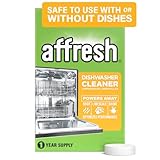
- HELPS POWER AWAY SMELLS created by odor causing bacteria, foggy limescale and mineral deposits hiding deep inside the dishwasher’s pump, filter, tub, valve, drain, washer arms and recirculation hoses to help optimize appliance performance.
- USE WITH OR WITHOUT DISHES. Unlike other brands, affresh dishwasher cleaner is safe to use while running a full load.
- TRUSTED BY APPLIANCE EXPERTS. Backed by over 100 years of appliance innovation, affresh is the dishwasher cleaner brand recommended by Whirlpool, Maytag, KitchenAid, Amana, and JennAir.**
- SAFER FOR PEOPLE. SAFER FOR PLANET. Affresh dishwasher cleaner is EPA Safer Choice Certified and is septic safe.
- NO MESSY POWDERS OR LIQUIDS. Affresh tablets are clean, convenient and powerful.
Rinse aid, dishwasher cleaner, and hard water have limited jobs
Rinse aid
Rinse aid helps water sheet off dishes during the final rinse and can improve drying. It is most relevant when dishes are clean but wet, spotted, or covered with a light film. Adjust the dispenser only within the range and procedure in the manual. Rinse aid will not unblock a spray arm, clean a filter, or compensate for a bowl blocking the wash pattern. Whirlpool explains its function in its rinse-aid FAQ.
Dishwasher cleaner
Periodic dishwasher cleaning can help remove visible buildup inside the tub and circulation path. Whirlpool recommends periodic cleaning and describes a cleaner as useful for buildup. Treat cleaner as optional maintenance, not a guaranteed cure for a failed inlet valve, weak pump, blocked drain, heater problem, or incorrect loading. Use a product and cycle that your manual allows, and place this step after inspecting the filter and spray arms.
Hard-water testing and softening
Hard water can leave mineral spots, grit, and deposits. Confirm hardness before considering a softener, and verify that the appliance instructions support the treatment. A softener is a conditional water-quality solution, not a general grease-removal device. GE’s film troubleshooting information is at its hard-water and residue guidance.
What’s actually slowing this PC down?
Pick the symptom - the matching free tool is one click away.
When basic checks do not solve the problem
Persistent poor cleaning after a completed cycle, manual-approved filter cleaning, unobstructed spray arms, sensible loading, fresh correctly dosed detergent, and appropriate incoming water requires model-specific help. Possible causes can include filling, circulation pressure, heating, drainage, or another failed component, but no single service threshold applies to every dishwasher.
Prepare useful information for service
- Record the model and serial information from the appliance label.
- Describe whether the residue is oily food soil, white mineral film, grit, or simply water left on clean dishes.
- Note the cycle used, whether it completed, and any displayed error or interrupted-cycle indication.
- List the checks already completed: filter, spray arms, loading, dispenser, detergent, and incoming-water measurement.
- Follow the manufacturer’s troubleshooting path before removing panels or attempting electrical, pump, heater, or inlet-valve repairs.
Contact the manufacturer or a qualified appliance service provider when the issue remains after those checks. Avoid repeated high-dose detergent experiments or unapproved disassembly; they can mask the symptom or damage seals and components.
A maintenance routine that prevents greasy residue
- Inspect the filter whenever food debris is visible and clean it at the interval specified by the manual.
- Check spray-arm openings when coverage seems uneven or a section of the load remains dirty.
- Load with gaps, avoid nesting, face soil toward the spray pattern, and keep the dispenser and arms clear.
- Keep automatic-dishwasher detergent dry, replace stale or lumpy product, and measure the label-directed dose.
- Use rinse aid for spotting, filming, or drying concerns when the manual supports it, not as a substitute for mechanical cleaning.
- Run periodic cleaner maintenance when recommended for the model and when buildup is visible.
- Check incoming-water temperature only when troubleshooting or when the manual calls for it, using a thermometer and safe water-heater settings.
- Test water hardness before making a major softener decision.
What manufacturers identify as the key wash factors
GE summarizes its guidance this way: “There are four important factors for getting good wash performance in all areas of your Dishwasher: loading the dishes, water temperature, detergent, rinse aid.” This is manufacturer guidance rather than an independent study, and each factor has a different role: loading controls spray access, temperature supports dissolving and soil removal, detergent supplies cleaning chemistry, and rinse aid mainly improves runoff and drying.
The Bottom Line
For greasy food residue, clean the filter as the manual directs, clear and free the spray arms, reload so water can reach every soiled surface, use fresh automatic-dishwasher detergent at the specified dose, and verify model-specific incoming-water requirements. Treat white film, spots, and wet dishes as separate symptoms. If the problem survives these checks, obtain model-specific service guidance instead of adding more detergent or buying a softener without confirming the cause.
Free tools Windows power users keep installed
One-click scans. No signup required.
Quick Recap
Product prices and availability are accurate as of the date/time indicated and are subject to change. Any price and availability information displayed on Amazon at the time of purchase will apply.

