
Do these 3 things before closing this tab:
1Scan for outdated or missing drivers - takes under a minute2Clear out junk files and repair common Windows errors3Fix the driver behind crashes, sound loss and screen glitchesiTechGuides is reader-supported. When you buy through links on our site, we may earn an affiliate commission. As an Amazon Associate I earn from qualifying purchases. Learn more
Plug-in solar became a real option in Great Britain on 27 August 2026, but it is not a smaller, interchangeable version of a rooftop installation. It is capped at about 800 W and is intended to offset some everyday household use; a typical rooftop system cited by the government is 3.5 kW. That difference in scale, alongside export eligibility and the cost of waiting, can make a full installation the better fit for a household that can use more generation.
The available figures explain the trade-off, but they do not establish why one particular homeowner chose to install when they did. Without that person’s installation date, quote, roof, system size, expected generation, battery and export tariff, a personal “here’s why” account would be guesswork. What can be judged is when the full-install route makes sense—and when waiting for plug-in solar may be more practical.
What changed when plug-in solar became available?
On 27 August 2026, the UK government announced that compliant plug-in solar products could come to market in Great Britain under an interim product route. The Energy Saving Trust’s guidance accessed on 7 October 2026 says Northern Ireland’s regulations had not yet been updated, so the Great Britain launch should not be read as confirmation of equivalent availability across the whole UK. Check the current rules and approved-device status before buying: the government’s launch announcement and Energy Saving Trust’s plug-in solar guidance.
These devices are designed to be self-installed and connected through a standard socket, but only when the product and setup comply with current requirements and its instructions. The interim route does not cover plug-in solar with integrated batteries. A rooftop installation, by contrast, is permanently mounted and hardwired, generally through a professional installer. The product route and its limits are described in the Energy Networks Association’s plug-in solar guidance.
#1 Best Overall

- [Wide Application]: Daily Output 800wh/day under 4 hours full sunshine condition. Perfect for RV, Caravan, Marine, Camper, Electric scooter, Golf Carts, Power wheels, Trolling motor, Tool trailer, Backup power supply for cabin shed home etc.
- [Excellent Performance]: ECO-WORTHY solar panels use high-performance monocrystalline solar cells, which can provide up to 21.5% higher efficiency sufficient light conditions.size:35.2*23.1.37in
- [Durable]: Corrosion-resistant aluminum alloy frame, so that the panel can be used for decades, and can withstand strong wind (2400Pa) and snow load (5400Pa), with a long service life. Ip65 rated junction box provides complete protection.:
- [Complete and Easy]: The back of the pre-drilled and plug-and-play cables allow quick installation, the kit can be connected in series (24V) or parallel (12V) if you need. What you will get: 2 pcs 100W mono solar panel + 2 set of Z mounting brackets + 30A solar controller + 1 pair of 16.4ft 10 awg solar cables + 1 pair of 2-in-1 connectors + 1 pair of 4.92ft tray cable.
- [Support]: 1 year with 24/7 tech support, if any problems or questions about the product,please do not hesitate to let us know through Amazon or call ECO-WORHTY hotline for solution.
How do plug-in and rooftop solar compare?
| Decision | Plug-in solar | Full rooftop solar |
|---|---|---|
| Typical scale | Up to about 800 W average output under Energy Saving Trust guidance; estimated generation is around 700 kWh a year under its assumptions. | A typical system in the Department for Energy Security and Net Zero’s Solar Roadmap is 3.5 kW; domestic systems can be larger. |
| Cost figures | Compliant kit starts at around £450, according to Energy Saving Trust guidance accessed 7 October 2026; the listed package includes panels, microinverter, mounting brackets and cables. | The Solar Roadmap gives £6,500 for a typical 3.5 kW installation in 2024/25. Energy Saving Trust separately cites around £7,600 as an average rooftop system cost in guidance accessed 7 October 2026; these are distinct estimates, not necessarily like-for-like specifications. |
| Installation | Self-installed through a standard socket, subject to product approval, registration requirements and instructions. | Permanently mounted and hardwired, normally by a professional installer. |
| Export payments | Energy Saving Trust says Smart Export Guarantee access is generally unavailable without MCS certification, though some suppliers may offer another export tariff. | Smart Export Guarantee eligibility requires MCS or equivalent certification for both the installation and installer. |
| Battery storage | The current interim plug-in rules do not cover plug-in solar with an integrated battery. | Can be paired with a home battery; the value depends on household use and tariff. |
Sources: Energy Saving Trust plug-in solar guidance, Department for Energy Security and Net Zero Solar Roadmap, and Ofgem’s Smart Export Guarantee guidance.
What does the price difference actually tell you?
The figures show a lower entry cost for plug-in equipment, not that the two options deliver the same amount of power or have comparable lifetime economics. The Solar Roadmap says a typical 3.5 kW rooftop system cost £6,500 in 2024/25, compared with about £9,000 in 2013/14 when adjusted to 2024 prices. Energy Saving Trust’s separate current estimate is around £7,600 for an average rooftop system. Specifications and dates differ, so those rooftop numbers should not be treated as competing quotes for identical systems.
Rank #2

- 【Versatile Off-Grid Solar Panels Kit】Generates up to 1.1kWh daily power with 5 hours of full sunlight. All-inclusive kit includes 2x110W N-Type panels, 30A PWM controller, Y connectors, Z brackets, PV and battery cables. Compact design fits Class B camper vans, RV, Camping, marine, boats, rooftops, farms, trailers, caravans, greenhouses, cabins, sheds and more off grid Applications.
- 【N-Type 16BB Performance】Premium N-Type cells with 16 busbar structure achieve 25% high efficiency, eliminating light-induced degradation. Delivers stable output even in low-light/cloudy conditions, with sturdy construction resisting road vibrations, perfectly stable for use on RVs, trailers and other mobile off-grid scenarios.
- 【Smart Controller & Anti-Shade Design】30A PWM controller auto-senses 12V/24V systems, compatible with lithium, gel, sealed and flooded batteries. LCD monitor, dual USB ports, 3-stage charging, and built-in safeguards (reverse polarity, overcharge, etc.) plus anti-shade bypass diodes ensure stable power.
- 【Durable & Expandable Design】IP68 waterproof with corrosion-resistant aluminum frame withstands strong wind and heavy snow. N-type cells feature low temperature coefficient maintains high output in extreme heat. Flexible for 12V/24V systems, PWM supports up to 400W input, easy series or parallel expansion with included connectors.
- 【Reliable Warranty & Support】We back our products with a 10-year warranty for solar panels and a 2-year warranty for the controller. 7*24 customer service and technical support are available to resolve your installation and product concerns efficiently.
For plug-in solar, Energy Saving Trust puts compliant equipment at around £450 and estimated annual generation at around 700 kWh, with average output capped at about 800 W. A lower upfront cost can be appealing if a roof installation is unaffordable or unsuitable, but the smaller generation ceiling matters if the goal is to cover a substantial share of household demand.
Quick wins for a faster PC:
Clear out junk files and repair common Windows errorsFree Scan →Fix the driver behind crashes, sound loss and screen glitchesFind Drivers →Repair Windows errors before they cause bigger problemsFix Now →How much could plug-in solar save?
Energy Saving Trust estimates annual bill savings of £100 for a household home during the day and £70 for a household out during the day. These are scenario estimates for an 800 W system, a home using 2,500 kWh a year, Manchester, a south-facing installation tilted at 30 degrees with no shade, and electricity priced at 24.7p/kWh. They are not guarantees and may not describe a different home, location, tariff or usage pattern.
Rank #3

- High-Efficiency Monocrystalline Silicon: The 100W solar panel uses premium monocrystalline silicon cells, providing up to 30% higher efficiency than ordinary silicon, ensuring maximum power output even in low-light environments
- All-Weather Durability: Constructed with a waterproof junction box, edge-seal waterproofing, and a corrosion-resistant aluminum frame, this panel is built to withstand hail, snow, rain, and other adverse weather conditions for long-lasting performance
- Smart Solar Charge Controller: The included controller offers comprehensive protection including overcharge, over-discharge, over-voltage, and short-circuit safeguards, and is compatible with 12V batteries, with a built-in LCD display and USB ports for convenient monitoring and device charging
- Complete Installation Kit: The package comes with all necessary accessories including solar-to-controller cables, O-ring terminal power cables, Z-brackets, and screws so you can install the system quickly and easily without additional purchases
- Versatile Off-Grid Compatibility: Suitable for RVs, boats, cabins, and remote power needs, this system is compatible with a wide range of 12V battery types, making it a flexible and reliable solution for off-grid living
The government’s 26 August 2026 launch announcement gives a separate headline estimate of up to £110 a year and says plug-in solar could supply up to 20% of average home electricity use. That “up to” estimate is not the same as Energy Saving Trust’s modeled scenarios. Both sources tie the financial benefit to assumptions about generation and consumption: solar is most useful when the home is using electricity while the panels are producing it.
When does a full rooftop installation make more sense?
You want more generation than a socket-connected system can provide
A typical rooftop system cited in the Solar Roadmap is 3.5 kW, compared with plug-in solar’s roughly 800 W ceiling. Rooftop solar can therefore be the more relevant option for a household seeking materially greater generation, provided the roof and property are suitable. Output still depends on orientation, shade and system design; south-facing, unshaded roofs are particularly favorable, while east- or west-facing roofs can also work.
Rank #4

- 【200W N-Type 16BB High Efficiency】Built with advanced N-type monocrystalline cells and 16BB busbar technology, the Callsun 200 watt solar panel delivers up to 25.6% conversion efficiency. N-type cells provide excellent power generation and reliability, while the 16BB design helps reduce hot spots and microcrack risks for dependable long-term performance.
- 【400W Series Connection for Portable Power Stations】Pair two Callsun 200W panels in series to reach 400W total power, 47.48V Vmp and 54.62V Voc while maintaining 8.43A operating current. This configuration is well suited for many portable power stations with 60V-class solar input limits, helping maximize solar charging within supported voltage and current ranges.
- 【Boost Energy with Bifacial Technology】The Callsun 200W bifacial solar panel features a transparent backsheet that captures sunlight from both the front and rear sides. By utilizing direct, reflected and diffuse light, the bifacial design can generate additional energy from the rear side under suitable installation conditions, helping maximize overall solar output.
- 【TwinCell Anti-Shading Design】The Callsun 200W solar panel features a dual-module parallel design that divides the panel into two independently operating sections. When one section is partially shaded by trees, buildings or other obstacles, the other section can continue generating power. This design helps reduce the impact of partial shading and maintain more consistent energy production.
- 【Compact Design for RVs, Vans & Off-Grid Use】Each panel measures 51.3 × 30.3 × 1.4 inches and weighs 23.8 lbs, delivering strong power output in a compact footprint. This 200W solar panel is ideal for Class B vans, RVs, marine applications, rooftops and other space-conscious off-grid solar systems. Pre-drilled mounting holes make installation with compatible mounting hardware straightforward.
You can use or export the additional electricity
Self-consumption is only part of the calculation. For rooftop systems, exported power may earn payments through the Smart Export Guarantee if the installation and installer meet MCS or equivalent certification requirements. Some suppliers may offer other export arrangements, but do not assume a particular tariff or income without checking the supplier’s current terms. Ofgem explains the SEG requirements at its Smart Export Guarantee page.
Free tools Windows power users keep installed
One-click scans. No signup required.
Network approval can also affect system planning. The Solar Roadmap says systems above 3.68 kW per phase generally need approval from the distribution network operator (DNO). Ask the installer to confirm the applicable process for the proposed system rather than assuming that every household installation has the same threshold or paperwork.
Best Value
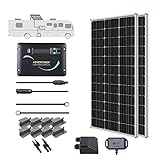
- [Wide Application] 800Wh daily output depends on the 4 hours sunlight availability. This panel is suited for applications that require a smaller footprint, making it a favorite for those with RVs, campers, caravan, boat, Green house and more.
- [Excellent Performance] 22% High solar cell efficiency; Corrosion-resistant aluminum frame for outdoor use, allowing the panels to last for decades as well as withstand high winds (2400Pa) and snow loads (5400Pa)
- [Multiple Protection] The Renogy Adventurer-Li 30A PWM charge controller is designed for aesthetically clean flush mounting on RV or camper walls; Protection against: overcharging, overload, short-circuit, and reverse polarity
- [Easy Installation] Pre-drilled holes and Plug&Play cables on the back allow for fast mounting, and it supports lithium batteries, lead-acid batteries, gel batteries; 3 pairs of Y branch connectors are newly added to meet your parallel requirements
- [VVarranty] 5 year vvarranty and 24/7 technical support team.
You want a permanent, integrated system
A rooftop installation is fixed to the property and hardwired, rather than being a smaller device that can be moved. It can be paired with a home battery, though whether storage is worthwhile depends on household demand, generation timing and tariff. The plug-in interim route described in current guidance does not cover products with an integrated battery.
Independent reader supportYour contribution helps us test, update, and keep practical guides available for everyone.When is waiting for plug-in solar more sensible?
- The upfront budget is the main constraint. Energy Saving Trust lists compliant plug-in equipment from around £450, substantially below the cited rooftop installation estimates, although the products also have a lower output ceiling.
- A roof system is not available to you. Plug-in devices may suit some renters or people in homes where rooftop installation is impractical, but renters and flat owners should first obtain landlord or freeholder permission.
- You want a smaller, potentially portable system. Portability can be useful, but placement and suitability matter. Energy Saving Trust notes that garden units are more suitable than current balcony options; check the product’s approved status and installation instructions.
- You can use power during daylight. The modeled savings are higher for households home during the day, because using generation directly avoids buying as much electricity from the grid.
Before purchasing, check the latest approved-device list and the current rules for your part of the UK. Verify that your electrical setup is suitable, follow the product’s registration and installation instructions, and secure any required property permission. Approval status, regulation and prices can change; a product advertised as plug-in solar is not automatically compliant.
What would explain one homeowner’s decision to install now?
A credible personal explanation would need the details that distinguish one home’s decision from the general comparison: when the installation happened, the quote and system capacity, roof orientation and shading, expected generation, whether a battery was included, the household’s daytime use, and any export tariff. It would also need to say what “waiting” meant—for example, delaying all solar, or choosing a smaller plug-in unit instead.
Without those particulars, the sound conclusion is conditional rather than autobiographical: a full installation can be rational when a suitable property can use or export more electricity than a plug-in system can supply. Plug-in solar can be the more accessible choice where low initial cost, portability or lack of roof access matters more than scale.
Why the timing matters in the wider market
The government’s 26 August 2026 announcement cited nearly 150,000 MCS-certified solar panel installations in the first six months of 2026, 17% above the previous highest start to a year in 2025, alongside 36,000 certified battery installations in that period. Those figures show strong installation activity, but they do not establish that a particular household would save money by installing earlier rather than waiting. A household decision still turns on its own quote, expected generation, consumption, export terms and property suitability. The figures are reported in the government announcement.
Quick Recap
Product prices and availability are accurate as of the date/time indicated and are subject to change. Any price and availability information displayed on Amazon at the time of purchase will apply.

