
iTechGuides is reader-supported. When you buy through links on our site, we may earn an affiliate commission. As an Amazon Associate I earn from qualifying purchases. Learn more
Data-center electricity demand is rising because more computing, storage and network traffic are moving into large facilities, while artificial-intelligence workloads add power-hungry accelerated servers. The International Energy Agency (IEA) estimates global data-center electricity consumption at about 415 TWh in 2024 and around 945 TWh in its 2030 Base Case. Expansion is constrained less by a worldwide shortage of annual energy than by whether a particular site can obtain enough firm power, transformers and grid capacity on the developer’s timetable.
The central timing problem is stark: a data center can often be constructed in one to three years, while planning, permitting and building the grid infrastructure for its connection can take five to 15 years. High rack densities, rapid load swings and equipment supply chains add further risk. Those limits mean aggregate demand forecasts cannot tell you whether any individual project will connect on schedule.
What the headline electricity numbers actually measure
Two different IEA measures are often mixed together. Consumption is the electricity used by data-center equipment and facility systems. Generation to supply data centers is a supply-side accounting measure that includes the electricity generation needed to serve that load. They are related, but they are not interchangeable.
| Measure | 2024 | Forward estimate | Qualification |
|---|---|---|---|
| Global data-center electricity consumption | About 415 TWh | Around 945 TWh in 2030 | IEA Base Case; a scenario estimate, not a guaranteed outcome. IEA, 2025 |
| Global electricity generation to supply data centers | About 460 TWh | More than 1,000 TWh in 2030 | Supply-side accounting in the IEA Base Case; do not read it as direct facility consumption. IEA, 2025 |
| United States data-center electricity use | 58 TWh in 2014; 176 TWh in 2023 | 325–580 TWh in 2028 | U.S.-specific estimates summarized by the Department of Energy in 2024; the 2028 figure is a range, not a point forecast. U.S. Department of Energy, 2024 |
The IEA also publishes lower-growth High Efficiency and Headwinds cases. They reflect different assumptions about AI adoption, hardware utilization, software efficiency and energy-system constraints. Treat the Base Case as one modeled path rather than a promise that demand will reach exactly 945 TWh.
#1 Best Overall

- POWER AND CHARGE: This rack mount power strip provides an additional 8 NEMA 5-15 outlets (120V/15A) and features a 6ft (1,8m) long cord so you can plug your devices in while leaving the rack mobile
- 1U RACK DESIGN: Compatible with all 19" server racks 4 inches or deeper, this horizontal-mount power distribution unit fits many network racks and has an integrated power cord; ANSI/EIA RS-310-D standard
- EASY INSTALLATION: This IT-grade rackmount PDU features a rugged steel chassis, LED indicators for ground and surge protection, and lets you control the power state with power and reset switches
- PROTECTS YOUR EQUIPMENT: This rack mountable 8-outlet (120V) power strip features a built-in circuit breaker and reset switch, ensuring a dependable performance of your networking equipment
- THE IT PRO'S CHOICE: Designed and built for IT Professionals, this rack PDU is backed for 2-Years, including free lifetime 24/5 multi-lingual technical assistance
Why data-center demand is increasing
More cloud and digital workloads
Enterprise applications, online services, content delivery, databases and analytics continue to move into enterprise, colocation, server-provider and hyperscale facilities. Conventional servers remain a major source of load, and they are joined by storage, networking and the electrical and mechanical systems that keep equipment operating continuously. The IEA’s accounting framework includes servers, storage, networking, uninterruptible power supplies (UPS), cooling, network connections, grid connections and backup generators. The mix varies with facility design and workload.
AI adds accelerated servers
Training and running modern AI models use accelerated servers built around specialized processors. In the IEA Base Case, electricity use by accelerated servers grows at roughly 30% per year from 2024 to 2030, compared with about 9% per year for conventional servers. The IEA attributes almost half of the net increase in global data-center consumption in that case to accelerated servers. These are scenario growth rates, not measurements of every operator’s year-over-year usage. IEA analysis
Rank #2

- Versatile and Space-Saving: This 1U Rack mount PDU features a compact design that allows for efficient use of space in standard 19-inch racks. 16 rear-facing plug outlets and three front-facing outlets provide ample connectivity for your devices
- Efficient USB Power: Featuring four USB ports, it enables simultaneous power supply to your favorite devices, ensuring convenience and productivity
- Built-in Circuit Breaker: The PDU is equipped with a built-in 12-Amp circuit breaker that protects against circuit overloads. This ensures reliable performance and helps prevent damage to your equipment
- Heavy-Duty Construction: The power distribution unit is designed with heavy-duty components and a sturdy metal housing for durability and long-lasting use
- Convenient Mounting: The PDU features mounting ears on the back panel for easy installation in a standard 19-inch rack
Power density changes the engineering problem
AI affects more than the annual energy total. High-performance racks draw far more power in a smaller footprint than many traditional server racks. AI training and inference can also create large, rapid changes in demand as workloads start, stop or shift between clusters. The IEA identifies transformers and power electronics as supply chains that may be tested by this combination of density and variability. A site therefore has to be designed for peak and changing electrical load, not just its yearly TWh total. IEA, 2025
Facility overhead grows with IT load
Every additional megawatt of computing requires supporting capacity: cooling, power conversion, UPS systems, networking, lighting, controls and, where specified, backup generation. Efficiency improvements can reduce the overhead per unit of computing, but they do not eliminate it. The IEA’s scenarios account for both IT equipment and facility infrastructure, which is why a simple count of processors understates the electricity requirement.
Rank #3

- 10 NEMA 5-15R Outlets with Long Power Cord: This rack mount power strip provides 10 NEMA 5-15 outlets (15A) and features a 6ft long cord to conveniently plug in devices, keeping the mounting more easily and flexible
- Universal 19-Inch Rack Compatibility: Compatible with all 19-inch server racks 4 inches or deeper, this horizontal-mount power distribution unit fits many network racks and has an integrated 6ft/1.8m power cord
- Fireproof Heavy-Duty Construction: This server rack mountable power distribution unit features whole housing fireproofed construction that will support long-life working performance
- Built-In Circuit Breaker Protection: This rack mountable 10-outlet (AC100-240V) power strip features a built-in circuit breaker and reset switch, ensuring dependable performance of your power equipment and safety for using power
- Industrial-Grade Materials and Design: Features industrial equipment pure copper wire material for high power capacity, industrial-grade metal housing, and cord retention tray for enhanced durability
What limits expansion
The grid often moves slower than the building
The IEA gives a broad five-to-15-year range for planning, permitting and completing grid infrastructure, versus one to three years to construct a data center. A developer can finish a building before a new substation, transmission line or upstream reinforcement is ready. Connection queues then become a practical limit even when the project has financing, land and equipment. These are broad lead times, not a schedule guarantee for a specific site. IEA, 2026
Capacity is local, not an abstract global number
A global forecast says nothing about the spare capacity at a proposed site’s feeder, substation or transmission corridor. Utilities must study voltage, thermal limits, fault levels, protection, stability and the timing of other queued projects. A region may have adequate generation on an annual basis while lacking deliverable capacity at the location and hour a data center needs it. Only a project-specific connection study can establish whether a requested load can be served, when and under what operating conditions.
Rank #4
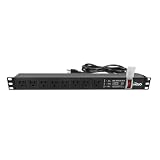
- Efficient Power Distribution: Delivers 12A (US Listed 12A) power through 8 NEMA 5-15R ports, ideal for server racks, network setups, and office environments
- Comprehensive Indicators: Monitors status with Power (yellow), Earth (green), and Lightning Protection (red) indicators, ensuring secure power for server rooms and warehouses
- Compact Design: Sleek 1U horizontal profile (19" x 1.7" x 1.7") maximizes rack space efficiency in IT cabinets
- Versatile Compatibility: 1 NEMA 5-15P input for seamless integration in diverse setups, providing flexibility for network installations
- Safety Assurance: UL listed for compliance, guaranteeing safety and quality in data centers and office spaces
Transformers, switchgear and power electronics can become bottlenecks
Large, concentrated loads require high-voltage transformers, switchgear, converters and protection equipment. AI’s rapid load swings can make controls and power-quality requirements more demanding. If manufacturing and delivery of these components take longer than the construction schedule, a finished building may sit below its intended capacity. The constraint is not necessarily a lack of fuel or annual generation; it can be the physical equipment needed to move and condition power safely.
Quick wins for a faster PC:
Scan for outdated or missing drivers - takes under a minuteDriver Scan →Repair Windows errors before they cause bigger problemsFix Now →Fix the driver behind crashes, sound loss and screen glitchesFind Drivers →Supply has to arrive at the right time and place
In its Base Case, the IEA expects renewables to provide a substantial share of additional supply, with gas and coal also contributing in the near term and nuclear becoming more important later in the decade and beyond. The balance differs by country and scenario. In the IEA’s modeled Lift-Off case, long grid-connection queues cause much of the additional increase beyond 2030 to be met by fossil generation. That is a scenario result, not a prediction that every project will use fossil power or that renewable procurement removes a local connection constraint. IEA supply analysis
Best Value

- 【Heavy-Duty 9 Outlet PDU】 Designed for standard 19" server racks, this 1U rack mount power strip provides 9 US standard outlets (15A/125V/1875W), ideal for data centers, network cabinets, and audio-visual setups needing reliable power distribution.
- 【Individual Switch Control】 Each outlet is equipped with its own illuminated on/off switch, so you can manage connected devices individually instead of unplugging them. The switch modules are fully independent: if one outlet trips, only that outlet shuts down while all remaining outlets keep running normally — no whole-strip shutdown, no interruption to your other equipment. A tripped switch also tells you exactly which device has reached its load limit, giving you faster, more sensitive overload protection and a clear visual cue for troubleshooting.
- 【Overload Protection & Power Monitoring】 Equipped with overload protection and a digital power monitoring display, this PDU safeguards your equipment from overloads while providing real-time voltage and current data for secure operation. The switch will automatically trip if the current exceeds 15A. Simply having wires or cables touch the switch will not cause it to trip — the switch only responds to an overload condition.
- 【Durable Metal Construction】 Built with a sturdy metal housing and a 14AWG heavy-duty 6.5FT power cord, ensuring durability and stable performance even in high-demand environments like professional server rooms and industrial settings.
- 【Versatile Installation】 Ideal for studios, labs, and data centers, ensuring peak performance and reliability. Designed for 1U rackmount for hassle-free cable management. Supports horizontal installation in server racks with included mounting brackets.
Other constraints require local evidence
Water availability, permitting, community impacts, electricity prices and project economics can matter, but their importance varies by location and design. The cited global studies do not establish that any one of these factors binds every data-center project. They should be assessed with local environmental reviews, utility studies, permitting records and commercial analysis rather than generalized from a global demand figure.
Independent reader supportYour contribution helps us test, update, and keep practical guides available for everyone.How grids and developers can increase usable capacity
Responses fall into several categories. They do not have identical deployment times, reliability, costs or geographic usefulness, so there is no universal best option.
| Measure | How it helps | Where it fits | Important limitation |
|---|---|---|---|
| Dynamic line rating | Adjusts a line’s allowable transfer using measured weather and conductor conditions. | Transmission corridors whose real-time thermal capability is higher than a fixed conservative rating. | Does not create a new line or solve a constrained substation or feeder. |
| Dynamic transformer rating | Uses operating and temperature data to manage transformer capacity more precisely. | Existing transformers with monitored thermal headroom. | Cannot substitute for a transformer that is physically undersized or unavailable. |
| Advanced power-flow control and topology optimization | Redirects flows and uses the network more efficiently. | Networks where congestion is caused by how power is routed. | Requires compatible controls, studies and operating authority. |
| Storage used as a transmission asset | Charges when the network has room and discharges during constrained periods. | Locations where shifting delivery can defer or reduce a line upgrade. | Energy duration, cycling, interconnection and replacement requirements limit the service. |
| Non-firm connections | Allows a project to connect with agreed curtailment when the network is constrained. | Projects able to tolerate interruptions or schedule flexible workloads. | Power is not guaranteed at all times; operating rules must be explicit. |
| Demand response and workload shifting | Moves computing or charging away from stressed hours. | Batch AI training, backups and other workloads that can be delayed or relocated. | Latency-sensitive services and tightly coupled jobs may not be movable. |
| Connection-process reform | Improves queue management, readiness requirements and coordination between developers and utilities. | Regions where speculative requests obscure projects that are ready to build. | Better administration cannot replace physical network construction. |
The IEA identifies these grid-enhancing technologies, storage, demand-side participation and connection reforms as complementary tools for increasing flexibility and usable capacity. IEA, 2026 A battery, on-site generation contract or renewable-power purchase can support reliability or energy sourcing, but none automatically grants a project the right to draw unlimited power from a constrained local network.
A practical way to evaluate a proposed data-center expansion
- Define the electrical load precisely. Separate initial load from the ultimate build-out, and document average, peak, ramp rate, power factor, redundancy and expected AI-training or inference schedules.
- Identify the actual network constraint. Ask whether the limiting element is generation, transmission, distribution, a substation transformer, protection equipment or the facility’s own electrical plant. A regional surplus does not answer this question.
- Obtain a formal connection study. Require the utility or network operator to state available capacity, reinforcement work, queue position, milestones, curtailment conditions and the date firm service could begin.
- Check equipment and permitting lead times. Confirm delivery windows for transformers, switchgear, converters and protection systems, then compare them with the building schedule and local permitting requirements.
- Test flexibility options. Determine which workloads can be delayed, relocated or curtailed; whether storage can cover the constrained interval; and what reliability level a non-firm connection would provide.
- Model several demand and supply cases. Use at least an efficiency or slower-adoption case alongside a high-growth case. Include the effect of software efficiency, hardware utilization, renewable output, fuel availability and delayed grid projects.
- Document what remains uncertain. Keep annual energy, firm capacity, peak demand and backup capability as separate fields. Record assumptions by date, region, facility phase and operating mode so a later design change does not invalidate the connection plan.
What to expect through 2030
The direction is clear even though the exact scale is not. Cloud services and conventional computing continue to add load, while accelerated servers make AI the fastest-growing component in the IEA Base Case. Efficiency improvements, better software, changing model demand and delays in power delivery can produce outcomes closer to the IEA’s High Efficiency or Headwinds cases. Conversely, faster AI adoption can push requirements toward the upper end of the modeled range.
The binding question for an individual project will remain local: can the required peak megawatts be delivered with the necessary firmness, equipment and timing? Aggregate TWh forecasts are useful for planning generation and transmission, but they cannot replace a connection study, an equipment schedule and an operating profile. Expansion succeeds when those three pieces advance together; otherwise, the building can be ready while its power connection is not.
Quick Recap
Product prices and availability are accurate as of the date/time indicated and are subject to change. Any price and availability information displayed on Amazon at the time of purchase will apply.

