
iTechGuides is reader-supported. When you buy through links on our site, we may earn an affiliate commission. As an Amazon Associate I earn from qualifying purchases. Learn more
Android keyboard shortcuts usually fail for one of four reasons: the command belongs to a different layer (Android, an app, or language switching), the Bluetooth keyboard is connected but its physical layout is wrong, the app does not handle that key combination, or the keyboard app itself is unresponsive. Start by testing the exact combination in the app where you need it, then verify the connection and physical-keyboard settings before changing anything else.
This guide is for a physical keyboard connected to an Android phone or tablet, especially over Bluetooth. Menu names vary by Android release, manufacturer and form factor. Google’s tablet instructions identify some physical-keyboard steps as Android 14 and later, so an older device may show a different path.
First determine what kind of shortcut is failing
The word “shortcut” covers several unrelated mechanisms. A key combination that works in a text editor is not necessarily an Android navigation command, and a language-switch command may be controlled by the device maker rather than by the app.
What’s actually slowing this PC down?
Pick the symptom - the matching free tool is one click away.
| Shortcut type | Where it is handled | What to check first |
|---|---|---|
| Android or system command | Android’s hardware-keyboard input layer | Whether the keyboard is recognized, the modifier keys are being received, and the command is supported on that device |
| App command | The individual app, such as a document editor, terminal or browser | The app’s own shortcut documentation and whether the same combination works in another app |
| Language or layout switch | Android’s physical-keyboard settings or an OEM interface | The selected layout and any manufacturer-specific language-shortcut setting |
| Keyboard-app action | An on-screen keyboard such as Gboard | Whether that app is crashing, frozen or otherwise unresponsive |
Android Developers describes common hardware shortcuts as combinations using Ctrl, Alt, Shift and Meta. The same documentation also makes clear that application input handling affects what a combination does. Therefore, a shortcut that fails in one app is not proof that the Bluetooth keyboard is defective.
#1 Best Overall

- Full 3-System Compatibility & Wide Device Support: Perfectly compatible with Android, iOS and Windows three major systems. Works seamlessly with Samsung tablets, iPads, iPhones, laptops, smartphone, android, iOS, windows etc
- How to Switch Systems: Switching to the corresponding system will improve compatibility and higher work efficiency (“FN + A” is for iOs , “FN + S” is for Windows, “FN + D” is for Android )
- Enhanced Oversized Keycaps:27% bigger than standard keycaps. The spacious surface minimizes accidental presses and ensures comfortable typing for long hours
- 5 Adjustable Angles & Foldable Stand for tablet or phone, It effectively eases hand and eye fatigue during long hours of use, helping you stay focused and work more efficiently
- Long Battery Life & Smart Power Saving:Built‑in rechargeable lithium battery, Type‑C fast charging (full charge in 2–3 hours, last up to 200 hours with the backlight off, and 3-5 hours with the backlight on). Auto sleep mode after inactivity to save power, no frequent charging needed
“Common keyboard shortcuts that include the
Ctrl,Alt,Shift, andMetakeys are expected when using a hardware keyboard.” — Android Developers, “Input compatibility on large screens.”
Collect the details that identify the fault
Before trying random fixes, write down the exact conditions. A useful diagnosis needs more than “shortcuts do not work.” Record:
- The complete combination, including whether the modifier is left or right
Ctrl,Alt,ShiftorMeta. - The app in which it fails and what the combination is supposed to do there.
- The Android device model, Android version and whether it is a phone, tablet or desktop-style mode.
- The keyboard model, connection type and physical layout selected in Android.
- Whether the problem affects every app, only one app, or only language switching.
- Whether ordinary typing works and whether each modifier key produces an expected result when tested separately.
This information separates a connection problem from an app-specific limitation. It also prevents assuming that two keyboards with similar legends send exactly the same layout or modifier mapping.
Do these 3 things before closing this tab:
1Repair Windows errors before they cause bigger problems2Fix the driver behind crashes, sound loss and screen glitches3Clear out junk files and repair common Windows errorsRun a five-minute isolation test
- Confirm ordinary typing. Open a text field and type letters, numbers and punctuation. If no characters arrive, solve the connection or layout problem before investigating shortcuts.
- Repeat the exact shortcut in the intended app. Use the app’s documented command, not a combination chosen from memory. Note whether the app shows any visual response or message.
- Try a second app. Use another app that accepts text and has documented hardware-keyboard commands. If the combination works there, the original app’s input handling is the leading explanation.
- Test modifiers individually. Check whether
Shiftchanges letter case, whetherAltorMetaproduces the expected symbols or system behavior, and whetherCtrlis recognized by a known app command. Do not infer a failure from a shortcut whose behavior is undocumented. - Test language switching separately. If only the language or layout command fails, skip app troubleshooting and inspect physical-keyboard language settings.
Keep the result of each test. “Works in another app,” “types normally but does not switch language,” and “nothing is recognized” point to different next steps.
Make sure Android has actually connected the keyboard
A Bluetooth keyboard can appear powered on while Android has not completed pairing or is no longer using it as an input device. On an Android tablet, Google’s documented pairing route is:
Rank #2

- Cable-Free: Bluetooth Connection with your mobile devices such as tablets and mobile phones. Bring you more convenience when you need to type. Operating distance up to 10 meters. This keyboard is bluetooth enabled and it doesn't come with a USB dongle. It also supports Bluetooth-enabled PCs or Laptops. Arteck Ultra-Slim Bluetooth Keyboard Compatible with iPad 10.2-inch / iPad Air / iPad 9.7-inch / iPad Pro / iPad Mini, iPhone and other Bluetooth Enabled Devices Including iOS, Android, Windows, Black
- Broad Compatibility: Use with all four major operating systems supporting Bluetooth (iOS, Android, Mac OS and Windows), including iPad 10.2-inch / Air / iPad Pro / iPad 9.7-inch / iPad Mini / iPhone / Android Tablets like Samsung Galaxy Tab, Google Nexus / Windows, etc.
- Convenient Layout: QWERTY layout with hot keys customized for all iPads, including volume, music control, brightness, etc.
- Long Battery Life: Energy-saving design and automatic sleep mode allow up to 4 months between battery changes. (based on 2 hours' non-stop use per day) (2 X AAA batteries included)
- Package contents: Arteck HB098 Bluetooth Keyboard, 2 X AAA batteries, welcome guide, our 24-month warranty and friendly customer service.
- Open Settings.
- Choose Connected devices.
- Tap Pair new device.
- Put the keyboard in pairing mode, select it when it appears, and complete any code confirmation shown on both devices.
Labels can differ on phones, older releases and manufacturer interfaces. If the keyboard is listed as saved but not connected, open its device entry and reconnect it. If it is not listed, turn the keyboard off and on, recharge or replace its batteries, and repeat pairing mode. These are connection checks; they do not change an app’s shortcut support.
When Bluetooth pairing is intermittent
- Keep the keyboard close to the Android device during pairing.
- Disconnect it from another computer or tablet that may be reclaiming the connection.
- Remove the saved keyboard entry and pair it again if Android reports a connection but no keypresses arrive.
- After reconnecting, repeat the ordinary-typing test before testing shortcuts.
If normal typing remains reliable but one shortcut fails, stop treating Bluetooth as the primary suspect and continue with layout and app checks.
Crashes, No Sound, or Screen Glitches?
Random freezes, missing sound and display glitches usually trace back to one bad driver. Find and replace yours safely.Free scan · under a minuteWindows Errors? Fix Them Before They Spread
Repair common Windows errors and clear accumulated junk for a smoother, more stable PC - no reinstall needed.Free scan · no reinstallCheck the physical-keyboard layout
Android separates an attached physical keyboard from the on-screen keyboard. Google’s tablet help gives this path for physical-keyboard settings:
Settings > System > Keyboard > Physical keyboard
The exact names and location vary by Android version and manufacturer. Google notes that some steps on its tablet page require Android 14 or later. In the physical-keyboard screen, inspect the connected device and select the layout that matches the keys printed on it.
Why a wrong layout can look like a shortcut failure
A layout mismatch can change punctuation, symbol keys and the character generated with a modifier. The keyboard may therefore type letters correctly while a command that depends on a particular symbol or modifier appears broken. Do not assume that a US, UK or other regional layout maps every key identically. Select the actual layout, reconnect the keyboard if Android asks you to, and repeat the same shortcut test.
Rank #3
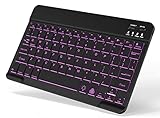
- 7-Color LED Backlit: This Bluetooth keyboard has a 7 colors backlight mode, 1 breathing light mode, and 3 brightness levels. Even in the dark, it makes your typing more easily and conveniently. You can turn the lights on/off and adjust the backlight mode by the light bulb key, and switch colors among red, yellow, purple, green, ice blue, blue, and white by the RGB key. When the keyboard is idle, the light will automatically turn off to save power.
- Broad Compatibility: Perfect for iPad A16 11th 10th 9th Gen, iPad Air Mini Pro iPhone, Android Samsung galaxy tab tablet smartphone cell phone, and so on mobile devices with built-in Bluetooth, and compatible with Android, iPad OS, iOS, etc. multiple operating systems. This Bluetooth keyboard is specially designed for small mobile devices such as tablets, smartphones. SO, NOT suitable for desktop devices such as laptops, computers, Macs, MacBooks, etc.
- Stable and Reliable Bluetooth Connection: The advanced Bluetooth technology can provide a stable reliable and powerful connection. The keyboard is easy to connect and easy to use. Don't worry about delay. The keyboard has shortcut hot keys, which makes your work easier and more efficient. Keyboard size: 9.65 x 5.91 x 0.24 inch.Weight: 6.53 ounce/0.4pounds.
- Rechargeable Battery: The Bluetooth keyboard has a built-in rechargeable battery, so there is no need to replace the battery frequently, you can use the included Type-C cable for charging. It will enter sleep mode after about 5 minutes of inactivity to save power, you can press any key to activate it and wait for 3 seconds to use it again. If not used for a long time, you can turn off the keyboard power.
- Quiet Typing and Ultra-Slim: The keyboard adopts a scissor switch structure to provide you with a quiet, sensitive and comfortable typing experience, so that you can focus on your work without worrying about disturbing others. The compact and portable design can be easily put into your bag or backpack, easy to carry, can be used at home school travel office. The back of the keyboard is aluminum alloy design, which is perfect for use with iPad/ tablet case with magnetic adsorption function.
Check whether Android is seeing the intended device
If more than one physical keyboard has been paired, verify that the settings page is showing the keyboard currently in use. A layout selected for a different saved device can make diagnosis misleading. Remove stale entries only after recording which keyboard is active, because deleting the wrong entry creates an additional pairing task.
The Tool Desk
Outbyte PC Repair FREEClear out junk files and repair common Windows errorsFree Scan →Outbyte Driver Updater FREEFix the driver behind crashes, sound loss and screen glitchesFind Drivers →Test an app-supported command instead of a guessed one
Android’s hardware-keyboard compatibility guidance establishes expected modifier keys, not a universal list of commands for every app. An app receives key events and decides which combinations it handles. A browser, text editor, game and remote-session client may all interpret the same keys differently.
How to distinguish app behavior from an Android problem
- Find the target app’s current shortcut documentation or in-app shortcut list.
- Use a command that the app explicitly documents and test it with the keyboard’s selected layout.
- Repeat that command in a second app only if the second app documents an equivalent action.
- Compare the results. Success elsewhere indicates that the original app may not implement the command, may reserve the combination for another feature, or may be receiving a different key event.
For an app-specific failure, update the app if an update is available, inspect its own keyboard or accessibility settings, and contact the app’s support channel with the exact combination, device, Android version and layout. Android’s system settings cannot add a shortcut that the app does not implement.
When a shortcut works only in some screens
Some apps handle hardware input only when a particular editor, search field or focused pane is active. Tap the intended field first, then repeat the command. If it works in one screen but not another within the same app, report the focus-dependent behavior to that app rather than repeatedly re-pairing the keyboard.
Fix language and layout switching separately
Language switching is a distinct category. It may be assigned in Android’s physical-keyboard settings or exposed through a manufacturer’s interface, so a general app shortcut test does not prove that the language command is configured.
Rank #4

- Excellent Compatibility: The Bluetooth keyboard compatible with iOS, Android and iPad OS system. It is perfect for Apple iPhone, iPad, iPad Mini, iPad Pro, iPad Air, Android Samsung LG tablet smartphone cell phone.
- Light portable and compact: This keyboard is much lighter, smaller than traditional keyboard. You can easily carry it without taking up more space on your desk or bag. 10 inch keyboard dimensions: 25 x 15 x 0.6 cm, weight: 180g. 【Size: 9.84 x 5.9 x 0.24 inch, weight: 6.35ounce/0.4pounds】
- Long-term use: Built-in rechargeable lithium battery, after fully charged, it can be used for more than 20 days (When used continuously for 2 hours a day). If you don't use it for more than 10 minutes, the keyboard will automatically enter the sleep state to save power. If you want to continue to use it, just click any key to wake up the keyboard.
- Comfortable Bluetooth Keyboard: The keys of the keyboard are scissor structure, square chocolate keycap design. Use this keyboard, you can type quietly on your tablet, iPad, iPhone, smartphone and provide you with a comfortable and pleasant typing experience.
- Bluetooth Connection: The keyboard adopts stable Bluetooth technology, the working distance is up to 10m. The keyboard is US QWERTY layout, easy to use, has hot keys, such as volume control, play and pause, previous and next etc. The front is brushed, the back is ultra-thin and smooth aluminum alloy design.
Samsung-specific example
Samsung’s DeX documentation includes a Change language shortcut control for supported Galaxy tablet and DeX contexts. Treat this as a Samsung-specific example, not a universal Android menu. On a supported device, open the physical-keyboard or DeX keyboard settings, locate that control, and verify the assigned combination. The control may not appear on another manufacturer’s phone or tablet.
If the language command still does nothing
- Confirm that more than one input language or layout is enabled; a switch has no visible effect when only one is available.
- Check the physical layout selected for the keyboard, because the required modifier may be different from the key you expect.
- Try the configured combination in a text field where the current language is visible.
- If ordinary app shortcuts work but language switching does not, keep the investigation in keyboard-language settings rather than resetting the app.
Use Gboard recovery only when Gboard itself is failing
Gboard troubleshooting is appropriate when Gboard crashes, freezes or becomes unresponsive. It is not a universal fix for a shortcut that fails only inside one app or for a Bluetooth keyboard whose hardware input is otherwise working.
Google’s recommended recovery sequence is:
- Restart the device. This clears a temporary process or input-service failure.
- Update Gboard. Install any available update, then test the keyboard again.
- Clear Gboard’s cache. In Android settings, open the app’s storage information and clear only the cache first. Menu names vary by device.
- Force stop and relaunch Gboard. Use the app-info screen, force stop it, then open a text field and test again.
- Reinstall Gboard if necessary. Google documents reinstalling as a later recovery step, after the less disruptive actions above.
These actions repair the on-screen keyboard application. They do not establish that an app-specific hardware shortcut will become supported, and they should not be the first response when physical typing and Gboard are both normal.
Independent reader supportYour contribution helps us test, update, and keep practical guides available for everyone.What to do when only one combination fails
A single failing combination is usually a mapping or handling question, not evidence that every key is defective. Work through this branch:
- Check the app’s documented command and whether the command is available in the current screen.
- Verify the physical layout in Settings > System > Keyboard > Physical keyboard, or the equivalent path on the device.
- Try the same documented command in another app that supports the same action.
- Test the modifier key with a different documented command to determine whether the modifier is recognized at all.
- Contact the app developer if the command is documented but fails only there, including your exact combination and test results.
Do not substitute a different modifier combination and assume it is equivalent. Android’s documentation describes common modifiers, but the app decides which combinations are meaningful.
Best Value

- Type on Any Device: A new type of wireless computer keyboard for your desk that also works with your tablet and smartphone; connect with any Bluetooth-enabled device with external keyboard support. Wireless range: > 10m wireless range
- Easy-Switch Dial: Simply turn the dial of the Logitech K480 keyboard to switch typing between 3 connected Bluetooth wireless devices, you can work with Windows, macOS, Chrome OS, Android, and iPadOS
- Familiar Keyboard Layout: Find all the shortcut keys you use the most, but in a space-saving design that lets you place your mouse close to you, for less arm reaching and better posture
- Integrated Cradle: A cradle to hold your phone or tablet at just the right angle for you to read while you type; fits most phones and tablets up to 0.4 inches thick and 10 inches wide
- Reliable Power: This portable, wireless Bluetooth keyboard comes with 2 pre-installed AAA batteries which can last up to 24 months (2) and is compatible with wired, wireless or Bluetooth mice. Battery indicator light
What to do when every shortcut fails but typing works
When letters and numbers arrive normally yet no shortcut produces an action, concentrate on the shared layers:
- Confirm that you are testing commands documented for the current Android version, device mode and app.
- Check that the keyboard’s physical layout is correct and that the modifier keys are not being remapped by a device-specific setting.
- Test a documented command in a second app. If none work anywhere, capture the device, Android version, keyboard model and layout for support.
- Look for manufacturer settings that alter keyboard behavior, especially on tablet desktop modes. A control documented for one vendor should not be assumed to exist on another.
If ordinary typing, layout selection and a second-app test all pass, the remaining issue may be an Android or keyboard compatibility defect. The available Android guidance does not identify one universal root cause or one guaranteed fix; support needs the exact combination and environment.
When replacing the keyboard is reasonable
Buy or borrow another Bluetooth keyboard only to test hardware or compatibility, not as a guaranteed cure for an app shortcut bug. A replacement is reasonable when the current keyboard cannot maintain a connection, a modifier key fails in ordinary tests, or its physical layout cannot be selected correctly. Choose a keyboard whose Android/device compatibility and modifier labeling match your use case.
Quick wins for a faster PC:
Scan for outdated or missing drivers - takes under a minuteDriver Scan →Clear out junk files and repair common Windows errorsFree Scan →A new keyboard will not add a command that an app does not support, and it will not replace a missing language-switch setting. Pair the replacement through Settings > Connected devices > Pair new device, select its layout under the physical-keyboard settings, and repeat the same controlled tests so the comparison is meaningful.
Keep a concise troubleshooting record
For a repeatable diagnosis, save these results:
- Device model, Android release and form factor.
- Keyboard model, connection type and selected physical layout.
- The exact shortcut, including modifier and key.
- The app and screen where it fails.
- Whether ordinary typing works.
- Whether the same documented command works in another app.
- Whether the problem is a language switch, an app action or a system command.
- Which pairing, layout or Gboard recovery steps were completed and what changed.
This record gives an app developer, device manufacturer or Android support representative enough context to reproduce the behavior instead of guessing from the phrase “shortcuts do not work.”
Quick Recap
Practical decision tree
- No text appears: reconnect or re-pair the Bluetooth keyboard, then verify that Android lists it as the active physical keyboard.
- Text appears but symbols are wrong: correct the physical layout and retest.
- One app fails: check that app’s documented shortcuts and focus state; escalate to the app if the command is supported but still fails.
- Only language switching fails: inspect Android or OEM language-shortcut settings, including the vendor-specific control where applicable.
- Gboard is frozen or crashing: restart, update, clear cache, force stop and, if needed, reinstall Gboard.
- Every documented shortcut fails in every app: provide the complete device, Android, keyboard and layout details to support; the available documentation does not establish a single universal repair.
Product prices and availability are accurate as of the date/time indicated and are subject to change. Any price and availability information displayed on Amazon at the time of purchase will apply.

