
What’s actually slowing this PC down?
Pick the symptom - the matching free tool is one click away.
iTechGuides is reader-supported. When you buy through links on our site, we may earn an affiliate commission. As an Amazon Associate I earn from qualifying purchases. Learn more
AI performance depends on the network connecting data, computing resources and users—not just on model quality or accelerator speed. Bandwidth and throughput affect how quickly data and distributed work reach compute; latency, jitter, packet loss and reliability affect how consistently AI services respond. Networking is one part of the system, alongside compute, storage, software and workload design, so a slow AI task is not automatically a network problem.
What the network does for AI
An AI system moves information between storage, accelerators, other computing sites, services and people. The network carries training data to compute, coordinates distributed work, and transports inference requests and responses. When those paths cannot keep up with a workload, accelerators may wait for data or users may experience slower, less consistent responses. These are possible effects, not proof that networking is the bottleneck in every deployment.
Google Cloud’s Bikash Koley, VP of Google Global Infrastructure, and Arjun Singh, Engineering Fellow, described the requirement from Google’s engineering perspective: “The network supporting this stack must meet the stringent bandwidth, scale, and performance needs of AI workloads.” This is a first-party view of infrastructure needs, not an independent standard. Google Cloud’s explanation of networks built for AI also illustrates how much capacity can matter: Google estimates that transferring 1 petabyte would take 22.2 hours over a 100 Gbps link and 0.7 hours over a 3.2 Tbps connection. Those are illustrative capacity calculations, not a promise of application-level transfer times.
Training and inference put different demands on the network
Training: moving data and coordinating compute
Training may involve loading large datasets into the compute environment and coordinating work across accelerators or facilities. The network needs to deliver data at a rate the workload can use and carry communication among distributed workers. If delivery or coordination falls behind, compute resources can spend time waiting. The actual effect depends on the model, data pipeline, parallelism strategy, storage and network design.
#1 Best Overall

- 8 GIGABIT PORTS: Features 8 RJ45 ports supporting 10/100/1000 Mbps speeds, providing high-speed wired network connectivity for computers, printers, gaming consoles, and other Ethernet-enabled devices
- PLUG AND PLAY SETUP: No configuration required; simply connect the switch to your network devices and it is ready to use immediately, making network expansion quick and hassle-free
- FANLESS QUIET DESIGN: The fanless design ensures silent operation, making this switch suitable for noise-sensitive environments such as home offices, bedrooms, or conference rooms
- STURDY METAL CONSTRUCTION: Built with a durable metal housing and shielded ports that provide reliable performance, better heat dissipation, and protection against electromagnetic interference
- TRAFFIC OPTIMIZATION: Supports IEEE 802.3x flow control and advanced traffic optimization technology to reduce data bottlenecks and ensure smooth, efficient data transfer across your network
Inference: keeping requests responsive
Inference sends a user’s or another service’s request to a model and returns its output. End-to-end latency matters because delays along the route add to the time a user waits. Jitter—variation in latency—can make response times less predictable; packet loss or unreliable routes can disrupt or delay exchanges. Placing compute nearer to users may help reduce the distance requests travel, but route quality, service architecture and compute capacity also influence the result.
Training and inference can coexist in one deployment, but their traffic patterns need not be the same. A design that handles large data transfers well does not automatically provide the best responsiveness for user-facing requests.
Rank #2

- GIGABIT ETHERNET PORTS: Features 5 x 1.0Gbps Ethernet ports for high-speed connectivity. Auto-negotiating ports detect the optimal speed for connected devices and work with existing Cat5e or Cat6 Ethernet cables.
- PLUG-AND-PLAY UNMANAGED NETWORK SWITCH: Simple plug-and-play setup with no software to install or configuration required.
- FLEXIBLE MOUNTING OPTIONS: Compact metal design supports desktop or wall-mount placement for versatile installation.
- SILENT & ENERGY-EFFICIENT OPERATION: Fanless design ensures silent performance, while IEEE 802.3az Energy Efficient Ethernet reduces power consumption without compromising high-speed network performance.
- REGIONAL COMPATIBILITY: Made for use in U.S. & CA only
Network speed is not the same as network quality
Bandwidth describes a link’s capacity; throughput is the rate a workload actually achieves. Congestion, protocol overhead, competing traffic and the path between endpoints can keep real throughput below a link’s headline capacity. For AI, teams also need to consider whether the network remains dependable and observable under load.
Do these 3 things before closing this tab:
1Clear out junk files and repair common Windows errors2Scan for outdated or missing drivers - takes under a minute3Repair Windows errors before they cause bigger problems- Latency and jitter: How long data takes to travel and how much that time varies, especially important for interactive inference.
- Packet loss and availability: Whether data arrives reliably and whether the service remains reachable.
- Resilience and route diversity: Whether alternate paths or connections can keep a distributed deployment operating through a failure.
- Traffic management and observability: Whether teams can prioritize traffic appropriately, see congestion or faults, and diagnose problems.
- Security and data location: Whether network policy is consistent and data travels through permitted routes and locations.
- Carrier and interconnect diversity: Whether a deployment depends on a single provider or connection where alternatives are needed.
These concerns grow more consequential as systems span facilities, cloud environments and user regions. Capacity is only one element of a network design.
Rank #3

- 𝗢𝗻𝗲 𝗦𝘄𝗶𝘁𝗰𝗵 𝗠𝗮𝗱𝗲 𝘁𝗼 𝗘𝘅𝗽𝗮𝗻𝗱 𝗡𝗲𝘁𝘄𝗼𝗿𝗸: 5× 10/100/1000Mbps RJ45 Ports supporting Auto Negotiation and Auto MDI/MDIX.
- 𝗚𝗶𝗴𝗮𝗯𝗶𝘁 𝘁𝗵𝗮𝘁 𝗦𝗮𝘃𝗲𝘀 𝗘𝗻𝗲𝗿𝗴𝘆: Latest innovative energy-efficient technology greatly expands your network capacity with much less power consumption and helps save money.
- 𝗥𝗲𝗹𝗶𝗮𝗯𝗹𝗲 𝗮𝗻𝗱 𝗤𝘂𝗶𝗲𝘁: IEEE 802.3X flow control provides reliable data transfer and Fanless design ensures quiet operation.
- 𝗣𝗹𝘂𝗴 𝗮𝗻𝗱 𝗣𝗹𝗮𝘆: Easy setup with no software installation or configuration needed.
- 𝗔𝗱𝘃𝗮𝗻𝗰𝗲𝗱 𝗦𝗼𝗳𝘁𝘄𝗮𝗿𝗲 𝗙𝗲𝗮𝘁𝘂𝗿𝗲𝘀: Prioritize your traffic and guarantee high quality of video or voice data transmission with Port-based 802.1p/DSCP QoS and IGMP Snooping.
What current surveys say—and what they do not
Several company-published findings point to networking as a practical concern for AI infrastructure, but they measure different things and should not be treated as a single industry benchmark.
- Google Cloud, 2026: Google reports that traffic on its own WAN grew 10x from 2020 to 2025. This describes Google’s global network, not industry-wide traffic growth. Google Cloud’s account.
- Ciena-commissioned survey, 2025: 53% of 1,303 data-center workers responsible for infrastructure planning or purchasing across 13 countries expected AI workloads to place the greatest demand on data-center interconnect over the next two to three years. Fieldwork ran January 8–16, 2025; this is respondent expectation, not measured future demand. Ciena’s survey release.
- Flexential report, 2026: The provider says 96% of respondents reported a network-related AI performance issue in the preceding 12 months, while 71% reported excessive latency affecting AI workloads. The report summary does not provide full sampling details, so these are findings as reported by Flexential, not population-wide estimates. Flexential’s report summary.
- Cisco report page, 2026: Cisco says 97% of respondents reported that AI had created network challenges. The page summarizes Cisco and Foundry research; it is separate from Flexential’s survey and should not be directly compared with it. Cisco’s report page.
Ciena CTO International Jürgen Hatheier summarized the provider’s position this way: “The AI revolution is not just about compute—it’s about connectivity.” The quote appeared in Ciena’s March 17, 2025 release describing its commissioned survey; it is a vendor statement, not a neutral performance standard. Ciena’s release and survey context.
Rank #4

- 24-Port Gigabit Connectivity for Business Expansion: Featuring 24×10/100/1000Mbps auto-negotiation ports, this Ethernet switch enables seamless expansion for computers, NAS, printers and other wired devices. Ideal for offices, server rooms, and control environments
- Flexible Installation Options for Any Setup:Includes 2 rackmount ears and screws for easy installation in standard 19" racks. Also supports wall mounting and desktop placement, providing versatile deployment for offices, server rooms, and network cabinets
- 4 Working Modes for Optimized Networking:The network switch can easily switch between standard mode, port isolation(VLAN) for device separation, link aggregation up to 2Gbps for increased bandwidth, and flow control for stable data transmission, supporting diverse business needs
- Plug and Play, No Configuration Required : This gigabit switch requires no software installation or setup. Simply plug in your devices and enjoy instant connectivity for fast and effortless deployment
- Advanced Cooling Design for Reliable Performance: Featuring a solid metal housing with side ventilation holes, aluminum heatsinks, and thermal pads, this 24 port switch ensures efficient heat dissipation and stable operation even under continuous use
Data-center networking is not your home internet connection
These infrastructure claims concern networks used to connect data, compute and services—such as data-center fabrics, wide-area networks and data-center interconnects. They do not establish a recommended household broadband speed or show that upgrading a home internet plan will make an AI model smarter or faster. A home connection can affect access to an online AI service, but the cited figures are about enterprise and provider infrastructure, not consumer internet performance.
Free tools Windows power users keep installed
One-click scans. No signup required.
How to assess an AI network design
There is no universal minimum bandwidth or latency target established by these sources. Requirements depend on workload, architecture, geography and deployment environment. For a real design review, evaluate the path between the relevant data, compute and user locations rather than relying on a single advertised link speed.
Best Value
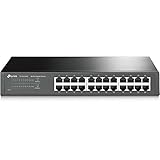
- 𝙊𝙣𝙚 𝙎𝙬𝙞𝙩𝙘𝙝 𝙈𝙖𝙙𝙚 𝙩𝙤 𝙀𝙭𝙥𝙖𝙣𝙙 𝙉𝙚𝙩𝙬𝙤𝙧𝙠: 24 port of 10/100/1000Mbps RJ45 Ports supporting Auto Negotiation and Auto MDI/MDIX
- 𝙂𝙞𝙜𝙖𝙗𝙞𝙩 𝙩𝙝𝙖𝙩 𝙎𝙖𝙫𝙚𝙨 𝙀𝙣𝙚𝙧𝙜𝙮: Latest innovative energy-efficient technology greatly expands your network capacity with much less power consumption and helps save money
- 𝙍𝙚𝙡𝙞𝙖𝙗𝙡𝙚 𝙖𝙣𝙙 𝙌𝙪𝙞𝙚𝙩: IEEE 802. 3X flow control provides reliable data transfer and Fanless design ensures whisper quiet operation
- 𝙋𝙡𝙪𝙜 𝙖𝙣𝙙 𝙋𝙡𝙖𝙮: Easy setup with no software installation or configuration needed, just plug it in and start
- 𝙈𝙚𝙩𝙖𝙡 𝘾𝙖𝙨𝙞𝙣𝙜: Metal-cased switches provide superior durability, heat dissipation, and EMI protection, making them the clear choice for reliable performance over cheaper plastic switches.
- Define the workload. Separate training data movement and distributed coordination from latency-sensitive inference traffic; account for any workloads that run concurrently.
- Map endpoints and geography. Identify where data resides, where compute runs and where users or calling services are located. Include inter-site links and relevant data-location constraints.
- Measure delivered performance. Check effective throughput under realistic load, congestion behavior, end-to-end latency, jitter, packet loss and availability across the actual routes.
- Review failure handling. Assess redundant paths, interconnect and carrier diversity, recovery behavior and whether a single link or provider creates an unacceptable dependency.
- Check operations and controls. Confirm that traffic can be managed, network behavior observed, faults diagnosed, and security policies applied consistently.
- Compare total cost against the workload. Weigh capacity and resilience needs against the cost and operational complexity of the proposed design; a faster link alone may not address a storage, software or compute constraint.
For cloud and network choices, treat provider descriptions as first-party claims unless they are independently benchmarked. Google Cloud’s scale and performance statements describe Google’s network; they are not a comparative ranking of providers.
Quick Recap
Product prices and availability are accurate as of the date/time indicated and are subject to change. Any price and availability information displayed on Amazon at the time of purchase will apply.

