
What’s actually slowing this PC down?
Pick the symptom - the matching free tool is one click away.
iTechGuides is reader-supported. When you buy through links on our site, we may earn an affiliate commission. As an Amazon Associate I earn from qualifying purchases. Learn more
No. In a basic camera, light from the top of a scene reaches the lower part of the sensor, while light from the bottom reaches the upper part. The physical image formed behind the lens is inverted; the camera’s finished photo is normally displayed upright because the viewing and image-processing system presents it that way.
How light forms an image inside a camera
Imagine a dark box with a tiny hole on one side and a screen on the opposite wall. Light travels in straight lines through the hole. A ray from the top of an object crosses the opening and lands low on the screen; a ray from the bottom lands high. The projected image is therefore upside down. Light from the left and right sides also crosses, so the projection is reversed left-to-right as well. MIT Computational Photography explains this pinhole image geometry, and USC Viterbi’s account of camera development describes the same basic inversion.
A camera lens gathers and focuses more light than a tiny pinhole, but it preserves this basic image-forming geometry: rays from opposite sides of the scene cross as they are brought to focus on the image plane. The lens and the sensor’s position determine which parts of the scene fit and how large they appear; the sensor does not receive an upright projection simply because the camera is pointed upright.
What “inverted” means—and why diagrams can look different
In the straightforward pinhole projection, the top maps to the bottom and the left maps to the right. Together those reversals amount to a 180-degree rotation, not just a mirror reflection. “Backward” can mean different things in everyday speech, so the top-to-bottom and left-to-right description is more precise.
#1 Best Overall

- 16MP Sensor: Captures detailed photos with a CMOS sensor for everyday shooting
- Optical Zoom: 5x optical zoom with a 28mm wide angle lens for flexible framing indoors or outdoors
- Full HD Video: Records 1080p video for travel clips, family moments, or simple vlogging
- Memory Support: Works with Class 10 SD, SDHC, or SDXC cards up to 512GB
- Rechargeable Battery: Included LB-012 lithium-ion battery charges in the camera over USB with the supplied adapter in about 2 hours; charge it for at least 4 hours before first use to maximize battery life
Some optics and computer-vision diagrams draw a virtual image plane in front of the pinhole. It is an imaginary surface used as a coordinate convention; light does not land on it. Because it carries an upright version of the scene and can simplify calculations, such a diagram may look different from one showing the physical sensor behind the aperture. The sensor behind the aperture still receives the inverted image. MIT’s pinhole-image explanation distinguishes the physical image from this diagram convention.
Why the viewfinder or photo can appear upright
The inverted optical image is not the same thing as the final way a camera presents a picture. A viewing system can redirect the light or otherwise present the scene upright. In a single-lens reflex camera, for example, light travels through the lens, reflects from a movable mirror angled at 45 degrees, then passes through a prism to the viewfinder. When the shutter is released, the mirror moves and exposes the sensor. That is one specific optical path, not a description of every camera. TU Delft’s overview of optical instruments describes this arrangement.
Rank #2

- MEANINGFUL GIFT - This digital camera features a high-performance CMOS Sensor and anti-shake function, enabling you to capture vibrant, clear 44MP photos and record smooth, stable Full HD 1080P videos. It's a meaningful Christmas, birthday gift for kids, teens, students, and beginners to discover the joy of photography, experience and record their lovely life, and preserve funny, memorable moments with family and friends.
- COMPACT FOR TRAVEL & EASY TO USE - Special pocket-size design, this camera for photography fits in your pocket for easy carrying. Comes with a lanyard and powerful battery, portable to take along while traveling or camping. With clear, simple settings and features, this camera is easy for kids and starters to figure out and operate on their own. Simply insert the included SD card and battery, power it on, and start taking photos and recording videos. Capture life’s moments with ease!
- SAFE MATERIALS & CREATIVE FILTERS - Made of high-grade and reliable materials, the kid camera is safe, non-toxic, and durable. This digital vlogging camera for photography supports a variety of cute filter effects to choose from, and kids can create creative pictures. The timestamp function helps add the date and time to your photos and videos, allowing you to track special moments, such as birthdays, trips, or events. 16X digital zoom allows for enlarging distant subjects in photos.
- SMALL BUT POWERFUL - Equipped with two powerful rechargeable batteries, providing long-lasting use during vacations and camping trips. The automatic turn-off feature helps conserve energy. The kids digital camera features a large LCD screen and the ability to playback photos and videos on the camera or a computer. Also supports multiple features, including anti-shake, self-timer, webcam capability, time-lapse, slow motion, continuous shooting, motion detection, face detection, and so on.
- WARRANTY & PACKAGE LIST - We provide a two-year satisfaction warranty, along with a no-hassle replacement policy. Any problems or questions with the camera, please contact us for help. Package list: Digital Camera, 32 GB SD Card, Type C Cable, Charger Adapter, 2 Rechargeable Batteries, Lanyard, and Bag.
Likewise, a camera’s displayed or saved photograph need not look inverted just because the physical image forms that way at the sensor. The optical image and the image a person sees on a screen are different stages of the process.
What a mirror changes in a camera obscura
A mirror redirects the light path, so the resulting orientation depends on where the mirror sits and where the image is viewed or projected. The Oxford History of Science Museum describes a camera obscura using a lens and a mirror at 45 degrees to send the projection onto horizontal paper. In that arrangement, the reflected image is right-side up but remains reversed left-to-right because of the lens. A mirror does not universally correct every inversion; the whole optical arrangement matters. The museum’s camera obscura explanation shows this example.
Rank #3

- FHD 1080P & 44MP : This digital camera, designed specifically for teens, utilizes advanced CMOS technology to ensure precise detail capture and vividly record unforgettable moments, helping you preserve timeless memories. With no complicated settings required, it perfectly sparks your child's interest in photography, making it easy to document joyful times
- 16X Zoom & Multi-function: The small digital camera features 16x digital zoom function, You can press the W/T button to zoom in or out the subject, obtain high quality image, and features such as a self timer, continuous shooting, 20+ fun filters function, it‘s perfect for beginners
- Smile Capture & Face Detect : The advanced face detection and smile capture features in the travel camera simplify focusing. Turn on Smile Capture to automatically take photos, making it easy for teens to snap great pictures with just a smile
- Anti-Shake & Fill Light: The kids digital camera is equipped with an anti-shake and fill-in-light function that allows you to take clear and bright pictures even in dark conditions. The anti-shake function ensures that all images remain clear and stable and is easy to operate
- Thoughtful Gift: Digital camera for teens are perfect for Birthday Party, School Season, Christmas, Children's Day, as a perfect gift for kids and friends! You will receive camera x1, USB-C cable x1, battery x1, lanyard x1, user manual x1.(It can support up to a 64GB memory card.)
Pinhole versus lens: the trade-off
A pinhole makes the ray-crossing effect easy to see, but it admits little light. If the hole is too large, the image blurs; making it smaller can improve sharpness while reducing the light reaching the image surface. A lens allows a larger opening while focusing light, producing a brighter, higher-quality projection than a simple pinhole in the camera obscura described by the museum. These are qualitative trade-offs, not universal aperture or exposure specifications: results depend on the device and conditions. TU Delft discusses the pinhole trade-off, and Oxford’s museum account describes the lens-based camera obscura.
Quick Recap
Best Value
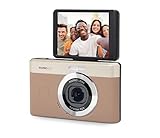
- 13MP Sensor: Captures detailed photos with a CMOS sensor and a bright f/2.0 wide angle lens
- 26mm Fixed Focus Lens: Wide angle framing for selfies, group shots, and travel scenes, with no zooming or focusing to adjust, just point and shoot
- Flip Screen: 2.8in LCD screen tilts 180 degrees for selfies, vlogs, and group shots
- Full HD Video: Records 1080p video for travel clips, family moments, or content creation
- Rechargeable Battery: Built-in lithium-ion battery with USB-C charging for on-the-go use
Rank #4
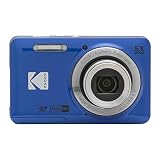
- 16MP Sensor: Captures detailed photos with a CMOS sensor for everyday shooting
- Optical Zoom: 5x optical zoom with a 28mm wide angle lens for flexible framing indoors or outdoors
- Full HD Video: Records 1080p video for travel clips, family moments, or simple vlogging
- Memory Support: Works with Class 10 SD, SDHC, or SDXC cards up to 512GB
- Rechargeable Battery: Included LB-012 lithium-ion battery charges in the camera over USB with the supplied adapter in about 2 hours; charge it for at least 4 hours before first use to maximize battery life
Product prices and availability are accurate as of the date/time indicated and are subject to change. Any price and availability information displayed on Amazon at the time of purchase will apply.

