
Free tools Windows power users keep installed
One-click scans. No signup required.
iTechGuides is reader-supported. When you buy through links on our site, we may earn an affiliate commission. As an Amazon Associate I earn from qualifying purchases. Learn more
There is no evidence-based winner among white, pink, and brown noise for sleep. The colors describe how sound energy is distributed across frequencies, which changes whether a track sounds hissy, soft, or rumbly. Reviews of sleep studies find mixed or very low-quality evidence that continuous noise improves sleep, and a small controlled study published in 2026 found that pink noise reduced REM sleep under its laboratory conditions. If intermittent outside noise is waking you, a physical barrier such as earplugs worked better than pink noise in that experiment. The practical choice is therefore the sound you can tolerate at the lowest comfortable level and that masks the specific disturbance you hear—not a color with a proven sleep effect.
This guide separates sound masking from claims about changing sleep physiology, explains what each color is, summarizes the strongest available studies, and gives a cautious way to test a sound machine or app without treating it as an insomnia therapy.
What white, pink, and brown noise actually mean
“Color” is an audio description, not a medical classification. It refers mainly to the balance of energy across frequencies. Your ears therefore perceive the three signals differently even when they are played at the same overall level.
Do these 3 things before closing this tab:
1Repair Windows errors before they cause bigger problems2Fix the driver behind crashes, sound loss and screen glitches3Clear out junk files and repair common Windows errors| Sound | Spectral balance | Typical perception | What sleep evidence supports |
|---|---|---|---|
| White noise | Relatively even energy across the frequency range | Bright, hiss-like, similar to steady static or airflow | It has been studied more than brown noise, but reviews find mixed or very low-quality evidence for a sleep benefit. Capezuti et al. (2022); Riedy et al. (2020) |
| Pink noise | More energy at lower frequencies than white noise | Usually softer or less bright than white noise | Results are mixed. A seven-night controlled laboratory study published February 2, 2026 found reduced REM sleep with continuous pink noise in its tested conditions. Basner et al. (2026) |
| Brown or Brownian noise | A still stronger tilt toward lower frequencies than pink noise | Deep, bass-heavy, or rumbling | The sources reviewed for this article provide little direct sleep evidence specific to brown noise. They do not establish that it is better than white or pink noise. Australian Acoustical Society review (2024) |
A lower-pitched sound can feel calmer because it is less sharp, but “deeper” does not mean “more sleep-promoting.” A track can be pleasant and still fail to improve sleep, while an unpleasant-sounding track may be useful if it masks a repetitive disturbance. Comfort, masking ability, playback practicality, and the lowest level you can tolerate are more defensible selection criteria than the color name.
#1 Best Overall
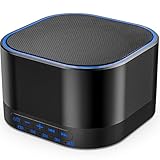
- ❤Notice: This sound machine needs to be plugged in for use.
- ❤20 Non-Looping Sleep Sounds: White noise ,Brown noise, pink noise, blue noise, fan,brook, rain, ocean,bird and Bonfire,suitable for for Baby and Kids and Adults.
- ❤Precise Volume & Timer Settings:With 32 Levels of Volume ,it is perfect for baby sleeping .And you can set 1 hour,2 hours,3 hours,4 hours and continuous play,control the comfort level for your own environment.
- ❤Unique Design: Solid-state design with 3.01inch*3.01inch *1.77inch,it is portable for home, office or travel,can give you a perfect sleep.
- ❤Function & Safety:Memory function automatically restores your previous volume, sound and time,it is powered by AC or USB.The machine is approved by FCC, CE and RoHS,don't need to worry about accidents.
What the strongest reviews conclude
The 2022 systematic review
Capezuti and colleagues reviewed 34 studies involving 1,103 people. The studies covered white noise, pink noise, and multiaudio interventions. Positive findings appeared in 6 of 18 white-noise studies (33%), 9 of 11 pink-noise studies (81.9%), and 4 of 6 multiaudio studies (66.7%). Those figures are proportions of studies reporting a positive result, not the percentage of participants who benefited and not proof that a color works. Differences in study design, participants, sounds, outcomes, and comparison groups made the results difficult to combine. The authors concluded that there was no strong evidence to support auditory stimulation as a sleep intervention. Read the systematic review in the Journal of Clinical Sleep Medicine.
The same review said that none of its included studies reported adverse effects from short-term auditory stimulation during sleep. That observation applies to the short applications studied; it does not prove that every volume, device, duration, or long-term listening pattern is risk-free.
The 2020 review of continuous noise
Riedy, Smith, Rocha, and Basner examined continuous white or similar broadband noise as a sleep aid. Their methods and noise conditions varied substantially, and their conclusion was cautious: using GRADE criteria, the quality of evidence for continuous noise improving sleep was “very low.” They also noted that noise can negatively affect sleep and hearing. Widespread use of a product or habit is therefore not the same as clinical evidence that it improves sleep. Read “Noise as a sleep aid: A systematic review”.
Why setting matters
A 2025 perspective that summarized earlier systematic reviews found inconsistent outcomes overall. Improvements were more consistent in some hospital studies, where a steady sound could mask alarms, conversations, doors, or other unpredictable disturbances. Home studies were much more variable. That difference is important: masking a disruptive sound in a noisy ward is a different question from adding sound to an already quiet bedroom. See the 2025 perspective in SLEEP.
Rank #2
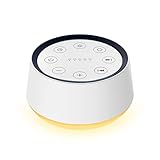
- ❤[Plug In White Noise Machine] This sound machine needs to be plugged in for use.
- ❤[30 Natural and Soothing Sounds] Our white noise machine provides 30 soothing sounds, including 3 Brown noise, 2 White noise(White noise, Pink noise), 2 fan noises( Loud and Soft Fan), 8 lullabies and 15 natural sounds( Rain, Sea waves, Brook, Bird, Train, etc.). This sound machine suitable for relieve stress, relax your mind and create a relaxing sleep environment.
- ❤[12 Night Light Colors] Sound machine with 12 kinds of light color, to suit your personal preferences at any time. You can choose the suitable nightlight to decorate the environment and create the perfect atmosphere for sleep and rest.
- ❤[10 Adjustable Levels Night Light] An adjustable soft lighting creates a comfortable sleeping atmosphere for baby kids and adults. Change your surroundings to create the perfect atmosphere for baby sleep, it is the best choice for night feedings.
- ❤[5 Timer Settings & Memory Function] This sound healing machine can be played continuously or 1,2,3, 4 hours auto-off timer, it is good for taking naps, relaxation, meditation, concentration while studying and working. The white noise machine is powered by AC. Our white noise machine can remember the last sound and volume level you selected when restarted, no need to reset to your previous settings.
What the 2024 evidence review does—and does not—say
A 2024 review of reviews judged the evidence for white or broadband noise equivocal. The reviews it assessed had examined white, broadband, and pink noise but had not examined other colors beyond those categories. That gap means there is no strong review-level basis for a brown-noise superiority claim. It does not prove that no brown-noise study exists anywhere; it means the available synthesis does not establish a clinical advantage. Read the Australian Acoustical Society review.
What the 2026 pink-noise experiment found
The newest result is a useful caution against blanket recommendations, not a final verdict on every pink-noise recording. Basner and colleagues studied 25 healthy adults in a controlled, seven-night polysomnographic laboratory protocol. Participants experienced intermittent environmental-noise events, pink noise at 40 or 50 dBA, earplugs, and combinations of those conditions. The comparison included a quiet control night.
- Intermittent environmental noise reduced N3, the deepest non-REM sleep stage, compared with the quiet control.
- Pink noise reduced REM sleep under the tested continuous-playback conditions.
- Adding pink noise to the environmental-noise condition worsened sleep structure overall, although there were minor, dose-dependent improvements in some measures of fragmentation and N3 sleep.
- Earplugs mitigated nearly all of the tested environmental-noise effects. Mitigation began to fail at the highest environmental-noise level used in the experiment.
The authors concluded that, in contrast to pink noise, earplugs were efficacious in mitigating the effects of environmental noise on sleep. The sample was small, all participants were healthy adults, the protocol lasted seven nights, and the sounds and levels were controlled in a laboratory. The result does not establish that every sound machine, every pink-noise spectrum, or every ordinary bedroom volume will reduce REM sleep. It does show why claims that pink noise protects everyone from outside noise—or should run all night—go beyond the evidence. The authors called for further work on optimal noise color and level, longer-term use, and vulnerable populations. Read the full 2026 study.
The Tool Desk
Outbyte Driver Updater FREEScan for outdated or missing drivers - takes under a minuteDriver Scan →Outbyte PC Repair FREERepair Windows errors before they cause bigger problemsFix Now →Masking a disturbance is different from improving sleep
A steady sound can help in one narrow, practical way: it may make an intermittent sound less noticeable. A fan-like track can reduce the contrast between quiet and a passing car, neighbor, plumbing cycle, or hallway conversation. If fewer sound changes reach your attention, you may wake less often. That is a masking explanation, not proof that the noise itself improves sleep biology.
Rank #3

- 【Notice】This sound machine with night light needs to be plugged in for use.
- 【❤️30 Non Looping Sounds for Noise Canceling】Our Plug-in sound machine has 30 Non-looping natural soothing sounds including 3 white noise like brown noise, pink noise and white noise, 2 fan sounds and 15 nature sounds like rain, river, thunderstorm, sea waves, singing birds and 10 lullabies. It can block animal calls, neighbor noise, street noise, urban traffic and used for sleep aid, sound therapy, concentration, privacy protection and anxiety relief. Prefect sound machine for adults baby kids students elderly and office privacy noise canceling.
- 【🧡12 Night Lights Create Comfortable Environment】The white noise machine has unique 12 color night lights and 10 adjustable night lights creating a romantic and warm environment for your favorite style. It can choose different light colors and brightness to meet the needs of different scenarios, which can be used in the office, nursing baby, bedside sleep. It can be used not only as white noise, but also as a night light, or as sound and light simultaneously, giving you a triple experience.
- 【💜5 Times & Memory Function】This sleep machine has 5 timing functions, you can set 1 hour, 2 hours, 3 hours, 4 hours or choose continuous playback. Timing function let you free your hands, peace of mind sleep. In addition, The sleep machine also has a memory function to remember the sound track, light and volume Settings you last used, so you don't need to set them again when you use them next time.
- 【💚36 Volume Levels & Easy to Use】 Compared to the sound machine on the market, our sound machine for sleep has the highest 36 level adjustable volume and large volume which Can effectively block the noise and provide you with more accurate volume and show better sound effect, to create a perfect environment for your sleep. In addition, the button interface design is simple and clear, the button switch is easy to use, the overall design is suitable for any age group, and can be easily used by the elderly.
An intrinsic sleep claim would say that a color changes sleep stages, increases restorative sleep, or treats insomnia even when no external disturbance is present. The systematic reviews do not establish that claim. The 2026 experiment makes it especially important to avoid assuming that a “gentle” pink track is physiologically neutral.
Before choosing a color, identify which problem you are trying to solve:
- Intermittent external noise: address the source and consider a physical barrier first. In the 2026 laboratory comparison, earplugs outperformed pink noise for the tested environmental-noise exposure.
- Continuous, low-level background sound: a steady recording may be worth a personal trial if it masks the disturbance without becoming noticeable itself.
- A quiet room and a hope of deeper sleep: the evidence does not justify adding noise as a proven physiological enhancer.
- Persistent difficulty falling or staying asleep: a sound machine should not replace evaluation for insomnia, medication effects, pain, breathing problems, mood symptoms, or another sleep disorder.
How to choose among the three colors
Choose white noise when brightness helps mask sharp changes
White noise contains relatively even energy across frequencies and often sounds like static, rushing air, or a fan. Its broad spectrum can cover a wide range of household sounds, but some listeners find the high-frequency hiss tiring or intrusive. It is a reasonable first trial when the disturbance includes speech, clicks, or other relatively sharp sounds and the brightness does not bother you. The evidence does not show that white noise improves sleep in a quiet room.
What’s actually slowing this PC down?
Pick the symptom - the matching free tool is one click away.
Choose pink noise when you prefer a softer balance
Pink noise places more energy in lower frequencies than white noise, so many people perceive it as smoother. That perceptual preference can make it easier to tolerate, but it is not evidence of better sleep. Because the 2026 study found reduced REM sleep under its tested conditions, do not assume that a soft-sounding pink track is harmless for everyone or that it should play continuously by default.
Rank #4

- ORIGINAL SLEEP SOUND MACHINE: Beloved by millions since 1962, the Dohm Classic was the first white noise machine ever created. It features our signature sound: natural, comforting, fan-based white noise—without the annoyance of actual moving air.
- CUSTOMIZED EXPERIENCE: The Dohm Classic effectively blocks out disruptive sounds like traffic, snoring, or noisy neighbors, making it easier to sleep or concentrate. Its dual speed settings let you fine-tune the tone & volume to your heart’s content.
- CRAFTED WITH LOVE: For over 60 years, Yogasleep has consistently set the gold standard in crafting sleep-enhancing products, leading the way in the industry. It’s lovingly assembled by hand in the USA, a testament to our commitment to quality.
- SIMPLE TO USE: Just plug in the Dohm Classic using the included 7-foot 120V AC power cable, flip the switch & find your happy sound. It’s a lifesaver for better sleep, soothing babies, tuning out tinnitus, or escaping the snore-fest next to you.
- CLASSIC DESIGN: The Dohm Classic’s timeless design fits into any space. Available in a palette of colors to match your style—white, black, gray, pink, tan & camo. To care for & clean your sound machine, simply wipe the exterior with a damp cloth.
Choose brown noise only as a preference or masking experiment
Brownian noise emphasizes low frequencies even more and is often described as deep or rumbling. Some people prefer that character; others notice vibration, bass buildup, or a feeling of pressure. Direct sleep evidence specific to brown noise is sparse in the reviewed material, so selecting it is a personal sound-quality decision, not an evidence-based upgrade.
| If your priority is… | Most defensible first step | Reason |
|---|---|---|
| Blocking unpredictable outside noise | Reduce the source and try earplugs; use steady sound only if it helps mask what remains | The controlled comparison found earplugs more effective than pink noise under its tested conditions. |
| A less bright sound | Compare pink and brown at the same comfortable setting | Their lower-frequency emphasis changes perception, not proven sleep efficacy. |
| Broad coverage of varied household sounds | Trial white noise, then adjust based on comfort | Its spectrum is relatively even across frequencies, but evidence for a sleep benefit remains weak. |
| “Deeper” or more restorative sleep | Do not select a color on that promise | No color has established superiority or a validated sleep-enhancing mechanism. |
A cautious way to test a sound machine or app
A sound machine with selectable profiles or a generic sleep-audio app can make comparison convenient. The literature describes these products as widely available, but it does not identify a best device, model, app, or commercial service. Treat the trial as a comfort and masking experiment.
- Describe the disturbance. Note whether it is intermittent or continuous, high- or low-pitched, and strongest at a particular time. A sound that masks traffic may not mask voices or bass.
- Compare short samples. Listen to white, pink, and brown versions from the same device or app. Compare their character and whether any hiss, rumble, looping seam, or digital artifact attracts attention.
- Place the source for even coverage. Keep the machine or speaker where the sound reaches the room consistently rather than directly beside your head. Avoid positioning that makes the device vibrate against furniture.
- Begin at the lowest comfortable playback level. The studies summarized here do not establish a universal safe-volume number for consumer use. More volume is not automatically better masking, and a sound that remains noticeable can become another sleep interruption.
- Run a limited personal trial. Keep the same bedtime and other major conditions while comparing one color for several nights, then another. Record sleep onset, awakenings, morning alertness, and whether the track itself became irritating.
- Stop or change the setup if sleep worsens. New awakenings, a feeling of pressure, ringing, headache, or next-day fatigue are reasons to reduce the level, change the spectrum, use a timer, or stop. Do not keep a setting merely because a product description calls it “sleep frequency.”
- Review the result honestly. If the sound only hides a specific disturbance and does not improve sleep in a quiet room, use it as a masking tool rather than assuming a therapeutic effect.
A timer can be useful if you need masking only while falling asleep, while continuous playback may be reasonable only when it remains comfortable and does not disturb you. The available studies do not establish whether one schedule is best for long-term home use.
When earplugs make more sense
For intermittent environmental noise, start with the source: close a window, move the bed away from a shared wall, ask for quiet during predictable periods, or address a mechanical source when possible. Earplugs add a physical barrier instead of introducing another sound. In the 2026 laboratory study, they mitigated nearly all tested effects of environmental noise, whereas pink noise was less effective. The result is limited to the study’s participants, noise events, levels, and earplug protocol; it is not a guarantee for every bedroom.
Best Value

- 💕25 Non-Looping Sleep Sounds:White noise,fans,brook,sea waves,bird, bonfire,train,piano,lullabies,meditation and so on,this special gift with big big love,will give you the most peace of mind,suitable for baby, kids and adults.
- 💕Adjustable Night lights: Four levels of warm lights,it is perfect for sleeping, feeding, even reading.This is a humanized bedside lamp with white noise for your family to take care of their sweet sleep!
- 💕5 Timers & 32 Levels of Volume:You can set it for continuous play or setting a timer 60,120,180,240 min auto-off. And this machine has 32 levels of volume,can easily mask the disruptive environmental noise.
- 💕Compact design& Memory function: With 3.9*3.9*2.3 inch ,it can be easily fitted into a handbag or suitcase,perfect for home, office or travel.And memory function will automatically restore your previous volume, sound and time.
- 💕Quality Assurance & 100% Satisfaction Guarantee:18 Months Warranty for the white noise machine from the date of purchase.This machine is powered by AC or USB,it is approved by ETL, FCC, CE and RoHS,don't need to worry about accidents.Any question just don’t hesitate to contact us.
Fit and comfort determine whether earplugs are practical. If they cause pain, pressure, skin irritation, or make you less aware of an important alarm, stop using them and consider another approach. A steady sound can be an optional supplement for residual noise, not proof that the sound itself improves sleep.
Common mistakes and how to correct them
| Mistake | Why it can fail | Correction |
|---|---|---|
| Assuming the lowest pitch is automatically best | Spectral balance changes perception, but no color has proven superiority. | Choose the least irritating sound that masks your actual disturbance. |
| Turning the volume up until the room disappears | A louder signal can become a new disturbance, and reviews note possible sleep and hearing downsides. | Use the lowest comfortable level and reassess whether masking is sufficient. |
| Running pink noise all night because it sounds gentle | The 2026 laboratory study found reduced REM sleep under its tested pink-noise conditions. | Trial it cautiously, consider a timer, and stop if sleep quality declines. |
| Using a sound machine to treat diagnosed insomnia | Reviews do not establish auditory stimulation as an insomnia treatment. | Seek evidence-based clinical evaluation while treating sound as an optional environmental aid. |
| Generalizing hospital findings to home use | Hospital masking studies and quiet-bedroom use involve different disturbances and expectations. | Judge the setup by your own disturbance and sleep response. |
| Believing a favorable study percentage proves personal success | The 2022 percentages count studies with positive findings, not successful individuals. | Read them as heterogeneous study results, not a probability that you will benefit. |
When to stop experimenting and seek help
Stop a track that causes discomfort, new awakenings, ringing, or worse daytime function. If sleep difficulty persists despite removing obvious environmental triggers, discuss it with a qualified healthcare professional rather than escalating volume or cycling through colors indefinitely. A sound machine is not a substitute for assessment of chronic insomnia or another sleep disorder. The evidence summarized here supports consumer-level sound masking decisions; it does not provide individualized treatment instructions.
For most readers, the practical conclusion is simple: use a color only if its sound is comfortable and masks a real disturbance at a low level. If the room is being disrupted by intermittent external noise, try to block that noise—earplugs performed better than pink noise in the cited laboratory study. If there is no disturbance to mask, current reviews do not justify claiming that white, pink, or brown noise will improve sleep, and the small 2026 pink-noise experiment is a reason to avoid blanket promises.
Quick Recap
Product prices and availability are accurate as of the date/time indicated and are subject to change. Any price and availability information displayed on Amazon at the time of purchase will apply.

