
iTechGuides is reader-supported. When you buy through links on our site, we may earn an affiliate commission. As an Amazon Associate I earn from qualifying purchases. Learn more
For most turntables, upgrade in this order: setup and maintenance, replacement stylus, cartridge, phono stage, then platter or isolation changes. A stylus is usually the safest hardware improvement when your cartridge body accepts interchangeable styli. A new cartridge can make a larger sonic change, but only when its mass, mounting, tracking-force range and alignment geometry suit the tonearm. Mats, platters and external power supplies are problem-solving parts, not universal upgrades.
Start by identifying the symptom you want to fix. Worn or damaged stylus? Replace the stylus. Want a different tonal balance and have a compatible arm? Consider a cartridge. A record that does not couple properly to the platter, or a resonance problem? Investigate a mat or platter. Speed instability on a deck designed for an external supply? Check the manufacturer-approved power option. Hum, skipping and speed faults should be diagnosed before buying anything.
The upgrade order that makes sense
The most reliable sequence is to eliminate setup errors first, then replace the stylus, then consider a complete cartridge. Only after those decisions should you investigate a phono stage, platter or isolation changes. A model-specific external power supply belongs wherever the turntable manufacturer designed it into the platform; it is not a generic step for every deck.
What’s actually slowing this PC down?
Pick the symptom - the matching free tool is one click away.
That order reflects risk as much as sound quality. A stylus replacement can use the existing cartridge body and preserve alignment. A cartridge swap requires wiring, overhang and tracking-force adjustments. A mat or platter can change arm height and the mechanical relationship between record and bearing. A power supply must match the motor electronics, voltage and connector exactly.
#1 Best Overall

- NEW: Update of the venerable ATN3600L conical replacement stylus, which has sold by the millions
- COMPATIBLE MODELS: AT-LP60X series, AT-LP60 series, AT-LP2D series, AT-PL300 series, AT-SB727, AT-SB2022, AT-LPGO-BT, AT-PL50
- SUPERIOR SOUND: The ATN36000LC stylus' reliability and sound quality have made it the replacement stylus for many turntables
- EASY TO INSTALL: Simply snap the replacement stylus onto the cartridge
- STYLUS LIFE: Approx. 300 - 500 hours
Spend nothing until the basic setup is right
Before shopping, make these checks:
- Level the turntable in both axes so the bearing and tonearm operate as intended.
- Set tracking force to the cartridge maker’s specification, using a suitable gauge when possible.
- Confirm anti-skate and cartridge alignment are appropriate for the arm.
- Clean the stylus with a stylus-safe brush and clean the record before judging sound.
- Inspect the stylus under magnification for damage or an uneven, worn contact surface.
- Check that the headshell, cartridge screws and tonearm connections are secure.
A dirty record, incorrect tracking force or a worn stylus can sound like a cartridge problem. Correcting those conditions costs nothing and prevents you from evaluating an upgrade against a false baseline.
How the four upgrade paths compare
| Upgrade | Problem it can address | Compatibility risk | Installation and alignment | Reversibility | Relative cost |
|---|---|---|---|---|---|
| Replacement stylus | Wear, damage or a desire for a different stylus profile within the same cartridge family | Low when the exact cartridge body and stylus family are confirmed | Usually a simple removal and insertion; no cartridge alignment if the body stays mounted | High | Generally the lowest hardware cost |
| New cartridge | Broader change in tonal balance, detail retrieval or tracking capability | Medium to high; mass, mounting, geometry and electrical requirements must suit the arm and phono stage | Wiring, mounting, overhang, azimuth or vertical-angle checks, and tracking-force setup | High, but the original cartridge must be retained | Generally higher than a stylus |
| Platter mat or platter | Record-to-platter coupling, damping, resonance or a mechanical fit issue | Medium to high; diameter, spindle, thickness and bearing interface are model-dependent | Usually easy physically, but thickness can require tonearm-height or tracking-angle correction | High if the original part is kept | Varies widely by material and part |
| External power supply | Motor noise, electrical isolation or speed control on a design intended to accept one | High; voltage, connector, polarity and motor architecture must match | Normally plug-and-play only with the approved unit | High, provided the original supply remains available | Model-specific; no universal value ranking |
There is no controlled, cross-brand published statistic that ranks these upgrades on one common performance scale. The sensible choice therefore depends on the fault, the turntable’s design and how much setup work you are prepared to do.
Replacement stylus: the safest first hardware upgrade
When a stylus is the right purchase
Choose a replacement stylus when the existing tip is worn, damaged, contaminated or when you want a different profile without changing the cartridge body. It is the least disruptive path because the cartridge remains aligned to the headshell. You avoid rewiring and normally keep the same tracking-force range.
Free tools Windows power users keep installed
One-click scans. No signup required.
Wear life depends on the stylus, records, cleanliness and tracking setup. Platter & Plinth cites approximately 300–500 hours for the conical Audio-Technica ATN3600LC and about 300 hours for the elliptical ATN3600LE. Those are estimates for the cited models, not a universal replacement schedule. Audible distortion, increased sibilance, mistracking or visible damage takes priority over an hour count.
Rank #2
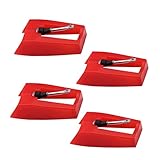
- 1: Ruby Ceramic Record player needle: Compatible with most record player in the markets now. like:Crosley,ION,Victrola,1byone,Jenson,Innovative-Technology, Boytone, TechPlay,Capehart and more
- 2: Easy to Install: No tools required, you can install the record needle easily by your hand. Plays 33 1/3, 45, 78PRM records player.
- 3.Upgraded Material: High-Grade ABS Plastic and Aluminum arm,With conical diamond Ceramic needle design for long playing life and great rendition of voice and music.
- 4: High Sound Quality: Strong tracking ability. Channel balance (at 1kHz): below 2 dB : Two-channel (stereo) , Step up cartridge, with an conical stylus, giving better bass response and greater realism.
- 5: Well Packed Turntable Needle Stylus: Protective form protect turntable needle from damaged ,Check your turntable cartridge first before order..
Confirm the exact stylus family
Do not buy by appearance alone. Read the cartridge body’s model marking, compare the manufacturer’s replacement-stylus designation and verify that the cantilever assembly physically matches. Some families allow an upgraded stylus on the same generator. Fluance, for example, states that its 2M Blue Stylus can be used on the same cartridge engine as the 2M Red. That compatibility statement applies to those named products; it should not be generalized to unrelated cartridges.
What installation involves
- Lower the tonearm lift and secure the arm so it cannot move.
- Remove the stylus guard if the replacement instructions require it, keeping the new tip protected.
- Pull the old stylus assembly straight out in the direction specified by the cartridge maker; do not twist the cantilever.
- Slide the replacement fully into the cartridge body and refit the guard.
- Reset tracking force and anti-skate to the cartridge manufacturer’s values, then play a clean record at moderate volume.
If the new stylus does not seat completely or the channel balance changes, stop playback and recheck the part number and fit rather than forcing the assembly.
Cartridge upgrade: larger change, more conditions
Check mechanical compatibility before buying
A cartridge is sensible only after you have measured or confirmed the tonearm’s requirements. Audur Audio recommends checking platter size, mat thickness, spindle dimensions, cartridge mounting method, tonearm geometry, tracking-force range and available adjustment range. Also check cartridge mass and the arm’s effective-mass range if the turntable maker provides it.
As one concrete example, Fluance lists compatible cartridges in a 5.0–7.5 gram range for its specified models. That range is not a universal standard: use the range published for your own arm and turntable. A cartridge that is too heavy, too light or outside the counterweight’s adjustment range can be impossible to balance correctly.
Rank #3
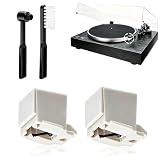
- 【Universal Compatibility: Fits 20+ Models & More】This ATN3600L replacement stylus is the OEM-compatible needle for AT3600L cartridges, fully matching Audio-Technica cartridges including AT3600, AT3600L, AT3601, AT3650, AT3651, and AT3626. It fits perfectly with Audio-Technica turntables such as the AT-LP60/60X series (AT-LP60, AT-LP60-USB, AT-LP60BT, AT-LP60X, AT-LP60XBT, AT-LP60XBT-USB), AT-LP2D series, AT-PL300 series, AT-SB727/AT-SB2022 Sound Burger portable turntables, and AT-LPGO-BT. For the AT-LP60X and Sound Burger series, this stylus is the manufacturer-recommended replacement for optimal performance and longevity
- 【Diamond Stylus for Exceptional Sound】Genuine conical diamond tip offers distortion-free sound and steady smooth playback. Compatible with Denon DP-300F/DP-450USB, Sony PS-LX310BT/PS-LX350H, Pioneer PL-2200, PL-J2500, PL-S30, PL-X500, PL-Z series, FiiO TT13, TEAC, Technics and Marantz turntables with 1/2" P-mount MM tonearm, 3.0-4.0g tracking force. Comes with 2 free cleaning brushes to prolong service life.
- 【Precise Tracking for 33&45 RPM Records】High-precision stylus accurately reads record grooves to reduce skipping and noise. Perfectly reproduces rich, original vinyl sound with clear details, ideal for replacing your old or worn needle.
- 【Tool-Free & Perfect Fit Installation】Plug-and-play design allows fast, tool-free installation—just align and press. This replacement stylus fits precisely and securely, greatly reducing issues caused by improper mounting.
- 【Standard Specification & Premium Listening Experience】 It features easy plug-and-play installation to replace worn original needle directly. Restoring original clear and warm vinyl sound details effectively, it owns long service life up to 300-500 hours. Cost-effective and durable, it is an ideal spare replacement part for daily vinyl playing.
Mounting standards and alignment
Determine whether your deck uses a standard half-inch mount, a fixed integrated cartridge or a proprietary headshell. A half-inch mount still requires correct overhang, offset angle and, where adjustable, azimuth and vertical tracking angle. Cartridge height matters because changing the body height alters the arm’s angle relative to the record.
Retain the original hardware and record the original alignment before removing anything. NAD’s 2020 setup instructions describe removing the old cartridge, connecting the four signal wires and using the supplied alignment tool. Follow the tool and the cartridge maker’s sequence rather than relying on a visual estimate.
Reset every operating parameter
- Balance the arm with the new cartridge installed, then set the counterweight to the specified tracking force.
- Set anti-skate according to the cartridge or tonearm guidance.
- Check overhang and offset with the supplied protractor or alignment gauge.
- Confirm channel wiring: left hot and return, right hot and return.
- Verify that the phono stage’s moving-magnet or moving-coil input matches the cartridge type and its loading requirements.
- Listen for equal channel output, clean inner-groove tracking and absence of hum before making tonal judgments.
A cartridge can deliver a broader sonic change than a stylus, but its benefit is lost if alignment or loading is wrong. If you cannot make the required adjustments, a compatible replacement stylus is the lower-risk choice.
PC Slower Than It Used to Be?
A free scan shows the junk files, broken settings and background clutter dragging Windows down - then fixes them in one click.Free scan · Windows 10 & 11Outdated Drivers Are Slowing You Down
One free scan finds every outdated or missing driver and matches the right update for your exact hardware.Free scan · exact hardware matchWill a platter mat or platter make a difference?
What a mat actually changes
A mat controls the interface between the record and platter. Its material and compliance can alter damping, static behavior and how securely the record sits. Pro-Ject’s catalog, for example, includes cork, cork-rubber and leather mats, as well as record pucks and sub-platter options. These are different mechanical solutions, not interchangeable universal upgrades.
Rank #4

- CHECK COMPATIBILITY BEFORE YOU BUY: Please match your cartridge to our listing images; this needle fits ceramic cartridges only and is NOT compatible with common Audio-Technica or other moving-magnet (MM) cartridges
- Universal Fit: Compatible with Crosley, Victrola and most turntable cartridge styles; snaps in securely within seconds
- 4-Pack Value: Budget-friendly record player needles replacement set; swap often without harming vinyl records; clear storage box keeps spares organized
- Fresh Sound: New ruby turntable stylus revives dull records; improves clarity; safe tracking force preserves vinyl record accessories for longer life
- Aluminum Cantilever: Precision lightweight center rod tracks grooves accurately; reduces skips; delivers cleaner highs on every vinyl record
Thickness is critical. A thicker mat raises the record and changes the tonearm’s vertical angle; a thinner one can lower it. Any change may require resetting tonearm height or rechecking tracking geometry. Measure the original mat and confirm the replacement’s thickness before installation.
When a platter change is justified
Consider a platter or sub-platter only when you can identify a mechanical reason: poor record contact, unsuitable damping, bearing-interface wear or a documented resonance problem. Confirm platter diameter, spindle dimensions, bearing fit, belt path and total mass. A heavier platter can change motor-start behavior and bearing load; it is not automatically an improvement.
If the turntable is already quiet, stable and correctly damped, changing the mat or platter may produce less benefit than replacing a worn stylus. Keep the original parts so you can reverse the change if arm height, speed or handling becomes worse.
Do these 3 things before closing this tab:
1Fix the driver behind crashes, sound loss and screen glitches2Clear out junk files and repair common Windows errors3Scan for outdated or missing drivers - takes under a minuteDo you need an external power supply?
Only for a compatible motor platform
An external supply is model-specific. Before connecting one, verify the exact voltage, polarity, connector size, current rating and whether the motor electronics are designed for an external source. An incorrect supply can damage the motor controller; a physically fitting plug is not proof of compatibility.
Best Value
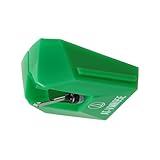
- REPLACEMENT STYLUS: For the AT-VM95E cartridge
- COMPATIBLE WITH: AT-LP120X Series, AT-LP3XBT, AT-LPW30, AT-LPW40, AT-LPW50, AT-LP5X, AT-LP8X
- INTERCHANGEABLE: Swap or upgrade any VM95 Series cartridge with any VM95 Series stylus
- EASY TO INSTALL: Simply snap the replacement stylus onto the cartridge
- 0.3 x 0.7 mil elliptical stylus with bonded shank construction
Vertere’s 2024 DG-X guide calls its LunA Dedicated DC Power Supply a “great first upgrade” for that turntable platform, then places isolation and cartridge or cabling changes later in its route. That recommendation is specific to the DG-X design. Pro-Ject’s catalog likewise lists High Power i power supplies for compatible DC turntables, not as a universal accessory.
Diagnose speed symptoms first
Use an approved supply when the manufacturer identifies it as a remedy for motor noise, electrical isolation or speed-control behavior. If speed wanders, first check belt condition, platter seating, bearing cleanliness, the selected speed setting and mains or motor faults. A power supply will not correct a stretched belt or a failing motor.
Choose by symptom, not by upgrade fashion
Distortion, sibilance or mistracking
Clean the record and stylus, verify tracking force and inspect the tip. If the stylus is worn and the cartridge body accepts a replacement, replace the stylus first. Move to a cartridge only after confirming alignment capability and arm compatibility.
Hum or buzz
Check grounding, cartridge lead connections, shielding, cable routing and the phono-stage input. Do not buy a mat or cartridge until the hum source is isolated. A new cartridge can have different output and grounding behavior, so it may mask rather than solve the wiring fault.
Skipping or intermittent channel loss
Check record damage, tracking force, stylus seating, headshell contacts and tonearm bearings. Skipping is a setup or mechanical fault until proven otherwise; a heavier platter is not a first-line fix.
Speed instability
Inspect the belt, pulley, platter fit and motor control, then consult the turntable maker about an approved supply. Confirm the motor architecture before considering any power accessory.
A practical buying workflow
- Write down the exact turntable, tonearm, cartridge and stylus model numbers.
- Describe the audible symptom and reproduce it with a clean, known-good record.
- Complete leveling, cleaning and tracking-force checks.
- If the stylus is worn, select the exact compatible replacement and keep the cartridge body.
- If you want a different cartridge, verify mounting, mass, geometry, tracking-force range, alignment tools and phono-stage loading.
- If considering a mat or platter, measure diameter, spindle and thickness and assess the bearing and motor limits.
- If considering a power supply, use only the turntable manufacturer’s specified voltage, connector and motor-platform option.
- Change one variable at a time and keep the original component so you can undo the change.
Bottom line for most listeners
Correct setup is the highest-value “upgrade.” After that, a compatible replacement stylus is usually the best first purchase because it restores performance with minimal risk. Choose a cartridge when you can support the required mass and alignment work and want a broader sonic change. Choose a mat or platter to solve a demonstrated interface or resonance issue, and choose an external power supply only when your turntable was designed for that exact accessory. Diagnose hum, skipping and speed instability before spending money on any of them.
Quick Recap
Product prices and availability are accurate as of the date/time indicated and are subject to change. Any price and availability information displayed on Amazon at the time of purchase will apply.

