
Recommended Free Tools
iTechGuides is reader-supported. When you buy through links on our site, we may earn an affiliate commission. As an Amazon Associate I earn from qualifying purchases. Learn more
The right choice depends on the job: use ObsPy or Pyrocko for seismological data workflows, SeisComP for seismic-network operations, OpenQuake for hazard and risk, OpenSees for structural or geotechnical response, seismicat for earthquake-catalog statistics, and FaultMod for specialist dynamic-rupture modelling. These tools solve different problems, so this guide compares them by fit rather than ranking them on speed or accuracy.
How should you choose a geophysics or seismic tool?
Start from the output you need, not from a general label such as “geophysics software.” A waveform-processing library, a real-time monitoring system, a hazard engine, a structural simulator, and a research code are not substitutes for one another. The official documentation reviewed for these seven tools does not provide a common benchmark for speed, accuracy, or adoption, so feature fit is the meaningful comparison.
| Tool | Best fit | Workflow form |
|---|---|---|
| ObsPy | Programmable seismological waveform and catalog processing | Python framework and library |
| Pyrocko | Seismological processing and analysis, including waveform and modelling workflows | Python toolbox, library, and standalone applications |
| SeisComP | Acquisition, real-time monitoring, and event workflows | Modular operations system with automatic and interactive workflows |
| OpenQuake Engine | Seismic hazard and risk calculations | Hazard and risk engine |
| OpenSees | Structural and geotechnical dynamic-response simulation | Simulation framework |
| USGS seismicat | Earthquake-catalog statistics | R package |
| USGS FaultMod | Three-dimensional spontaneous dynamic-rupture modelling | Finite-element research software |
Before committing, check the current project documentation for release, licence, supported platforms, dependencies, and installation instructions. The sources give different levels of detail on these points; “not stated” below means the cited pages do not establish a comparable value, not that a project lacks the feature.
Which tools handle seismological data and monitoring?
ObsPy: a programmable Python workflow
ObsPy is a strong fit when you want to build repeatable seismological workflows in Python. Its project README describes parsers for common seismological formats, clients for data centers, and signal-processing routines. That makes it suited to scripts and applications that bring waveform and catalog data into a common workflow; it is not presented as a complete seismic-network operations system. The project page identifies the licence as LGPL v3.0. See the ObsPy project README for the project’s stated scope and current project information.
#1 Best Overall
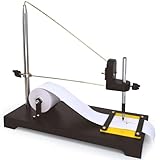
- SEISMOGRAPH MODEL || Demonstrates seismic waves in a classroom setting. Pull the paper strip manually while simulating movements like jumping or gently shaking the surface to record shock waves.
- ACTIVE DEMONSTRATION TOOL || Ideal for hands-on learning, students, educators and others will simulate the seismic activity to help understand earthquake wave generation and recording.
- INCLUDES ROLL OF PAPER || Comes with one roll of paper for recording wave patterns. A pencil or similar marking device is required but not included.
- EXPERTLY DESIGNED FOR EDUCATION || Developed by subject matter experts, this sturdy model is perfect for teaching geological and mathematical concepts.
- DURABLE AND VERSATILE || Built with high-quality materials for repeated use, making it ideal for classrooms, labs, and educational exhibits.
Choose it when your work benefits from code-driven processing and integration with Python. Your workflow still depends on having suitable input data and understanding the processing choices; the README’s feature list is not a substitute for checking the documentation for the formats, clients, and routines your project needs.
Pyrocko: a wider toolbox with standalone applications
Pyrocko combines a Python library with applications for different stages of seismological analysis. Its documented capabilities include waveform browsing and processing, archive management, Green’s-function calculations, ray theory, synthetic seismograms, and online catalog and FDSN access. Named applications include Snuffler, Cake, and Fomosto. That breadth makes Pyrocko worth considering when you want a toolbox that spans interactive exploration and programmable or modelling work, rather than a single-purpose waveform reader. The Pyrocko manual overview describes its components and capabilities.
Rank #2
![[BLE Vibration Sensor] WTVB01-BT50 Smart Vibration Module Ar-duino, 3-axis Vibration(Amplitude+Frequency+Displacement+Speed) Detector, Wireless Acceleration Shock Motor Monitor](https://m.media-amazon.com/images/I/41va7oLvGmL._SL160_.jpg)
- 【Integrated Vibration Sensor】Real-time capture of 3-axis vibration and temperature data: Vibration displacement (0~30000um) + Speed (0~50mm/s) + Amplitude (0~180°) + Operating temperature (-20°C~60°C). Vibration and shock omnidirectional measurements can prevent breakdowns and repair costs.
- 【BLE 5.0 Low Power】 50m transmission distance, approximately 8 hours battery life. Bluetooth 5.0 is compatible with Android/iOS systems. The WITMOTION APP supports connecting sensors on smartphones (up to 4 on the same phone). It can also be connected to a computer via TYPE-C, making it easy for users to choose the best connection.
- 【Easy Install & Use】The wireless design allows the sensors to be installed on machine parts that are difficult to access. A small and portable sensor designed with strap holes at both ends that can be used and go anywhere.
- 【Analysis Vibration Sensor System】Condition monitoring and vibration analysis are seamlessly integrated with WITMOTION PC software, making it quick and easy to analyze and visualize data. Maintenance teams can set it up as needed.
- 【Attitude Measurement More Accurate & Reliable】Sensors integrated R&D fusion algorithm, low noise level, and increasing measurement accuracy ensuring stable data output. WITMOTION has been focusing on the sensor field for 10 years, providing professional attitude measurement solutions globally.
Match the particular Pyrocko component to your task and consult its documentation for applicable data and model inputs. The overview establishes a broad feature set, but it does not give a uniform comparison of setup requirements across every application.
The Tool Desk
Outbyte Driver Updater FREEFix the driver behind crashes, sound loss and screen glitchesFind Drivers →Outbyte PC Repair FREEClear out junk files and repair common Windows errorsFree Scan →SeisComP: operations and event workflows
SeisComP is aimed at running seismic network workflows: its documentation covers acquisition, archiving, data exchange, quality control, real-time processing, event detection and location, magnitude calculation, focal mechanisms, and alerts. The documented system supports both automatic and interactive workflows. This is the relevant choice when the task involves operating a monitoring workflow, rather than only processing files after the fact.
Rank #3

- 【Faster Sampling Speed】FNIRSI DSO152 handheld oscilloscope has a real-time sampling rate of 2.5 MS/s and a 200 KHz bandwidth. The 10 x probe can measure up to 800 VPP, which is equivalent to 280 V AC. Voltages up to 400 V can be measured
- 【Professional Designed 】The DSO152 automotive oscilloscope supports full trigger modes(Auto/Normal/Single). Works perfectly for both periodic analog signals and aperiodic digital signals. 2.8'' HD LCD display screen, a resolution of 320*240, clear to observe
- 【Portable Oscilloscope】Pocket oscilloscope is an Assembled finished Machine, lightweight and easy to carry, it can be used directly to avoid assembling welding process problems. Applicable to the maintenance industry and R&D education industry
- 【Easy Measuring】Equipped with efficient one-key AUTO setting of all parameters, the measured waveform can be displayed without cumbersome adjustment. Long press the AUTO button to quickly calibrate the baseline,fast measurement of waveforms
- 【Longer Battery Life】FNIRSI DSO152 digital oscilloscope has a built-in 1000 mAh high-quality lithium battery, which can be used continuously for about 4 hours after being fully charged. Type-C interface supports data transmission and charging, firmware upgrade
The reviewed documentation is for SeisComP Release 7.4.0 and identifies AGPL licensing; check the SeisComP introduction and scope for current documentation and terms. Its documentation describes it as “likely the most widely distributed software package for real-time monitoring of earthquakes and other seismic events.” Treat that as the project documentation’s qualified characterization, not as an independently established market ranking.
Which tools are for hazard, risk, and engineering response?
OpenQuake Engine: hazard and risk calculations
OpenQuake Engine is the choice in this group for seismic hazard and risk calculation and decision support. The Global Earthquake Model Foundation’s manual identifies those as the engine’s purpose. It is not a waveform-processing package or a structural-response simulator, so use it when the question concerns hazard or risk rather than how a particular structure responds. The reviewed manual is version 3.26.2; consult the OpenQuake Engine documentation for current guidance and calculation workflows.
Rank #4
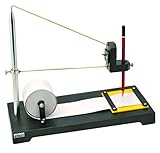
- Heavy Duty Construction: Premium seismograph demonstration model built with durable materials for long-lasting classroom use
- Educational Applications: Can be used to study both geological and mathematical phenomena in science education settings
- Writing Instrument Not Included: Any standard pencil or marking device of similar size may be used with this model
- Science Classroom Tool: Suitable for demonstrating seismic wave concepts and earthquake principles in educational environments
- Complete Demonstration Kit: Includes seismograph model and one roll of paper for conducting hands-on experiments and visual demonstrations
Hazard and risk calculations require appropriate inputs and modelling choices for the question being asked. The manual is the place to verify the relevant model, data, and workflow requirements; the version number above identifies the reviewed manual, not a promise that it remains the latest release.
Crashes, No Sound, or Screen Glitches?
Random freezes, missing sound and display glitches usually trace back to one bad driver. Find and replace yours safely.Free scan · under a minutePC Slower Than It Used to Be?
A free scan shows the junk files, broken settings and background clutter dragging Windows down - then fixes them in one click.Free scan · Windows 10 & 11OpenSees: structural and geotechnical simulation
OpenSees is an open-source framework for simulating the dynamic response of structural and geotechnical systems. Its command manual covers model generation, analysis, and recorded output. It therefore fits work where the object of interest is the response of a modelled system, rather than regional hazard calculations or seismic event monitoring. Start with the OpenSees documentation for modelling and analysis details.
Best Value
![[Bluetooth 5.0 Accelerometer+Inclinometer] WT901BLECL MPU9250 High-Precision 9-axis Gyroscope+Angle(XY 0.2° Accuracy)+Magnetometer Compass with Kalman Filter, Low-Power 3-axis AHRS IMU Tilt Sensor](https://m.media-amazon.com/images/I/41f5FfeSQiL._SL160_.jpg)
- 【Precision Sensor Suite】The sensor features a high-precision 3-axis XYZ(Pitch Roll Yaw) accelerometer, gyroscope, and magnetometer, providing a comprehensive and reliable solution for motion and orientation detection in robotics, gaming controllers, motion detection systems, VR, and etc.
- 【Advanced Algorithm Filter】10-year Professional Attitude Measuring Solution Provider, sensors integrated R&D dynamic fusion algorithm and Kalman Filtering ensuring stable data output and excellent bias stability, low noise level, increasing measurement accuracy. Featured a high-performance Cortex-M4 core processor operating at up to 168MHz, it balances power efficiency with performance.
- 【BLE Compatibility】Low consumption Bluetooth 5.0 (battery life about 10 hours), one-click connectivity to WitMotion App/PC for real-time monitoring, and sample codes for C++, Python, Unity, Android, and iOS to streamline development.
- 【 Powerful PC software/App provides】Real-time data monitor(Dashboard/graph/raw data); Data Storage & Exporting(Excel/csv/txt); Multiple configuration(calibration, angle setting, return rate);
- 【 What You Get 】1*WT901BLECL BLE 5.0 sensor Type-C interface, 1*Type-C Data & Charging Cable, 1 x Welcome Guide. (Adapter is not included. Required to purchase BLE adapter *B07ZGG9KY9 for computer connection.)
The Berkeley project page reports binary version 3.8.0 in February 2026. That is a dated version report, not a claim about the newest build available today. Check the OpenSees project home page and documentation for current binaries and installation information. The reviewed pages do not state a comparable licence value here.
Independent reader supportYour contribution helps us test, update, and keep practical guides available for everyone.Which choices are specialist research tools?
USGS seismicat: earthquake-catalog statistics
seismicat is an R package for analyzing earthquake catalogs to estimate Gutenberg–Richter b-values and earthquake rates, including uncertainty. It is a focused option for catalog-statistics work, not a general waveform-processing environment. The USGS catalog listing is dated January 23, 2026. Find it through the U.S. Geological Survey’s Earthquake Hazards software catalog, and verify its current listing and instructions before using it.
USGS FaultMod: dynamic rupture modelling
FaultMod is specialist finite-element software for spontaneous dynamic-rupture models. The USGS catalog description notes flexibility in fault geometry and friction laws. It belongs in a research workflow built around dynamic rupture modelling, not as a general-purpose geophysics application for beginners. The USGS listing is dated June 29, 2026; check the USGS software catalog for the listing and any linked project materials.
Do these 3 things before closing this tab:
1Repair Windows errors before they cause bigger problems2Fix the driver behind crashes, sound loss and screen glitches3Clear out junk files and repair common Windows errorsWhat should you verify before installing?
- Confirm the task match. Decide whether you need data processing, network operations, hazard or risk calculations, response simulation, catalog statistics, or rupture modelling.
- Check input and model requirements. Identify the waveform, catalog, network, earth-model, or structural-model inputs your work requires, then confirm the relevant project manual supports your planned workflow.
- Check licence and dependencies. Licence terms and software dependencies can affect research, redistribution, deployment, and collaboration. Use the project’s current official documentation rather than assuming all open-source licences or installation paths are alike.
- Verify release currency and platform support. Version evidence in this guide is tied to the dated pages noted above; release status and supported platforms can change.
The seven tools are a selected set, not an exhaustive directory. The USGS says its displayed software is a subset of downloadable earthquake research software and points readers to USGS GitHub for a comprehensive listing. Its catalog showed 72 items when crawled, a changeable catalog count rather than a count of directly comparable tools. See the USGS Earthquake Hazards software page for its current catalog links.
Quick Recap
Product prices and availability are accurate as of the date/time indicated and are subject to change. Any price and availability information displayed on Amazon at the time of purchase will apply.

