
iTechGuides is reader-supported. When you buy through links on our site, we may earn an affiliate commission. As an Amazon Associate I earn from qualifying purchases. Learn more
Seafood currently has the strongest PFAS detection signal in U.S. Food and Drug Administration (FDA) monitoring, but the evidence does not support a complete ranking of every food. FDA detected at least one PFAS in 46 of 67 seafood samples in its Total Diet Study and 60 of 81 samples in a targeted 2022 seafood survey. Most foods in the broader study had no PFAS detected above the method-detection limit. Those results describe sampled products, not every brand, harvest area, season or serving.
The most specific food concern was PFOA in some imported canned clams from China linked to particular processors. That finding should not be generalized to all clams or all seafood. For recreationally caught fish and shellfish, the most useful action is to follow the applicable state consumption advisory. No official source establishes a universal list of “low-PFAS” foods or proves that a consumer product removes PFAS already present in food.
What the FDA’s food testing actually shows
FDA’s Questions and Answers on PFAS in Food describes food exposure as an emerging area of science. The agency has tested more than 1,900 foods from the U.S. market, using methods that can measure as many as 30 PFAS in different food categories. Its December 19, 2025 update reports results across bread and grains, fruits and vegetables, meat, eggs, dairy and seafood.
The clearest pattern is that seafood produced more detections than other categories in the available FDA samples. It is a monitoring signal, not a probability that applies to every seafood purchase.
#1 Best Overall
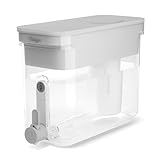
- 5-stage advanced water filter dispenser: Our filter’s 5-Stage Advanced Water Filtration technology removes 99.9% of dissolved solids – guaranteed.
- Certified to reduce lead and Total PFAS: Our water filter dispenser is certified by IAPMO to reduce Total PFAS (also known as forever chemicals), lead, chlorine, mercury and many other harmful contaminants.
- Powerful filtration for total confidence: Each water filter dispenser is equipped with a powerful Culligan with ZeroWater Technology filter, certified to reduce 5x more contaminants than the leading filter.
- Includes TDS water tester: Our built-in TDS meter measures the level of dissolved solids in your water instantly and alerts you when it’s time to change your filter. When the meter reads 0, that means your filter is removing virtually all TDS from your water.
- Space-saving design: Our BPA-free pour-through filtered water pitchers and water dispensers fit easily into refrigerators or stand elegantly on your countertop, saving you space without sacrificing style.
| FDA sample set | Result | What the result means |
|---|---|---|
| Total Diet Study, all fresh and processed foods | 1,290 of 1,352 samples (more than 95%) had no PFAS detected above the method-detection limit | Most sampled foods were nondetects under that analytical method; a nondetect does not prove absolute zero PFAS. |
| Total Diet Study, seafood | 46 of 67 samples (69%) had one or more PFAS detected | Seafood had frequent detections in this broad study, but the sample count was limited. |
| Targeted 2022 seafood survey | 60 of 81 samples (74%) had one or more PFAS detected | A targeted survey is designed to investigate a category and cannot be read as a market-wide prevalence estimate. |
| Additional processed-clam testing | 12 of 12 samples from two processors associated with the highest levels had at least one PFAS; PFOA was detected in all 12 | This was a focused follow-up to the clam finding, not a test of every clam processor or origin. |
FDA says seafood may face greater risk of environmental PFAS contamination than other food types, while also emphasizing that its seafood data are limited. Environmental contamination does not guarantee that a food will contain a detectable amount: uptake varies with the particular PFAS, the food, the animal or plant’s environment and other factors.
“Although it is well documented that PFAS are present throughout the environment, PFAS exposure from food is an emerging area of science and there remains much we do not yet know about which types of foods are more likely to contain PFAS.” — FDA, Questions and Answers on PFAS in Food
Why seafood leads the detection signal without proving that all seafood is unsafe
PFAS are persistent environmental chemicals that can move through contaminated water, soil and sediment. Fish and shellfish can be exposed in those environments, so a seafood sample can reflect local conditions in ways that a nationally distributed food may not. That helps explain why seafood appears more often among FDA detections, but it does not identify a single contamination level for a species, country or package format.
Several limitations matter when interpreting the percentages:
- Individual foods were sampled in limited numbers. A small set cannot represent every producer, harvest location, season, size of fish or processing line.
- Targeted and general-market studies answer different questions. The Total Diet Study samples commonly consumed foods broadly; a targeted seafood survey deliberately concentrates on a category of interest.
- PFAS are a family of chemicals. A result for one compound does not describe all PFAS, and different compounds behave differently in the environment and in food.
- FDA’s current assessment treats PFAS individually. The agency says it does not yet account for possible additive effects when several chemicals occur together.
For these reasons, “seafood had the most detections” is a more accurate conclusion than “seafood is the most contaminated food” or “all seafood should be avoided.”
Rank #2

- Removes 20X more contaminants than a traditional pitcher. Third-party tested to filter lead, chlorine, microplastics, PFOA, PFOS, and more contaminants other filters miss.
- Keeps good minerals in. Other filters strip out minerals. Aquagear targets nasty contaminants without removing healthy minerals like calcium and magnesium.
- Last 3X longer. Each Aquagear filter lasts 120 gallons—three times longer than most standard filters.
- Filter recycling included. Never throw another water filter in the trash again. We send you a postage-paid label so you can return your filter for recycling and keep it out of the landfill.
- Filter Media Made in USA. The Aquagear filter media is made in an ISO 9000 facility.
The specific canned-clam concern
FDA’s 2022 seafood survey identified PFOA exposure from some imported canned clams from China as potentially a health concern. Recalls followed. In additional testing of 12 samples from the two processors associated with the highest levels, PFOA was detected in every sample. The finding is important because it connects a particular contaminant to a defined product subset and led to regulatory action.
It does not establish that every canned clam, every clam harvested in China or every seafood product contains concerning PFOA. It also does not justify treating fresh clams, shellfish from other origins or unrelated fish species as equivalent. When evaluating a clam product, check the current FDA information and recall notices for the exact product, processor and lot rather than relying on the word “clam” alone. FDA’s analytical results are published on its PFAS food-testing results page.
How to choose lower-exposure options in practice
1. Start with the advisory for recreationally caught seafood
For fish or shellfish caught by you, a friend or a local charter, location-specific advice is more useful than a national list. FDA recommends checking the relevant state fish and shellfish consumption advisory. State agencies can incorporate information about a particular waterway, species and contaminant that a national food survey cannot capture. Use the advisory before deciding whether to eat the catch, which species to keep and how often to consume it.
- Identify the exact waterbody or coastal area where the seafood was caught.
- Identify the species and whether it is fish, crab, clam, mussel or another shellfish.
- Find the current state fish or shellfish consumption advisory for that location.
- Follow the advisory’s serving and frequency limits, including any advice for children, pregnant people or people who fish frequently.
- If no advisory is available, contact the state health or environmental agency rather than assuming the catch is PFAS-free.
This approach also covers other contaminants that may be present in local waters. An advisory is a location-specific risk-management tool, not proof that every commercial product of the same species has the same exposure.
2. Treat commercial seafood as a product with an origin, not as one uniform category
For seafood sold in stores or restaurants, use the origin and processor information available on the label or from the seller. The canned-clam investigation shows why a specific origin and processor can matter. If a product matches an FDA recall or safety notice, do not consume it and follow the notice’s instructions.
Rank #3

- UNBEATABLE FILTER VALUE: Dollar for dollar nothing compares to performance and value of the UC-200 with an unbeatable 5 year filtration life. Other Under the sink filters last just 6 months, making them exceedingly expensive in comparison to UC-200
- 3-STAGE FILTRATION: Using a precise blend of Micro Sediment Membranes, KDF-55 and Coconut Shell Carbon, delivering clean, crisp water. The UC-200 purifies without removing beneficial minerals from drinking water
- INLINE FILTER SIMPLE DIY: Designed for direct connect for kitchen or bathroom sink with minimal space. No drilling required, all installation parts included. How to Install Video Tutorial Instructions Available
- EFFECTIVE FILTRATION: Independently tested & approved to reduce harmful impurities like PFAs, PFOA/PFOS, Lead, and Chlorine from kitchen or bathroom faucet tap water. NSF/ANSI 42 certified components/material deliver noticably improved water quality
- AFTER-SALE COMMITMENT: CuZn's backs the UC-200 quality and high filtration performance. Should any issues arise, we advise you contact CuZn support for swift response. NOTE: does not reduce TDS, which can only be performed by reverse osmosis
Beyond that narrow finding, the available FDA data do not establish a reliable ranking such as “frozen is safer than canned,” “farmed is safer than wild” or “one species is always low in PFAS.” Do not convert a packaging format, production method or country name into a guarantee that the product contains no PFAS.
Windows Errors? Fix Them Before They Spread
Repair common Windows errors and clear accumulated junk for a smoother, more stable PC - no reinstall needed.Free scan · no reinstallCrashes, No Sound, or Screen Glitches?
Random freezes, missing sound and display glitches usually trace back to one bad driver. Find and replace yours safely.Free scan · under a minute3. Do not infer a “PFAS-free” list from nondetections
FDA’s broad study found no PFAS above the method-detection limit in more than 95% of tested fresh and processed foods. That is reassuring about the sampled products, but it is not a certification for every item in a category. A nondetect can mean the concentration was below the method’s detection capability; it does not demonstrate that the food contained exactly zero PFAS.
Accordingly, labels such as “produce,” “dairy,” “meat” or “grain” should not be presented as universally lower-PFAS choices. FDA says sample counts for individual foods remain limited and that uptake differs by PFAS and food type. A practical response is to maintain a varied diet and use official advisories for seafood rather than eliminating an entire food group based on a limited data set.
4. Use recalls and official updates for unusual or specific concerns
When FDA identifies a product-specific problem, the actionable information is the product description, processor, country of origin and recall status. Check the agency’s food-testing and safety pages for updates instead of relying on social-media lists that may merge unrelated findings. FDA’s December 2025 update is available in its PFAS results bulletin.
What a PFAS detection does—and does not—tell you about health risk
A laboratory detection means an analytical method found a PFAS at or above its reporting capability. It is not, by itself, a conclusion that eating the food will cause harm. FDA evaluates detected concentrations against toxicological reference values and exposure assumptions. The agency reports that most detections in its tested seafood were not considered likely health concerns; the described canned-clam PFOA finding was the notable exception.
Do these 3 things before closing this tab:
1Fix the driver behind crashes, sound loss and screen glitches2Clear out junk files and repair common Windows errors3Scan for outdated or missing drivers - takes under a minuteRank #4

- Less than $25.99 per replacement filter WD-RF10(Search " B085G66JTZ "on Amazon), save over 50% of cost on subsequent use.
- [After Sales Assistance] Waterdrop Backs the WD-10UA's high-end technical performance with a comprehensive prorated performance service; should a quality issue arise with the filter, you can contact us. It is specifically designed for municipal tap water and can only be used with cold water sources. It is not suitable for well water or hot water.
- [Innovative Design] Only a cold-water source should be used to power the filter. Its twist-and-lock construction and push-to-connect fittings enable installation in three minutes, three second replacement, and safety-assuring integration. This filter comes with a 3/8" line that connects directly to US sinks' standard 3/8" feed water valves. The system is connected to 1/2" and 3/8" cold water pipes and faucets with the use of the 3/8"-1/2" convertor fitting.
- [Solve Clogging Problem] By upgrading the filtration area, our filter now provides a 20X increase in dirt adhesion area, enhancing filtration capability while minimizing the risk of clogging.
- [Filter Replacement and Long Lifespan] This system may be upgraded with a UF or a MZ filter to meet your water needs. It is compatible with several filters with various functions. Each system has a maximum service life of 12 months when used with municipal water, which is sufficient to cover the needs of an entire household. Before going on vacation, please Put the filters in separate sealed plastic bags, and store the bags in your refrigerator (NOT the freezer) to keep it fresh in 30 days.
Risk depends on the compound, concentration, serving size, frequency of consumption and the person’s overall exposure. A single result cannot be turned into a universal “safe serving” for every person without the underlying product and exposure details. Conversely, a nondetect does not prove that repeated consumption of every similar product carries no exposure.
PFAS exposure also comes from routes other than food. The U.S. Environmental Protection Agency lists contaminated drinking water and other environmental sources alongside food as possible pathways in its overview of PFAS health and environmental risks. Food-selection advice should therefore not imply that diet is the only, or necessarily the dominant, route for a particular individual.
Independent reader supportYour contribution helps us test, update, and keep practical guides available for everyone.Why a water filter or cookware change is not an answer to PFAS in food
The sources above do not establish that a household water filter, cookware item, food-storage container or consumer food-test kit reliably reduces PFAS already present in food. A filter may be relevant to drinking-water exposure if it is specifically certified and maintained for the contaminants of concern, but that is a separate question from selecting seafood or other foods.
Likewise, the available evidence here does not show that rinsing, freezing, reheating or a particular cooking vessel removes PFAS from a contaminated food. Do not promise a preparation technique as a substitute for an advisory, a recall check or choosing a different product.
Free tools Windows power users keep installed
One-click scans. No signup required.
How FDA testing and detection limits affect the numbers
FDA’s testing programs use analytical methods that cover different sets of PFAS in different foods. The agency may report a result as detected when it is above the method-detection limit and as not detected when it is below that threshold. The threshold is a property of the method and sample analysis, not a biological definition of zero.
Best Value
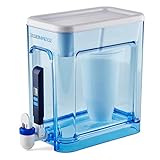
- Filtered Water Dispenser: The 22 Cup 5-stage Ready-Read Water Filter Dispenser has an integrated TDS Meter to instantly check the levels of dissolved solids before dispensing or pouring water - always know when it is time to change your filter! Change filter when meter reads 006.
- 5-Stage Filtration: Removes virtually all total dissolved solids (TDS) for the purest tasting water; Total Dissolved Solids are organic and inorganic materials, such as metals, minerals, salts, and ions dissolved in water.
- IAPMO certified and BPA free: The filter is IAPMO certified to reduce PFOA/PFOS, lead, chromium and mercury. All material is BPA free
- Including: 22-cup Ready-Read Filter Water Dispenser, 1 ZeroWater 5-Stage Filter with Ion Exchange Technology and a Free TDS Meter.
- Eco-Friendly: Save up to 110 single-use plastic bottles per filter or up to 660 bottles a year while enjoying the purest tasting water
The studies also have different designs. A broad diet study is useful for seeing which foods appeared among detections in commonly purchased samples. A targeted survey can investigate a concern in greater detail but may intentionally select products, regions or categories that are not representative of the entire market. Comparing the 69% seafood detection rate in the Total Diet Study with the 74% rate in the targeted 2022 survey without noting those designs would overstate what the percentages prove.
FDA continues to expand testing. Its current public information describes more than 1,900 food samples and methods that can measure up to 30 PFAS across multiple categories. More data may refine which products deserve attention, but the present evidence does not support a permanent, universal ranking.
A practical lower-exposure checklist
- For recreational fish or shellfish, look up the current state advisory for the exact waterbody and species before eating the catch.
- When buying canned clams, check FDA notices for the product’s origin, processor and lot; do not generalize the specific China-linked investigation to all clams.
- Use official FDA updates for product-specific findings and recalls.
- Interpret “not detected” as below a method’s reporting capability, not as proof of zero PFAS.
- Avoid calling any broad food category PFAS-free when the available samples are limited.
- Do not assume that fresh, frozen, canned, farmed or wild automatically means lower exposure; the reviewed evidence does not establish those rankings.
- Keep food exposure in context with drinking-water and environmental pathways.
- Do not buy a food product or preparation device on the promise that it removes PFAS unless reliable, product-specific evidence supports that claim.
What consumers should expect next
The most defensible current answer is provisional: seafood is the food category in which FDA monitoring most often found detectable PFAS, while most tested foods overall were nondetects above the method limit. The agency is still building a larger evidence base, and its own assessment notes uncertainty about co-occurring PFAS and limited samples for individual foods.
Quick wins for a faster PC:
Scan for outdated or missing drivers - takes under a minuteDriver Scan →Repair Windows errors before they cause bigger problemsFix Now →That uncertainty does not leave consumers without options. Follow local advisories for recreational seafood, pay attention to narrowly defined recalls and product notices, and avoid turning limited nondetections or one contaminated product into a claim about an entire food group. Those steps reduce avoidable exposure without asserting a certainty that current testing cannot provide.
Quick Recap
Product prices and availability are accurate as of the date/time indicated and are subject to change. Any price and availability information displayed on Amazon at the time of purchase will apply.

