
The Tool Desk
Outbyte PC Repair FREERepair Windows errors before they cause bigger problemsFix Now →Outbyte Driver Updater FREEScan for outdated or missing drivers - takes under a minuteDriver Scan →iTechGuides is reader-supported. When you buy through links on our site, we may earn an affiliate commission. As an Amazon Associate I earn from qualifying purchases. Learn more
AI can help teams find promising materials, generate packaging concepts, understand consumer preferences and choose better-sized shipping packages. It does not make a package sustainable, safe, cheaper or more appealing by itself: each result still needs engineering, lifecycle, market and user validation.
What AI can do across the packaging lifecycle
Packaging decisions link material science, product protection, manufacturing, shipping and the customer’s experience. AI can help teams analyze information and explore options across those stages, but it is best treated as decision support—not as an automatic packaging designer or sustainability certification.

| Packaging task | How AI can help | What people still need to verify |
|---|---|---|
| Material discovery | Screen candidate chemistries or predict properties such as barrier performance. | Actual performance, safety, manufacturability, cost, recyclability and lifecycle impact. |
| Design and consumer insight | Analyze text, images, surveys and sales data; generate or adapt design directions. | Whether the data reflects the target market and whether a concept can be produced and used as intended. |
| Shipping and fulfillment | Match package formats and sizes to products and orders, potentially reducing empty space. | Damage rates, total material use, handling needs and performance in the distribution network. |
| Degradation modelling | Help predict how candidate materials may break down under specified conditions. | Measured degradation, product safety, shelf life and the disposal conditions available where the package is sold. |
These applications solve different problems. A material that performs well as a barrier may not be easy to recycle in a given market; a smaller shipping box may not be suitable if it increases product damage. Teams should evaluate the whole package and its product system rather than optimize one metric in isolation.
What’s actually slowing this PC down?
Pick the symptom - the matching free tool is one click away.
How can AI help design sustainable packaging?
AI can broaden the set of options a team considers. In materials work, models can search or rank candidates against desired properties. In design work, machine-learning and language tools can analyze consumer comments, survey responses, images and sales information to surface patterns that designers may want to investigate. Generative tools can then help produce concept variations or suggest materials for further review.
#1 Best Overall

- Whether you’re packing, moving, shipping, or storing, these kraft paper sheets safeguard items and fill space to prevent damage during transit. Ideal for manual or paper crumpling machine use
- Elementree packing paper is the perfect eco-friendly alternative to plastic bubble wrap, plastic air pillows, polystyrene foam, and packing peanuts – protecting both your items and the Earth
- This USA-made void fill is developed from 100% post-consumer recycled paper that is thicker than newsprint. It is recyclable, supporting an eco-friendly product lifecycle
- Includes 1500 sheets (1375 ft) of durable 14.5" x 11" brown shipping paper; continuous 11" perforations are engineered for clean and easy controlled tearing; flexible protection any way you fold it
- The fanfold design of this packaging paper delivers the same amount of material as bulky bubble wrap and kraft paper rolls in a more compact, stackable form for easier storage and handling
Material discovery is screening, not a ready-to-use material
Nestlé and IBM Research described a generative AI tool in a July 3, 2025 announcement. It combines a knowledge base of known materials and a chemical language model with a regression transformer that relates molecular features to physical and chemical properties. The work aims to identify high-barrier packaging candidates that protect against moisture, temperature changes and oxygen. Nestlé said future applications would also consider cost, recyclability and functionality.
This is a research and development pathway, not evidence that a new material is commercially available, safe for a particular product, recyclable in local systems or lower-impact over its lifecycle. A candidate must still be made and tested under relevant conditions, including product protection, food or product safety, production constraints and end-of-life outcomes.
Design tools can turn consumer data into hypotheses
Berry Global’s June 2024 white paper describes possible uses including natural-language processing, machine learning, image analysis, predictive analytics, automated design generation, material suggestions and trend monitoring. These are supplier-described capabilities, not independent proof that AI-generated designs improve sales or sustainability. The paper also emphasizes that people must ask targeted questions and translate insights into feasible designs.
Recommended Free Tools
Rank #2
Consumer research needs careful framing: a model can identify a pattern in the data it receives, but cannot establish that the pattern applies to every audience or explain its cause without further investigation. Validate concepts with the intended users and test production feasibility before treating a generated design as a packaging solution.
How can AI reduce packaging waste and shipping cost?
In fulfillment, the opportunity is to select a package that fits the product and the shipment while still protecting what is inside. Machine-learning models can consider product and order information when choosing a format or size. Amazon reports using machine learning to make package choices, including for multi-item orders, with the goal of reducing empty space while maintaining damage-free delivery.
Amazon’s packaging page reports 5.4 million metric tons of packaging materials avoided in North America and Europe since 2015. It also reports 28 million unique products certified for its Ships in Product Packaging program globally, and says 11% of its packages worldwide shipped without additional Amazon packaging in 2025. These are company-reported figures with different scopes and timeframes; none establishes how much AI alone caused the reported results.
Rank #3
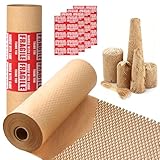
- Eco-Friendly & Biodegradable Material:Made from 100% recycled biodegradable packing paper, this honeycomb packing paper is recyclable and easily degradable. It’s an innovative alternative to traditional bubble wrap, packaging fillers, and shipping/moving packing paper sheets.
- Superior Cushioning & All-Around Protection:Moving paper honeycomb structure, providing 360° full protection for your items. It offers effective protection for shipping boxes, moving supplies,gift wrapping paper, electronic products, and packaging supplies for small businesses.
- Space-Saving Design & High Extensibility:Measuring 12" x 200ft, the honeycomb wrapping paper is compact when unexpanded, saving valuable storage and transportation space. Its natural kraft paper finish makes it ideal for small business packaging supplies and everyday wrapping & packing.
- Easy-to-Tear & Versatile Packaging:No tools needed! Tear off the exact length by hand to fit carton gaps perfectly—eliminating cutting waste and insufficient filling, so every inch of material is fully utilized. This honeycomb wrap is incredibly flexible,simply tear, wrap, or stuff it into spaces. It's high tensile strength allows it to conform to the shape of any irregular items effortlessly.
- Valuable Free Gifts for Double Protection:Every purchase includes 1 roll of hemp rope and 4 large "Fragile" labels as free gifts. More than just add-ons, this is a complete professional packaging solution.
Right-sizing may reduce material use and shipping volume, but a cost case should include more than box dimensions. Compare total packaging and fulfillment costs with damage, returns, labor, storage, equipment changes and customer experience. A package that saves material but increases breakage may worsen both cost and environmental impact.
How can packaging be made recyclable without compromising product protection?
Start with the product’s actual protection needs, then assess material choices against the collection and processing systems in the places where the package will be sold. A label such as “bio-based,” “biodegradable” or “recyclable” does not, by itself, establish the package’s end-of-life outcome. Material composition, local collection access and the conditions required for processing all matter.
The European Commission’s CORDIS record for the E-OILÉ project describes work on biodegradable packaging for single-use oily food and cosmetic products. Its objectives include biopolyester- and polysaccharide-based materials, improved barrier and mechanical performance, validation of performance, shelf life, safety and sustainability, and AI or advanced modelling to predict degradation. These are project goals and planned validation—not proof that the materials have passed those tests or can be disposed of in every local system.
Rank #4

- INNOVATIVE CUSHIONING MATERIAL, BOX FILLER: The only authentic, 100% ORIGINAL HexaFil honeycomb packing paper. Proudly made in the US. Brown color. Size: 43 lbs kraft paper roll, 15-inch wide and 1700 feet long when expanded, in a self-dispensed box made from recyclable cardboard
- THE ONLY PROVEN SLIT PAPER TECHNOLOGY: The HexaFil produced by the slit paper technology was developed over 30 years ago. Five years ago, the technology was improved, and a new interlocking design system was added to create even better packing material with extra cushioning. The newly engineered hexagonal cells allow the honeycomb wrapping to expand as you pull, creating a high-performance void filling material. The achieved three-dimensional cushioning product (paper) replaces traditional plastic, bubble, and other paper-based packaging products in terms of properties and efficiency
- USED BY THE USA’S LEADING RETAILERS: Do not risk the integrity of the package, choose the proven one to get the expected protection for your products. We offer a smart solution from the leader in sustainable packaging. Approved by leading e-commerce retailers
- PERFECT FOR GLASSWARE, CERAMICS, AND ALL FRAGILES: The most reliable and effective box filler for fixing products inside to eliminate movement. Great for shipping, moving and storing any fragile items such as glassware, electronics, perfumes, ceramics, paintings, toys, etc. It is easily hand torn, no scissors or knives are needed
- ECO-CONSCIOUS ALTERNATIVE TO ALL PLASTIC PACKAGING WRAPS: For the longest time, you’ve had to use bubble plastic wraps, air pillows, or peanuts to protect your valuables during shipping. Now we present the revolutionary and sustainable alternative to all plastic void fillers and wraps. HexaFil is the most popular option that provides efficient void filling in the box, and HexcelWrap is perfect material for your products' packaging and wrapping
For a candidate package, test the complete product-packaging combination. Check whether it preserves quality for the required shelf life, withstands transport and use, meets applicable safety requirements, and has a verified end-of-life route in the intended market. Keep the test conditions and geography attached to any sustainability claim.
Independent reader supportYour contribution helps us test, update, and keep practical guides available for everyone.How can packaging design influence consumer decisions?
For customers, engagement is most credible when it comes from a benefit they can experience: protection, ease of opening, reclosability, portability, convenient storage or clear disposal instructions. Personalization can help when it serves a real need, but visual novelty or a sustainability claim alone does not demonstrate consumer value.
Berry Global’s 2024 white paper cites an Ipsos 2018 survey in which 72% of surveyed Americans agreed that packaging design influences their purchasing decisions. This is an older, US-specific survey figure cited by a supplier-authored paper; it is neither a current measure of all consumers nor evidence that AI caused purchase behavior.
Best Value

- Whether you’re packing, moving, shipping, or storing, these kraft paper sheets safeguard items and fill space to prevent damage during transit. Ideal for manual or paper crumpling machine use
- Elementree packing paper is the perfect eco-friendly alternative to plastic bubble wrap, plastic air pillows, polystyrene foam, and packing peanuts – protecting both your items and the Earth
- This USA-made void fill is developed from 100% post-consumer recycled paper that is thicker than newsprint. It is recyclable, supporting an eco-friendly product lifecycle
- Includes 250 sheets (229 ft) of durable 14.5" x 11" brown shipping paper; continuous 11" perforations ensure clean tears every time; flexible protection any way you fold it
- The fanfold design of this packaging paper delivers the same amount of material as bulky bubble wrap and kraft paper rolls in a more compact, stackable form for easier storage and handling
PepsiCo Design’s Doritos STAX case illustrates a practical packaging experience rather than an AI application: it describes a durable, reclosable paperboard canister intended to be convenient and widely recyclable in the paper waste stream. The case reports that Kantar ranked it among the top 10 FMCG launches of 2020 and number one for category incremental sales within that group. That reported ranking does not establish that AI drove the design or that the package is recyclable in every local system.
How to assess whether an AI packaging project is worth pursuing
Define the decision the model should support before choosing a tool. For example, a team might want to rank materials for barrier testing, identify patterns in consumer feedback, or reduce shipping-package mismatch. Establish a baseline and success measures that include trade-offs, not just the metric the model is designed to optimize.
- Set the product and market requirements. Record protection and shelf-life needs, safety requirements, sales markets, production limits and the relevant disposal routes.
- Choose measurable targets. Track material use and total cost alongside damage, usability, recyclability in target markets and implementation effort.
- Check the input data. Confirm that product, order or consumer data is relevant, sufficiently complete and representative of the decisions being made.
- Use AI to prioritize options. Treat model outputs as candidate rankings, patterns or concepts—not as test results or approval to launch.
- Test with specialists and users. Run the appropriate material, safety, engineering, production and consumer checks before adoption.
- Monitor the live result. Compare outcomes with the baseline over time, including unintended effects such as more damage, difficult disposal or added production complexity.
The Consumer Goods Forum and Bain & Company’s January 2026 report summary attributes three industry figures to its work: 30% of companies already leverage AI across the packaging lifecycle, 70% see the greatest potential for AI in packaging design, and 40% say AI can help map where and why material loss occurs. The figures come from different questions and do not demonstrate achieved savings or environmental outcomes; they are best read as reported adoption and expectations, not as a forecast of what an individual company will achieve.
Free tools Windows power users keep installed
One-click scans. No signup required.
Quick Recap
What AI cannot establish on its own
- That a material is sustainable: This depends on its production, performance, product-protection effects, collection infrastructure and end-of-life conditions.
- That a design is safe or manufacturable: Generated ideas and predicted properties need appropriate engineering and safety validation.
- That a package will engage consumers: Data analysis can suggest preferences, but intended users need to evaluate real concepts and use cases.
- That a project will save money: Cost depends on the baseline, scale, production changes, shipping, damage and other costs. The cited examples do not establish a universal ROI or fixed saving from AI.
Product prices and availability are accurate as of the date/time indicated and are subject to change. Any price and availability information displayed on Amazon at the time of purchase will apply.

