
Quick wins for a faster PC:
Fix the driver behind crashes, sound loss and screen glitchesFind Drivers →Clear out junk files and repair common Windows errorsFree Scan →Scan for outdated or missing drivers - takes under a minuteDriver Scan →iTechGuides is reader-supported. When you buy through links on our site, we may earn an affiliate commission. As an Amazon Associate I earn from qualifying purchases. Learn more
Treat lawn grubs according to their life stage, your local species calendar, and evidence that they are actually damaging the turf. Preventive products are usually applied before or around egg laying and hatch, when they can reach newly hatched larvae. Curative products are used after sampling confirms grubs, while the larvae are still small and feeding near the roots. There is no single national treatment date: weather, species, soil, turf vigor, and the product label all change the answer.
First decide whether the lawn needs treatment
White-grub populations vary sharply by year, neighborhood, soil, weather, and lawn condition. A brown or thinning patch is not proof of grubs; drought, compacted soil, disease, and animal activity can produce similar symptoms. Damage may also be concentrated in one part of a lawn while nearby turf has few or no larvae.
| # | Preview | Product | Price | |
|---|---|---|---|---|
| 1 |

|
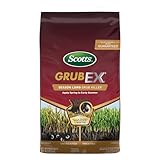
Scotts GrubEx1 Season Long Grub Killer, 5,000 sq. ft. | $29.47 | Buy on Amazon |
| 2 |
|
Scotts GrubEx1 Season Long Grub Killer, 28.7 lbs | $44.97 | Buy on Amazon |
| 3 |

|
BioAdvanced Season Long Grub Control Granules - 10 lb Bag | $25.88 | Buy on Amazon |
| 4 |

|
Ortho BugClear Lawn Insect Killer1, 20 lbs. | $20.98 | Buy on Amazon |
Iowa State University Extension describes three legitimate strategies:
- Preventive treatment: apply a long-residual product before or around egg laying and hatch when repeated, damaging infestations are likely.
- Curative treatment: wait for signs, sample the affected turf, and treat only when grubs are present at a damaging level.
- No insecticide: tolerate or repair limited damage if monitoring does not justify chemical treatment.
Prevention buys advance protection but commits you to treating before this year’s population is confirmed. Curative treatment uses less product when pressure is patchy, but it requires monitoring and can fail if larvae have already grown large or moved deeper.
#1 Best Overall
- Scotts GrubEx1 Season Long Grub Killer can help prevent turf damage by killing grubs when they are young
- One application of this lawn care treatment kills and prevents grubs for up to 4 months
- This grub killer also controls caterpillars (armyworm), chinchbugs, May/June beetles, and more (as listed), and can help control Japanese beetle infestations when applied annually
- Apply this granular insecticide to a dry lawn in the spring or early summer to kill grubs as they develop before they cause damage to your lawn
- One 14.35 lb. bag of Scotts GrubEx1 Season Long Grub Killer covers 5,000 sq. ft.
How timing follows the grub life cycle
Egg laying and hatch
Adult beetles lay eggs in or near turf during the warm season. Eggs hatch after accumulated heat and moisture reach species-specific requirements. A cool summer can delay hatch; hot weather can accelerate it. Because hatch dates move, a calendar borrowed from another state can be wrong even when the same beetle species is present.
Newly hatched and young larvae
Small larvae feed in the upper root zone and are the principal target for preventive products. Long-residual materials are placed before or around hatch so residues are present when young grubs begin feeding. This is why a preventive application made after larvae have become large is often poorly timed.
Older larvae and overwintering
As larvae mature, they consume more roots, become harder to control, and may move deeper as soil cools. Curative products work best after hatch but before larvae are large. Overwintered grubs in spring are generally less susceptible, so spring is not the default rescue window.
The Tool Desk
Outbyte PC Repair FREERepair Windows errors before they cause bigger problemsFix Now →Outbyte Driver Updater FREEScan for outdated or missing drivers - takes under a minuteDriver Scan →Preventive timing: apply before or around hatch
The general preventive target is the interval immediately before egg laying through early hatch. Iowa State University Extension states: “Late June to early August is the best time to apply a preventive insecticide.” That is a regional recommendation, not a universal date for every lawn.
Other extension calendars illustrate why the species and location must be identified. The University of Wisconsin–Madison Extension table, revised January 29, 2026, gives these windows for Wisconsin:
| Species | Preventive window in Wisconsin | Curative window in Wisconsin |
|---|---|---|
| Japanese beetle | June–July | August–October |
| May/June beetle | May–early June | July–September |
| European chafer | Late May–mid July | August–October |
| Northern masked chafer | June–July | August–October |
These month ranges describe Wisconsin conditions and should not be transplanted to the rest of North America. Kentucky guidance places the optimum preventive period generally from mid-June to mid-July. Iowa’s late-June-to-early-August window is different because climate, species mix, and development rates differ.
When prevention is reasonable
- The site has had damaging grub infestations in multiple recent seasons.
- The turf is high value or difficult to repair, and little damage can be tolerated.
- Local extension guidance identifies a predictable species and treatment window.
- You can follow the current product label for the identified pest and jurisdiction.
Prevention is less compelling when the lawn has no history of grub damage, the area is already thin for another reason, or you are unwilling to treat without confirmation. Sporadic pressure can leave a preventive application covering turf that never develops a damaging population.
Rank #2
- GRUB CONTROL: Scotts GrubEx1 Season Long Grub Killer can help prevent turf damage by killing grubs when they are young
- APPLICATION: One application of this lawn care treatment kills and prevents grubs for up to 4 months
- FOR GRUBS & OTHER LISTED INSECTS: This grub control for lawns also controls caterpillars (armyworm), May/June beetles, and more (as listed), suppresses chinchbugs, and can help control Japanese beetle infestations when applied annually
- APPLICATION: Apply this lawn grub killer granular insecticide to a dry lawn in the spring or early summer to kill grubs as they develop before they cause damage to your lawn
- COVERAGE: One 28.7 lb.. bag of Scotts GrubEx1 Season Long Grub Killer, insect killer for lawns, covers 10,000 sq. ft.
Curative timing: sample first, then treat young larvae
Curative treatment starts after eggs have hatched and sampling finds active grubs. The preferred window is early in the larval period, while grubs are small and feeding in the root zone. Kentucky Cooperative Extension favors early to mid-August for curative action in its region. Wisconsin’s species table extends curative windows from July through October, depending on the beetle.
Late-season treatment is not automatically futile, but efficacy declines as larvae mature or move deeper. A product label may permit a September or October application for a particular species; that does not guarantee control in every soil or weather condition.
Why spring rescue treatments often disappoint
In spring, the surviving larvae are larger and may be deeper in the soil. Kentucky and West Virginia University Extension both describe spring applications as generally less effective for white-grub control. Spring treatment can be appropriate only when local guidance and the current label support it for the pest and product; it should not be the routine response to every spring brown patch.
How to sample before you spend money
Inspect the transition between healthy and damaged turf, not just the center of a dead patch. Lift a small section of sod with a soil knife or narrow trowel and examine the roots and upper soil for C-shaped, white-bodied larvae with brown heads. Check more than one spot because populations are patchy.
Recommended Free Tools
- Choose several points in and around the affected area.
- Cut through the sod and lift enough turf and soil to expose the root zone.
- Count live grubs and note their size, depth, and species characteristics.
- Compare damaged and healthy areas; a uniform absence of larvae points to another cause.
- Use the count, turf value, local threshold guidance, and label directions to decide whether treatment is justified.
UC Statewide Integrated Pest Management guidance gives six grubs per square foot as a curative threshold in its California guidance for the specified turf setting. That number is not a universal homeowner threshold: soil, grass species, irrigation, climate, and tolerance for injury change the level at which treatment pays off. Many ordinary lawns have few insect problems, and UC IPM recommends infrequent treatment when monitoring remains below damage thresholds.
Regional timing examples at a glance
| Strategy | What you are targeting | Published regional examples | How to use the information |
|---|---|---|---|
| Preventive | Egg laying, hatch, and newly hatched larvae | Iowa: late June–early August; Kentucky: generally mid-June–mid-July; Wisconsin: species-specific windows from late May through July | Use local species and weather data; these are not national dates. |
| Early curative | Confirmed, small larvae feeding near roots | Kentucky: early–mid-August; Wisconsin: July–October depending on species | Sample first and treat only where the count and turf value justify action. |
| Late curative | Active larvae that are still reachable and covered by the label | Some Wisconsin windows extend into September or October | Expect lower and less predictable efficacy as larvae age or move deeper. |
| Spring | Overwintered, larger larvae | Kentucky and West Virginia guidance: generally less effective | Do not use spring as the default rescue period; follow local guidance and the label. |
Choose a product by active ingredient and label
Extension sources discuss preventive products containing chlorantraniliprole and curative products containing ingredients such as carbaryl or trichlorfon. These are ingredient examples, not a recommendation to use a particular brand. The same ingredient can have different formulations, concentrations, permitted sites, and pest claims.
Before buying or applying anything, verify:
- The active ingredient and formulation on the current label.
- That the label lists your grub species or the applicable pest group.
- That use on your turf type and in your jurisdiction is permitted.
- The application rate, personal-protective equipment, re-entry interval, and environmental restrictions.
- Whether the product is preventive, curative, or both, and which larval size it is intended to control.
Products must reach the root zone. Irrigation may be required to move an ingredient through the thatch and into soil, but the amount and timing are product-specific. Do not apply a universal watering volume; follow the current label exactly, including rain, irrigation, and mowing restrictions.
Rank #3
- GRUB KILLER: Season-Long Grub Control kills grubs and listed lawn damaging insects above and below the surface
- SEASON-LONG CONTROL: One application kills grubs and protects all season long; For all lawns types
- KILLS MOLE CRICKETS & MORE: Kills 40+ destructive lawn insects, including: ants, ticks, mole crickets, chinch bugs, European crane fly larvae, crickets, and other listed insects
- BARRIER TREATMENT: New, improved formula kills listed insects in the lawn and creates a barrier for season long protection; Use a rotary or drop spreader, then water lawn lightly after applying
- GET MORE FROM THE BLUE BOTTLE: BioAdvanced science-based solutions for insect and pest control* take down the bugs, inside and outside your home, and above and below the ground (*Listed)
Biological controls
Entomopathogenic nematodes are mentioned by UC and West Virginia sources as biological options whose performance depends on the product, soil moisture, temperature, and timing. They are not universally effective substitutes for chemical treatment. Wisconsin Extension reports that recent university research has not found milky spore effective for white-grub control. Treat biological products as site- and condition-dependent, and check their labels as carefully as chemical products.
Do these 3 things before closing this tab:
1Scan for outdated or missing drivers - takes under a minute2Clear out junk files and repair common Windows errors3Fix the driver behind crashes, sound loss and screen glitchesMatch the calendar to your location
Use local university extension recommendations, state pesticide resources, and the product label together. Ask a diagnostic service or extension office for help when species identification is uncertain, damage is severe, or sampling produces mixed results. Weather can shift hatch and feeding by weeks, and different beetles living in the same region can require different preventive dates.
A practical decision sequence is:
- Identify the likely beetle or obtain a local diagnosis.
- Check the current regional calendar for egg laying, hatch, and young-larva activity.
- Sample damaged and healthy turf rather than assuming the whole lawn is infested.
- Select prevention only when history, turf value, and local risk justify treating before confirmation.
- Select curative treatment only when sampling finds active grubs and the label covers the timing and pest.
- Apply and irrigate exactly as directed, then record the date, product, weather, and treated area for next season.
Common timing mistakes and their fixes
Applying on a fixed national date
Problem: A June date from one state may precede egg laying elsewhere or miss an earlier species.
Fix: Replace the date with a local species window and adjust for unusual weather.
Treating every brown patch
Problem: Drought, disease, compaction, and animals can mimic grub injury.
Fix: Dig and compare several locations before applying an insecticide.
Using a preventive product after larvae are large
Problem: Long-residual prevention is designed for young larvae and may provide little benefit late in development.
Rank #4
- LONG-LASTING PROTECTION: This lawn insect and ant killer provides up to 6 months of ant control (excludes pharaoh, carpenter and harvester ants) and 3 months residual protection against other listed pests
- FAST-ACTING BUG BARRIER: This pest control product starts to work in minutes (except against fire ants) to protect your lawn, ornamental plants, home perimeter, flower beds, and listed vegetable plants
- WHEN TO USE: Apply lawn insect killer granules with a Scotts Spreader or other compatible spreader when you first notice insect activity or damage, then water in to activate
- KILLS LAWN PESTS: Outdoor bug killer targets ants, spiders, ticks, fleas, armyworms, grubs, and more, helping you protect your lawn from common listed insects
- COVERAGE: A 20 lb. bag of Ortho BugClear Lawn Insect Killer1 treats up to 33,000 sq. ft., ideal for large outdoor spaces
Fix: If sampling confirms older grubs, consult the curative section of the current label and local extension guidance; accept that control may be limited.
Waiting until spring for rescue
Problem: Overwintered larvae are larger and deeper.
Windows Errors? Fix Them Before They Spread
Repair common Windows errors and clear accumulated junk for a smoother, more stable PC - no reinstall needed.Free scan · no reinstallCrashes, No Sound, or Screen Glitches?
Random freezes, missing sound and display glitches usually trace back to one bad driver. Find and replace yours safely.Free scan · under a minuteFix: Monitor after hatch and act during the early curative period when justified.
Assuming more water is always better
Problem: Excess irrigation can run product off target, waste water, or violate label directions.
Fix: Use only the irrigation amount and timing specified for that formulation and site.
A simple annual monitoring plan
Before the expected hatch period
- Review last season’s damage map and repair unrelated turf problems.
- Identify the local species and preventive window.
- Decide whether the lawn’s history and damage tolerance warrant prevention.
After hatch
- Inspect turf edges and sample roots and soil in several places.
- Record larval size and counts, not just surface symptoms.
- Treat only areas that exceed locally appropriate damage criteria or have a clear risk-based reason for action.
After treatment
- Follow label irrigation and re-entry instructions.
- Do not assume immediate greening; roots and turf need time to recover.
- Recheck the site and document what worked under that season’s weather.
The most reliable timing rule is therefore conditional: prevent before or around hatch when repeated risk justifies it; cure after sampling finds small, active larvae; and avoid routine spring rescue or blanket treatment when evidence of damaging grubs is absent.
Quick Recap
Product prices and availability are accurate as of the date/time indicated and are subject to change. Any price and availability information displayed on Amazon at the time of purchase will apply.

